
Table of Contents
- How to Rent an Apartment in Boca Raton: Where to Start
- Best Neighborhoods to Rent in Boca Raton
- Cost of Living Breakdown: What to Budget When Renting in Boca
- Florida Rental Application Requirements You Need to Know
- Boca Raton HOA Rental Rules: What Renters Must Understand
- Short-Term Rental Laws in Boca Raton: What You Can and Cannot Do
- How to Evaluate Apartments in Boca Raton Before Signing a Lease
- Conclusion
Last Updated: May 28, 2026
Figuring out how to rent apartment in Boca Raton is more straightforward than most people expect, but only if you know where the friction points are. This guide from Cynthia Gardens walks you through every stage of the process, from choosing a neighborhood to signing a lease, so you can move confidently in one of South Florida’s most competitive rental markets. Below, we’ll show you exactly how to search, apply, and settle into Boca Raton, FL, including the local rules most guides skip entirely.
The Boca Raton rental market rewards preparation. Listings in desirable areas near Florida Atlantic University and the beach move quickly, and applicants who arrive without documentation or a clear budget often lose units to better-prepared renters. The five sections that follow cover everything from search filters and cost breakdowns to HOA regulations and short-term lease laws.
How to Rent an Apartment in Boca Raton: Where to Start
Renting an apartment in Boca Raton, FL starts with understanding what the local market actually offers. Boca Raton is not a one-size-fits-all rental city. You’ll find garden-style communities tucked behind lush landscaping, high-rise condos overlooking the Intracoastal, and sprawling townhome complexes in West Boca, all competing for tenants across many price points.
The most effective approach is to clarify your priorities before opening a single listing aggregator. Decide on your non-negotiables: pet-friendly building, proximity to FAU, parking, fitness center, or a resort-style pool. That clarity will save you hours of scrolling through rental listings that look appealing but don’t fit your actual life.
Property Types Available: Apartments, Condos, Townhomes, and Houses
Boca Raton’s rental inventory breaks into four main categories, each with a different renter experience:
| Property Type | Typical Setup | Best For | Common Amenities |
|---|---|---|---|
| Apartment | Multi-unit building, shared hallways | Professionals, students | Pool, gym, parking |
| Condo | Individually owned units in larger building | Couples, long-term renters | HOA amenities, concierge |
| Townhome | Multi-floor, attached units | Families, roommates | Private garage, patio |
| Single-family house | Detached, private yard | Families, remote workers | Full privacy, driveway |
Garden-style apartment communities, like Cynthia Gardens, sit in a category of their own: low-rise buildings surrounded by landscaped grounds, offering the feel of a private retreat without the maintenance burden of a house. These communities tend to attract professionals and individuals who want a quiet, well-established environment.
Using Search Filters: Price Range, Beds, Baths, and Amenities
Property search filters are only useful if you use them honestly. Set your maximum monthly rent at what you can actually afford, not what you hope to negotiate down to. Most verified listings on major rental platforms allow you to filter by beds and baths configuration, move-in date, pet-friendly status, utilities included, and availability.
When filtering by amenities, prioritize the features you’ll use daily (parking, in-unit laundry) over aspirational ones (rooftop deck). Amenity-heavy buildings often pass those costs into monthly rent.
For Boca Raton specifically, filter by zip code rather than just city name. The difference between 33431 (near the beach and FAU) and 33428 (West Boca) is significant in terms of commute time, price, and lifestyle.
Best Neighborhoods to Rent in Boca Raton
Boca Raton’s neighborhoods are genuinely different from each other, and picking the wrong one creates daily friction that no apartment amenity can fix.

According to City of Boca Raton community planning resources, the city spans distinct zones that vary considerably in density, walkability, and access to services. Choosing the right zone before you start your rental search will narrow your options productively.
Downtown Boca: Walkability and Nightlife Access
Downtown Boca Raton is the right choice for renters who want to walk to restaurants, retail, and cultural venues. Mizner Park anchors the area, and the surrounding streets offer some of the highest walkability scores in Palm Beach County. Rental listings here tend to be priced at a premium because of that convenience, and floor plans are often smaller than what you’d find in West Boca for the same monthly rent.
The tradeoff is real: you pay more per square foot, but you spend less on gas, parking, and time. For young professionals who work remotely or commute locally, downtown Boca delivers a lifestyle that suburban communities can’t replicate.
West Boca: Space, Gated Communities, and Suburban Comfort
West Boca is where space and privacy win over walkability. Gated community options are abundant here, and many complexes offer larger floor plans, private garages, and access to top-rated schools. The commute to downtown Boca or FAU adds time, but the tradeoff is a quieter, more suburban environment that many renters actively prefer.
Families and remote workers tend to cluster in West Boca for exactly this reason. Monthly rent is often more competitive than downtown, and you get significantly more square footage per dollar.
Near FAU: Student Housing and Young Professional Options
The corridor near Florida Atlantic University in Boca Raton is its own micro-market. FAU student housing demand keeps vacancy rates low and lease terms competitive. Renters in this area include students, graduate researchers, and young professionals who work on or near campus.
Cynthia Gardens sits minutes from FAU, making it a practical option for professionals who want a well-maintained, garden-style community with modern finishes rather than a traditional student apartment complex. The distinction matters: proximity to FAU doesn’t mean the only rental options are student housing.
Cost of Living Breakdown: What to Budget When Renting in Boca
Most rental guides stop at monthly rent. That’s the wrong place to stop, because monthly rent is only one part of what you’ll actually spend each month in Boca Raton, FL. This section goes further than any listing aggregator will: it breaks down the Boca-specific costs that routinely surprise new renters, with enough detail to build a realistic pre-move budget.
Monthly Rent by Neighborhood and Unit Type
Base rent in Boca Raton varies significantly depending on where in the city you land and what property type you choose. As a general orientation:
- Downtown Boca Raton (33432): Commands a premium for walkability. One-bedroom units in and around Mizner Park tend to sit at the higher end of the local market. Expect smaller square footage per dollar than anywhere else in the city.
- East Boca / Near the Beach (33431): Proximity to the Intracoastal and Atlantic Ocean pushes prices up. Condo-style rentals dominate here, and HOA pass-through costs (see below) are common.
- Near FAU (33431 / 33433 border): A more competitive price band than downtown, with a mix of purpose-built student housing and well-maintained garden-style communities. Garden-style apartments like Cynthia Gardens offer modern finishes at a price point that reflects value rather than just location premium.
- West Boca (33428 / 33498): The most square footage per dollar in the city. Gated community options are plentiful, and monthly rent is generally lower than east-side equivalents, but you’re trading walkability and beach proximity for space and quiet.
When comparing listings across zip codes, calculate cost per square foot rather than comparing monthly rent in isolation. A unit that costs more per month in 33431 may cost less per square foot than a larger unit in 33432, and vice versa.
Florida Electric Bills: The Cost Most Out-of-State Renters Underestimate
This is the single most common budget surprise for renters relocating from northern states or from outside the U.S. Florida Power & Light (FPL) serves most of Boca Raton, and summer cooling costs are not theoretical, they are substantial.
From roughly June through September, air conditioning in a South Florida apartment runs nearly continuously during daytime hours. A one-bedroom apartment with older HVAC equipment can generate electric bills that are meaningfully higher than what the same renter paid in a northern climate for heating in winter. Newer communities with energy-efficient HVAC systems and impact-resistant windows (which also provide insulation) perform better, but the cost is real regardless.
Practical steps to manage this:
- Ask the property manager for average monthly electric bills from current residents before signing, many will provide this on request.
- Check whether the unit has a programmable or smart thermostat; setting it to 78°F while away rather than 72°F makes a measurable difference.
- Confirm whether the building has LED common-area lighting and energy-efficient appliances, which signal a property that has been updated with efficiency in mind.
Parking, HOA Pass-Through Fees, and Hidden Monthly Costs
Boca Raton has a higher concentration of HOA-governed communities than many comparable Florida cities, and HOA costs can reach renters in ways that aren’t always visible in a listing price.
Parking: Covered or assigned parking is not always included in base rent. Some communities charge separately for a covered spot, a garage space, or even a second vehicle. Confirm this in writing before signing.
HOA pass-through fees: In condo communities where individual units are rented out by owner-landlords, the landlord’s HOA dues may be partially or fully passed through to the tenant as a line item in the lease. This is legal in Florida and common in Boca Raton’s condo rental market. Always ask whether any HOA-related fees are included in or added to the advertised rent.
Pest control: Florida’s climate means pest control is not optional. Some communities include quarterly pest control in rent; others require tenants to arrange and pay for it independently. Clarify this before signing.
Trash and water: These are sometimes bundled into rent and sometimes billed separately. In communities that bill water separately, usage-based billing means your monthly cost varies.
Move-In Cost Stack: What to Have Liquid Before You Sign
Beyond ongoing monthly costs, the move-in period requires a lump sum that many renters underestimate. A realistic move-in cost stack for a Boca Raton apartment typically includes:
| Cost Item | Notes |
|---|---|
| Security deposit | Florida law (F.S. § 83.49) governs how landlords must hold and return deposits; the amount itself is not capped by state law |
| First month’s rent | Due at or before move-in |
| Last month’s rent | Required by some (not all) landlords |
| Application fee | Non-refundable; covers credit and background check processing |
| Administrative or move-in fee | Charged by some communities separately from the security deposit |
| HOA application fee | If the community has an HOA with its own tenant approval process |
| Renters insurance (first term) | Required by many landlords; typically paid upfront for the first policy period |
| Pet deposit or pet fee | If applicable; may be partially or fully non-refundable depending on lease terms |
Florida Statute § 83.49 requires landlords to either hold your security deposit in a separate non-commingled account or post a surety bond. Within 30 days of receiving your deposit, they must notify you in writing of which method they’re using and where the funds are held. If you don’t receive this notice, follow up in writing, it’s your legal right and your protection if a deposit dispute arises at move-out.
According to Florida Department of Agriculture and Consumer Services cost of living resources, housing costs in South Florida have risen steadily, making pre-move budgeting more important than ever for new renters entering the market. Building your full cost stack, not just base rent, before you start touring will prevent the common scenario of falling in love with a unit that doesn’t actually fit your budget once all costs are accounted for.
Florida Rental Application Requirements You Need to Know
Florida rental application requirements are more standardized than many renters realize. Most property managers in Boca Raton follow a consistent process, and knowing it in advance removes the stress from a competitive application situation.
Standard requirements include a completed application form, government-issued photo ID, proof of income (typically pay stubs, bank statements, or an employment offer letter), a credit check authorization, and consent to a background check. Subletting and co-signer arrangements are handled case by case, so ask directly if your situation requires either.
The application fee is almost universally non-refundable. Submit applications only to properties you’re genuinely interested in.
Application Checklist for Out-of-State and International Renters
Out-of-state and international renters face additional friction that local applicants don’t. Here’s a practical checklist:
- Passport or government-issued ID (international renters: include visa documentation)
- Proof of income: last three months of bank statements or employment contract
- U.S. credit history: if limited, ask about co-signer options or increased security deposit
- Reference letters from previous landlords (especially valuable without U.S. rental history)
- Virtual tour confirmation: schedule before traveling to avoid wasted trips
- Lease agreement review: have a local attorney or tenant advocate review before signing
- Proof of renters insurance: some landlords require proof before move-in date
- Wire transfer or certified check capability: many Florida landlords don’t accept personal checks from out-of-state banks
International renters without U.S. credit history should address this proactively. Offering a larger security deposit or prepaying several months of rent upfront is a common and accepted approach in the Boca Raton rental market.
Boca Raton HOA Rental Rules: What Renters Must Understand
Boca Raton HOA rental rules are one of the most overlooked aspects of renting in this city, and ignoring them creates real problems after you’ve already signed a lease. This section goes further than any listing aggregator covers: it gives you the specific documents to request, the questions to ask, the timeline to expect, and the Florida statutes that govern your rights and obligations as a renter in an HOA-governed community.
Why HOA Rules Hit Renters Differently Than Owners
When you rent in a community governed by a homeowners association or condominium association, you are subject to two separate sets of rules simultaneously: your lease agreement with the landlord, and the HOA’s governing documents. These are not the same document, they are not always consistent with each other, and, critically, the HOA’s rules take precedence over your lease in most conflicts.
Your landlord may be an individual unit owner who is themselves a member of the HOA. That landlord agreed to the HOA’s rules when they purchased the unit, and those rules follow the unit regardless of who occupies it. You, as the tenant, inherit those obligations the moment you move in, whether or not your lease spells them out.
Common HOA restrictions that directly affect renters in Boca Raton communities include:
- Occupancy limits: Maximum number of occupants per unit, sometimes stricter than what local building codes require
- Pet restrictions: Breed prohibitions and weight limits that may be stricter than the landlord’s own pet policy
- Parking rules: Assigned spaces, guest parking time limits, commercial vehicle prohibitions, and restrictions on how many vehicles a unit may have
- Move-in and move-out scheduling: Many HOAs require moves to occur during specific hours and days, and some require advance notice and elevator reservations in high-rise buildings
- Noise and quiet hours: Specific curfews that may be earlier than what local ordinance requires
- Lease term minimums: Some Boca Raton HOAs prohibit leases shorter than six months or one year, which directly affects your flexibility if you want a short-term arrangement
- Guest policies: Restrictions on how long non-tenant guests may stay consecutively
- Balcony and common area use: Rules about what can be stored or displayed on balconies, patios, and in common areas
The HOA Tenant Approval Process: What to Expect
Many HOAs in Boca Raton, particularly condominium associations, require tenants to complete a separate application and approval process that runs parallel to the landlord’s application. This is not a formality. It is a legally authorized screening process, and it adds time to your move-in timeline.
Under Florida Statute § 718.112 (for condominiums) and § 720.306 (for homeowners associations), associations have the right to screen prospective tenants and, in some cases, to reject a tenant or exercise a right of first refusal. The specific authority varies by community based on what their governing documents allow.
A typical HOA tenant approval process in Boca Raton looks like this:
- Request the governing documents before applying. Ask your landlord or the property manager for the HOA’s Declaration of Covenants, Conditions, and Restrictions (CC&Rs), the Rules and Regulations, and any tenant-specific addenda. You are entitled to review these before committing.
- Submit the HOA’s tenant application. This is separate from the landlord’s application and typically includes its own fee (non-refundable), background check authorization, and sometimes a personal interview requirement.
- Wait for HOA board approval. Processing times vary. Some HOAs meet monthly, which means if you apply the week after a board meeting, you may wait three to four weeks for approval. Factor this into your move-in timeline.
- Register with the association. Once approved, many HOAs require tenants to formally register, receive a welcome packet with community rules, and obtain access credentials (key fobs, gate codes, parking decals) directly from the association office.
- Confirm lease term compliance. Before your landlord finalizes your lease, verify that the lease term meets the HOA’s minimum rental period requirement. A 30-day lease in a community that requires six-month minimums is a violation that can result in fines against your landlord, and pressure on you to vacate.
If an HOA rejects your tenancy, your lease agreement with the landlord does not protect your right to occupy the unit. In communities where the HOA has rejection authority, a landlord who signs a lease before obtaining HOA approval has put both of you in a difficult position. Always confirm that HOA approval is either already obtained or that the lease is contingent on it.
Questions to Ask Before Signing Any Lease in an HOA Community
Use this list as a pre-signing checklist for any Boca Raton rental that involves HOA governance:
- Does this community have an HOA or condominium association? (Ask directly, don’t assume based on property type.)
- What is the minimum lease term the HOA allows?
- Is there a separate HOA tenant application, and what is the processing timeline?
- What is the HOA application fee, and is it refundable if I’m rejected?
- Does the HOA have the right to reject tenants, or only to screen them?
- What are the pet restrictions in the HOA rules specifically (not just the landlord’s policy)?
- What are the parking rules, and how many vehicles am I permitted?
- Are there move-in scheduling requirements I need to coordinate?
- What happens if I violate an HOA rule, am I fined directly, or is the landlord fined?
- Can I sublet or have long-term guests under the HOA rules?
When HOA Fines Affect Renters Directly
Florida law allows some HOAs to pursue tenants directly for rule violations rather than routing all enforcement through the unit owner. Whether this applies in a specific community depends on the association’s governing documents. In communities where direct tenant enforcement is authorized, you can receive a violation notice and fine from the HOA for something as routine as parking in the wrong spot or leaving a bicycle in a common area.
In communities where enforcement runs through the landlord, the landlord receives the fine and may pass it to you under a lease clause, or may use it as grounds for a lease violation notice. Either way, HOA fines create friction that is entirely avoidable if you understand the rules before you move in.
Always request the HOA’s governing documents, specifically the CC&Rs, Rules and Regulations, and any tenant addendum, before signing a lease in any Boca Raton community. Read them, not just the lease. If anything conflicts with what your landlord has told you, get clarification in writing before you pay an application fee or security deposit. As documented in [Florida HOA and condominium law overview](https://www.leg.state.fl.us), Florida statutes give associations significant authority over rental arrangements, and that authority is real regardless of what your lease says.
Short-Term Rental Laws in Boca Raton: What You Can and Cannot Do
Short-term rental laws in Boca Raton are more restrictive than many renters expect, particularly those coming from cities where platforms like Airbnb operate with minimal oversight.
Boca Raton, FL follows Florida state law on short-term rentals, but the city and individual HOAs layer additional restrictions on top of state minimums. Many residential communities prohibit rentals of less than 30 days entirely. Others require city registration, proof of compliance with fire and safety codes, and payment of local tourist development taxes.
For renters considering subletting their unit short-term while traveling, the answer in most Boca Raton communities is: you cannot do this without explicit written permission from both your landlord and, if applicable, your HOA. Violations can result in lease termination.
Short-term lease arrangements of one to six months for the primary tenant are a separate matter. These exist in Boca Raton but are less common than standard 12-month leases. Expect to pay a premium for the flexibility, and verify availability directly with property managers rather than assuming listing platforms show accurate short-term availability.
How to Evaluate Apartments in Boca Raton Before Signing a Lease
The biggest mistake renters make is treating the tour as a formality. A thorough evaluation before signing a lease prevents expensive surprises after move-in.
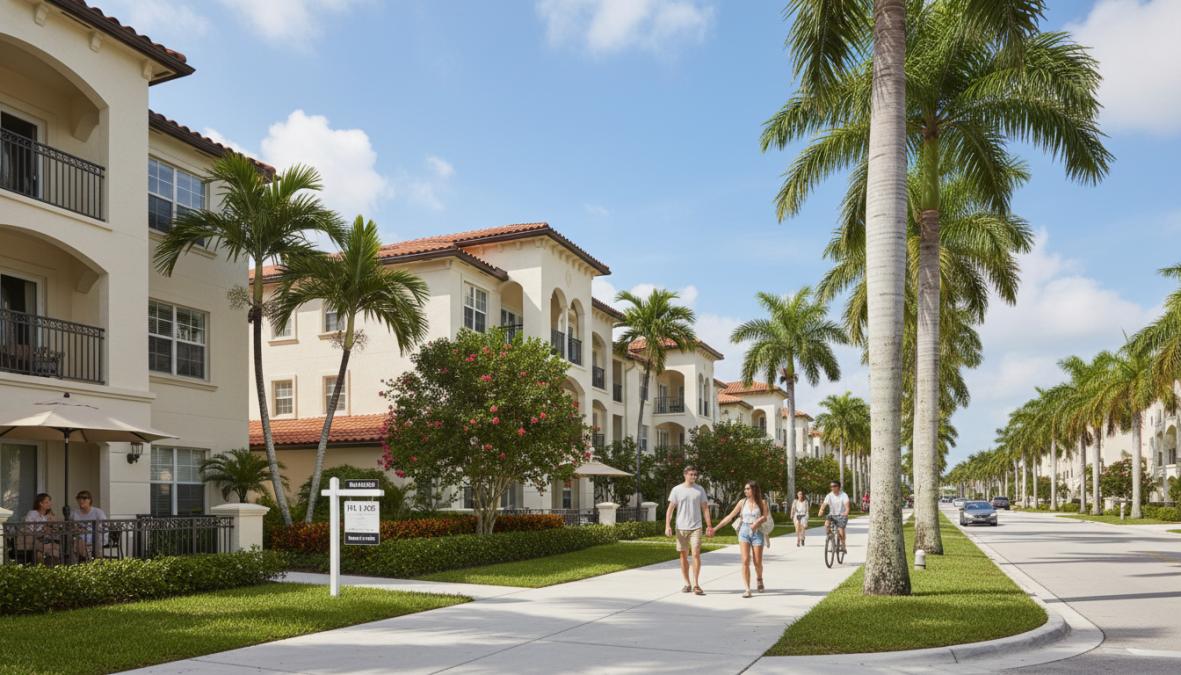
Virtual Tours, 3D Walkthroughs, and In-Person Visits
Virtual tours and 3D walkthroughs have become standard in the Boca Raton rental market, and they’re genuinely useful for narrowing your list before committing to an in-person visit. Use them to assess layout, natural light, and floor plan proportions. What they don’t show you: noise levels, hallway smells, parking lot conditions, and how the property manager actually interacts with prospective tenants.
The in-person visit is non-negotiable before signing. Schedule it at different times if possible: morning for light assessment, evening for noise. Arrive early and walk the grounds. A well-maintained community shows its quality in the landscaping, the common areas, and the condition of the resort-style pool, not just the staged interior of a model unit.
Commute Time, Transportation, and Location Considerations
Commute time is the variable renters consistently underestimate. Boca Raton, FL has limited public transit compared to larger metro areas, which means most residents rely on personal vehicles. Factor in I-95 and US-1 traffic patterns during your actual work hours, not mid-day when roads are clear.
Proximity to the beach, FAU, and downtown Boca Raton are the three location factors that most renters cite as priorities. All three are accessible from communities near the center of the city, but the definition of "minutes away" varies considerably depending on time of day.
According to South Florida Regional Transportation Authority transit planning resources, Tri-Rail service connects Boca Raton to Miami and West Palm Beach, making the Boca Raton station a useful commute option for renters who work outside the city.
Specialty Housing: Senior Living, Student, and Pet-Friendly Options
Specialty housing in Boca Raton covers three distinct renter segments, each with different search strategies.
Senior living communities in Boca Raton offer age-restricted (typically 55+) environments with amenities tailored to that demographic. These require age verification during the application process and operate under specific federal housing guidelines.
Student housing near FAU ranges from purpose-built complexes with shared amenities to individual apartments rented by students independently. FAU students who want a quieter, more polished living environment often look beyond the immediate campus corridor to communities like Cynthia Gardens, which offer modern one-bedroom apartments with high-end finishes in a maintenance-free setting just minutes from campus.
Pet-friendly rentals require careful vetting. "Pet-friendly" on a listing doesn’t mean unlimited. Most communities specify breed restrictions, weight limits, and pet deposit requirements. Confirm the exact policy in writing before submitting an application fee.
Finding the right apartment in Boca Raton takes research, preparation, and a clear-eyed view of what you actually need versus what looks appealing in listing photos. For professionals and individuals who want a quiet, well-maintained community with convenient access to FAU, the beach, and local landmarks, Cynthia Gardens offers modern one-bedroom apartments with stainless steel appliances, quartz countertops, a resort-style pool, and a maintenance-free living experience in a beautiful garden-style setting. Schedule a tour today and see why Cynthia Gardens residents describe it as the kind of community you stop searching once you find.
Frequently Asked Questions
What documents do I need to rent an apartment in Boca Raton?
To rent an apartment in Boca Raton, you typically need a government-issued photo ID, proof of income such as recent pay stubs or bank statements, references from previous landlords, and a completed rental application. Most property managers will also run a credit check and background check. Out-of-state or international renters may need to provide additional documentation, such as an employment offer letter or a larger security deposit to compensate for limited local rental history.
Do I need HOA approval to rent a condo in Boca Raton?
Yes, in many Boca Raton communities, HOA approval is required before a tenant can move in. Boca Raton HOA rental rules vary by community but often include submitting a formal application, paying an HOA application fee, undergoing a background check, and waiting for board approval. Some HOAs also restrict the number of times a unit can be rented per year or impose minimum lease terms, so always review the HOA bylaws before signing any lease agreement.
Are there restrictions on short-term rentals in Boca Raton?
Yes, short-term rental laws in Boca Raton are governed by both city ordinances and individual HOA rules. Florida state law generally preempts local bans on vacation rentals registered before certain dates, but Boca Raton enforces licensing and inspection requirements for short-term rental properties. Many condo communities and HOAs impose their own minimum lease terms, often 30, 90, or even 180 days, effectively limiting platforms like Airbnb. Always verify local regulations and HOA rules before pursuing a short-term lease arrangement.
What is the typical income requirement for renting in Boca Raton?
Most landlords and property managers in Boca Raton require renters to earn a gross monthly income of at least two to three times the monthly rent. For example, if your monthly rent is $2,000, you would generally need to demonstrate a gross income of $4,000 to $6,000 per month. This is a standard Florida rental application requirement. Some properties may also require renters insurance as a condition of the lease agreement, so factor that into your monthly budget.
What are the best neighborhoods to rent in Boca Raton for young professionals?
Young professionals looking to rent in Boca Raton often favor Downtown Boca for its walkability, dining, and entertainment options, and the area near FAU for its proximity to the university and beach. West Boca is popular for those who prefer more space and quieter, gated communities. Commute time is an important consideration, Downtown Boca offers easier access to major employers and I-95, while areas near FAU provide quick access to the beach and university research corridor.
This article was written using GrandRanker