
TL;DR:
- Renters insurance provides essential liability and property protection for pet owners at an affordable cost, typically $15 to $25 per month. It covers injuries or damages caused by your pet to others but excludes damage to your own rental unit and may impose breed or bite history restrictions. Proper disclosure, higher liability limits, and reviewing policy language are crucial to ensure adequate coverage when owning pets in a rental home.
Renters insurance is defined as a policy that covers a tenant’s personal belongings and personal liability, including injuries or property damage caused by their pets. If you share your apartment with a dog, cat, or any animal that interacts with other people, you carry a financial risk that your landlord’s policy does not cover. GEICO confirms that renters insurance fills this gap by combining personal property protection with liability coverage. The typical cost runs about $15 to $25 per month, which makes it one of the most affordable financial safety nets available to renters. Pet owners who skip it are betting that their animal will never scratch a neighbor, knock over a guest, or bite a visitor. That is a bet worth reconsidering.
Why renters insurance for pet owners is a financial necessity
Renters insurance for pet owners addresses two separate risk lanes at once: protecting your belongings from covered perils and shielding your finances if your pet injures someone or damages their property. The Texas Department of Insurance describes these as distinct coverage components, each requiring its own consideration. Most renters focus only on property protection and overlook the liability side entirely. That oversight can be expensive.
Personal liability coverage under a standard renters policy, typically labeled Coverage E on the ISO HO-4 form, pays for medical bills and legal defense costs when your pet causes harm to another person. Dog-bite claims averaged $69,272 per incident in the U.S. in 2024, according to the Insurance Information Institute. That figure means a single incident can exceed what most renters have in savings, making liability coverage far more than a nice-to-have.
Renters insurance also covers your personal belongings against named perils like theft, fire, and vandalism. Your landlord’s building policy protects the structure but not your furniture, electronics, or clothing. This distinction matters especially for pet owners, who often invest in specialized gear, crates, and equipment that would need to be replaced after a covered loss.
What personal liability covers for pet owners
Pet-related liability coverage under a renters policy typically includes:
- Medical bills for a neighbor, guest, or visitor injured by your pet
- Legal defense costs if the injured party files a lawsuit
- Property damage to third parties if your pet destroys someone else’s belongings
- Medical payments to others (Coverage F), which pays smaller medical claims without requiring proof of fault
- Bodily injury claims arising from bites, scratches, or knockdowns
Pro Tip: Request a policy that includes Coverage F alongside Coverage E. Coverage F pays out smaller medical claims quickly, without a lawsuit, which can preserve neighborly relationships and prevent minor incidents from escalating.
How much does renters insurance cost for pet owners?
A standard renters insurance policy costs roughly $150 to $300 per year, or about $15 to $25 per month. That price point covers both personal property and personal liability, making it one of the most cost-efficient policies in the insurance market. For pet owners, the question is not whether to buy it but whether the default coverage limits are high enough.

Personal liability limits typically start at $100,000 and can extend to $300,000 or more. Given that a serious dog-bite lawsuit can easily exceed the minimum limit, MoneyGeek recommends higher limits for households with larger dogs or multiple pets. Increasing your liability limit from $100,000 to $300,000 often adds only a few dollars per month to your premium. That is a small price relative to the exposure.
The table below shows how coverage options and estimated premium ranges typically compare for renters with pets:
| Coverage type | Liability limit | Estimated annual premium |
|---|---|---|
| Basic renters policy | $100,000 | $150 to $200/year |
| Mid-tier renters policy | $200,000 | $180 to $240/year |
| Higher-limit renters policy | $300,000+ | $220 to $300/year |
| Renters + pet endorsement | $300,000+ | $240 to $320/year |
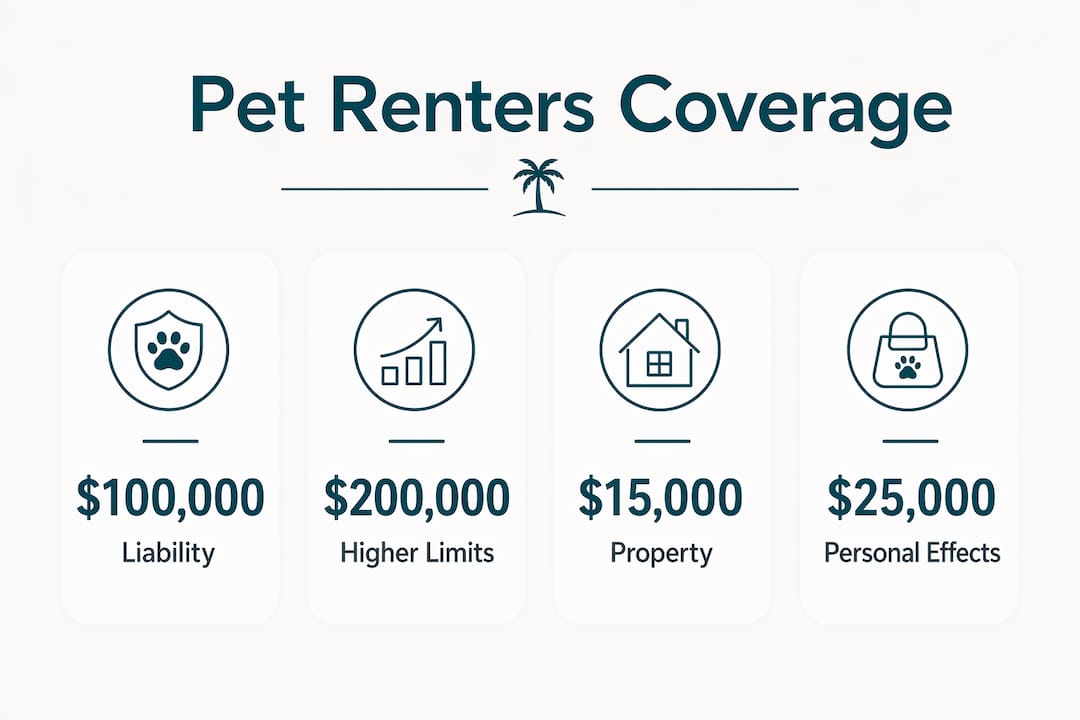
Personal property coverage is a separate component. Most policies offer $15,000 to $30,000 in personal property protection, which covers your belongings if they are stolen or destroyed by a covered peril. Pet owners should inventory their possessions, including pet-related equipment, to confirm the coverage amount is sufficient.
Pro Tip: Bundle your renters insurance with your auto insurance through the same carrier. Most major insurers offer multi-policy discounts that can reduce your total premium by 5 to 15 percent.
What exclusions can affect your pet liability coverage?
Pet liability coverage is often included in renters policies by default, but it comes with restrictions that can leave you unprotected at the worst possible moment. Breed restrictions and prior bite history are the two most common grounds for exclusion, and many pet owners do not discover them until after a claim is denied.
Insurers commonly restrict coverage for breeds they classify as high-risk, including Pit Bulls, Rottweilers, Doberman Pinschers, and Akitas, though the list varies by carrier and state. If your dog falls into a restricted category, the insurer may exclude pet liability entirely or require a separate endorsement at an additional cost. Some carriers will decline to write the policy at all.
Honest disclosure of your pet’s bite history is mandatory during the application process. Providing inaccurate information to secure coverage is considered misrepresentation and gives the insurer legal grounds to deny any future claim. The financial and legal consequences of a denied claim far outweigh the short-term benefit of omitting a prior incident.
There is also a critical distinction between liability for third-party injuries and damage to your own rental unit. Pet damage to your own rental property is typically excluded from standard renters insurance. If your dog chews through the baseboards or your cat scratches the hardwood floors, your renters policy will not pay for repairs. That cost falls to you directly, often deducted from your security deposit or billed as a lease violation.
Common exclusions to review before signing a policy:
- Breed restrictions that remove liability coverage for specific dog types
- Bite-history exclusions that void coverage if your pet has a documented prior incident
- Damage to your own rental unit caused by your pet, which is not covered under standard liability
- Landlord property damage caused by your pet, which may require a separate endorsement
- Exotic or non-standard pets such as reptiles or large birds, which some policies exclude entirely
Reviewing the exact liability wording and any pet endorsements before committing to a policy is the only way to confirm what you are actually buying. Coverage language varies by insurer, policy form, and state regulation.
How to choose the right renters insurance when you have pets
Selecting the right renters insurance with pets requires more than picking the cheapest monthly premium. Follow these steps to get coverage that actually holds up when you need it.
- Disclose your pet fully. Provide your pet’s breed, age, weight, and any prior bite incidents during the quote process. Incomplete disclosure is the leading cause of denied pet-related claims.
- Check for breed restrictions. Ask each insurer directly whether your dog’s breed is excluded. If it is, request a pet liability endorsement or shop carriers that do not enforce breed restrictions, such as State Farm or USAA, which have more flexible underwriting in many states.
- Evaluate your liability limit. Start at $300,000 if you own a large dog or live in a densely populated building where your pet regularly interacts with neighbors. The premium difference is minimal compared to the added protection.
- Read Coverage E and Coverage F language carefully. Coverage E is your primary liability protection. Coverage F handles smaller medical payments without a lawsuit. Confirm both are active and not subject to pet exclusions.
- Pair renters insurance with pet health insurance. Renters insurance covers harm your pet causes to others. Pet health insurance covers veterinary costs for your pet. These two policies serve different purposes and work best together.
- Communicate with your landlord. Many rental pet agreements require proof of renters insurance as a condition of keeping a pet on the premises. Confirm what your lease requires before you sign.
- Review your coverage annually. Adding a second pet, moving to a new unit, or experiencing a bite incident all change your risk profile. Treat your annual renewal as an opportunity to reassess limits and exclusions.
Pairing renters insurance with a clear understanding of your apartment pet policy puts you in the strongest possible position as a renter. You know what your lease requires, and you know your policy actually covers it.
Key takeaways
Renters insurance is the single most cost-effective tool pet owners have to manage personal liability and protect their belongings in a rental home.
| Point | Details |
|---|---|
| Liability is the core benefit | Coverage E pays medical bills and legal defense if your pet injures someone, with claims averaging $69,272 in 2024. |
| Cost is low relative to risk | Standard policies run $150 to $300 per year, with liability limits up to $300,000 available for a small premium increase. |
| Exclusions can void coverage | Breed restrictions and undisclosed bite history are the most common reasons pet-related claims get denied. |
| Pet damage to your unit is excluded | Standard renters insurance does not cover damage your pet causes to your own rental property. |
| Annual review is required | Changes like a new pet or a bite incident alter your risk profile and may require updated coverage or endorsements. |
The liability gap most pet owners never see coming
I have talked with enough renters to know that most people buy renters insurance for the property coverage and treat the liability section as a bonus. That thinking gets reversed fast after a dog-bite incident. The property coverage replaces your laptop. The liability coverage keeps you out of a lawsuit that could cost more than your annual salary.
What surprises people most is how quickly a seemingly minor incident escalates. A neighbor’s child gets knocked down by an excited dog, visits an urgent care clinic, and the family retains an attorney. Suddenly you are looking at a five-figure claim with no coverage because you never disclosed that your dog had nipped someone two years earlier. The insurer pulls the application, finds the omission, and denies the claim. You pay out of pocket.
The uncomfortable truth about pet liability coverage is that the policy language matters more than the premium. Two policies at the same price can have completely different outcomes in a claim scenario depending on how Coverage E is worded and whether your breed or bite history triggers an exclusion. I always recommend reading the declarations page and the exclusions section before the first payment clears. If the policy language is unclear, call the insurer and ask them to confirm in writing whether your specific pet is covered.
The other thing worth saying plainly: renters insurance does not replace pet health insurance. They solve different problems. One protects the people your pet might hurt. The other protects your pet. You need both, and the combined cost is still less than a single emergency veterinary visit or a single liability lawsuit.
— Ayman
Find a pet-friendly home where coverage makes sense
Cynthiagardens is a modern apartment community in Boca Raton, Florida, built with pet owners in mind. The community offers transparent pricing with no hidden fees, so you know exactly what you are paying before you sign. Understanding renters insurance is part of being a prepared renter, and Cynthiagardens makes it easy to ask the right questions before you move in. Explore pet-friendly one-bedroom apartments designed for young professionals and students who want comfortable, affordable living alongside their pets. Virtual tours, AI chat support, and an interactive property map are available to help you find the right fit quickly and confidently.
FAQ
What does renters insurance cover for pet owners?
Renters insurance covers personal liability if your pet injures someone or damages their property, plus your personal belongings from perils like theft and fire. It does not cover veterinary costs for your pet or damage your pet causes to your own rental unit.
How much does renters insurance cost if you have a pet?
A standard renters insurance policy costs roughly $150 to $300 per year, with liability limits starting at $100,000. Pet owners with larger dogs or higher risk profiles should consider limits of $300,000, which typically adds only a few dollars per month.
Does renters insurance cover dog bites?
Renters insurance covers dog bites through personal liability coverage, but breed restrictions and prior bite history can trigger exclusions that void the coverage. Always disclose your dog’s breed and any prior incidents during the application process to avoid a denied claim.
Is pet damage to my apartment covered by renters insurance?
Pet damage to your own rental unit is typically excluded from standard renters insurance policies. Repairs for scratched floors, chewed trim, or other pet-caused damage to the rental property are the tenant’s financial responsibility.
Do I need separate pet insurance if I have renters insurance?
Yes. Renters insurance covers harm your pet causes to others, while pet health insurance covers your pet’s veterinary costs. The two policies address different risks and work best when carried together.
Recommended
- What Is Renters Insurance and How Does It Work – Luxury Apartments for Rent in Boca Raton | Premium Boca Raton Apartments | Aapartments Boca Raton
- Pet Screening in Rentals: What Every Pet Owner Must Know
- Navigating Your Apartment Pet Policy – Luxury Apartments for Rent in Boca Raton | Premium Boca Raton Apartments | Aapartments Boca Raton
- Affordable Housing for Pet Owners—What Matters Most