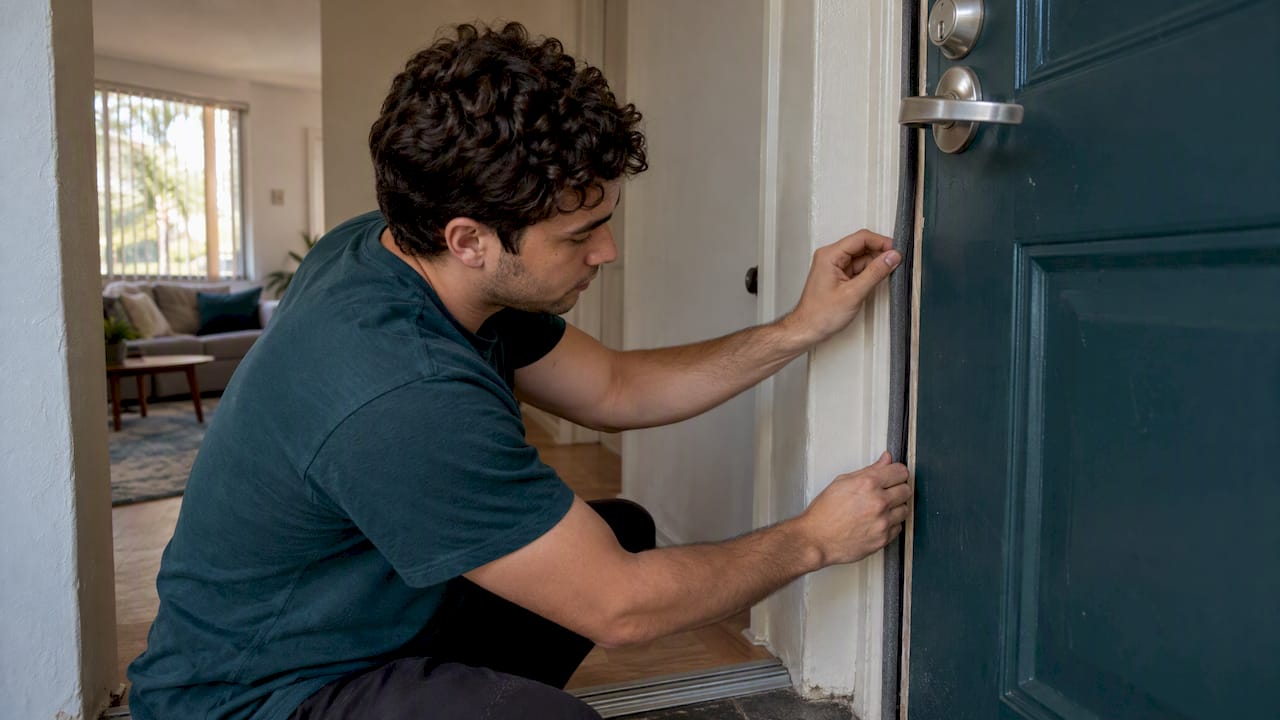
You can make a rented apartment noticeably quieter without drilling, building walls or losing your deposit. You can’t make it silent. Sealing air gaps, putting dense furniture against shared walls, covering hard surfaces and treating windows and doors cut voices, TV noise and street hiss. They do little against bass and footsteps. This guide covers what works, what doesn’t, and how to pick a unit that needs less fixing in the first place.
TL;DR
- Seal first: gaps under doors, around outlets and along trim are the cheapest and often the most effective fix.
- Add mass with freestanding items, such as a bookshelf packed with books against the shared wall, and soft layers like rugs and heavy curtains.
- Damage-free methods tame echo and mid-to-high frequency noise. Bass, footsteps and thumping need a fix at the source: a conversation with the neighbor or the landlord.
- White noise can mask what you can’t block, and a quiet floor plan, location and lease terms matter as much as any product.
- Before signing, tour at different times of day and ask about noise policies in writing.
Table of Contents
- Why renters can’t fully soundproof, and what that means
- Step 1: Seal the leaks
- Step 2: Add mass without anchors
- Step 3: Soften the room
- Soundproofing windows in an apartment
- Doors and thin interior walls
- What won’t work
- Fix the source: talk, document, escalate
- Perspective: choose quiet before you need to fix it
- How to pick a quieter apartment
- Looking at a one-bedroom in Boca Raton
- FAQ
- Sources
Why renters can’t fully soundproof, and what that means
Real soundproofing relies on two things: adding mass and breaking the mechanical path that sound travels along (decoupling). Both are structural and invasive. According to a renter-focused guide on damage-free soundproofing, what you can do without damage is mostly seal air leaks and add soft absorption, which reduces echo and muffled sound but offers little resistance to bass or footsteps. Family Handyman reaches the same conclusion: unless your landlord agrees to permanent structural changes, you can reduce noise but not truly soundproof.
That isn’t a reason to give up. It’s a reason to spend money where it pays off and skip the products that promise more than they deliver.
What the numbers say about a “quiet enough” apartment
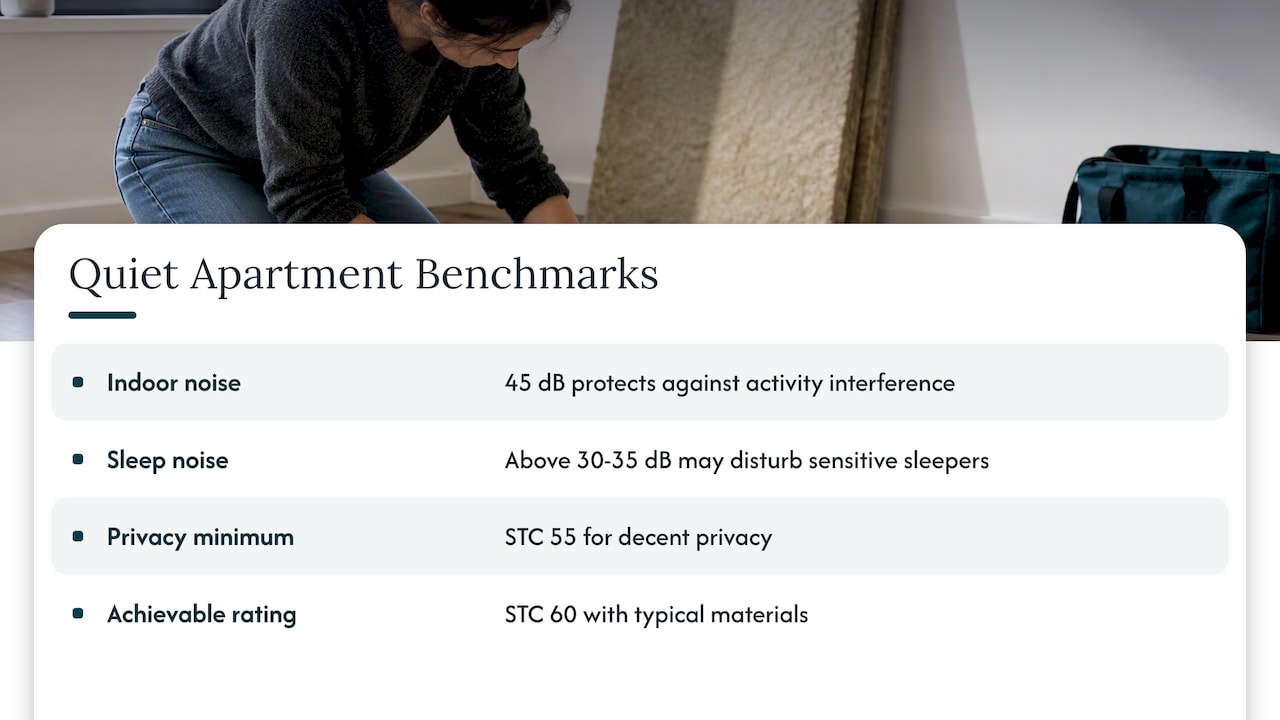
A useful benchmark: the EPA’s noise-level document identifies 45 decibels indoors as a level that protects against activity interference and annoyance. For sleep, the same research notes that continuous indoor noise above roughly 30 to 35 dB can disturb sensitive sleepers.
For walls between units, the Canadian Building Digest on sound transmission says occupants of multifamily buildings should expect STC 55 to be the effective minimum for decent privacy, and that STC 60 is achievable with typical materials when designed correctly. STC (Sound Transmission Class) is a rating for how well a wall or floor blocks airborne sound. A renter can’t change the rating of the wall, but you can stop leaks from dragging the real-world result down.
Step 1: Seal the leaks
This is the highest-return move. The same renter guide reports that gaps as small as 1/16 of an inch hurt wall performance, and that a gap equal to 1% of a wall’s surface can cap its sound-blocking at around 20 decibels. It also cites well-sealed walls rating around STC 37 to 39, against 28 to 32 for leaky ones. Sound takes the path of least resistance, so close the weak points first.
Where to look:
- Door bottoms. Add a door sweep or a draft stopper. A visible strip of light under the door is a sound path too.
- Door frames. Self-adhesive weatherstripping around the jamb closes the perimeter gap when the door is shut.
- Outlets and switches on shared walls. Foam outlet gaskets behind the cover plates are cheap and need no tools beyond a screwdriver. Switch the power off at the breaker before you remove a plate.
- Floor trim and baseboards. Check with the landlord before using acoustic caulk. Removable options exist, and many leases allow minor caulking if it doesn’t damage finishes. Ask first and get the answer in writing.
- Vents and pass-throughs. Leave HVAC vents open and unblocked for safety and airflow. Report oversized gaps around pipes or ducts to maintenance instead of stuffing them yourself.
We’ve put together a quick list of low-cost fixes in under-$20, one-hour apartment soundproofing fixes for renters if you want a shopping list.
Step 2: Add mass without anchors
Mass blocks sound. In a rental it has to be freestanding. A heavy bookshelf packed with books or a garment rack full of clothes against a shared wall gives you dense, reversible mass with no adhesive or screws.
Some practical rules:
- Put the furniture against the wall you share with the neighbor, not the exterior wall.
- Fill it. A half-empty shelf with air gaps does much less than a full one.
- Push it tight to the wall and keep it away from outlets and heating vents.
- Anchor tall furniture according to the manufacturer’s tip-over guidance, using methods your lease allows.
- In the bedroom, the headboard wall is usually the one to treat first, because you spend eight hours next to it.
Step 3: Soften the room
The same guide says hanging heavy, loose-textured fabrics such as thick curtains or quilts absorbs sound reflections. Rugs with a dense pad, upholstered furniture and wall-hung textiles all shorten the echo in a room. Be realistic about what that gives you: these measures reduce reverberation inside your space and take the edge off high frequencies. They don’t stop a neighbor’s speakers from coming through the wall.
A related point from the research: how loud a sound seems depends on how quiet the room is. A NIST paper on sound transmission notes that intruding sound is easier to hear in a quiet room, and that in a noisier one a weaker wall can seem to do the job because background sound masks the noise. This is why a fan or a white noise machine often feels better than another layer of foam.
Soundproofing windows in an apartment
Windows are the weak point for traffic, sirens and construction. In a rental, your options sit on three levels.
| Option | Damage-free? | What it does | Good for |
|---|---|---|---|
| Weatherstripping around the sash | Yes | Closes air gaps | Wind hiss, general street noise |
| Heavy, lined curtains over the window | Yes | Absorbs some high-frequency noise, reduces echo | Evening street noise |
| Removable acrylic or glass window insert | Usually, ask first | Adds an extra air space | Persistent road noise |
| Replacing single-pane with double-pane windows | No, landlord decision | Better sealing and insulation | Long-term fix the landlord controls |
If you’re wondering whether you need double-pane windows, the practical answer is that they are an upgrade the property owner makes, not something a tenant installs. What you can do is ask about the window type before you rent, and request that maintenance reseal any window that rattles or leaks air. For a deeper look at traffic noise, see our guide to renter-safe fixes for apartment road noise, which also covers which side of a building tends to be quieter.
Doors and thin interior walls
Hollow-core interior doors leak sound. A sweep and perimeter seal help most. For a front door facing a loud hallway, a removable door-hung blanket or a heavy curtain on a tension rod on the inside adds some absorption. Don’t block the exit path or the door’s operation.
For thin interior walls between rooms, think layout. Put the bedroom, not the TV, against the noisier neighbor. Move the desk away from a shared wall if you take calls.
What won’t work
A few common purchases waste money in a rental.
- Egg-crate foam and thin foam panels. They absorb a little echo. They don’t block sound passing through a wall. Treating them as soundproofing is the classic mistake.
- Bass and footsteps. According to a technical document on determining STC, STC ratings are built around speech-like sounds and don’t capture low-frequency sources such as subwoofers or impact noise like footsteps. Generic advice often fails for these. A bookshelf won’t stop a subwoofer, and a rug on your side won’t stop the person upstairs.
- Anything that needs drilling or gluing to the walls, unless the landlord agrees in writing.
When you can’t block the sound, masking helps. The Canadian Building Digest linked above notes that in apartments where standards aren’t met, white noise generators are often more effective at masking annoyance than trying to block structural sound.
Fix the source: talk, document, escalate
Sound insulation is a system. If you can’t stop noise at the source, you’re limited to what you can do in your own space. So the most effective move is often a conversation.
- Talk to the neighbor. Most people don’t know how far their sound carries. Be specific: the time, the room, what you hear.
- Write to management. Note dates, times and what you heard. A written record is what gets action under a lease’s quiet-hours clause.
- Know your local rules. In Boca Raton, the noise ordinance summarized by the Noise Pollution Clearinghouse sets limits in apartment-zoned areas of 55 dBA by day (7:00 a.m. to 7:00 p.m.) and 50 dBA at night, measured at the property boundary. Enforcement starts with voluntary compliance and a warning from an environmental officer before formal violation processing. The city’s own noise ordinance document is the primary text. Ordinances can be amended, so check the current version.
- Animal noise has its own process. The same summary says complaints about animals require two sworn affidavits from unrelated residents in separate dwellings, or one affidavit plus video evidence.
Our own guides go further on this: the Boca Raton named-complainant rule, quiet hours and dBA limits in Florida and apartment noise laws in plain language. If a barking dog is the issue, here are seven ways to soundproof around it. For legal questions about a specific dispute, a Florida landlord-tenant attorney or local legal aid is the right professional, not a blog.
Perspective: choose quiet before you need to fix it
We run a one-bedroom community in Boca Raton, and the question we hear from prospects, students and professionals who work from home alike, is rarely “how thick is the wall?” It’s “will I sleep?” Our honest view is that the best soundproofing is the one you do at the tour, not after move-in.
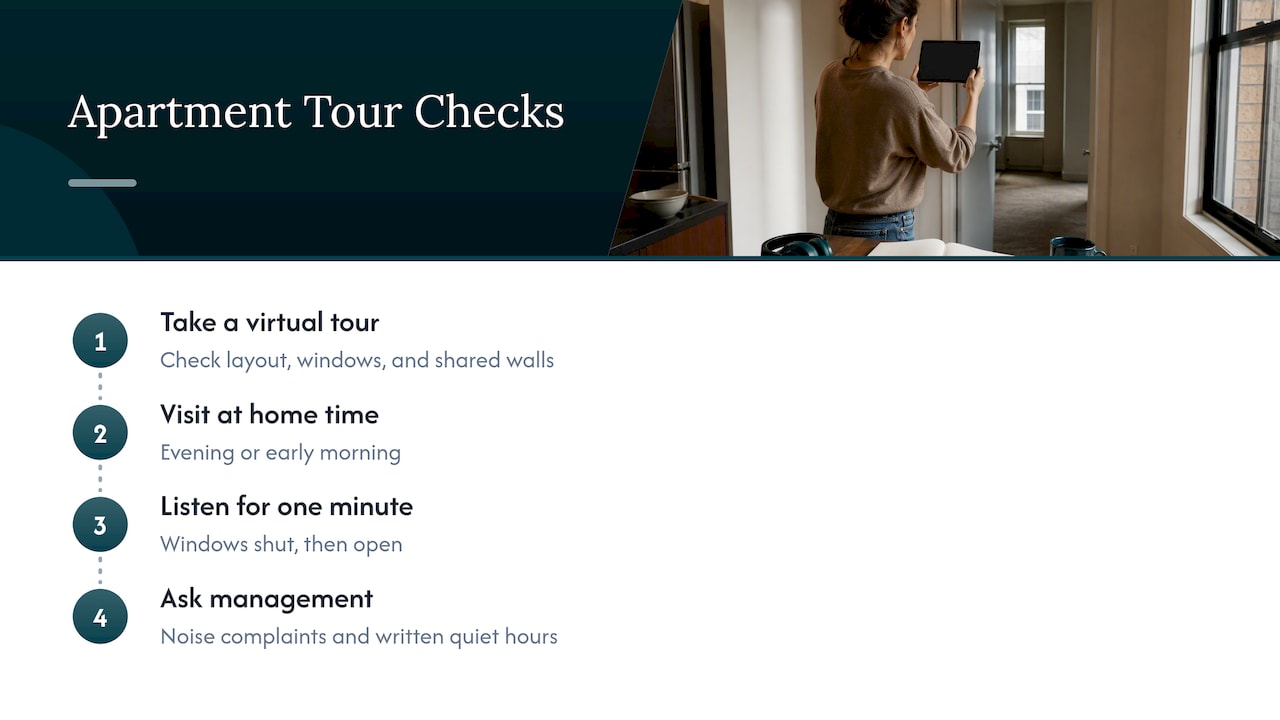
That’s why we believe in making the evaluation easy. Virtual tours let you look at the layout, window placement and what shares a wall with what. Then visit in person at the time you’d be at home: evening for neighbors and traffic, early morning for garbage trucks and commuting. Listen for a full minute with the windows shut, then open. Ask management how noise complaints are handled and where quiet hours are written down.
A community with clear rules, same-day maintenance when a door sweep or window seal fails, and a quiet, respectful resident mix does more for your sleep than a stack of foam panels. We’d rather you ask hard questions now than discover the answers in month three.
— Ayman
How to pick a quieter apartment
Use this checklist on any tour:
- Which units share a wall, floor or ceiling with neighbors, and what’s on the other side: bedroom, living room, stairwell, laundry?
- Is the unit on the side of the building facing a main road?
- Do doors close tightly? Is there light under them?
- Do the windows rattle, and are they single or double pane?
- What does the lease say about quiet hours and how complaints are handled?
- Can you hear plumbing, hallways or neighbors at the time you’ll actually be home?
We have more detailed material on this: how to find quiet rental units, quiet apartments for professionals in Boca Raton and our picks for quiet apartments for rent in Boca Raton. If you have a cat, our page on Boca Raton noise policies for pet-friendly apartments explains what to expect.
Looking at a one-bedroom in Boca Raton
If you’re apartment hunting and want a place you can evaluate openly, our one-bedroom apartments are listed at $1,990 to $2,220 per month on our units page. Pricing is transparent, with no hidden fees. The one-time fees are published on our fees page: a $75 non-refundable application fee per applicant, a $300 administration fee, and a $15 wire transfer fee. Cat owners pay a one-time, non-refundable pet fee of $300 to $500 per cat, with no ongoing pet rent. You can start with a virtual tour and a map of the property, then ask us anything about noise before you apply.
FAQ
How do I stop sound going through my apartment walls?
You can reduce it but not eliminate it without structural work. Seal gaps at outlets, trim and doors, then place a full bookshelf or similar dense furniture against the shared wall. Soft furnishings help with echo. Bass and impact sounds usually require action at the source.
Does soundproofing work against footsteps and bass?
Mostly not with renter-safe methods. Damage-free fixes are better at echo and speech-range noise, and standard STC ratings don’t capture low frequencies or footsteps. For those, talk to the neighbor, document the problem and involve management. A white noise machine can help mask what remains.
Are double-pane windows worth asking about?
Yes, ask about them before you sign, because the landlord decides whether windows are replaced. If you already live in a unit with leaky windows, ask maintenance to reseal them, and use weatherstripping and heavy curtains in the meantime.
How much noise is acceptable in an apartment?
There’s no single number. For health, the EPA’s research points to 45 dB indoors as a protective level, and Boca Raton’s ordinance sets 55 dBA by day and 50 dBA at night for apartment-zoned areas, measured at the property boundary. Your lease’s quiet-hours clause is the rule that applies most directly to a neighbor dispute.
Sources
- How to Soundproof Apartment Walls Without Damaging Them
- Can You Truly Soundproof an Apartment? (Family Handyman)
- EPA Identifies Noise Levels Affecting Health and Welfare
- CBD-239. Factors Affecting Sound Transmission Loss
- NIST: sound transmission paper
- Determination of STC (Montana State University)
- Noise Pollution Clearinghouse
- City of Boca Raton noise ordinance