Yes, Boca Raton enforces a municipal noise ordinance under Chapter 10 of its Code of Ordinances. It sets numeric decibel limits by zoning district, protects hospitals, schools, parks, and churches within 500 feet, and restricts loud activity during nighttime hours. Daytime complaints go to Code Enforcement at 561-393-7934; after-hours or urgent issues go to the police non-emergency line at 561-368-6201.
TL;DR:
- Enforcement relies on measured decibel thresholds tied to zoning, with stricter nighttime limits and additional reductions for impulsive noises like bass or banging.
- Noise sources within 500 feet of hospitals, schools, parks, or churches are prohibited during their active use periods, unless posted signage indicates otherwise.
- Contractors can apply for permits to work outside standard hours, but noise must stay below 75 dBA for no more than 10% of the measured time at 50 feet; neighbors should be notified in advance.
- A valid complaint requires the caller’s name due to Florida law, and documenting incident times and recordings strengthens the case before escalation.
- Most disputes resolve faster through direct neighbor contact or mediation; formal complaints are a last resort when issues persist or pattern over time.
Table of Contents
- What the Boca Raton Noise Ordinance Actually Prohibits
- How Loud Is Too Loud? Decibel Limits By Zoning District
- Quiet Hours and the 500-Foot Rule Near Schools and Hospitals
- Construction Hours, Decibel Caps, and Permit Exceptions
- How to Report a Noise Complaint in Boca Raton
- What Happens After You File: Penalties and Enforcement Escalation
- Steps Renters and Owners Can Take Before Filing an Official Complaint
- Local Noise Resources for Boca Raton Renters
- How to Appeal a Noise Citation in Boca Raton
- Recent Changes to Boca Raton’s Noise Rules
- Where to Find Mediation Help for Noise Disputes
- What Actually Matters When You’re Dealing With a Noise Problem
- A Managed Community Approach to Noise Problems
- Sources
- FAQ
What the Boca Raton Noise Ordinance Actually Prohibits
Chapter 10 doesn’t leave “too loud” up to a neighbor’s mood. The ordinance defines unlawful noise as sound that is excessive or unusually loud for the zoning district and time of day, and it backs that definition with measurable standards rather than pure judgment calls. That distinction matters if you’ve ever argued with a downstairs neighbor about whether their television counts as a violation.
The city adopted measurement standards from the American National Standards Institute (ANSI) and the Air-Conditioning and Refrigeration Institute (ARI) as the technical basis for how sound gets measured and evaluated. That’s a deliberate choice. It means an inspector isn’t just deciding a sound “feels” loud. They’re comparing a reading, taken with calibrated equipment, against a published threshold tied to zoning.
That said, enforcement in practice blends both worlds. A single loud party might get a warning based on an officer’s assessment and a documented complaint, without anyone pulling out a sound meter. But a persistent commercial or mechanical noise source, like a rooftop condenser unit running above spec, usually needs an actual decibel reading to sustain a citation. Subjective annoyance opens a case; measured evidence closes it.
How Loud Is Too Loud? Decibel Limits By Zoning District
Boca Raton’s noise limits shift depending on where you live and what time it is. Residential zones get the tightest thresholds because the ordinance assumes people are trying to sleep, work from home, or just get some quiet.
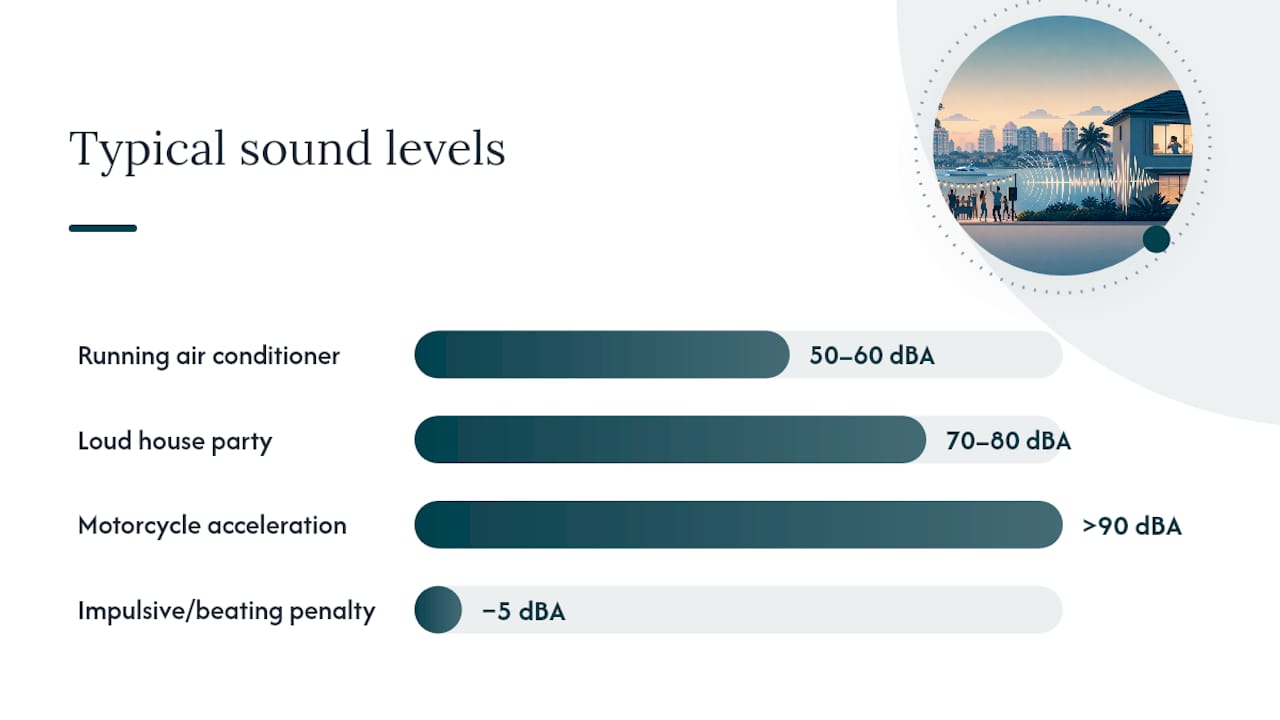
These figures come from Chapter 10 of the Municode ordinance text, which also applies a correction: impulsive or beating noises, like bass-heavy music or repetitive banging, get an additional 5 dBA subtracted from the allowable limit, making them easier to flag as violations. For context, a running air conditioner sits around 50 to 60 dBA, a loud house party can hit 70 to 80 dBA, and a motorcycle accelerating nearby can spike past 90 dBA. That’s why a party or a modified exhaust pipe crosses the line so much faster than a rattling window unit.
Quiet Hours and the 500-Foot Rule Near Schools and Hospitals
Nighttime hours carry stricter thresholds across every residential and commercial zone, with allowable decibel levels generally lower at night compared to daytime limits. The ordinance treats nighttime as the period when the city assumes people are sleeping, which is why a stereo that’s fine at 3 p.m. can trigger a valid complaint at 11 p.m. at the exact same volume.
Separately, Chapter 10 bars excessive noise within 500 feet of hospitals, schools, parks, and churches during their period of use, unless the property has posted signage acknowledging the restriction. “Period of use” is the key phrase. A church parking lot is protected during Sunday service, not necessarily at 2 a.m. on a Tuesday. This rule shows up most often around outdoor events, food trucks with amplified speakers, or construction crews working near an active school campus.
Construction Hours, Decibel Caps, and Permit Exceptions
Standard construction hours run Monday through Friday from 7 a.m. to 6 p.m., Saturday from 8 a.m. to 6 p.m., with Sunday work restricted under most circumstances. Even within those hours, construction noise can’t exceed 75 dBA for more than 10% of the time measured at 50 feet from the site. That’s a meaningful cap. Pile drivers and jackhammers routinely blow past it, which is why contractors on tight timelines often need to plan around it rather than through it.
Contractors who need to work outside those windows, say, pouring concrete overnight before a heat spike, can apply for a temporary permit through the city. Approval typically depends on the scope of work, duration, and proximity to residential units. Neighbors and contractors both do better with advance notice. A flyer on doors a few days ahead, staging noisy equipment away from bedroom windows, and limiting the loudest tasks to midday all reduce the odds of a complaint escalating into a citation.
How to Report a Noise Complaint in Boca Raton
Reporting a violation is straightforward once you know which number to call. During business hours, contact City Code Enforcement at 561-393-7934, Monday through Friday, 8 a.m. to 5 p.m. For anything happening after hours, especially loud disturbances after midnight, call the police non-emergency line at 561-368-6201 instead. Code Enforcement generally doesn’t dispatch officers overnight.
One detail catches a lot of renters off guard: Florida Statute 162.06 requires a named complainant before a code inspector can open an investigation. Anonymous tips don’t trigger action on their own. You’ll need to put your name on the complaint.
Before you call, gather:
- A time-stamped log of when the noise started and stopped
- Short audio or video clips (useful for context, though not always precise enough for court)
- Names of any neighbors willing to corroborate the complaint
- The specific address or unit generating the noise
Pro Tip: Keep a simple running log in your phone’s notes app every time an incident happens. A pattern of dated entries carries far more weight with an inspector than a single angry call after one bad night.
What Happens After You File: Penalties and Enforcement Escalation
Boca Raton Code Enforcement generally leads with education rather than punishment. A first complaint often results in a warning or informal notice asking the resident or business to correct the issue. Repeat violations move toward formal citations and fines, and if noncompliance continues, cases can escalate to a special magistrate hearing where penalties increase and daily fines can accrue until the violation is resolved.
Commercial and special-event violations tend to move faster through this pipeline than residential neighbor disputes, partly because businesses are easier to hold accountable through licensing and permitting leverage. A bar with repeated amplified-sound complaints risks its event permit, while a noisy neighbor typically gets more chances before real consequences land. That asymmetry is worth knowing if you’re dealing with a business rather than an individual.
Steps Renters and Owners Can Take Before Filing an Official Complaint
Most noise conflicts resolve faster with a direct approach than with a formal complaint. Try this order:
- Talk to the neighbor or leave a polite written note describing the specific issue and time it occurs.
- Start logging incidents immediately, even before you decide whether to escalate.
- Contact your property manager or landlord if the source is another unit in the same building.
- File the official complaint with Code Enforcement only if the direct approach doesn’t change anything within a reasonable window.
Property owners carry their own responsibilities here. Mechanical equipment, like rooftop HVAC units or pool pumps, needs to stay within the same decibel limits as any other noise source, and lease agreements should spell out quiet-hour expectations for tenants. HOAs and apartment communities that build noise clauses into their rules tend to see fewer disputes reach the city level in the first place, since community rules can address barking dogs and recurring disturbances before they become formal complaints.
Pro Tip: If a dispute involves a long-term neighbor relationship you’d rather not damage, ask about community mediation services before filing a citation. It often preserves the relationship better than an official complaint does.
Local Noise Resources for Boca Raton Renters
Cynthia Gardens maintains community guidelines that address common noise sources like barking dogs and shared-wall living, which cuts down on the kind of disputes that otherwise end up as formal city complaints. Prospective renters comparing units can also use virtual tours and the interactive property map to check a unit’s distance from busy roads, parking areas, or shared amenity spaces before signing a lease, rather than finding out after move-in.
How to Appeal a Noise Citation in Boca Raton
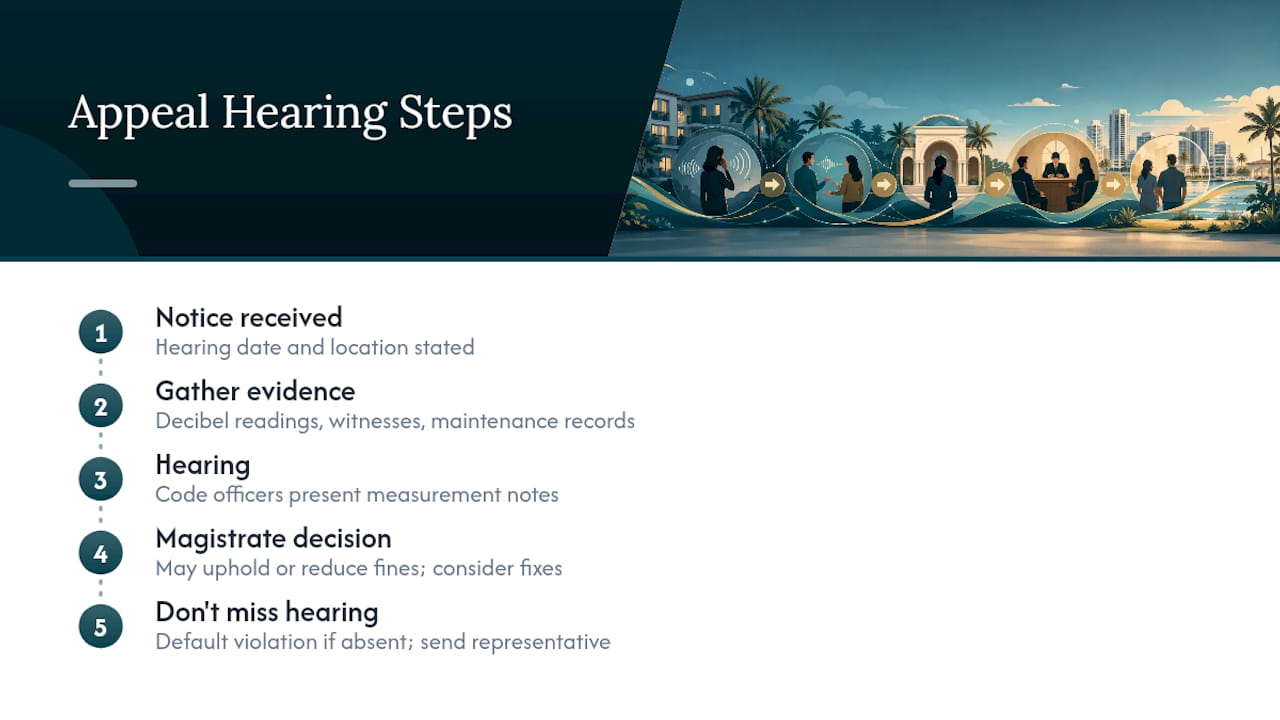
If you receive a noise citation and believe it was issued in error, or that the underlying complaint was unfounded, you have the right to contest it before a special magistrate. The process typically starts with a written notice of hearing that arrives with the citation itself, spelling out the date and location.
At the hearing, you can present evidence: your own decibel readings if you have them, witness statements, maintenance records showing equipment was within spec, or documentation that the complaint stemmed from a personal dispute rather than an actual noise violation. Code Enforcement officers present their side, usually backed by their measurement notes or the original complaint documentation.
The special magistrate then rules on whether the violation stands. If it does, the fine schedule outlined in the original citation generally applies, though magistrates have some discretion to adjust penalties based on circumstances, first-time status, or demonstrated corrective action. If you’ve already fixed the issue, showing proof of correction (a repaired unit, a removed speaker system, a written commitment from a landlord) can meaningfully affect the outcome.
Missing the hearing date is the most common mistake people make. An uncontested citation typically gets treated as a finding of violation by default, so if you intend to appeal, mark that date and show up, or send a representative if you can’t attend in person.
Recent Changes to Boca Raton’s Noise Rules
Boca Raton periodically revisits Chapter 10 as part of broader code updates, and the city’s own reference documents get refreshed to reflect current enforcement priorities. Residents should treat the official Municode text as the current source of truth rather than older summaries circulating on third-party sites, since ordinance amendments don’t always get reflected quickly across every website that references them.
One area that’s drawn continued attention citywide is short-term rental activity and how it interacts with residential noise expectations. As more units get listed for short stays, code enforcement has leaned harder into named-complaint documentation to manage disputes between long-term residents and transient renters, particularly around late-night gatherings. Construction-related noise rules have also stayed a point of ongoing scrutiny as development continues across the city, with the 75 dBA construction cap remaining the operative standard for contractors working near residential zones.
If you’re unsure whether a specific rule has changed since you last checked, the safest move is calling Code Enforcement directly rather than relying on a general web search, since ordinance PDFs and summary pages can lag behind actual amendments.
Where to Find Mediation Help for Noise Disputes
Not every noise conflict needs a citation to resolve. Community mediation services, often available through county-level dispute resolution programs, can bring neighbors together with a neutral third party before things escalate to Code Enforcement or a magistrate hearing. This route tends to work best when the dispute involves an ongoing relationship, like adjacent homeowners or long-term apartment neighbors, rather than a one-time event.
For renters, the property management office is usually the fastest mediation channel available. Most lease agreements include a section on tenant conduct and quiet enjoyment, giving management the authority to intervene directly with a disruptive tenant without involving the city at all. This can resolve a dispute in days rather than the weeks a formal Code Enforcement case might take.
Civil remedies also remain an option in more serious or persistent cases, particularly where a noise source causes documented property damage or health impacts. That route generally requires legal counsel and is a heavier lift than either mediation or a code complaint, so it’s typically reserved for situations where other channels have already failed. For most residential disputes, the order of operations stays simple: talk to the neighbor, involve management if you’re a renter, try mediation if the relationship is worth preserving, and file an official complaint when none of that works.
What Actually Matters When You’re Dealing With a Noise Problem
Most guides on this topic focus heavily on the decibel numbers, as if knowing the exact dBA threshold is the key to winning a dispute. It isn’t. The number that actually determines whether your complaint goes anywhere is whether you’re willing to put your name on it. Florida’s named-complainant requirement trips up more renters than any confusion over zoning limits, because people assume they can report a problem the way they’d report a pothole. They can’t, and that single fact changes the calculus for a lot of people who’d rather stay anonymous.
The other overlooked piece is timing your escalation correctly. Jumping straight to a formal complaint against a neighbor you’ll see in the hallway every day for the next year often creates more friction than it resolves. A documented log paired with a direct conversation solves most disputes before Code Enforcement ever needs to get involved. Save the official complaint for patterns that don’t respond to a polite ask, and treat the ordinance’s numeric limits as backup evidence, not your opening move.
— Ayman
A Managed Community Approach to Noise Problems
Chasing down decibel readings and filing named complaints gets old fast, especially if you’re dealing with the same disruptive neighbor every few months. Cynthia Gardens takes a different approach for renters who’d rather not become part-time noise investigators: enforced community rules that address quiet hours and tenant conduct directly through management, so disputes get handled internally before they ever need a city complaint.
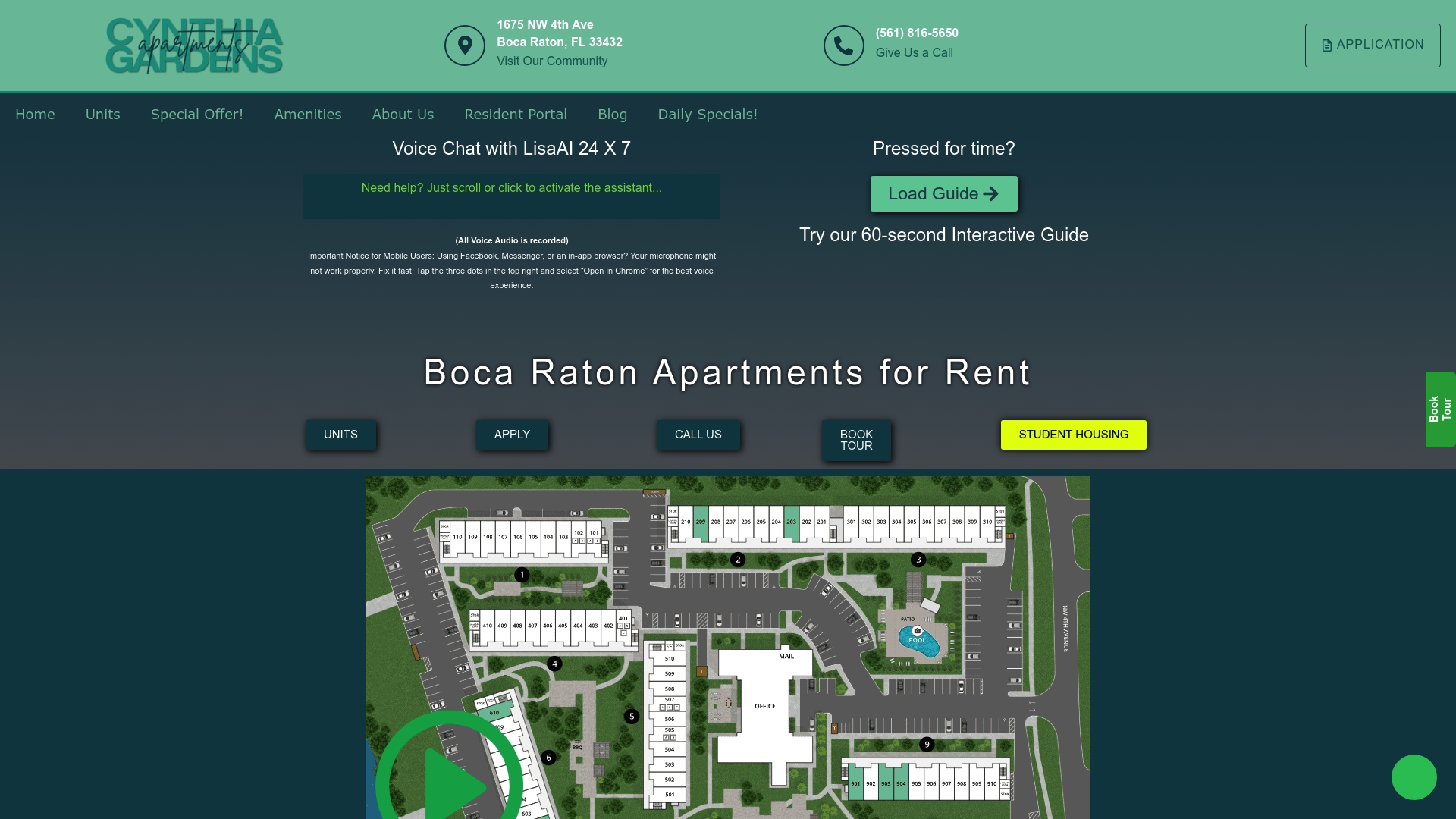
Prospective renters can check a unit’s layout and surroundings ahead of time using virtual tours, which helps you spot whether you’re near a busy amenity area or a quieter interior-facing unit before you commit to a lease. If a managed, rule-enforced community sounds like a better fit than negotiating noise problems on your own, explore available one-bedroom apartments at Cynthia Gardens and see what’s currently open.
Sources
- NOISE ORDINANCE — City of Boca Raton (Noise-Ordinance-ReferencePDF)
- Code of Ordinances | Boca Raton, FL — Municode Library (Chapter 10 Noise)
- Florida Statutes — Chapter 162 (Code Enforcement)
FAQ
What are the quiet hours in Boca Raton?
Nighttime hours carry stricter decibel limits than daytime across every zoning district, generally about 5 dBA lower, with residential zones capped around 50 dBA at night versus 55 dBA during the day.
At what point can you call the police for a noise complaint?
Call the police non-emergency line at 561-368-6201 for urgent or after-hours noise, especially after midnight; use Code Enforcement at 561-393-7934 during business hours for standard complaints.
What counts as unreasonable noise from neighbors?
Noise that exceeds the decibel limit for your zoning district and time of day, such as sound above 50 dBA at night in a residential zone, qualifies as a violation under Chapter 10.
How late can you play loud music in Florida?
Boca Raton’s nighttime limits apply once the sun sets and continue through morning, meaning music that’s compliant during the day can violate the lower nighttime threshold even at the same volume.
Does Boca Raton allow anonymous noise complaints?
No. Florida Statute 162.06 requires a named complainant before code enforcement can open an investigation, so anonymous tips alone won’t trigger official action.