
TL;DR:
- Renters should understand the differences between pet deposits, fees, and pet rent to avoid unexpected costs.
- Legal protections generally limit deposit amounts, require timely refunds, and prohibit charges for assistance animals.
- Preparing thorough move-in documentation and responding promptly to deductions can ensure the full return of your pet deposit.
Renting with a pet should not feel like a financial ambush. Yet for millions of renters, discovering a stack of pet-related charges on a lease agreement is exactly that. This pet deposit guide for renters cuts through the confusion by explaining what each charge actually is, what’s legal, and what you can do to protect your money from day one. You’ll learn how much to expect, how state laws govern refunds and deductions, how to negotiate better terms, and how to get every dollar back that you’re owed when you move out.
Table of Contents
- Key takeaways
- Pet deposit guide for renters: understanding the three charges
- Your legal rights around pet deposits
- How to protect your pet deposit before move-out
- Getting your pet deposit back after move-out
- My honest take on navigating pet deposits
- Renting with pets at Cynthiagardens
- FAQ
Key takeaways
| Point | Details |
|---|---|
| Know the three charge types | Pet deposits, pet fees, and pet rent are different. Only the deposit is refundable. |
| State law sets the rules | Deposit caps, refund timelines, and itemization requirements vary by state and must be followed by landlords. |
| Assistance animals are protected | Federal law prohibits landlords from charging any pet deposit or fee for service or emotional support animals. |
| Document everything at move-in | Timestamped photos and a written inspection report are your strongest defense against unfair deductions. |
| Disputes have a process | You can formally challenge improper deductions through itemization requests, housing authorities, or small claims court. |
Pet deposit guide for renters: understanding the three charges
Before you sign anything, you need to know that “pet deposit” is not a catch-all phrase. Landlords use three distinct charge structures, and each works very differently. Mixing them up costs renters real money.
Pet deposit
A pet deposit is a one-time, refundable payment you make before moving in. It works like a security deposit specifically for your animal. If your pet causes no damage beyond normal wear and tear, you get that money back. Typical refundable pet deposits range from $200 to $500, though high-cost cities like San Francisco or New York can push that to $1,000 or more per pet.
Pet fee
A pet fee is a one-time, non-refundable payment. You pay it upfront and it covers general administrative costs or anticipated wear. It’s gone the moment you hand it over, regardless of how clean your pet is. Landlords sometimes label upfront payments as fees specifically to sidestep deposit regulations, but state deposit laws may still apply depending on how the charge is structured.
Pet rent
Pet rent is a monthly surcharge added to your base rent. It’s also non-refundable and ranges from $25 to $100 per month depending on location and property type. Many landlords charge pet rent on top of a pet deposit, so you could be paying both a lump sum upfront and an ongoing monthly fee throughout your lease.
Here’s a quick comparison to keep it straight:
| Charge type | Refundable? | When paid | Typical amount |
|---|---|---|---|
| Pet deposit | Yes | Move-in | $200–$1,000+ |
| Pet fee | No | Move-in | $100–$500 |
| Pet rent | No | Monthly | $25–$100/month |
Pro Tip: Read your lease carefully and identify every charge by name. If something is labeled a “fee” but functions like a deposit, ask your landlord in writing to clarify its refundability before you sign.
Understanding the difference between charges is the first step toward avoiding a nasty surprise when you move out expecting a refund that was never coming.
Your legal rights around pet deposits
Pet deposit law is not uniform across the country, but certain protections apply almost everywhere. Knowing them puts you in a much stronger position.

Deposit caps. Many states limit how much a landlord can collect in total deposits, combining security and pet deposits into one ceiling. California, for example, caps total deposits at two months’ rent for unfurnished units. If a landlord charges more than that, the excess is illegal.
Refund timelines. State law dictates how quickly landlords must return deposits after you move out. California gives landlords 21 days, while New York sets a 14-day deadline. Missing these deadlines can forfeit the landlord’s right to make any deductions at all.
Itemized deductions. Landlords cannot just pocket part of your deposit. They must provide a written statement listing every deduction, along with receipts. In California, landlords are required to provide receipts for any deduction over $125. No itemization means no legal right to withhold your money.
Normal wear and tear. This is where most disputes start. Pet deposits can only be applied to damage caused by your pet, not to normal aging like small scuffs, minor carpet wear, or faded paint. Knowing this distinction gives you solid ground to push back on deductions that don’t qualify.
The most important protection many renters don’t know about:
If you have a service animal or an emotional support animal, your landlord cannot legally charge you a pet deposit, pet fee, or pet rent. The Federal Fair Housing Act makes this clear, and violations can result in civil penalties exceeding $21,000. If you’ve been charged fees for an assistance animal, file a complaint with HUD immediately.
This protection applies regardless of the landlord’s pet policy. A building that says “no pets” still cannot deny a reasonable accommodation for an assistance animal, and it cannot charge fees for that animal. For more on how pet and assistance animal policies differ in practice, Cynthiagardens has a breakdown worth reading before you sign a new lease.
How to protect your pet deposit before move-out
The best time to protect your deposit is before your first night in the apartment. Renters who skip this step are the ones who end up fighting over charges they can’t disprove.
-
Do a detailed move-in inspection. Walk every room with your landlord or property manager and note any existing damage on the official inspection form. If there’s no form, create your own written record and email it to the landlord the same day so it’s timestamped and documented.
-
Take photos and video immediately. Timestamped move-in photos are your strongest protection against wrongful deductions. Photograph floors, walls, baseboards, carpet edges, and doors. Any area your pet is likely to be near deserves close attention.
-
Document your pet’s care throughout the tenancy. Keep vet records, grooming receipts, and any proof of flea treatment or professional cleaning. This demonstrates responsible ownership and undermines claims that your pet caused neglect-level damage.
-
Communicate in writing. If your landlord gives you verbal permission for something, follow up with an email confirming the conversation. Written trails protect you if the story changes at move-out.
-
Negotiate before you sign. You have more leverage before signing than after. Consider proposing a refundable deposit instead of a non-refundable fee. Offer a “pet resume” with your animal’s training records, vet history, and references from previous landlords. Landlords respond to renters who demonstrate they’re low-risk.
-
Handle minor issues before you leave. Before your move-out inspection, patch small scratches on wood floors, steam-clean carpets professionally, and treat any odors. A $150 carpet cleaning bill you pay yourself is better than a $600 deduction from your deposit.
Pro Tip: Schedule your move-out inspection while you’re still present and repeat the same photo documentation process you did at move-in. Side-by-side comparisons make it nearly impossible for a landlord to claim damage that wasn’t there.
The Boca Raton renter’s guide on pet agreements also covers specific lease clause language to watch for if you’re renting in South Florida.
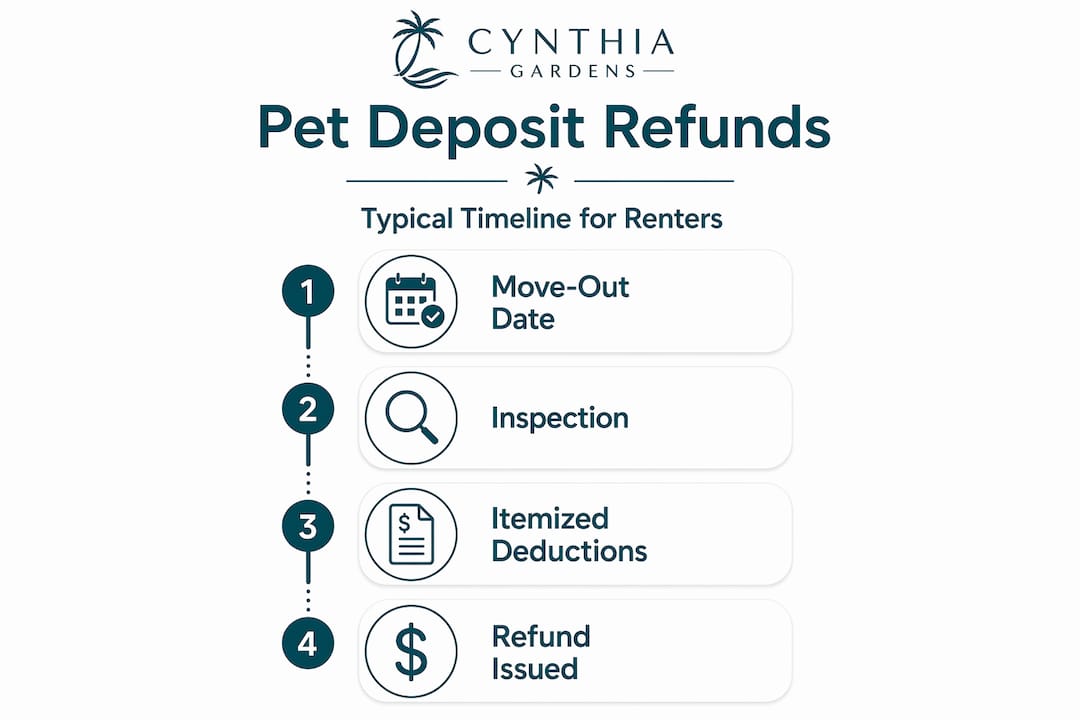
Getting your pet deposit back after move-out
Moving out is where everything you documented finally pays off. Here’s what the process typically looks like, and where renters commonly run into problems.
After handing in your keys, your landlord has a state-mandated window to return your deposit and, if applicable, an itemized list of deductions. Missing that deadline is a serious violation. In some states, it automatically entitles you to the full deposit regardless of any damage.
Common deductions landlords attempt:
- Deep carpet cleaning beyond standard cleaning costs
- Replacement of flooring due to pet urine or staining
- Repainting walls because of pet odor or scratching
- Replacement of doors, baseboards, or trim with visible pet damage
- Flea or pest treatment costs if not already handled by the renter
Some of these are legitimate. Others are inflated or applied to damage that qualifies as normal wear and tear, which is not your financial responsibility.
“Without documentation, proving pre-existing damage is difficult, risking full deposit loss.” This is not hypothetical. Renters who skip the move-in inspection regularly lose disputes because they cannot prove a stain existed before they moved in.
If you receive a deduction you believe is improper, respond in writing within the landlord’s required response period. Request the itemized statement and all receipts. Challenge deductions lacking itemized bills by citing your state’s deposit laws directly. If the landlord does not respond or refuses to correct the error, you have two escalation paths: file a complaint with your local housing authority, or take the matter to small claims court where judges routinely rule in favor of renters with solid documentation.
The deposit rules for Boca Raton apartments page covers Florida-specific timelines and filing procedures if that’s your local context.
My honest take on navigating pet deposits
I’ve watched renters lose money not because the law failed them, but because they walked into a lease unprepared. The single shift that changed my approach completely was treating move-in documentation like a legal filing, not a formality. That first set of timestamped photos has saved me from deduction disputes more than once.
What most renters overlook is that landlords are often testing how much pushback you’ll give. When you respond to an improper deduction with the specific state statute, a receipt request, and a written dispute, most landlords back down quickly. They know the law, and they know you now know it too.
The pet resume idea sounds uncomfortable until you try it. I’ve personally seen it reduce a proposed $400 non-refundable pet fee to a $200 refundable deposit at two different properties. Landlords are managing risk. If you remove the uncertainty, they often remove the upcharge.
One thing I’d encourage you to push for: never accept a blanket non-refundable pet fee if the unit has no actual pet-specific wear you would expect to create. Ask for a refundable deposit instead, propose a move-out inspection, and frame it as a mutual benefit. More landlords than you’d expect will agree.
— Ayman
Renting with pets at Cynthiagardens
If you’ve been doing the math on pet deposits, pet fees, and monthly pet rent across different properties, the numbers can get discouraging fast. Cynthiagardens in Boca Raton was built with pet owners in mind, and that’s reflected in how the community handles pet-related costs.

There are no hidden charges buried in pages of lease language. The pet-friendly apartment options at Cynthiagardens come with clear, upfront pricing so you know exactly what you’re paying and what’s refundable before you ever sign. You can explore the full community policies, pet rules, and apartment layouts through virtual tours, an interactive property map, or a quick chat with AI support. For renters who want a community that respects both their budget and their animals, Cynthiagardens is worth a look.
FAQ
What is a pet deposit and is it refundable?
A pet deposit is a one-time upfront payment that covers potential pet-related damage to the rental unit. It is refundable, meaning you get it back at move-out if your pet caused no damage beyond normal wear and tear.
How much is a pet deposit on average?
Most pet deposits range from $200 to $500, though high-demand cities can push that figure to $1,000 or more. Pet rent adds another $25 to $100 per month on top of that.
Can a landlord keep my entire pet deposit for cleaning?
A landlord can only deduct for damage caused by your pet, not for routine cleaning or normal wear and tear. Any deductions must be supported by an itemized written statement with receipts.
Do I have to pay a pet deposit for my emotional support animal?
No. The Federal Fair Housing Act prohibits landlords from charging any pet deposit, pet fee, or pet rent for assistance animals, including emotional support animals. Violations can result in civil penalties exceeding $21,000.
What should I do if my landlord won’t return my pet deposit?
Send a written request for the itemized deduction statement and all receipts. If the landlord does not comply or misses your state’s refund deadline, file a complaint with your local housing authority or take the matter to small claims court.
Recommended
- Understanding Pet Deposit Rules for Boca Raton Apartments: A Renter’s Guide – Luxury Apartments for Rent in Boca Raton | Premium Boca Raton Apartments | Aapartments Boca Raton
- Pet Deposit vs Pet Rent: What Boca Renters Need to Know
- Navigating Your Apartment Pet Policy – Luxury Apartments for Rent in Boca Raton | Premium Boca Raton Apartments | Aapartments Boca Raton
- Rental pet agreements: A Boca Raton renter’s guide