An assignment hands your whole lease to someone else. A sublet keeps the lease in your name and lets another person live in the apartment for part of the time. If you are leaving for good, you are usually looking at an assignment (also called a lease takeover or lease transfer). If you plan to come back, you are looking at a sublet. In both cases, your landlord’s written consent and your lease terms decide what you can actually do.
TL;DR
- Assignment: the new tenant takes over your remaining lease interest. It suits a permanent move.
- Sublet: you stay the tenant and rent to a subtenant for a limited time. It suits a temporary absence.
- Liability: with a sublet, the landlord can still hold you responsible if the subtenant stops paying or causes damage.
- Florida: the lease usually controls whether either option is allowed, so read it and get written approval before anyone moves in.
- Third option: if neither fits, a formal lease break may be cleaner.
Table of Contents
- The core difference in plain words
- Side-by-side comparison
- Other names for the same thing
- Who is responsible if something goes wrong
- Do you need the landlord’s permission?
- When an assignment is the better choice
- When a sublet is the better choice
- What to put in writing
- Think about fees before you decide
- Our perspective
- Looking for your own lease in Boca Raton?
- A quick decision guide
- Mistakes that cause disputes
- FAQ
- Sources
The core difference in plain words
Think of your lease as a bundle of rights: the right to live in the unit, for a set period, in exchange for rent. What matters is how much of that bundle you pass on.
An assignment transfers the whole remaining bundle. According to Nolo’s guide to subletting, an assignment moves the tenant’s entire remaining lease interest to a replacement, usually because the original tenant is leaving permanently. From then on, the new tenant stands in your shoes.
A sublease transfers less than the whole bundle. It might cover one room, or the whole apartment for a few months. You remain the tenant on the master lease and expect to get your rights back when the sublease ends.
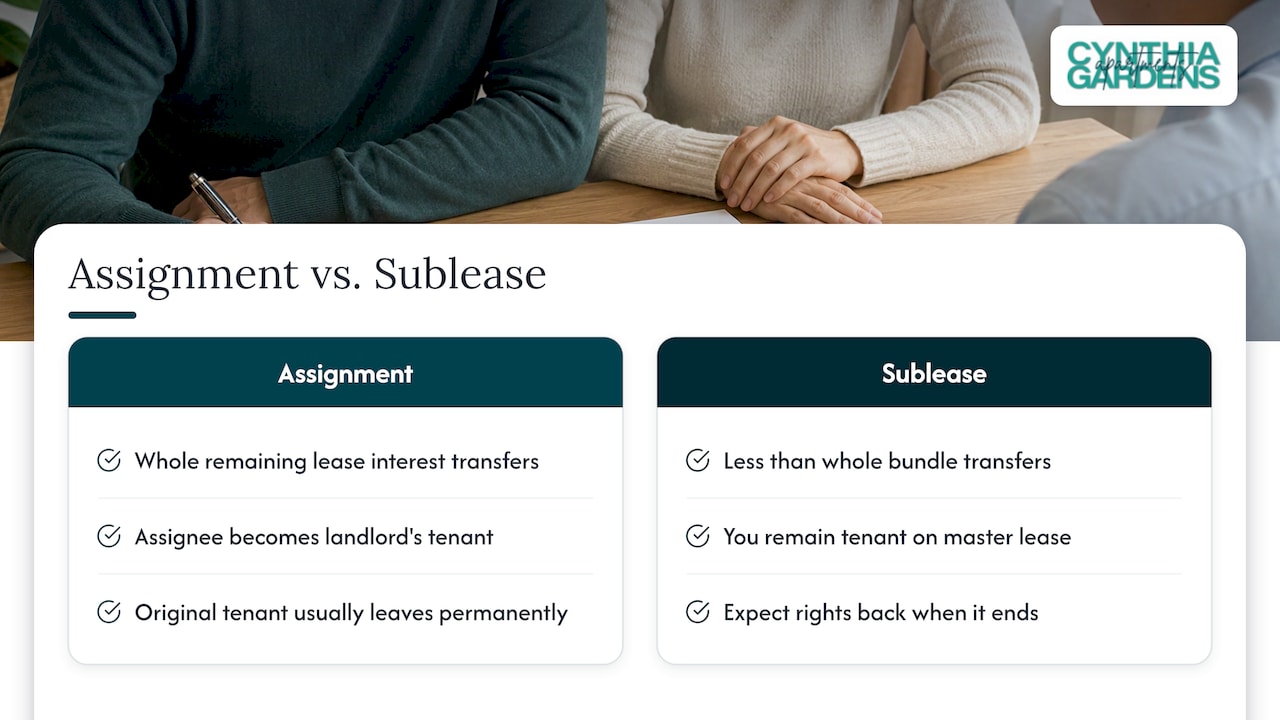
There is a second difference in who deals with whom. Justia’s overview of subleases and assignments explains that after an assignment, the assignee becomes the landlord’s tenant. After a sublease, you become the subtenant’s landlord under a separate arrangement, while you still answer to your own landlord.
Side-by-side comparison
| Question | Lease assignment | Sublet |
|---|---|---|
| What moves to the new person? | Your entire remaining lease interest | Part of the space or part of the term |
| Who is the new person’s landlord? | The building’s landlord | You |
| Are you still on the lease? | Depends on the landlord’s release (see below) | Yes, fully |
| Typical use | Permanent move, job relocation, graduation | Summer away, semester abroad, short assignment |
| Who collects rent? | Usually the landlord, from the new tenant | You collect it, then pay the landlord |
| Can you set the rent? | The lease terms carry over | You set the subtenant’s rent and term, within your lease limits |
| Landlord approval | Typically needed in writing | Typically needed in writing |
Other names for the same thing
Readers search this topic under several labels, and they overlap.
- Lease takeover and lease transfer normally describe an assignment: someone replaces you for the rest of the term.
- Sublease and sublet describe the same arrangement: you rent out to a subtenant while you stay on the lease.
- Assigning a lease is the action of doing the transfer.
The label you put on paper does not settle the question. Makris Legal notes that courts generally look at whether the tenant transferred the entire leasehold interest and what the parties intended, not only the word used. If you hand over everything for the entire remaining term, a document called a “sublease” can still be treated as an assignment. So write the document to match what you really intend.

Who is responsible if something goes wrong
This is the question that should drive your decision.
In a sublet, you carry the risk. Nolo states that if a subtenant fails to pay rent, damages the apartment or breaks lease rules, the landlord can hold the original tenant responsible and may go after the security deposit and any remaining balance. Your name is on the master lease, so your credit, your deposit and your rental history are exposed.
In an assignment, the picture is less clear-cut. The new tenant becomes the landlord’s tenant, but that does not automatically free you. Whether you are released depends on what the landlord agrees to and what the lease says. If you want a clean exit, ask for a written release from the landlord, not just a signed consent. Without a release, assume you may still be asked to answer for the lease.
Practical ways to lower your exposure either way:
- Screen the replacement the way a landlord would: income, ID, rental history and references.
- Collect a deposit if you are subletting, and decide in writing how it is held and returned.
- Document the unit’s condition with dated photos before the new person moves in.
- Keep every approval and signed copy in one folder.
Our guide to Florida move-out charges and the 15/30/15 rule shows how deposit claims are handled at the end of a tenancy, which helps when you decide how a subtenant’s deposit should work.
Do you need the landlord’s permission?
Almost always, yes. Nolo says most residential leases restrict or prohibit assigning or subletting without the landlord’s express written consent, and it advises reading your lease or rental agreement before you advertise the unit or let anyone move in.
What Florida adds
Florida’s residential landlord-tenant rules sit in Chapter 83, Part II of the Florida Statutes, which covers topics such as rent, deposits, maintenance duties, landlord access and termination procedures. A Florida-focused legal guide reports that these residential provisions do not specifically authorize or prohibit subleasing. In practice, that points you back to your lease: it may forbid subleasing, allow it only with prior written consent, or say nothing at all.
If you go ahead against a consent clause, you risk a lease violation. The same guide warns that an unauthorized sublease can expose the original tenant to eviction proceedings under Florida’s statutory notice process, and can put the subtenant’s home at risk because the subtenant’s rights depend on the original lease staying in force.
If you are unsure how your lease reads, a Florida landlord-tenant attorney or your local legal aid office can review it. Do that before you advertise, not after someone has paid you a deposit.
How to ask for consent
Where consent is required, the same guide recommends this order:
- Ask in writing.
- Include information about the proposed occupant.
- Wait for written approval.
- Only then sign anything or allow a move-in.
Expect the landlord to run the incoming person through the same screening as any applicant. Our page on Boca Raton lease application requirements shows what that screening typically involves at our community, and if the new tenant’s income is thin, our explainer on lease guarantor rules for Florida apartments covers a common fix.
When an assignment is the better choice
Choose an assignment when you are not coming back:
- You took a job in another city and the lease still has months to run.
- You are graduating and leaving the area.
- You are moving in with a partner and will not need the apartment again.
- You want your name off the lease as cleanly as the landlord will allow.
The benefit is simplicity. The incoming tenant deals directly with the landlord, there is one lease relationship rather than two, and you are not collecting rent and forwarding it each month. The condition is that the landlord must agree, ideally with a written release for you.
When a sublet is the better choice
Choose a sublet when your absence is temporary and you want the apartment back:
- A summer internship or study-abroad semester.
- A work assignment with a known end date.
- An extended family stay elsewhere.
- A roommate situation where you rent out one bedroom while you keep living there.
Here you keep control. You choose the subtenant, set the rent and term, and resume your tenancy afterward. The price is the continuing liability described above, plus the administrative work of collecting rent and handling issues. A sublease should not run past the end of your own lease, since your rights end then.
What to put in writing
For a Florida sublease, the legal guide above lists the details to cover: the parties, the premises, start and end dates, rent, how the deposit is handled, the terms of the master lease, any restrictions, and who pays utilities. It also recommends that everyone sign and date the document, keep signed copies, attach or incorporate the master lease, and give the final version to the landlord so the record is clear.
A simple checklist you can use:
- Names of everyone involved, including the landlord
- Address and unit number
- Start and end dates (never past your lease end)
- Monthly rent, due date and payment method
- Deposit amount, who holds it and when it is returned
- Utilities and who pays them
- Pet and guest rules carried over from the master lease
- Copy of the master lease attached
- Landlord’s written approval attached
For an assignment, use the same checklist, replace the end-date line with a statement that the new tenant takes over the remaining term, and add a line recording whether the landlord releases you.
Think about fees before you decide
Transfers rarely cost nothing. Landlords often charge screening or administrative fees for a replacement tenant, and a subtenant may pay you a deposit you must manage. Ask your landlord for a written list of any charges before you commit, so there are no surprises for you or the incoming person.
If you would rather end the lease than hand it off, read how to break an apartment lease in Florida. Sometimes a negotiated exit is simpler than finding a replacement, and it is worth comparing the two paths.
Our perspective
We see the same pattern every year: a tenant’s plans change, and they reach for the first option they have heard of. Most of the stress comes from skipping the paperwork, not from the choice itself.
Our view is simple. Decide first whether you are leaving or just stepping away. If you are leaving, an assignment with written landlord approval is the straightforward route. If you are stepping away, a sublet can work, but only when you accept that your name stays on the lease.
We built our community around transparent pricing and no hidden fees because surprises are what turn a normal move into a dispute. We apply the same thinking to tenants who need to change plans: ask early, put everything in writing, and talk to the leasing office before you advertise the unit. Our page on subletting Florida apartments explains how we approach the topic for residents.
If you are on the other side of the equation, the person who needs a one-bedroom quickly, a direct lease gives you your own clean agreement with the landlord, with your own terms from day one.
Ayman
Looking for your own lease in Boca Raton?
If you are the incoming person, a takeover or sublet is one way in, but it ties you to someone else’s dates and terms. A new lease gives you a fresh agreement in your own name.
At Cynthia Gardens, our one-bedroom apartments are published at $1,990 to $2,220 per month. Our published one-time fees are listed on our fees page: a non-refundable application fee of $75 per applicant, an administration fee of $300, and for cat owners a non-refundable pet fee of $300 to $500 per cat. We tell you this up front because we believe pricing should be clear before you apply. You can tour virtually and start the leasing process online.
Want to see what is available? Browse our one-bedroom apartments in Boca Raton and compare them with what a takeover would cost you.
A quick decision guide
Answer these in order:
- Will you live in the apartment again before the lease ends? If yes, think sublet. If no, think assignment.
- Does your lease allow either one? If it forbids both, ask the landlord about a negotiated exit instead.
- Can you afford to be liable if the new person fails? If not, push for an assignment with a written release, or consider a lease break.
- Is the lease nearly over? If only a few weeks remain, the paperwork may cost more effort than it saves.
- Do you have written approval? If not, stop and get it before anyone moves in.
Mistakes that cause disputes
- Advertising before reading the lease. A listing that violates a consent clause can start a problem you did not need.
- Relying on a verbal OK. Verbal approval is hard to prove. Ask for an email or letter.
- Letting the sublease outlast the lease. The subtenant’s rights end when yours do.
- Skipping the move-in condition record. Photos with dates protect both of you.
- Collecting cash with no receipt. Use a traceable payment method and keep a record.
- Assuming you are released after an assignment. Get that in writing.
FAQ
Is a lease takeover the same as a sublet?
No. In ordinary rental usage, a takeover describes an assignment: the new renter replaces you for the rest of the term. A sublet keeps you on the lease while someone else lives in the unit for a limited period.
Can I sublet or assign my apartment in Florida without my landlord’s approval?
Check your lease first. Florida’s residential statutes are reported not to specifically authorize or prohibit subleasing, so your lease usually controls. If it requires consent, proceeding without written approval can count as a lease violation, so get approval before anyone moves in.
If I sublet and my subtenant stops paying, who pays?
You may. Nolo explains that a landlord can hold the original tenant responsible for unpaid rent and damage caused by a subtenant, and may pursue the deposit and any remaining balance.
How long can a sublease last?
Not beyond the end of your own lease. The sublease depends on the master lease, so set the end date on or before your lease end date and attach the master lease to the agreement.
Which is easier to get approved?
That depends on your landlord and lease, so ask in writing. Many landlords prefer a clean replacement with one lease relationship, but you should confirm in writing how yours handles each option and whether it will release you.
Sources
- How to Sublet Your Rental: Rules, Consent, and Contracts (Nolo)
- Sublease v. Assignment (Makris Legal)
- Subleases and Assignments by Tenants (Justia)
- Florida Statutes, Chapter 83, Part II (Florida House of Representatives)
- Florida Sublease Agreement: Laws, Rules, and Requirements (LegalClarity)