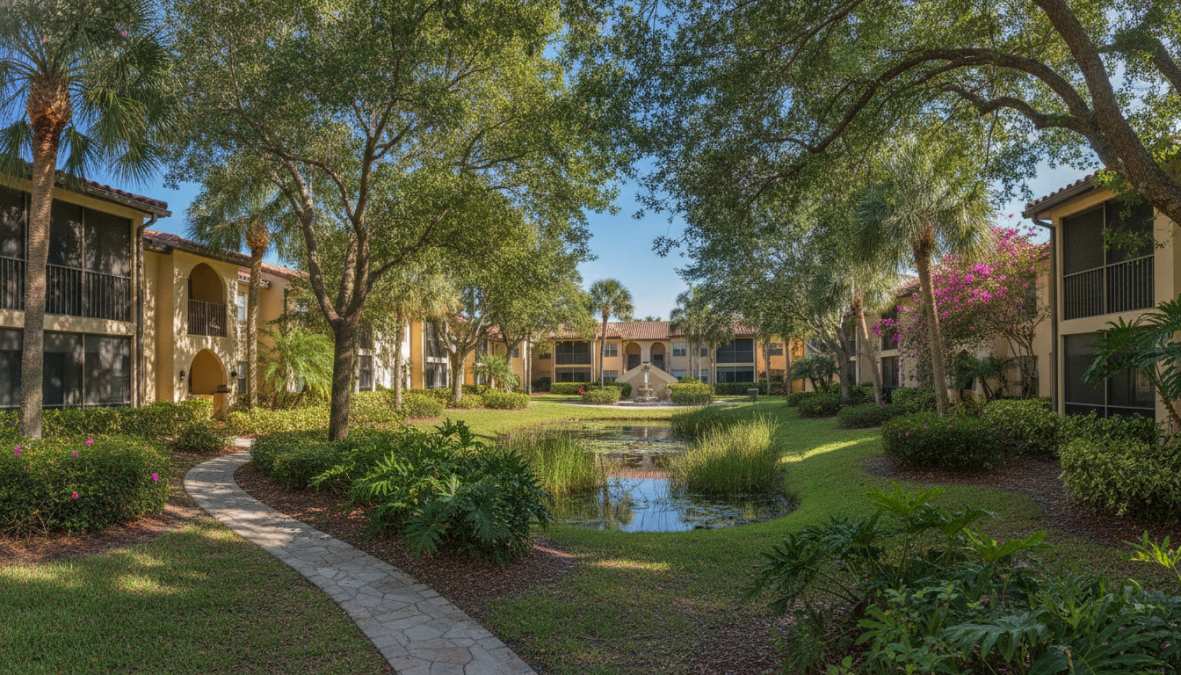
Cynthia Gardens is a residential apartment community in Boca Raton, Florida, offering quiet, garden-style living near Florida Atlantic University, Mizner Park, and Boca Raton’s beaches at 1675 NW 4th Ave, Boca Raton, FL 33432.
Table of Contents
- Why Finding a Quiet Rental Unit Is Harder Than It Looks
- How to Find Quiet Rental Units: Start with External Noise Factors
- Building Construction and Materials: What Actually Blocks Sound
- How to Check Apartment Noise Levels During a Viewing
- Unit Location Within the Building: Top Floor, Corner, and Floor Plan Choices
- Questions to Ask Your Landlord About Noise Before You Sign
- How to Find Quiet Rental Units When the Building Isn’t Perfect
- How to Soundproof a Rental Apartment Without Losing Your Deposit
Last Updated: June 8, 2026
Noise is one of the most underrated factors in renter satisfaction, and most people only discover how much it matters after signing a lease. Knowing how to find quiet rental units before you commit saves you from months of disrupted sleep and fractured focus. This guide from Cynthia Gardens covers every practical technique, from digital scouting to reading lease clauses that actually protect you, including tools most renters never think to use.
Here’s what most guides get wrong: they focus on what you can see during a single viewing, usually at 11am on a Tuesday when the building is at its quietest. The real test is what the unit sounds like at 7pm on a Friday, when neighbors are home and traffic peaks.
Why Finding a Quiet Rental Unit Is Harder Than It Looks
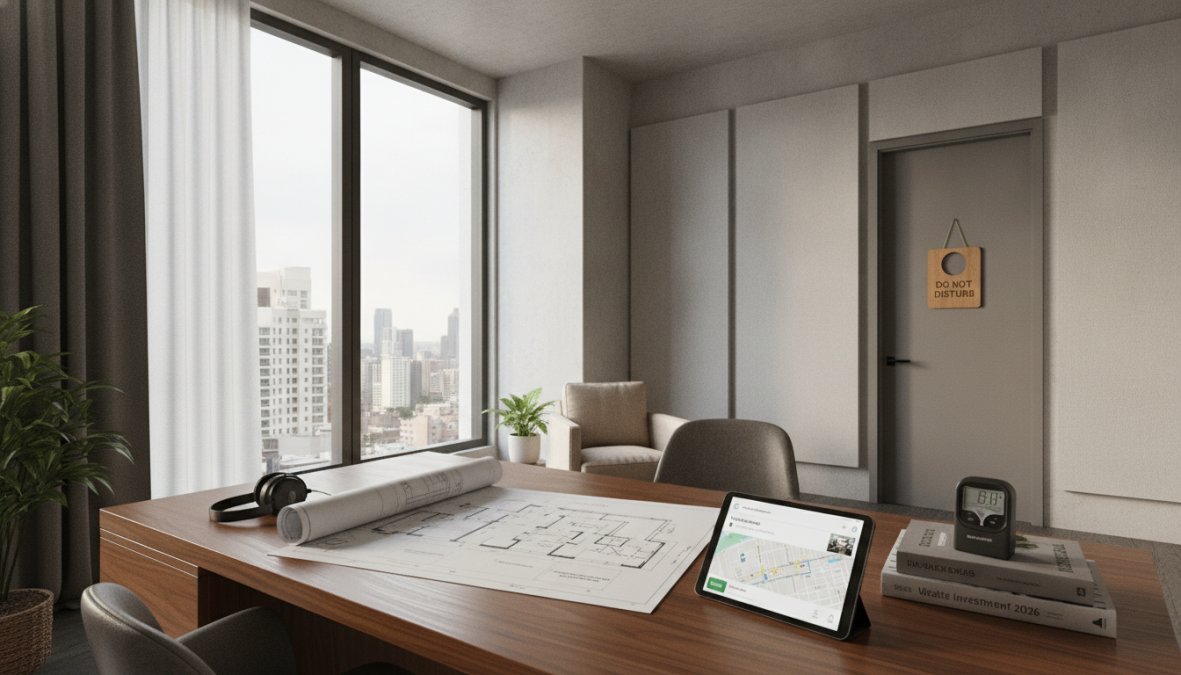
Sound insulation is invisible. Unlike a leaky faucet, noise pollution doesn’t announce itself during a standard walkthrough. A beautiful top-floor unit in a concrete building can still be acoustically miserable if it faces heavy traffic or sits beneath a rooftop HVAC system.
Landlords aren’t required to disclose noise conditions in most jurisdictions, and property management teams have every incentive to schedule showings during quiet hours. Renters relocating from another city often have no way to verify acoustic conditions before signing.
There are two distinct noise categories requiring different evaluation strategies:
- Airborne noise: Sound traveling through the air, voices, music, traffic. Controlled primarily by wall mass, window quality, and construction type.
- Impact noise: Sound transmitted through the structure itself, footsteps, dropped objects, mechanical vibrations. Harder to block and often the primary complaint in multi-story buildings.
A building with thick walls and double-paned windows may still transmit significant impact noise if its structure lacks proper acoustic decoupling between floors. Knowing what to listen for, and when, is the foundation of finding a genuinely quiet home.
How to Find Quiet Rental Units: Start with External Noise Factors
External noise factors are variables you can research before ever stepping inside. This is where most renters skip ahead too quickly.
Traffic, Flight Paths, and Urban Density
Street noise is the most persistent form of urban noise pollution. A unit one block from a major arterial road experiences meaningfully different sound levels than one two blocks away, and the difference compounds at night when ambient noise drops.
Flight paths are a factor many renters overlook entirely. According to FAA noise exposure mapping resources, residential areas near airports are classified by noise exposure levels that directly affect quality of life. Check whether an address falls within a flight corridor using publicly available flight tracking tools before committing.
Mixed-use zones combining retail, bars, and restaurants generate significantly more noise than purely residential zones. A ground-floor unit next to a late-night bar is a different acoustic environment than one in a quiet neighborhood, regardless of wall construction.
Digital Scouting Techniques Before You Ever Visit
Digital scouting is the single biggest gap in most renters’ search process. Start with satellite and street-level mapping to assess proximity to major roads, rail lines, commercial areas, and schools. Schools generate concentrated noise during arrival and dismissal windows that won’t be apparent during a midday viewing.
Next, check community forums and neighborhood review platforms, residents frequently discuss noise conditions with specificity no landlord will volunteer. Some municipalities also publish noise pollution maps showing decibel levels by block, which can confirm or contradict what a listing implies.
Use Google Street View to check the building at multiple times of day by toggling through historical imagery. [Look for](/what-to-look-for-in-rental-apartments/) bars, music venues, or 24-hour businesses within a one-block radius. A coffee shop is fine; a nightclub is not.
Building Construction and Materials: What Actually Blocks Sound
Building construction type is the single most predictive factor in acoustic privacy, and it’s something you can evaluate before visiting.
Concrete Frame vs. Wood Frame Buildings
Concrete frame buildings offer substantially better sound attenuation than wood frame construction. Density is the primary physical property that blocks airborne noise, and a poured concrete floor-ceiling assembly dramatically reduces both airborne and impact noise compared to a wood joist assembly with drywall.
Wood frame buildings dominate the suburban rental market and are inherently more acoustically transparent. This means the quality of additional soundproofing, insulation type, flooring material, ceiling treatment, becomes critical. Always ask what the building’s structural frame is made of. If the property management team doesn’t know, acoustic performance wasn’t a design priority.
STC Ratings, Double-Paned Windows, and Sound Attenuation
STC (Sound Transmission Class) measures how well a building assembly blocks airborne sound. An STC below 40 means normal speech is clearly audible through the wall; STC 50 or above means loud speech is barely audible. Most residential construction falls between STC 33 and 52. Ask the landlord if STC ratings are available, the fact that they can answer tells you something important.
Double-paned windows are the standard for blocking street noise. Single-pane windows facing a busy street are a problem no interior modification will fully solve.
| Construction Type | Sound Blocking | Impact Noise | Best For |
|---|---|---|---|
| Poured concrete frame | Excellent | Good | Urban high-rise, premium rentals |
| Concrete block (CMU) | Good | Moderate | Mid-rise, older buildings |
| Wood frame with insulation | Moderate | Poor | Suburban, garden-style |
| Wood frame, no insulation | Poor | Very poor | Older budget rentals |
How to Check Apartment Noise Levels During a Viewing
Checking apartment noise levels requires more than standing quietly for thirty seconds. It requires a structured approach that tests the unit under realistic conditions.
Visit at Different Times of Day
A single viewing at 10am on a weekday is almost meaningless as an acoustic test. The building is at its least populated and the communal dynamics that define the actual noise environment are absent.
Visit at least twice: once on a weekday evening between 6pm and 9pm, and once on a weekend afternoon. These windows capture neighbor noise, traffic peaks, and the actual sound character of the neighborhood. A landlord confident in their building’s acoustic quality will accommodate a second visit without hesitation.
Using Acoustic Testing Tools and Decibel Apps
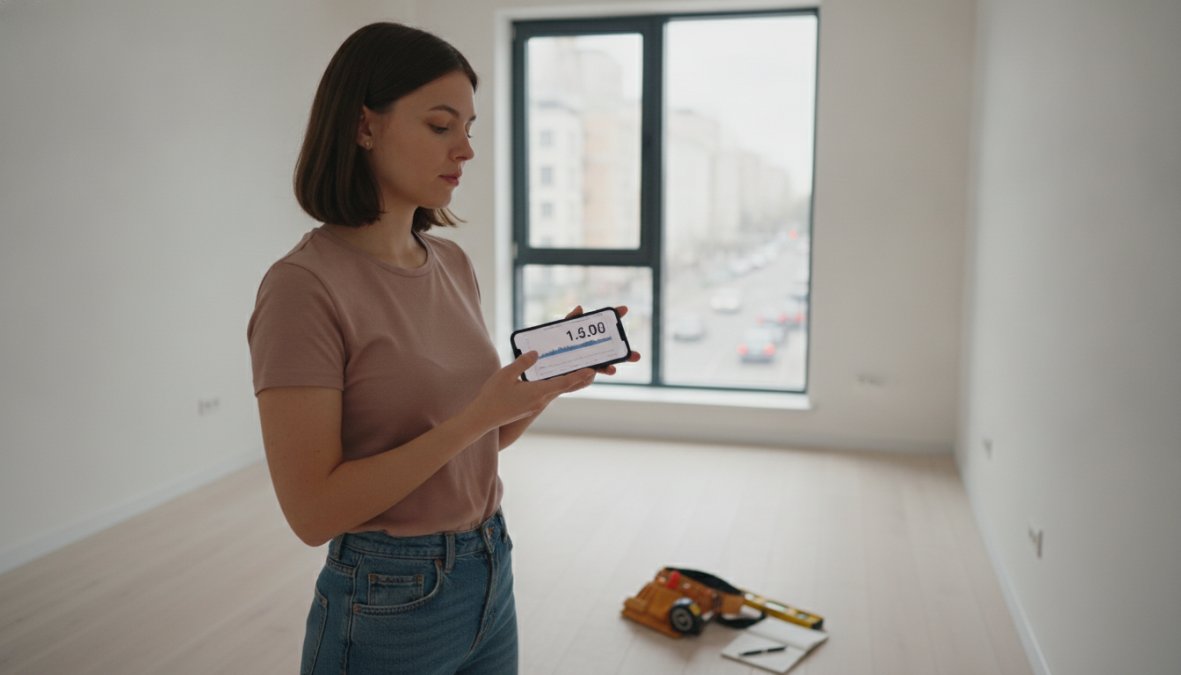
Free decibel meter apps on iOS and Android measure ambient sound levels in real time. According to EPA guidance on noise and its effects on health, indoor residential environments should stay below 45 decibels during the day and 35 decibels at night. Take readings near windows, at walls shared with neighbors, and near HVAC vents.
Do not rely solely on a quiet-hour reading. A unit measuring 38 decibels at 10am can easily register 55-60 decibels during evening hours. Take readings at multiple points and note the range, not just the average.
Unit Location Within the Building: Top Floor, Corner, and Floor Plan Choices
Unit position has a direct, predictable effect on noise exposure, and you can evaluate it from a floor plan before visiting.
Top floor units eliminate the most common complaint in multi-unit buildings: impact noise from upstairs neighbors. Footsteps, furniture dragging, and dropped objects are entirely absent when there’s no floor above you. Corner units reduce shared walls with neighbors, and exterior walls provide far better attenuation than party walls.
Floor plan layout matters too. Bedrooms positioned away from the street, adjacent to closets rather than shared walls, and separated from laundry rooms or elevator shafts will be substantially quieter. Ask to see the full floor plan and understand what’s on the other side of every wall, that’s basic acoustic due diligence.
Questions to Ask Your Landlord About Noise Before You Sign
Most renters don’t ask enough questions, and landlords rarely volunteer unflattering information.
Quiet Hours Policies and Property Management Rules
Ask specifically: what are the quiet hours, how are they enforced, and what is the complaint process? A building with clearly defined quiet hours and a documented enforcement process is a different acoustic environment than one where policy exists on paper but is never acted on. Ask to see the quiet hours policy in writing before signing.
Also ask about amenity locations. A unit near the pool, gym, or common room will experience noise from those spaces during peak hours.
Lease Agreement Clauses That Protect You From Noise
According to tenant rights resources from HUD, renters have legal recourse in many states when a landlord fails to maintain a habitable environment, which in some jurisdictions includes unreasonable noise conditions. Look for these specific elements in any lease:
- Quiet hours policy referenced or attached as an addendum
- Landlord’s obligation to enforce community rules against noise
- Lease termination or rent reduction provisions if habitability is compromised
- Prohibition on modifications that reduce sound insulation (e.g., removing carpet)
- Rules governing noise-generating amenities and their operating hours
If the lease is silent on noise, ask whether an addendum can be added specifying quiet hours and enforcement obligations. A landlord who refuses to put noise policies in writing is telling you something important.
How to Find Quiet Rental Units When the Building Isn’t Perfect
Perfect acoustic conditions are rare in competitive rental markets. The more useful skill is evaluating which imperfections are manageable and which are dealbreakers.
Traffic noise from a moderate street is often manageable with double-paned windows and white noise. A unit above a bar with music until 2am is not. The framework: assess whether the noise source is external or internal, continuous or intermittent, and structural or behavioral. External, intermittent, behavioral noise is manageable. Internal, continuous, structural noise is not.
When a building isn’t acoustically ideal, ask whether the noise source is something you can mitigate or something baked into the construction. Behavioral noise can be managed; structural noise cannot.
For renters in Boca Raton, the local market includes older wood frame garden-style communities and newer concrete construction. Proximity to Glades Road or I-95 adds meaningful traffic noise, and neighborhoods near FAU can experience elevated noise during the academic year.
How to Soundproof a Rental Apartment Without Losing Your Deposit
Soundproofing a rental is possible within real constraints. Focus on reversible modifications that can be removed at move-out:
- Heavy curtains and drapes: Dense, floor-to-ceiling curtains add meaningful attenuation at windows without permanent modification.
- Area rugs with thick underlays: In wood frame buildings, rugs with dense underlays reduce impact noise transmission and absorb reflected sound.
- Door sweeps and weatherstripping: Sound travels through gaps. A door sweep on the entry door and weatherstripping on interior doors reduce airborne noise transmission at minimal cost.
- Furniture placement: Bookshelves filled with books against a party wall add mass and absorption, a meaningful acoustic improvement.
White Noise Generators and Acoustic Panels
White noise generators are the most underrated tool in a renter’s acoustic toolkit. A white noise machine doesn’t block sound; it masks it by raising the ambient noise floor so intrusive sounds become less perceptible. For light sleepers or anyone working from home, a quality machine near the bedroom door can transform a moderately noisy unit into a functional environment.
Acoustic panels absorb reflected sound within the room and can often be mounted with removable adhesive strips, confirm this with your landlord before installation. As documented in National Apartment Association resources on building quality, building design and construction quality remain the most reliable predictors of long-term resident satisfaction, making tenant-side interventions a supplement, not a substitute, for choosing the right building.
Noise is a quality-of-life issue that compounds over time, and most renters discover they’ve made the wrong choice only after the lease is signed. Cynthia Gardens offers a garden-style community in Boca Raton designed around peaceful, private living: modern one-bedroom apartments with thoughtful construction, lush landscaped grounds that buffer external noise, and a serene resort-style pool setting. If you’re searching for a quiet rental near FAU and the beach, schedule a tour today and experience the difference a well-designed community makes.
Frequently Asked Questions
How can I tell if an apartment will be noisy before moving in?
To check apartment noise levels before committing, visit at multiple times of day, morning, evening, and on weekends. Use a free decibel meter app on your smartphone to measure ambient sound levels inside the unit. Look for double-paned windows, concrete frame construction, and a top floor or corner unit location, all of which reduce noise transmission. Also check proximity to traffic corridors, bars, schools, and flight paths using online mapping tools during your digital scouting phase.
What are the best questions to ask a landlord about noise?
When asking your landlord about noise, cover these key areas: Does the building have enforced quiet hours? What is the construction type, concrete or wood frame? Are there noise complaints on record from current tenants? What is the policy for neighbor noise violations? Does the lease agreement include any sound-related clauses or remedies? These questions to ask your landlord about noise help you assess both the physical soundproofing of the building and the property management's commitment to a peaceful environment.
Are top-floor apartments always quieter?
Top floor units eliminate impact noise from upstairs neighbors, which is one of the most disruptive forms of noise in communal living. However, they are not automatically quieter overall. Roof mechanical systems, HVAC units, and proximity to rooftop amenities can introduce new noise sources. A top floor unit in a concrete frame building with good sound attenuation will generally offer the best acoustic privacy, but unit location alone is not a guarantee, building construction quality matters just as much.
How do I soundproof a rental apartment without violating my lease?
You can soundproof a rental apartment without permanent modifications by using white noise generators to mask airborne noise, placing thick rugs on hard floors to reduce impact noise transmission, adding heavy curtains over windows, and installing removable acoustic panels on walls with adhesive strips. Door draft stoppers also reduce sound leakage under entry and interior doors. Always review your lease agreement before making any changes, and choose products specifically marketed as removable or renter-friendly to avoid deposit disputes.
What building features should I look for when searching for a quiet apartment?
When learning how to find quiet rental units, prioritize buildings with concrete frame construction over wood frame, as concrete significantly reduces both airborne noise and impact noise between units. Look for double-paned windows, high STC ratings in the building's specs, and units positioned away from street-facing facades. Garden-style communities with low-density layouts and landscaped buffers also tend to offer better acoustic privacy than high-rise urban buildings in dense residential zoning areas.