
TL;DR:
- Voice assistance in leasing uses AI-powered voice agents to handle routine tenant inquiries, schedule tours, and triage maintenance requests automatically. By enabling 24/7 response and qualifying prospects in real-time, voice AI significantly improves lead conversion rates and streamlines leasing workflows. Successful deployment begins with narrow pilot programs, proper integration, and strict compliance, ultimately enhancing efficiency without replacing human agents.
Voice assistance in leasing is defined as AI-powered technology that acts as an always-available digital leasing agent, handling routine tenant inquiries, scheduling tours, and triaging maintenance requests without human intervention. The role of voice assistance in leasing has shifted from experimental to operational in 2026, with platforms like EliseAI and Voice.ai now deployed across thousands of multifamily units. Voice AI agents handle 60–80% of routine leasing inquiries in production environments, which means your human team spends less time answering the same five questions and more time closing leases. For property managers looking to reduce missed calls, accelerate lead conversion, and scale communication without adding headcount, voice-assisted leasing is the most direct path forward.
How does voice assistance improve lead conversion and tenant engagement?
Speed is the single biggest variable in residential leasing conversion. Without instant response mechanisms, property managers lose 60% of inbound leads, and 85% of prospects never leave a voicemail. That means the majority of your marketing spend evaporates the moment a call goes unanswered after hours or during peak volume.
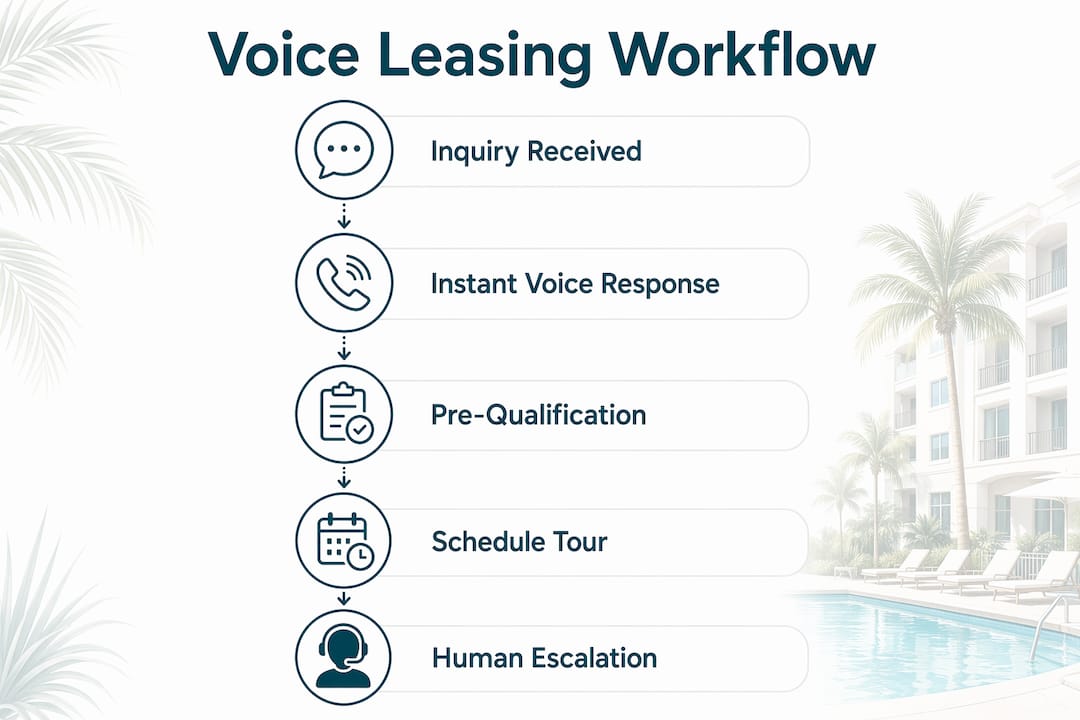
Voice AI eliminates that gap entirely. A prospect calls at 11 p.m. asking about pet policies and one-bedroom availability. The AI answers in real time, qualifies the lead by asking about move-in timeline, income range, and credit history, then books a tour before the call ends. Conversion rates improve 2 to 3 times when inquiry-to-tour scheduling is automated this way. That is not a marginal gain. It is a structural change in how your leasing pipeline performs.
The human agent’s role shifts as a result. Qualified prospects engage in leasing conversations lasting 6 to 8 minutes, and those are the interactions where rapport, negotiation, and deal-closing happen. When voice AI filters and qualifies inbound volume, your leasing team arrives at those conversations already briefed and ready to close.
- Voice AI qualifies prospects on income, credit, pet ownership, and move-in readiness before any human involvement
- Tour scheduling and confirmation messages are sent automatically within the same call
- After-hours coverage means no lead falls through due to time zone or staffing gaps
- Human agents receive pre-qualified handoffs, reducing time spent on low-probability inquiries
Pro Tip: Set your voice AI to ask the three questions that disqualify the most prospects first. Income verification, move-in date, and pet policy are the fastest filters. This keeps human escalation focused on genuinely qualified leads.
Speed-to-response is the key driver in residential leasing lead conversion, and conversion rates drop sharply if outreach is delayed beyond five minutes. Voice AI removes that delay entirely, which is why early adopters report measurable improvements in lease-up speed within the first 90 days of deployment.
What tasks and leasing workflows can voice assistants automate effectively?
Voice-enabled leasing solutions cover a wider range of workflows than most property managers initially expect. The technology is not limited to answering availability questions. It handles the full communication arc from first inquiry through move-in coordination.
Here are the core workflows where voice AI delivers consistent operational value:
- Availability and pricing inquiries. The AI pulls real-time data from your Property Management System (PMS) and answers unit-specific questions about square footage, pricing, and availability without any human involvement.
- Tour scheduling and reminders. Prospects book tours during the call. Automated confirmations and 24-hour reminders reduce no-show rates, which typically run 30 to 40% without follow-up.
- Maintenance request intake. The AI collects issue details, assigns urgency levels, and creates work orders directly in your maintenance system. A 5,000-unit multifamily operator reported that voice AI handled 70% of after-hours maintenance calls, which freed on-call staff for genuine emergencies.
- Lease renewal outreach. Automated calls notify residents of upcoming renewal windows, collect intent to renew, and escalate to a human agent when a resident signals hesitation or requests a rate negotiation.
- Rent reminders and payment plan intake. The AI sends proactive reminders before due dates and can collect payment plan requests, routing them to your accounting team with full call notes attached.
- Move-in and move-out coordination. Checklists, key pickup instructions, and utility transfer reminders are delivered automatically at the right point in the resident lifecycle.
| Workflow | Automation Level | Human Escalation Trigger |
|---|---|---|
| Availability and pricing FAQs | Fully automated | Unusual pricing requests |
| Tour scheduling | Fully automated | Prospect requests in-person agent |
| Maintenance intake | Automated triage | Emergency or safety issues |
| Lease renewal outreach | Automated first contact | Resident signals intent to leave |
| Rent reminders | Fully automated | Payment dispute or hardship claim |
Pro Tip: Start with maintenance intake and pre-lease inquiries as your first two automation targets. These are the highest-volume, most repetitive call types in any portfolio, and they produce the fastest measurable ROI.
The online leasing benefits that property managers in Boca Raton are seeing in 2026 align directly with these automation gains. Fewer manual touchpoints mean faster cycle times and fewer errors in the leasing pipeline.
How to successfully implement voice-assisted leasing in your property portfolio
Deployment quality determines whether voice AI becomes an asset or a liability. The most common mistake is launching with a vague mandate to “add AI” across all communication channels at once. Successful AI voice deployments start with narrowly defined, high-volume tasks and expand only after measuring results in those segments.
Here is what a sound implementation looks like in practice:
- Pilot on two workflows first. Maintenance intake and pre-lease inquiries are the right starting point. Both are high-volume, low-complexity, and easy to measure. Run the pilot for 60 days before expanding.
- Integrate with your PMS and CRM before launch. PMS integration is essential for the AI to provide accurate, real-time unit availability, pricing, and policy information. An AI that gives outdated pricing destroys prospect trust faster than no AI at all.
- Build explicit human escalation paths. Human escalation workflows are critical success factors in every deployment. Define exactly which call types trigger a live transfer: fair housing complaints, accommodation requests, lease disputes, and any caller who explicitly asks for a human.
- Address compliance from day one. Fair housing compliance, recording consent, and escalation workflows are mandatory when automating leasing communication. Work with legal counsel to review your AI scripts before going live.
- Monitor and adjust continuously. Track call completion rates, escalation frequency, and prospect satisfaction scores weekly during the first quarter. Adjust scripts based on the questions the AI handles poorly.
The integration quality between AI voice systems and PMS databases is the single factor that most determines whether prospects leave a call satisfied or frustrated. Treat integration as a core project requirement, not an afterthought.
Pro Tip: Record and review 20 AI-handled calls per week during your first 90 days. Patterns in failed or escalated calls will tell you exactly which scripts need revision and which workflows are ready to scale.

Voice assistance vs. traditional call centers and human agents
Understanding where voice AI outperforms traditional models and where it falls short helps you make a smarter investment decision.
Cost per unit decreases from $4 to $8 per unit for 20-unit properties to $1 to $3 per unit for 2,000-plus unit portfolios when voice AI replaces or supplements answering services. That cost curve is the opposite of human call center staffing, where adding units means adding headcount in a near-linear relationship.
Where voice AI wins:
- 24/7 availability with zero overtime cost
- Consistent script adherence across every call
- Simultaneous handling of unlimited concurrent calls during peak periods
- No fatigue, no sick days, no turnover
Where human agents remain irreplaceable:
- Complex lease negotiations requiring judgment and flexibility
- Sensitive conversations involving eviction, domestic situations, or accommodation requests
- Relationship-building with long-term residents who expect personal recognition
- Closing deals with hesitant prospects who need emotional reassurance
The most effective model in 2026 is not voice AI versus human agents. It is voice AI handling the commodity conversations so human agents can focus entirely on the 6 to 8 minute high-value interactions that actually close leases. Think of voice AI as a digital front desk that filters, qualifies, and routes. Your human team handles everything that requires genuine judgment.
The virtual leasing advantages that forward-thinking property managers are building in 2025 and 2026 depend on this division of labor. Technology handles volume. People handle relationships.
Key takeaways
Voice assistance in leasing delivers measurable ROI when deployed on high-volume workflows, integrated with live PMS data, and supported by clear human escalation paths.
| Point | Details |
|---|---|
| Lead retention depends on speed | 60% of inbound leads are lost without instant response, making voice AI a direct revenue protection tool. |
| Automate volume, not relationships | Voice AI handles availability, scheduling, and maintenance intake while humans close leases and manage disputes. |
| PMS integration is non-negotiable | AI accuracy depends entirely on real-time data from your Property Management System. |
| Start narrow, then scale | Pilot on maintenance intake and pre-lease inquiries before expanding to renewal outreach or payment workflows. |
| Compliance must be built in from day one | Fair housing rules, recording consent, and escalation triggers must be embedded in every AI script before launch. |
What I’ve learned from watching voice AI enter the leasing industry
The property managers who get the most from voice AI are not the ones who deploy it fastest. They are the ones who define the problem before they buy the solution. I have seen teams spend months configuring a voice AI platform only to realize their PMS integration was not ready, which meant the AI was giving prospects stale pricing and wrong availability. The technology worked perfectly. The data feeding it did not.
The other pattern I keep seeing is the temptation to remove human escalation paths to reduce cost. That is a short-term calculation with long-term consequences. A tenant calling about a mold complaint or a fair housing accommodation does not want to be looped in an AI workflow. One bad experience in that category can generate a complaint that costs far more than the staffing savings.
What actually works is treating voice AI the way you would treat a new leasing associate. You would not hand a new hire the keys on day one and walk away. You would train them on specific tasks, monitor their calls, and expand their responsibilities as they prove competency. The same logic applies here. The leasing workflow improvements that produce real results come from disciplined rollouts, not ambitious ones.
The property managers reporting the strongest outcomes in 2026 are those who started with two workflows, measured everything, and scaled deliberately. That approach is less exciting than a full deployment announcement. It is also the one that actually works.
— Ayman
How Cynthiagardens uses voice assistance in Boca Raton
Cynthiagardens integrates voice-assisted leasing technology directly into its apartment community in Boca Raton, Florida, giving prospects instant answers on pricing, availability, and pet policies at any hour. The community pairs voice assistance with AI chat support, virtual apartment tours, and an interactive property map so that every step of the leasing process moves at the prospect’s pace.
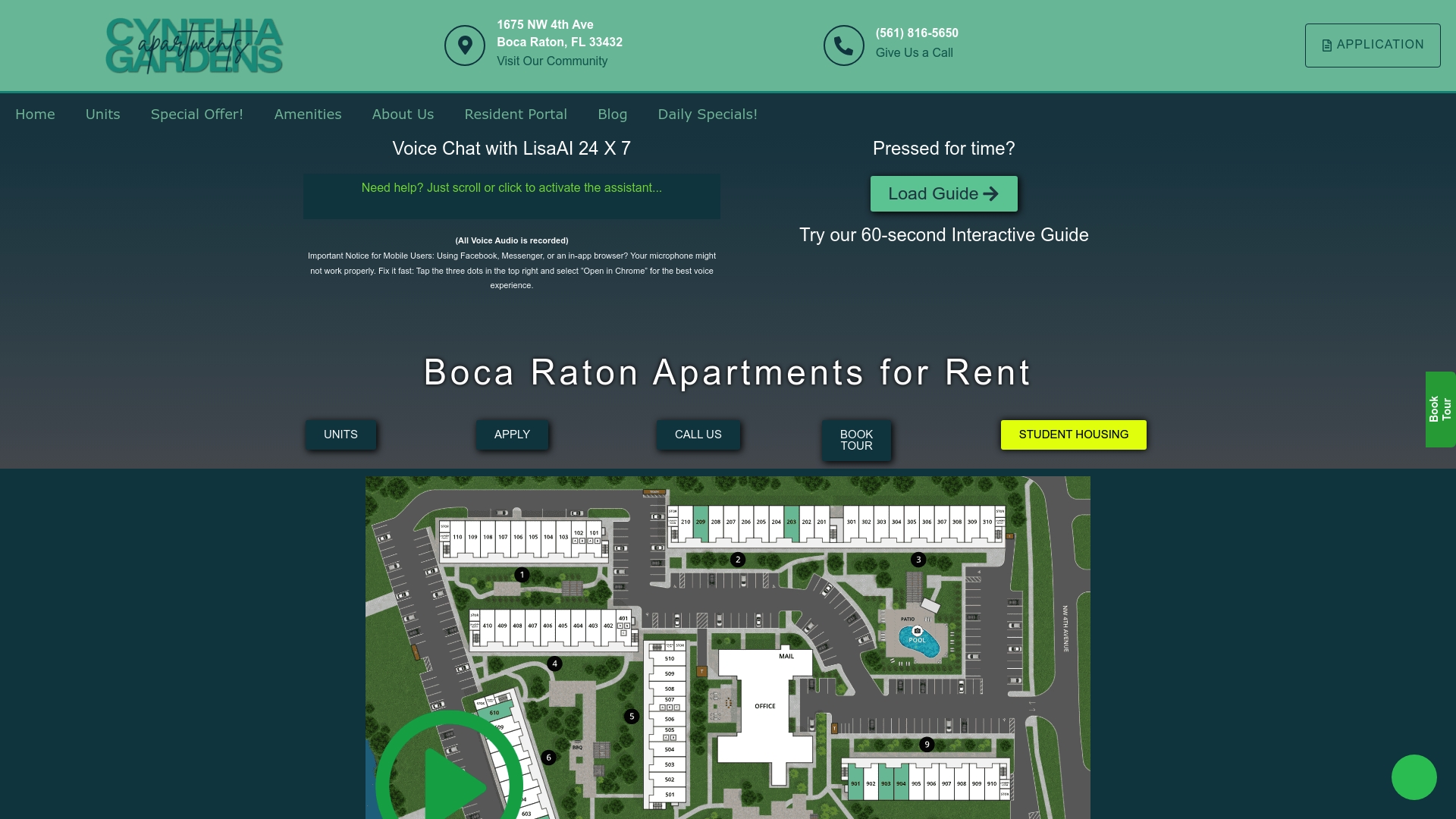
If you are a leasing professional looking to see how these tools work in practice, explore the apartment styles and features at Cynthiagardens to understand how a tech-forward community presents its units to prospects. Transparent pricing, no hidden fees, and a fully digital leasing path make Cynthiagardens a working example of what modern voice-enabled leasing looks like for one-bedroom apartments in South Florida.
FAQ
What is voice-assisted leasing?
Voice-assisted leasing is the use of AI-powered voice agents to handle tenant inquiries, schedule tours, and manage maintenance requests automatically. These systems operate 24/7 and integrate with Property Management Systems to provide accurate, real-time responses.
How much of leasing communication can voice AI handle?
Voice AI agents handle 60 to 80% of routine leasing inquiries in production environments as of 2026. The remaining calls, those involving complex negotiations or sensitive situations, are escalated to human agents.
Does voice AI replace human leasing agents?
Voice AI does not replace human leasing agents. It handles high-volume, repetitive calls so human agents can focus on qualified prospects and relationship-intensive conversations that typically run 6 to 8 minutes.
What are the compliance requirements for AI voice in leasing?
Fair housing compliance, recording consent, and explicit human escalation workflows are mandatory for any AI voice deployment in leasing. Legal review of AI scripts before launch is a required step, not optional.
How long does it take to see ROI from voice-assisted leasing?
Property managers who pilot voice AI on maintenance intake and pre-lease inquiries typically report measurable improvements in call resolution rates and lead conversion within the first 60 to 90 days of deployment.