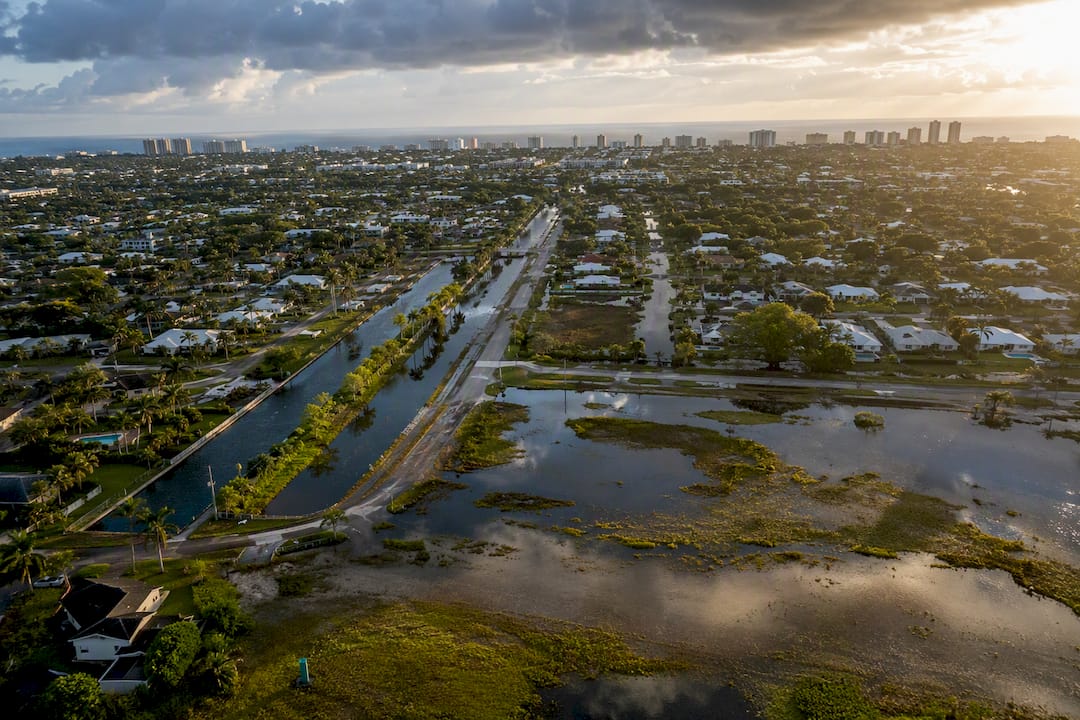
A large share of Boca Raton sits inside FEMA-designated Special Flood Hazard Areas, and the maps that define those boundaries changed on December 20, 2024. If you own, rent, or plan to buy here, check your exact address on the FEMA Flood Map Service Center or the City’s flood zone lookup before you assume anything based on your neighbor’s zone or last year’s paperwork.
TL;DR:
- The December 2024 FEMA flood map updates increased Base Flood Elevations for thousands of parcels in Boca Raton, affecting insurance and construction requirements.
- Flood zone designations can vary within a single parcel, making precise property assessment essential before buying, insuring, or renovating.
- Elevation Certificates and LOMA applications can help reduce flood risk and eliminate mandatory insurance if the structure is above the BFE.
- Flood risk and zone changes are driven by ongoing data updates and sea level rise, so current zone designations are not guaranteed long-term indicators of risk.
- Renters can inquire about local flood elevation and emergency plans, but cannot order certificates or change zone designations themselves.
Table of Contents
- How to Check Your Flood Zone in Boca Raton by Address
- What the December 2024 FIRM Update Changed for Boca Raton
- Insurance Costs, Elevation Certificates, and Boca Raton’s CRS Discount
- Fixing a Bad Flood Zone Designation or Lowering Your Risk
- Who to Call: Boca Raton’s Flood Resources and Contacts
- How Past Flooding Shaped Boca Raton’s Current Flood Maps
- What Rising Seas Mean for Future Boca Raton Flood Maps
- Renting Smart When You’re Watching Flood Risk
- Tour Cynthia Gardens Before You Decide Where to Live
- Sources
How to Check Your Flood Zone in Boca Raton by Address
Flood zone letters (X, AE, VE, AH) look interchangeable until you realize they trigger completely different insurance and building rules. Here is the actual process, in order.
- Start at the FEMA Flood Map Service Center. Go to Msc, type in the property address, and pull up the “FEMA Flood Zone” designation along with the “Current BFE” (Base Flood Elevation). You can download the full FIRM panel as a PDF if you need it for a mortgage or permit application.
- Cross-check with the City of Boca Raton’s lookup. The city’s “Know Your Flood Zone” portal links directly to current FIRM maps and adds local context FEMA’s national tool doesn’t, plus contact info for the city’s floodplain staff.
- Use Palm Beach County’s interactive map for the fine print. The county tool shows pending BFEs and LiMWA (Limit of Moderate Wave Action) lines that don’t always show up cleanly on the national viewer, and it’s the best place to spot a split parcel.
Split parcels trip up more buyers than any other flood issue in this city. A single lot can have part of it in a Special Flood Hazard Area and part outside it, which means the flood zone that applies to your actual structure depends on exactly where that building sits on the lot, not just the address.
Before you start any of this, gather:
- The full street address and parcel ID number
- Any existing Elevation Certificate or recent survey
- Your current insurance policy, if you have one, to compare zones
What the December 2024 FIRM Update Changed for Boca Raton
FEMA doesn’t update flood maps on a whim. The agency issues a Letter of Final Determination roughly six months before a new map becomes legally effective, giving communities time to adopt updated floodplain ordinances. For Boca Raton and much of Palm Beach County, that new map became effective on December 20, 2024.
The practical shift was in the numbers, not just the lines. County officials reported that thousands of parcels saw Base Flood Elevation increases, many by a foot or more. A one-foot BFE bump sounds small until it changes what your lender requires or what your renovation permit allows.
Here’s what that actually means on the ground:
- Lenders on federally backed mortgages may now require flood insurance where they didn’t before, if your parcel moved into or stayed in an SFHA.
- Renovation and rebuild rules can tighten, since substantial improvements to a structure in a higher-BFE zone often must meet the new elevation standard.
- Lowest-floor elevation requirements for new construction or major remodels may now sit higher than they did under the old map.
If you’re mid-contract on a purchase, don’t wait for your lender to flag this. Confirm the parcel’s current zone and BFE before closing, not after.
Insurance Costs, Elevation Certificates, and Boca Raton’s CRS Discount
Flood insurance through the National Flood Insurance Program is mandatory in one specific case: you have a federally backed or federally regulated mortgage and your property sits in an SFHA. Outside that trigger, coverage is voluntary, but that doesn’t mean it’s optional in any practical sense.
Even homes labeled Zone X aren’t risk-free. Properties outside the mapped high-risk zones still face exposure to rarer, larger flood events, and premiums in those zones tend to be modest relative to what a flooded first floor actually costs to repair.
An Elevation Certificate is the document that determines whether your premium reflects your building’s real elevation or a conservative default estimate. Older homes without one on file often get quoted at higher rates simply because the insurer has no proof of how high the lowest floor actually sits.
Boca Raton also participates in FEMA’s Community Rating System, a program that rewards cities for floodplain management practices that go beyond the federal minimum.
Before you shop for a quote:
- Ask the seller or city building department whether an Elevation Certificate already exists for the property.
- Have your parcel’s current zone and BFE ready. Insurers and lenders will ask for both.
- Get quotes early. Zone changes from the 2024 update can shift pricing enough to affect a purchase decision.
Fixing a Bad Flood Zone Designation or Lowering Your Risk
If you believe your property is mapped incorrectly, or you want to reduce your actual exposure, you have real options beyond just paying whatever premium you’re quoted.
- Apply for a LOMA or LOMC if your structure sits above the BFE. A Letter of Map Amendment or Letter of Map Change can formally remove a property from the SFHA when survey data shows it qualifies, which can eliminate the mandatory insurance requirement entirely.
- Get an Elevation Certificate if you don’t have one. A licensed surveyor documents your lowest floor’s exact elevation relative to the BFE. This single document is often the difference between a default premium and an accurate one.
- Tackle physical mitigation. Elevating utilities and mechanical equipment, installing flood vents in enclosed lower areas, and regrading for better drainage are the standard moves, and most of them require a city permit.
- Bring in a surveyor or engineer for anything contested. Split parcels, disputed BFEs, or major renovations are not do-it-yourself situations.
Pro Tip: Order the Elevation Certificate before you list a property for sale, not after an offer comes in. A current certificate in hand speeds up underwriting and often becomes a selling point on its own.
Who to Call: Boca Raton’s Flood Resources and Contacts
You don’t need to guess your way through this. Three offices handle nearly every question that comes up.
- City of Boca Raton Floodplain Manager: reachable through the city’s Floodplain Management page for permit questions and local ordinance details.
- Palm Beach County Flood Zone Hotline: 561-233-5374, or email floodzone@pbc.gov, for parcel-specific questions and site visit requests.
- FEMA Flood Map Service Center: Msc for official map downloads and the starting point for any LOMA/LOMC application.
- Local building permit office: check here first for whether an Elevation Certificate already exists on file for your address.
How Past Flooding Shaped Boca Raton’s Current Flood Maps
Flood zone lines aren’t drawn from theory. They’re drawn from what water has actually done to a given piece of ground, tracked over decades of storm data, tidal records, and drainage studies. South Florida’s history of tropical storms and seasonal heavy rain events is exactly why so much of Boca Raton carries an SFHA designation in the first place, rather than a handful of dramatic headline floods.
Boca Raton’s low, flat topography compounds the problem. The city’s average elevation runs around 13 feet above sea level, but that average hides enormous local variation, from spots barely above sea level near canals and waterways to pockets well above 30 feet. FEMA’s flood modeling accounts for that variation parcel by parcel, which is exactly why two houses on the same street can carry different zone designations.
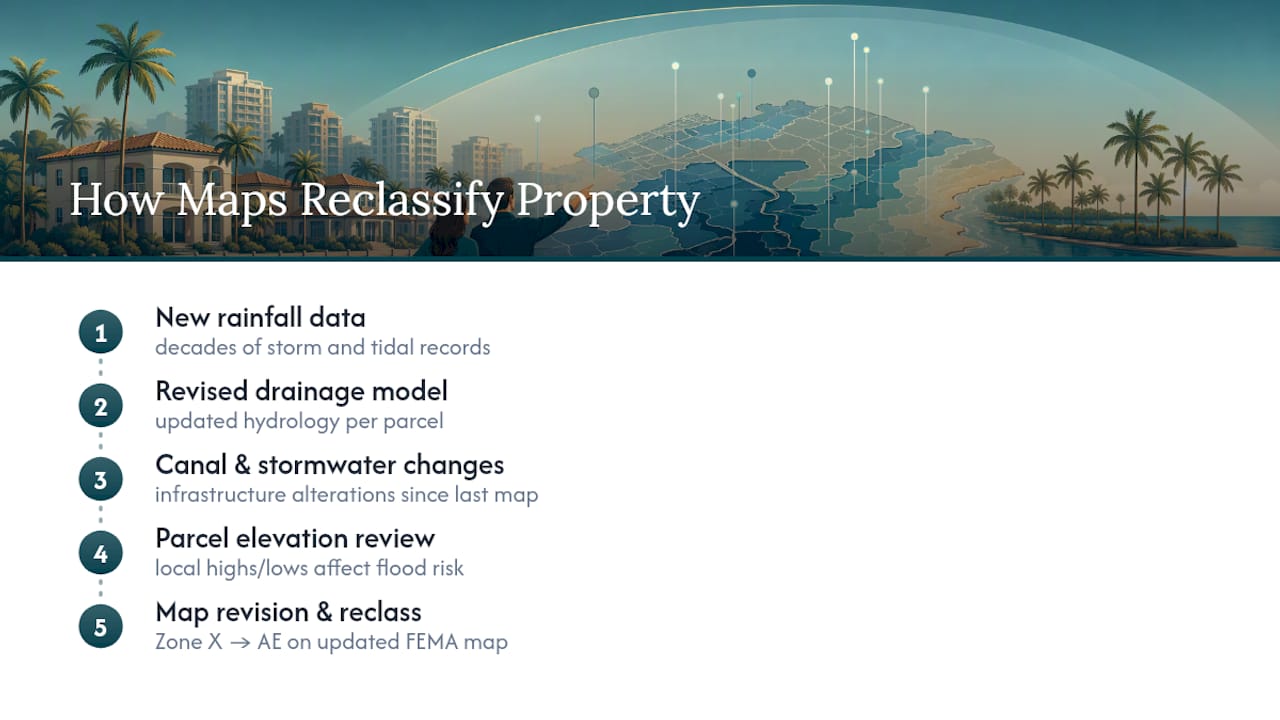
Every major mapping revision, including the one that took effect in December 2024, folds in updated rainfall data, revised drainage modeling, and changes to canal and stormwater infrastructure since the last map was drawn. That’s part of why zones shift over time even without a single named storm causing the change. A property that sat comfortably in Zone X a decade ago can move into an AE zone once the underlying hydrology data catches up. The lesson for owners is straightforward: your flood zone is not a permanent fact about your land. It’s a snapshot based on the best available data at the time of the last update, and it will keep being revised as that data improves.
What Rising Seas Mean for Future Boca Raton Flood Maps
Sea level rise doesn’t show up on today’s flood map, but it’s already shaping the next one. FEMA’s mapping process incorporates historical tidal and rainfall data, which means every future remapping cycle will reflect whatever sea level trend has occurred since the last update, not a forecast of what’s coming.
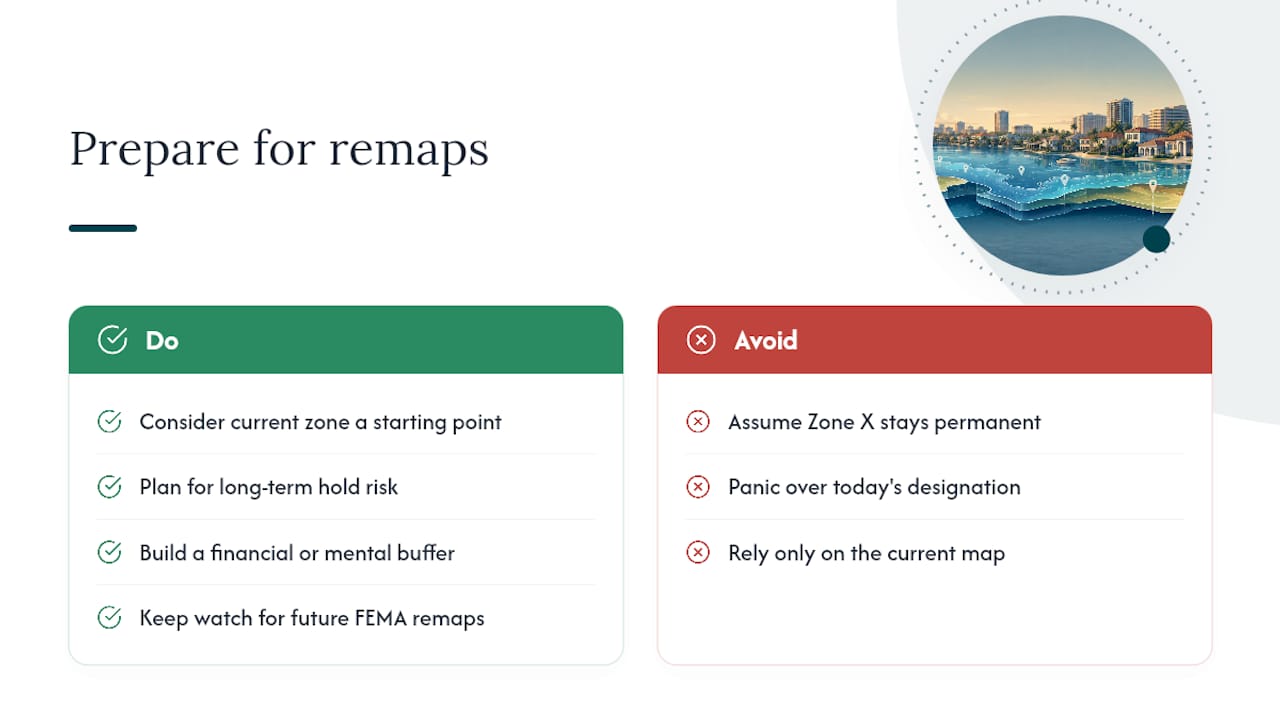
For a low-lying coastal city like Boca Raton, that has a specific practical consequence: areas currently mapped as Zone X, outside the mandatory insurance requirement, are reasonable candidates to shift into an SFHA in future revisions as tidal baselines creep upward and storm surge modeling gets recalibrated. Canal-adjacent and low-elevation parcels away from the immediate coastline face the same slow-moving exposure, since higher groundwater and reduced drainage capacity affect inland flooding as much as coastal surge.
None of this means panic about a property that’s currently outside a high-risk zone. It does mean that betting long-term on a Zone X designation staying put forever is a weaker bet than it looks today. Owners weighing a multi-decade hold, or buyers evaluating a property they intend to keep for fifteen or twenty years, should treat the current zone as a starting point, not a guarantee, and build in a mental (or financial) buffer for the possibility that voluntary flood coverage today becomes mandatory coverage down the line.
Renting Smart When You’re Watching Flood Risk
Renters can’t order an Elevation Certificate or file a LOMA, but you can still ask the right questions before signing a lease. Cynthia Gardens tracks local flood advisories and posts practical weather outlooks for Boca Raton so residents aren’t caught flat-footed during storm season.
Before you lease anywhere, ask about the building’s elevation, whether an Elevation Certificate exists, and what the property’s emergency plan actually covers. Location-specific questions are always worth a direct call to leasing rather than a guess.
— Ayman
Tour Cynthia Gardens Before You Decide Where to Live
Renters can evaluate a property’s location and surroundings without setting foot on-site first. Our interactive property map and virtual tours let you check exactly where a unit sits relative to the neighborhood before you commit to a showing, and our transparent pricing means you already know the real cost, with no hidden fees layered on after the fact.
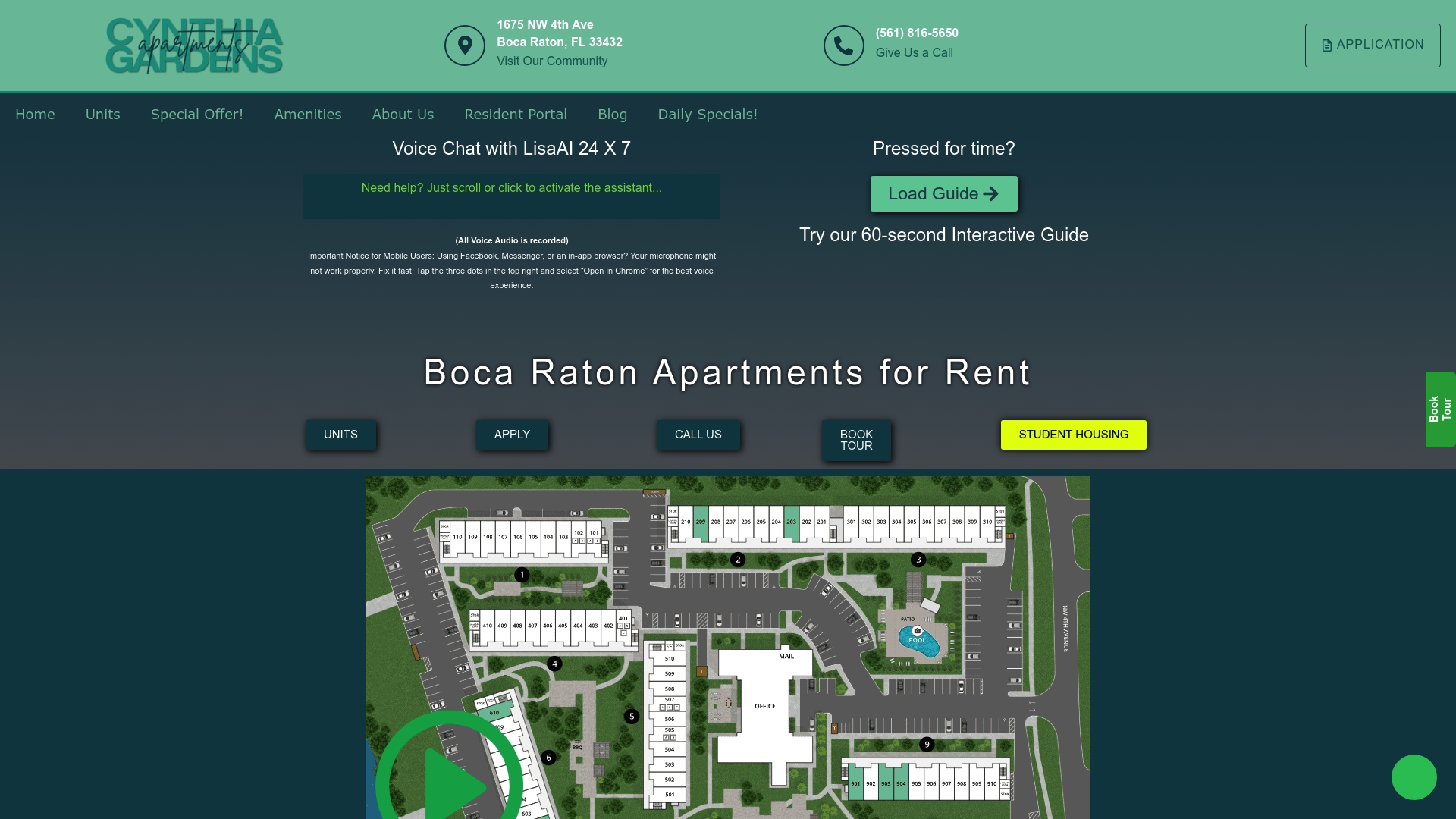
If elevation and location details matter to your decision, a leasing team can answer those specifics directly rather than leaving you to piece it together from public maps alone. Pet owners, students, and young professionals looking for a straightforward one-bedroom lease in Boca Raton can browse available apartment styles and schedule a virtual tour today to see exactly what you’d be renting before you sign anything.
Sources
- Know Your Flood Zone | Boca Raton, FL
- FEMA Flood Map Service Center
- Letters of Final Determination – 2024 | FEMA
- Update on Flood Zones — Palm Beach County
- Boca Raton, Florida — Wikipedia