
Last Updated: November 10, 2026
Quick Summary
To find pet-friendly apartments with no pet rent, search listings, then confirm with the leasing office whether a monthly charge applies. Many properties charge a one-time pet deposit or fee instead, and some waive pet rent entirely, so ask before you tour. Get the pet policy in writing.
- Confirm pet rent with the leasing office, since listings often don’t state it clearly.
- Pet rent is monthly and usually non-refundable, so it can exceed a one-time fee over a year.
- Ask for a full waiver, reduced pet rent, or conversion to a one-time fee.
- Get any waiver or reduction written into the pet addendum before you sign.
Table of Contents
- Why Pet Rent Adds Up Faster Than You Expect
- Pet Deposit vs. Pet Rent: What Each Charge Actually Costs You
- How to Find Pet-Friendly Apartments With No Pet Rent in Boca Raton
- Questions to Ask About Apartment Pet Policies Before You Sign
- Negotiating Pet Rent and Fees With Property Managers
- Understanding Service Animal and ESA Rights in Rentals
- Pet-Friendly Apartment Application Checklist
- Booking a Tour at Cynthia Gardens
- Frequently Asked Questions
Why Pet Rent Adds Up Faster Than You Expect
Finding a pet-friendly apartment is hard enough. Then the monthly pet rent shows up on the lease and changes the math. A 2026 Zillow analysis found that 77.3% of U.S. rental listings allow pets, so acceptance is common. Acceptance alone doesn’t tell you what you’ll pay each month, though.
Pet rent is a recurring charge, so it compounds. Over a year, the cost can exceed a one-time pet fee. A Texas study of pet fees in rental listings found that less expensive pet-friendly listings were more likely to charge pet fees on top of rent. That means the cheapest listing on your search may not be the cheapest one for your dog or cat.
Pet Deposit vs. Pet Rent: What Each Charge Actually Costs You
A pet deposit is usually paid once, at move-in. Pet rent is paid every month, for as long as you live there. Ask which one a property uses, and whether it charges both.
- Pet deposit: One-time, often refundable under the lease terms
- Pet rent: Monthly, usually non-refundable
- Pet fee: One-time, usually non-refundable
Read the lease for the exact terms. Pet deposit vs. pet rent is one of the first comparisons to make before you tour a unit.
Here is how the two common pet charges differ in timing and refundability.
| Charge | When it is paid | Refundable? |
|---|---|---|
| Pet deposit | One-time, at move-in | Often, under lease terms |
| Pet rent | Monthly, for the whole lease | Usually non-refundable |
| Pet fee | One-time | Usually non-refundable |
How to Find Pet-Friendly Apartments With No Pet Rent in Boca Raton
Start with listings, then confirm the details with the leasing office. Boca Raton has many pet-friendly rentals, but policies differ from one community to the next.
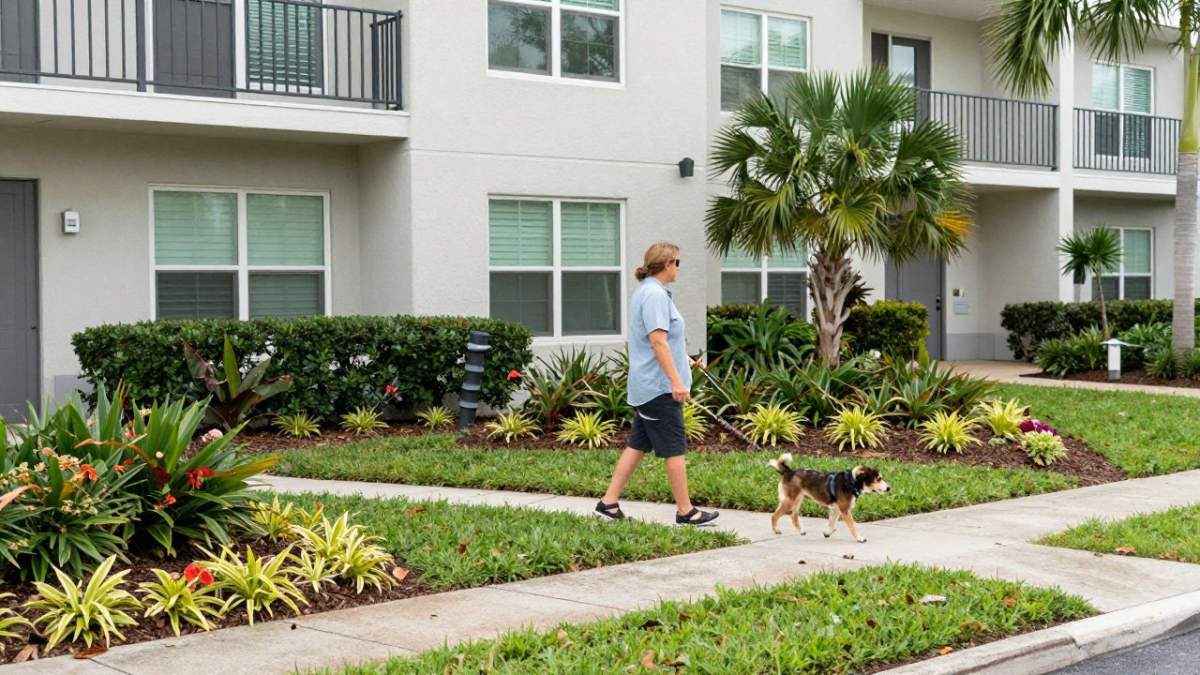
!A renter with a dog walking past a bright garden-style apartment community with landscaped grounds in Florida
Where to Search and What Listings Reveal
Search for “pet-friendly” listings, then filter by pet policy details. A listing that says pets are allowed does not always say whether pet rent applies. Check the listing, then call to confirm.
Use the pet-friendly apartments in Boca Raton guide to compare options before you schedule tours.
Reading Pet Policies Before You Tour
Look for these details in every pet policy:
- Monthly pet rent amount
- One-time pet deposit or fee
- Breed, size, and weight limits
- Number of pets allowed
- Required vaccination records
A pet policy breakdown for Boca apartments can help you read these terms without guessing. Pet policies can also be less clear than they look, so confirm everything in writing.
Questions to Ask About Apartment Pet Policies Before You Sign
Ask these questions before you commit:
- Is pet rent charged monthly, and how much is it?
- Is there a one-time pet deposit or fee?
- Are there breed or weight restrictions?
- Is there a limit on the number of pets?
- Is the pet deposit refundable, and under what conditions?
Get the answers in writing. A verbal promise won’t protect you if the lease says something different.
Negotiating Pet Rent and Fees With Property Managers
Pet rent is one of the few line items in a U.S. lease that may be open to discussion, but many renters never ask. They often assume the monthly charge is fixed, or worry that raising it could make the property less willing to rent to them.
Start by identifying what you actually want. In most cases you have three realistic outcomes to request, in order of difficulty:
- Full waiver: Pet rent is removed entirely, and the property keeps only a one-time pet deposit or fee.
- Reduced pet rent: The monthly amount is lowered, for example from a standard figure to a lower one that the leasing team can approve without escalating.
- Conversion to a one-time fee: The recurring charge is replaced with a single payment at move-in. Over a 12-month lease this can save a meaningful sum, and it is often the easiest concession for a manager to approve because it does not reduce the property’s per-unit revenue as sharply as a waiver would.
When you make the request, lead with evidence rather than emotion. A practical package includes current vaccination records, a reference from a prior landlord confirming the pet caused no damage, proof of a pet-specific renter’s insurance policy if you carry one, and a short written statement on how the pet is trained or crate-managed. Managers respond to documented risk reduction, not to general appeals.
Timing matters.
Ask for the outcome in writing before you sign. A verbal agreement from a leasing agent is not binding if the lease addendum says something else. Request that any waiver or reduction be written into the pet addendum itself, and confirm the final figure against the signed lease before you pay the first month’s rent.
Understanding Service Animal and ESA Rights in Rentals
Service animals and emotional support animals (ESAs) are not pets under federal housing law, and that distinction changes what a landlord may charge. The rule that matters most is the reasonable accommodation provision of the federal Fair Housing Act, administered by the U.S. Department of Housing and Urban Development (HUD). Under that provision, a housing provider may be required to make a reasonable exception to its no-pet or pet-fee policy for a tenant with a disability who needs the animal to use and enjoy the dwelling, and pet charges may not apply to that animal. Confirm the current requirements with HUD’s Fair Housing guidance.
The key word is reasonable. A landlord may ask for documentation that a disability-related need exists, and may deny a request in limited circumstances, such as when a specific animal poses a direct threat or would cause substantial damage that cannot be mitigated.
Three practical points help renters navigate this:
- Service animals that are individually trained to perform tasks for a person with a disability are generally recognized under the Americans with Disabilities Act.
- ESAs are covered under the Fair Housing Act’s accommodation rules rather than the ADA’s public-access rules.
- Damage liability still applies. A tenant with an assistance animal remains responsible for damage the animal causes, so renter’s insurance and documented care routines protect both parties.
State and local rules can differ from federal guidance. Confirm the current requirements with HUD’s Fair Housing guidance and with your state’s fair housing agency before you rely on any specific position.
Pet-Friendly Apartment Application Checklist
Have these ready before you apply:
- Pet’s name, breed, age, and weight
- Current vaccination records
- Pet resume or photo
- Landlord or previous-rental reference
- Renter’s insurance quote
- Written copy of the pet policy
Some communities also use a pet screening service. Ask what it costs and who pays for it.
Booking a Tour at Cynthia Gardens
At Cynthia Gardens, our one-bedroom apartments feature stainless steel appliances and quartz countertops in a garden-style community with a resort-style pool. Ask our leasing team to walk you through the current pet policy, including any pet rent or deposit, before you decide. Schedule a tour today to see the grounds and ask your questions in person. As you compare pet policies, remember that a refundable deposit may be separate from monthly pet rent, so ask what each charge covers at Highpoint Estate Apartments.
Frequently Asked Questions
Do some apartment complexes allow pets without charging monthly pet rent?
Yes, some do, but it varies by property and is rarely advertised in the main listing. A listing that says pets are allowed does not tell you whether monthly pet rent applies, so you need to confirm the full pet charge structure directly with the leasing office. Ask for the pet policy in writing and compare it against the total monthly cost, not just the base rent. Some properties charge a one-time pet fee or a refundable deposit instead of recurring pet rent, which can change the math significantly over a lease term.
What fees might apply if an apartment has no pet rent?
Even when a property waives monthly pet rent, you may still see a one-time non-refundable pet fee, a refundable pet deposit, or an application fee for each animal. Some communities also require a pet registration fee or proof of vaccinations. Ask for an itemized list of every pet-related charge before you apply so you can compare total move-in costs across properties. Pet rules and fees also depend on the animal’s species, breed, and weight, so confirm those limits as well.
What should I ask a Boca Raton landlord about pet policies?
Ask whether pet rent applies monthly, whether there are breed or weight restrictions, and how many pets are allowed. Find out whether the pet deposit is refundable and what it covers. Ask about pet screening, vaccination requirements, and any designated pet areas or outdoor space. If you have a service animal or emotional support animal, ask how the property handles those requests under fair housing rules, since standard pet policies generally do not apply to them.
How can I compare the total cost of pet-friendly apartments?
Build a simple side-by-side worksheet with base rent, monthly pet rent, one-time pet fees, refundable pet deposits, and any application or move-in charges. Multiply monthly pet rent by 12 to see the annual cost, then add the one-time amounts. A slightly higher base rent with no pet rent can cost less over a year than a lower rent with a monthly pet charge. Request quotes in writing so the numbers are documented before you sign.
