Table of Contents
- What to Look for in Rental Apartments Before You Commit
- Your Apartment Viewing Checklist: What to Inspect Room by Room
- Budgeting and Financial Requirements for Renting
- Questions to Ask Your Landlord Before Renting an Apartment
- Apartment Lease Red Flags Every Renter Should Know
- What to Look for in Rental Apartments Beyond the Unit Itself
- Community, Neighborhood Vetting, and Post-COVID Considerations
- Conclusion: Make a Confident, Informed Rental Decision
Last Updated: May 27, 2026
Renting an apartment is one of the most significant financial decisions most people make, and knowing what to look for in rental apartments can save you from costly mistakes, stressful disputes, and regret. This guide from Cynthia Gardens breaks down every factor that matters, from structural red flags to lease terms most renters skim past. Most apartment hunting guides stop at "check the water pressure." We go further. Below, you’ll find a room-by-room inspection framework, the financial questions nobody warns you about, and two critical angles competitors consistently overlook: digital infrastructure and noise pollution. These are the factors that determine whether an apartment works for your actual life, not just the life you imagine when touring a freshly staged unit.
What to Look for in Rental Apartments Before You Commit
Structural integrity is the first thing to assess, and most renters get it wrong. They look at finishes. They admire the quartz countertops and the stainless steel appliances. They forget to look up.
Structural Integrity and Physical Condition
Ceiling stains are a confession. A yellowish ring or soft, bubbling paint overhead tells you water has been there before, possibly repeatedly. Press gently on any discolored area. If it gives, you have an active or recent leak. Check the corners where walls meet ceilings, especially in bathrooms and rooms directly below another unit or the roof. These junctions are where moisture hides longest.
Beyond water, look at the floors. Walk every room deliberately. Soft spots, bouncing underfoot, or visible slope toward one wall can indicate structural settling or subfloor damage. Neither is a dealbreaker by itself, but both require a direct conversation with the property manager before you sign anything.
A useful framework for this walkthrough: think in three planes. Check the floor (levelness, soft spots), the walls (cracks, gaps at trim, evidence of patching), and the ceiling (stains, cracks, uneven texture). Any issue in two of three planes in the same room warrants serious scrutiny.
Never assume a freshly painted apartment is a structurally sound one. Fresh paint is the most common way landlords mask water damage, mold, and patching before a showing. If something smells musty despite new paint, trust your nose over the aesthetics.
Natural Light, Ventilation, and Storage Capacity
Natural light is harder to fake than people think. Visit the apartment at two different times of day if possible. A unit that faces north in a dense building may receive almost no direct sunlight, which affects mood, energy costs, and the practical usability of every room. Check whether windows open fully and whether screens are intact. Ventilation in bathrooms and kitchens is non-negotiable: a bathroom without a functioning exhaust fan is a mold incubator.
Storage capacity is consistently underestimated during apartment tours. Open every closet. Measure the primary bedroom closet if you have significant wardrobe needs. Check whether kitchen cabinets reach the ceiling or stop short, wasting vertical space. Look for linen closets, coat closets, and whether there’s any utility storage. A beautiful apartment with nowhere to put anything is a beautiful problem.
Your Apartment Viewing Checklist: What to Inspect Room by Room
The apartment viewing checklist most guides offer is a list of things to notice. A better one is a list of things to test.
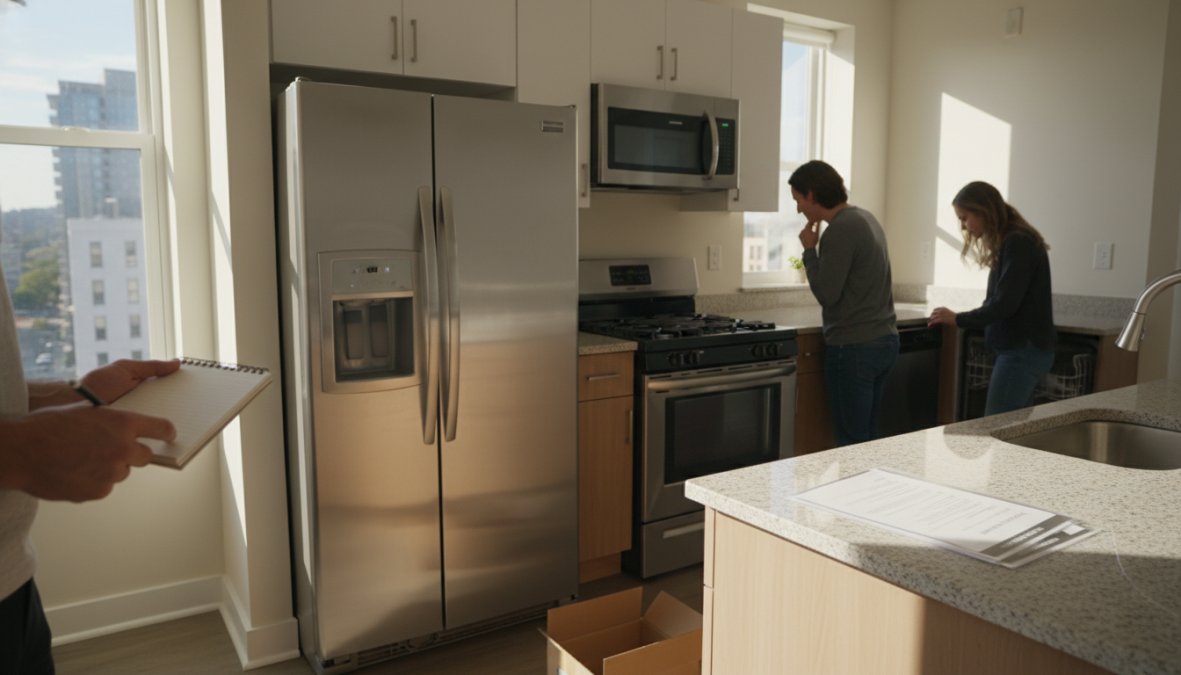
A prospective renter with a clipboard conducting a move-in inspection walkthrough of a bright, modern apartment kitchen, checking stainless steel appliances and cabinet condition under warm natural light streaming through large windows.
Plumbing, Electrical Outlets, and Heating and Cooling Systems
Run every faucet. Don’t just turn them on briefly: let them run for thirty seconds and check the water pressure, the drain speed, and whether the hot water arrives within a reasonable time. A slow drain during a showing means a slow drain on move-in day. Check under every sink for evidence of plumbing leaks: soft cabinet floors, water stains on the interior walls, or rust rings around the drain pipe.
Test every electrical outlet. Bring a phone charger or a small plug-in tester. Non-functioning outlets in a modern apartment often indicate overloaded or outdated wiring. Count the outlets per room: a bedroom with two outlets in 2026 is a genuine inconvenience for anyone working from home.
The heating and cooling system deserves specific attention. Ask the age of the HVAC unit. Ask when the filters were last changed. Turn the system on during your tour and listen: grinding, rattling, or delayed startup can indicate a unit approaching end of life. According to guidance from the U.S. Department of Energy on HVAC maintenance, HVAC systems typically last 15-20 years, and a unit at the end of that range will cost you in comfort and utility bills.
Signs of Water Damage, Mold Infestation, and Pest Control Issues
The bathroom is the highest-risk room for mold infestation. Check the grout lines around the tub and shower: black or green discoloration that won’t wipe off is active mold, not surface grime. Check behind the toilet tank, where condensation creates a persistent damp environment. Check the ceiling above the shower for soft spots or discoloration.
Pest control history is something you should ask about directly. Many landlords are legally required to disclose known infestations, but the question itself often reveals more than the answer. Ask: "Has this unit had any pest control treatments in the last twelve months, and for what?" Look along baseboards and inside kitchen cabinets for droppings, grease marks, or evidence of traps.
Bring a flashlight to apartment viewings. Shine it along the baseboard level in the kitchen and bathroom. Pest activity, moisture damage, and failed caulking are all far more visible at that angle than they are from standing height.
Budgeting and Financial Requirements for Renting
The biggest financial mistake renters make is budgeting for rent and forgetting everything else. Here’s where that calculation falls apart, and how to build a number that actually reflects what you’ll spend.
The Real Cost of Renting: Building Your True Monthly Number
Most landlords and listing sites quote a base rent figure. That number is a starting point, not a budget. Before you sign anything, calculate your true monthly cost by adding every line item below to the advertised rent:
| Cost Category | Typical Range | Notes |
|---|---|---|
| Base rent | Varies by market | The number on the listing |
| Electricity | $60-$150/month | Higher for electric heat or older buildings |
| Water/sewer | $20-$60/month | Sometimes included; always ask |
| Gas | $20-$80/month | Seasonal; ask for prior-year averages |
| Renters insurance | $15-$30/month | Required by many landlords; non-negotiable |
| Parking | $0-$200+/month | Often unlisted; ask explicitly |
| Pet rent | $25-$75/month per pet | Separate from pet deposit |
| Trash/recycling | $5-$20/month | Increasingly billed separately |
| Amenity fees | $0-$50/month | Gym, pool, package lockers |
Ask the property manager for the average monthly utility bills for that specific unit, ideally broken down by summer and winter. A ground-floor corner unit in a poorly insulated building can cost meaningfully more to heat and cool than a mid-floor unit with shared walls on three sides. This is not a minor difference, it can shift your true monthly cost by $100 or more.
The widely cited income-to-rent guideline is that housing costs should not exceed 30% of gross monthly income. A more practical version for renters in 2025-2026 is to apply that 30% to your true monthly cost, not just base rent. If your true monthly cost is $200 higher than the listed rent, your qualifying income threshold is correspondingly higher.
Security Deposit, Application Fees, and Credit Requirements
A security deposit is a sum of money held by the landlord as protection against damage or unpaid rent, typically equivalent to one to two months’ rent. Application fees cover the cost of background and credit screening, and they are generally non-refundable. Before you pay either, understand exactly what you’re agreeing to.
Ask for the credit score threshold in writing. Some landlords have flexible credit requirements with compensating factors, a larger security deposit, a co-signer, or several months of prepaid rent. Others have hard cutoffs. Knowing this before you pay a non-refundable application fee saves you money and time. Application fees commonly range from $35 to $100 per adult applicant; in competitive markets, some landlords charge more. If you’re applying to multiple units simultaneously, these fees add up quickly.
The security deposit terms matter as much as the amount. Ask specifically:
- What deductions are considered normal wear and tear versus tenant damage? (Scuffed paint after two years is typically wear and tear; a hole in the wall is not.)
- How long does the landlord have to return the deposit after move-out?
- Is the deposit held in a separate escrow account, as required in some states?
As documented in tenant rights guidance from Nolo’s legal encyclopedia, most states have specific statutory timelines, commonly 14 to 30 days, for returning security deposits after move-out, along with requirements for itemized written deductions. Landlords who miss those deadlines can forfeit the right to make deductions entirely, and in some states face penalty damages. Know your state’s specific timeline before you move out, not after.
Document the unit’s condition at move-in with timestamped photos and video of every room, every wall, every appliance, and every fixture. Email the documentation to yourself and to the landlord on move-in day. This single step resolves the majority of security deposit disputes in tenants’ favor.
Utility Bills, Renters Insurance, and Hidden Monthly Costs
Renters insurance is often framed as optional. It isn’t. Renters insurance is a policy that protects a tenant’s personal property against theft, fire, and certain types of water damage, and it typically also covers personal liability, meaning if a guest is injured in your apartment, your policy can cover legal costs. Most policies run well under $30 per month for standard coverage, and many landlords now require proof of coverage before move-in. If your landlord doesn’t require it, get it anyway.
Two things most renters don’t check on their renters insurance policy:
- Actual cash value vs. replacement cost coverage. Actual cash value pays you what your three-year-old laptop is worth today. Replacement cost pays you what it costs to buy a new one. The premium difference is small; the claims difference is significant.
- Whether your policy covers your unit if the building has a flood event. Standard renters insurance does not cover flood damage. If you’re in a flood-prone area, a separate flood policy through the National Flood Insurance Program may be worth considering.
Hidden monthly costs to ask about explicitly before signing:
- Parking fees (often separate from rent, and sometimes tiered by covered vs. uncovered)
- Pet fees or monthly pet rent (distinct from the one-time pet deposit)
- Trash and recycling fees
- Package locker or concierge fees
- Amenity fees for pool or gym access
- Late fee policy and grace period length
- Move-in or move-out fees charged by the building (common in high-rises with freight elevator reservations)
The true monthly cost of an apartment is almost always higher than the listed rent. Build your complete number, rent plus every line item above, before comparing units. An apartment that lists $100/month cheaper than a competitor may cost more once utilities, parking, and fees are included.
Questions to Ask Your Landlord Before Renting an Apartment
The questions to ask landlord before renting are not just about getting information. They’re about assessing how the landlord communicates, which is a preview of every future maintenance interaction you’ll have.
Maintenance Requests, Pet Policy, and Parking Availability
Ask how maintenance requests are submitted and what the typical response time is. A landlord who can’t answer that question clearly has never thought about it from the tenant’s perspective. Ask whether there’s an emergency maintenance line for after-hours issues. Ask who handles repairs: an in-house team or contracted vendors.
The pet policy question is more nuanced than it appears. Ask not just whether pets are allowed, but what the breed and weight restrictions are, whether there’s a pet deposit versus monthly pet rent, and whether those fees are refundable. Some communities allow cats but not dogs, or small dogs but not large breeds. Get the full policy in writing.
Parking availability is location-dependent but consistently important. Ask whether parking is assigned or first-come-first-served. Ask whether there’s a cost and whether it’s included in rent. Ask what happens if a guest needs parking. In dense urban areas, the parking situation can make or break the practicality of an otherwise excellent apartment.
The way a landlord answers your questions during the tour is a direct signal of how they’ll respond when something breaks at 10pm on a Friday. Vague, defensive, or dismissive answers are data points, not just bad manners.
Apartment Lease Red Flags Every Renter Should Know
A lease agreement is a legally binding contract, and most people sign it after a five-minute skim. This is where renters lose money, freedom, and sleep. The goal of this section is not just to name the red flags, it’s to explain the mechanism behind each one so you understand what you’re actually agreeing to.
How to Read a Lease Before You Sign It
Before reviewing specific clauses, establish a baseline: read the entire lease, not just the rent amount and move-in date. Print it or use a PDF with annotation tools. Flag every clause that contains the words "at landlord’s discretion," "without notice," "tenant waives," or "as determined by management." These phrases transfer decision-making power away from you and toward the landlord with no defined limits. Each one deserves a direct question before you sign.
If the lease is longer than 10 pages or contains language you don’t understand, many local tenant rights organizations offer free lease review services. The cost of an hour with a tenant advocate is far lower than the cost of a disputed deposit or an early termination fee.
Late Fee Policy, Subletting Clauses, and Rent Control Rules
Late fee policy should state three things explicitly: the grace period (the number of days after the due date before a fee is charged), the fee amount (a flat dollar figure or a capped percentage of monthly rent), and whether fees compound daily. A lease that says only "late fees will be assessed" without specifying the amount or grace period gives the landlord unilateral discretion, that’s a red flag. Many states cap late fees by statute (commonly at 5% of monthly rent or a flat dollar ceiling), but those caps only protect you if you know they exist. Look up your state’s late fee limits before signing.
Subletting clauses determine whether you can have someone take over your lease if your circumstances change. Many leases prohibit subletting entirely or require landlord approval with conditions that are effectively impossible to meet. The practical consequence: if you need to relocate for work, end a relationship, or face a financial hardship mid-lease, a blanket no-subletting clause leaves you liable for the full remaining rent with no exit. What to ask for instead: a clause that allows subletting with landlord approval, where approval cannot be unreasonably withheld. Get that language in writing, not just a verbal assurance.
Rent control rules vary dramatically by city and state, and the distinction matters enormously at renewal time. Some municipalities cap annual rent increases to a fixed percentage or tie them to a local inflation index. Most U.S. cities have no such protections, meaning your landlord can raise rent to market rate at renewal with proper notice, which in many states is as little as 30 days. According to National Multifamily Housing Council’s overview of rent control policies, rent stabilization ordinances exist in a minority of U.S. jurisdictions. Know which category your city falls into before you budget for year two.
Lease Clauses That Routinely Cost Renters Money
Beyond the three above, these clauses appear frequently in standard leases and carry consequences most renters don’t anticipate until it’s too late:
Automatic renewal clauses convert your lease to a new term, often a full year, if you don’t provide written notice of non-renewal within a specific window, sometimes 60 or 90 days before expiration. Miss the window by a week and you may be legally obligated to another 12 months of rent. Look for this clause near the end of the lease document, where it’s easy to overlook. The fix: set a calendar reminder the day you sign for 90 days before your lease end date.
Entry rights clauses define when and how a landlord can enter your unit. Most states require landlords to provide 24 to 48 hours of advance written notice for non-emergency entry. A lease that says "landlord may enter at any time for inspection or maintenance" may conflict with your state’s statutory notice requirements, but you’d need to know your rights to push back. If the lease entry clause is broader than your state law allows, ask for it to be amended to match the statutory standard.
Early termination clauses determine what you owe if you need to break the lease before the end of the term. Some leases require forfeiture of the full security deposit plus two months’ rent. Others have a prorated fee schedule. A small number allow termination with 60 days’ notice and one month’s penalty. Understand this clause completely before signing, because life circumstances change. Also note: many states require landlords to mitigate damages, meaning they must make a reasonable effort to re-rent the unit rather than simply collecting rent from you for the remaining term. A landlord who claims you owe rent for six empty months may be misrepresenting your legal exposure.
Maintenance responsibility clauses sometimes shift obligations that are legally the landlord’s onto the tenant. Watch for language requiring tenants to maintain HVAC filters, handle minor repairs up to a dollar threshold, or pay for pest control treatments. Some of these are reasonable; others conflict with the landlord’s implied warranty of habitability, which exists in most U.S. states regardless of what the lease says.
A lease clause cannot override state or local tenant protection law. If a clause in your lease conflicts with a statutory right, such as the right to advance notice before entry, or the right to a habitable unit, the clause is generally unenforceable. But you need to know your state’s tenant rights to recognize the conflict. Resources like [tenant rights guidance from Nolo’s legal encyclopedia](https://www.nolo.com) provide state-by-state summaries that are worth reviewing before you sign.
Quick-Reference: Red Flag vs. Acceptable Lease Language
| Clause | Red Flag Version | What to Ask For |
|---|---|---|
| Late fees | "Fees will be assessed at management’s discretion" | Specific dollar amount + grace period of at least 5 days |
| Automatic renewal | Renews for full term without notice | 60-day written notice requirement before renewal |
| Entry rights | "Landlord may enter at any time" | 24-48 hours advance written notice, per state law |
| Subletting | Blanket prohibition with no exceptions | Approval-based permission; approval not unreasonably withheld |
| Rent increases | No cap or notice period specified | Written 60-day notice minimum; cap tied to CPI or fixed % |
| Early termination | Forfeiture of full deposit + multiple months’ rent | Prorated fee schedule with defined exit process |
| Maintenance | Tenant responsible for repairs up to $X | Landlord responsible for all habitability-related repairs |
The lease is a negotiation, not a take-it-or-leave-it document, especially in slower rental markets. Landlords who want to fill a unit often accept reasonable amendments. The worst they can say is no. The worst outcome of not asking is signing a contract with terms that cost you hundreds or thousands of dollars when your circumstances change.
What to Look for in Rental Apartments Beyond the Unit Itself
The unit is only half the story. What surrounds it determines whether you’ll actually want to live there.
Noise Pollution Assessment and Security Features
Noise pollution is the rental factor most people discover too late. During a tour, the apartment feels quiet because you’re there at a scheduled time, likely midday on a weekday. The reality of a unit next to a parking garage, below a rooftop HVAC system, or adjacent to a busy road arrives later.
Visit the apartment at a different time than your scheduled tour, ideally on a weekend evening or early morning. Stand outside the building and listen. Ask current residents, if you can find them, about noise levels. Ask the property manager directly which units have had the most noise complaints.
Security features worth assessing: controlled building entry, functioning door and window locks on the unit itself, adequate exterior lighting in parking areas and walkways, and whether the building has security cameras in common areas. Ask about the history of break-ins or security incidents. A property manager who deflects this question is telling you something.
Digital Infrastructure, Connectivity, and Remote Work Readiness
This is the angle most apartment hunting guides completely ignore, and in 2026 it’s one of the most consequential factors for a large portion of renters.
Ask specifically which internet service providers serve the building. Some buildings have exclusive contracts with a single provider, which means no competition and no alternatives if the service is poor. Ask whether the building has fiber infrastructure or is limited to cable or DSL. Ask about the location of cable/ethernet ports in the unit: a living room with no ethernet port and a bedroom with no cable access forces you into a WiFi-only setup that may not support video calls reliably.
For remote workers, ask about cell signal strength inside the unit. Thick concrete construction in older buildings can drop signal to unusable levels. Test your phone signal during the tour. Ask whether the building has a WiFi mesh system in common areas. These details separate an apartment that works for your professional life from one that constantly fights it.
Community, Neighborhood Vetting, and Post-COVID Considerations

The neighborhood around your apartment affects your daily quality of life in ways the unit itself cannot compensate for. Walk the surrounding blocks at different times of day. Note the proximity of grocery stores, pharmacies, and transit options. Check commute times during actual peak hours, not on a map app at noon on a Sunday.
Post-COVID rental considerations have reshaped what many renters prioritize. Outdoor space, whether a balcony, courtyard, or nearby park, has moved from a nice-to-have to a genuine quality-of-life factor. Communal spaces that allow for distancing and fresh air, laundry facilities that don’t require sharing tight spaces with many neighbors, and buildings with strong ventilation systems have all gained relevance. Ask whether the building has HEPA filtration in its HVAC system. Ask about the outdoor amenities and whether they’re maintained year-round.
Community character matters too. A garden-style community with landscaped grounds and a resort-style pool, like what Cynthia Gardens offers in Boca Raton, provides a meaningfully different daily experience than a high-rise with shared elevators and no outdoor common space. The question isn’t which is objectively better: it’s which matches how you actually want to spend your time at home.
Use Walk Score’s neighborhood walkability and transit data to objectively assess any neighborhood before committing. Cross-reference with local crime data from city or county public records, not third-party aggregators that often have outdated information.
Conclusion: Make a Confident, Informed Rental Decision
Finding the right rental apartment requires more than a pleasant tour and a good feeling about the landlord. It requires a systematic walkthrough, honest financial accounting, careful lease review, and attention to the factors most guides skip entirely, including noise levels, digital infrastructure, and neighborhood character. For renters in Boca Raton seeking a community that already addresses these priorities, Cynthia Gardens offers modern one-bedroom apartments with high-end finishes, maintenance-free living, a resort-style pool, and a garden-style setting minutes from FAU and the beach. Schedule a tour today and see firsthand what a well-maintained, thoughtfully designed rental community actually looks and feels like.
Frequently Asked Questions
What should I check during an apartment viewing?
During an apartment viewing, use a walkthrough checklist that covers structural integrity, water damage, mold infestation, plumbing leaks, electrical outlets, and heating and cooling systems. Test water pressure, check natural light in each room, inspect storage capacity, and look for signs of pest control issues. Also assess noise levels from nearby traffic or neighbors, and confirm that amenities like parking availability and laundry are functional and accessible.
What are red flags when looking for an apartment?
Key apartment lease red flags include vague late fee policy language, overly restrictive subletting clauses, no mention of tenant rights, and pressure to skip a formal move-in inspection. Physically, watch for signs of water damage, mold infestation, or unaddressed plumbing leaks. A property manager who is slow to answer maintenance requests or unwilling to provide a written lease agreement before you sign are also serious warning signs worth taking seriously.
What questions should I ask a landlord before renting?
Before renting, ask your landlord about the security deposit amount and return conditions, the pet policy, parking availability, how maintenance requests are handled, and whether utility bills are included in rent. Also ask about the lease term options, background check and credit requirements, application fees, and whether renters insurance is required. Clarifying these details upfront helps you avoid surprises and ensures the lease agreement aligns with your lifestyle and budget.
What should I look for in an apartment lease agreement?
Review the lease agreement carefully for the lease term length, rent control provisions, late fee policy, subletting rules, and pet policy details. Confirm what the security deposit covers and the conditions for its return. Look for clauses about maintenance responsibilities, early termination penalties, and renewal terms. Any ambiguous or one-sided language around tenant rights should be questioned or negotiated before signing. When in doubt, consult a local tenant rights resource.
How do I know if an apartment is a good deal?
To evaluate whether an apartment is a good deal, compare the monthly rent against similar units in the area and factor in all costs: utility bills, renters insurance, application fees, and parking. Assess the value of included amenities like a resort-style pool, in-unit appliances, or maintenance-free living. A lower rent with high hidden costs may be less competitive than a slightly higher rent that covers more. Location, safety, and community quality are also major value factors.
Is it important to check water pressure in an apartment?
Yes, checking water pressure during your apartment viewing is an important step in your walkthrough checklist. Low water pressure can signal plumbing leaks, aging infrastructure, or issues that the property manager may be slow to fix. Run all faucets and the shower simultaneously if possible. Also flush the toilet while the sink is running to test consistency. Poor water pressure is a practical quality-of-life issue that can be difficult and costly to resolve after you have already moved in.
This article was written using GrandRanker