TL;DR:
- Creative space optimization in small apartments involves vertical storage and multifunctional furniture to maximize limited space. Using non-permanent dividers and transforming closets into offices creates effective boundaries that support productivity and wellbeing. Renter-friendly decor options and strategic organization elevate the workspace without damaging walls or increasing costs significantly.
Working from a small apartment sounds manageable until your kitchen table becomes your office, your bedroom is your conference room, and your couch is dangerously close to your laptop. If you are searching for practical work-from-home apartment ideas that go beyond “buy a desk,” this article delivers exactly that. You will find strategies for creating real separation between work and life, making tight spaces feel intentional, and building a setup that supports both productivity and your wellbeing, without requiring a bigger apartment or a bigger budget.
Table of Contents
- Key Takeaways
- 1. Build up, not out, with vertical storage
- 2. Use multifunctional furniture to earn back floor space
- 3. Zone your space without permanent walls
- 4. Invest in one serious ergonomic chair
- 5. Convert a closet into a dedicated office (the “cloffice”)
- 6. Keep apartment desk organization simple and visual
- 7. Try biophilic design on a small budget
- 8. Make it renter-friendly with damage-free solutions
- My honest take on small-space work setups
- Find an apartment that works as hard as you do
- FAQ
Key Takeaways
| Point | Details |
|---|---|
| Go vertical first | Wall-mounted shelves and tall bookcases free up floor space while expanding storage capacity. |
| Zone without walls | Curtains and folding screens create real psychological separation between work and relaxation areas. |
| One quality anchor piece | Investing in a single ergonomic chair improves health, focus, and how the whole workspace feels. |
| Renter-friendly decor exists | Damage-free options like magnetic photo tiles let you personalize without risking your deposit. |
| Cloffices are underrated | Converting a closet into a dedicated workspace gives you a door to close on the workday. |
1. Build up, not out, with vertical storage
The single biggest mistake in a small apartment workspace is thinking horizontally. Floor space is precious, but wall space is usually wasted. Wall-mounted shelving pulls the eye upward and makes a room feel larger while giving you real storage for books, gear, and supplies.
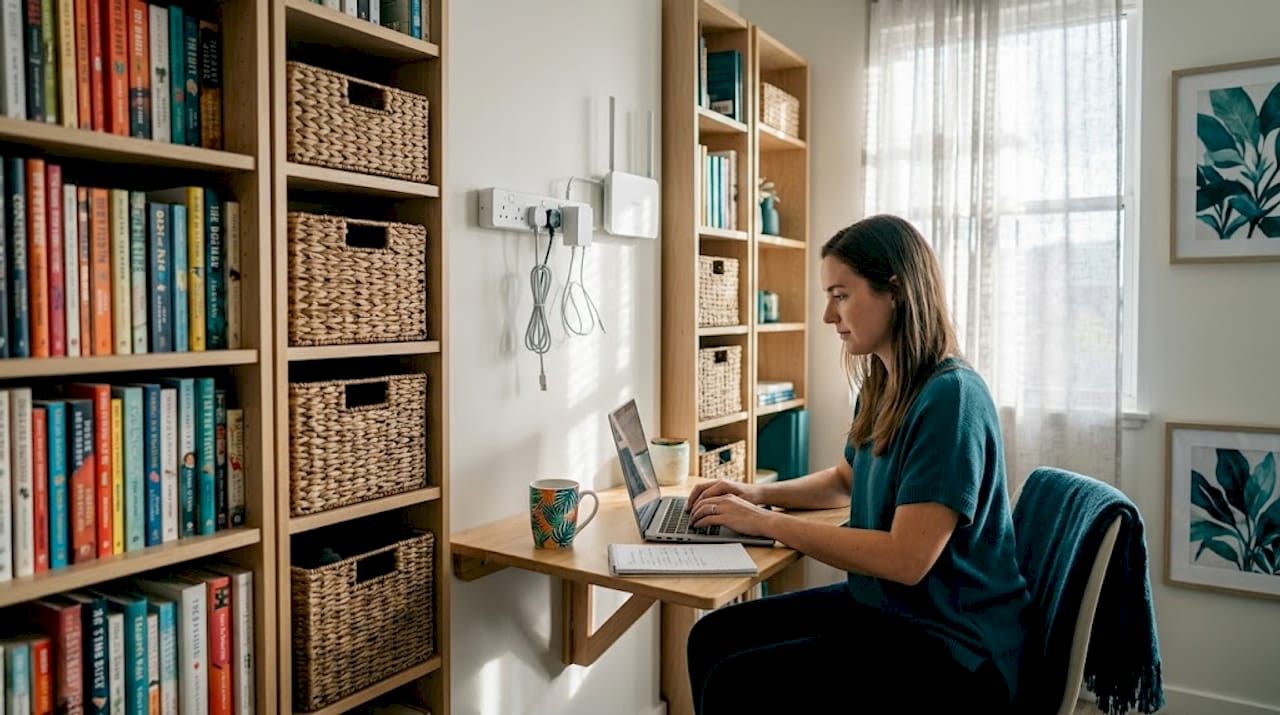
A wall-mounted foldable desk is one of the smartest buys for a studio or one-bedroom. When the workday ends, it folds flat and disappears. Pair it with floating shelves above it and you have a full small apartment workspace that takes up almost no floor space at all.
Tall, narrow bookcases work the same way. A bookcase that is 72 inches tall but only 12 inches deep stores more than a wide, low cabinet and leaves your floor plan open. The visual trick is real: vertical storage makes rooms feel taller and more spacious, not cluttered.
Pro Tip: Mount your router and a power strip to the wall behind your desk area. Eliminating cord clutter from the floor changes how the whole workspace reads visually.
2. Use multifunctional furniture to earn back floor space
Every piece of furniture in a small apartment should ideally serve two purposes. An ottoman with internal storage works as a footrest, extra seating, and a place to store cables, notebooks, or anything else cluttering your desk. A foldable desk doubles as a surface for hobbies or dining when the workday is done.
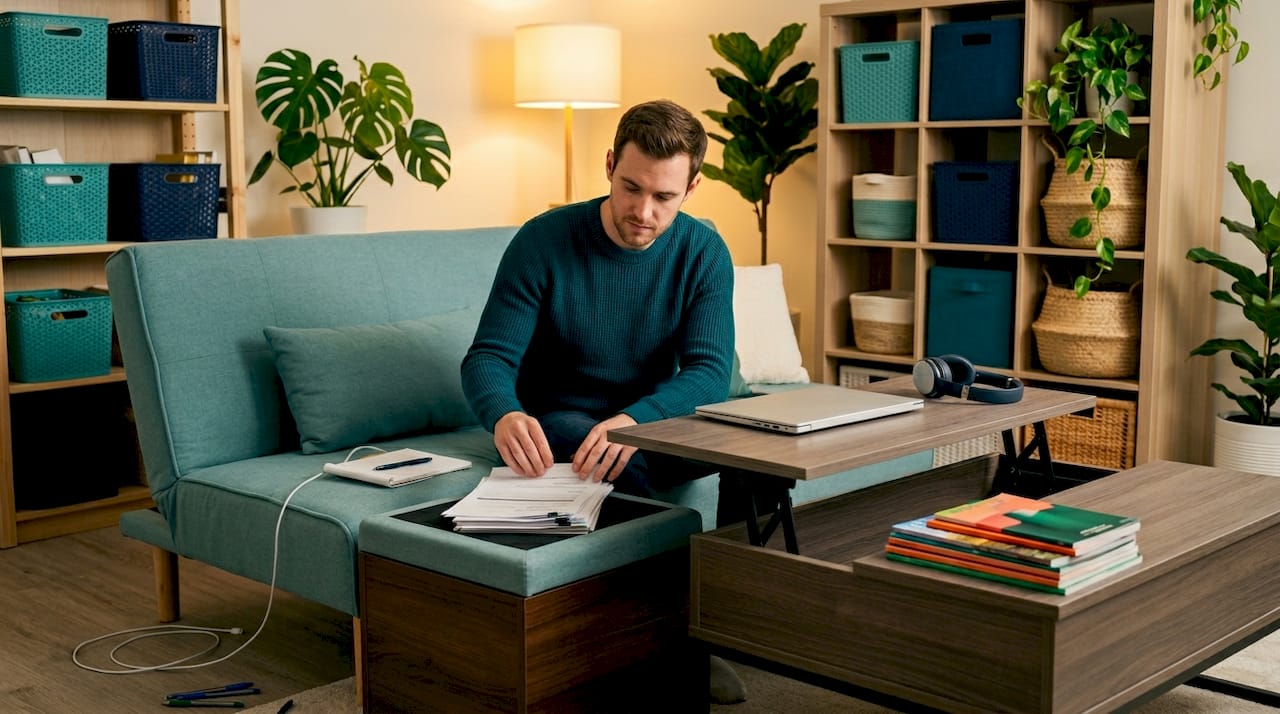
This idea goes deeper than just buying a storage ottoman. Think about your existing furniture with fresh eyes. Can a bookcase serve as both a room divider and a filing system? Can a bench at the foot of your bed hold office supplies? Multifunctional thinking reduces the number of pieces you need, which directly reduces how cramped your space feels.
For students especially, a loft bed with a built-in desk underneath is a legitimate game-changer. You reclaim the square footage under your sleeping area and give yourself a dedicated work zone without sacrificing any living space. Check your first apartment setup guide for a full breakdown on choosing foundational furniture pieces.
3. Zone your space without permanent walls
Creating a visual and psychological boundary between where you work and where you live is one of the most impactful remote work setup tips you can act on today. Studio apartments under 600 sq ft benefit significantly from segmenting space with non-permanent dividers like curtains or folding screens.
The key insight most people miss is this: the divider does not need to be opaque. Translucent curtains or glass partitions maintain natural light flow while still creating a clear boundary between zones. Opaque dividers block light and make already small spaces feel even smaller. Semi-transparent options give you the psychological separation without the boxed-in feeling.
Here are the most effective non-permanent zoning tools for apartment renters:
- Floor-to-ceiling curtains on a tension rod (no drilling required)
- Folding screens or decorative panels that can be repositioned
- Open-back bookshelves placed perpendicular to the wall
- A area rug under your desk to visually anchor the work zone
- Pendant lighting positioned specifically over your work area
Pro Tip: Use a different light color temperature in your work zone versus your living area. Cooler white light (5000K) promotes focus; warmer light (2700K) signals rest. Two lamps, two zones, zero construction.
Designers working on boutique hotel interiors use this exact zoning principle to make compact rooms feel purposeful rather than cramped. The same logic applies to your apartment.
4. Invest in one serious ergonomic chair
This is the advice most people skip because a good chair costs real money. It is also the advice that separates people who work from home productively from people who work from home with back pain. A quality ergonomic chair anchors the workspace both functionally and visually. It signals, to your brain and anyone on a video call, that this is a real work setup.
Proper desk height matters just as much. Your elbows should sit at roughly 90 degrees when typing, and your monitor should be at eye level. A quality chair supports spine curvature and reduces fatigue across long work sessions. If you are working eight-hour days, this is a health investment, not a furniture purchase.
For home office decor ideas that balance style with function, consider these elements together:
- A single large print on the wall behind your desk (far more impact than a collage of small frames)
- A small plant or two at desk level (biophilic design reliably lowers stress and improves mood)
- Task lighting positioned to eliminate screen glare and shadows on your face during calls
- A desk mat that defines your work surface and reduces visual clutter
Natural light control through curtains also supports focus by regulating your circadian rhythm, and canvas prints under $20 can give your work zone a polished, professional look without spending much.
Pro Tip: If you cannot afford a full ergonomic chair right now, buy a lumbar support cushion for whatever chair you have. It is a $30 fix that closes most of the gap.
5. Convert a closet into a dedicated office (the “cloffice”)
If you have a closet you rarely use, you have an untapped office. The cloffice concept works well precisely because it gives you one thing a desk in the corner never can: a door. When you close it, the workday is over. That physical boundary matters more than you might think.
Closet-to-office conversions require removing standard closet rods and installing task-specific lighting. Standard closet lighting is almost always too dim for focused work or video calls. Adding an LED strip light at the top of the opening and a small desk lamp on the work surface solves this completely.
Here is a simple cloffice setup that works in most standard apartment closets:
- Remove the clothing rod and any shelving that blocks desk height
- Install a wood plank or a simple desktop cut to fit the closet width
- Add a power strip with cord management along the back wall
- Install an LED light bar at the top of the door frame
- Use the upper shelf space for storage bins and books
- Add a small monitor arm to free up desk surface
The result is a fully functional efficient home workspace that disappears completely when the closet door is closed.
6. Keep apartment desk organization simple and visual
Clutter is a focus killer. The research on this is not subtle: visual noise competes for your attention and increases cognitive load. The fix does not require buying a lot of organizational products. It requires deciding where everything lives and keeping it there.
| Storage type | Best use case | Approx. cost |
|---|---|---|
| Modular cube shelves | Books, bins, printer | $40 to $120 |
| Desktop organizer tray | Pens, notes, cables | $15 to $35 |
| Mobile rolling cart | Supplies you move around | $30 to $80 |
| Decorative storage bins | Off-desk overflow storage | $10 to $40 per bin |
| Magnetic board or corkboard | Quick-reference notes | $20 to $50 |
A mobile rolling cart is especially useful in studio apartments. You can pull it next to your desk during work hours and roll it behind a curtain or into a corner when done. This kind of flexible apartment desk organization adapts to your space rather than forcing your space to adapt to it.
Build a five-minute end-of-day desk reset into your routine. Put everything back in its place before you close the laptop. You will start each morning with a clear surface and a clearer head.
7. Try biophilic design on a small budget
Plants make workspaces better. This is not just aesthetic opinion. Biophilic design, which incorporates natural elements into built environments, measurably reduces stress and improves focus in studies across multiple fields. The good news for apartment renters is that it requires almost no budget.
A snake plant is a strong choice for home offices. It tolerates low light, requires minimal watering, and according to wellness-focused design research, it helps filter indoor air without the fire or distraction risk that candles bring. A single plant on your desk and one on a nearby shelf adds visual depth, softens the hard lines of a tech-heavy workspace, and signals “this is a space I care about.”
If you want to go further, a small succulent garden in a tray, a hanging pothos, or even a sprig of eucalyptus in a glass vase near your monitor all cost under $15 and punch well above their price in terms of how the space feels to work in.
8. Make it renter-friendly with damage-free solutions
Most creative work-from-home solutions assume you own your walls. Renters face a stricter reality: no nails, no permanent modifications, no security deposit nightmares. The good news is that the best renter-friendly options have gotten genuinely good in recent years.
Magnetic photo tiles like MIXPIX® use a magnetic and adhesive system that lets you rearrange wall art without nails or screws. They work on most wall surfaces and peel away cleanly. For a home office, this means you can build out a personal, motivating wall display and adjust it as your taste or needs change.
Other damage-free approaches worth using:
- Tension rods for curtains and room dividers (no drilling)
- Removable wallpaper or peel-and-stick tiles to define your desk area
- Command strip hooks for cables, headphones, and small shelves
- Freestanding shelving units instead of wall-mounted versions
Pro Tip: Start with one small upgrade and build from there. Renters who try to transform their space all at once usually end up with a cluttered mix of things that do not work together. Commit to your desk setup first, then layer in storage and decor over a few weeks.
My honest take on small-space work setups
I have spent time working remotely in apartments where the “home office” was a corner of the living room with a borrowed chair. Here is what I learned that most articles will not tell you.
The size of your space matters far less than how deliberately you use it. I have seen people productive in 400 square feet and miserable in 900. The difference is almost always whether they created any real separation between work and rest, even symbolically.
Physical boundaries help ground the nervous system by creating associations. A spot you use only for work starts to cue focus. A spot you use only for relaxing starts to cue rest. When those spots overlap, neither cue works properly and you end up half-working and half-resting all day.
The misconception I want to push back on most is that you need more space. You probably need better boundaries within the space you have. One curtain, one lamp with a different color temperature, one plant on the desk. That combination alone changes how a space feels to live and work in.
Start with what bothers you most. Fix that first. Then build from there.
— Ayman
Find an apartment that works as hard as you do
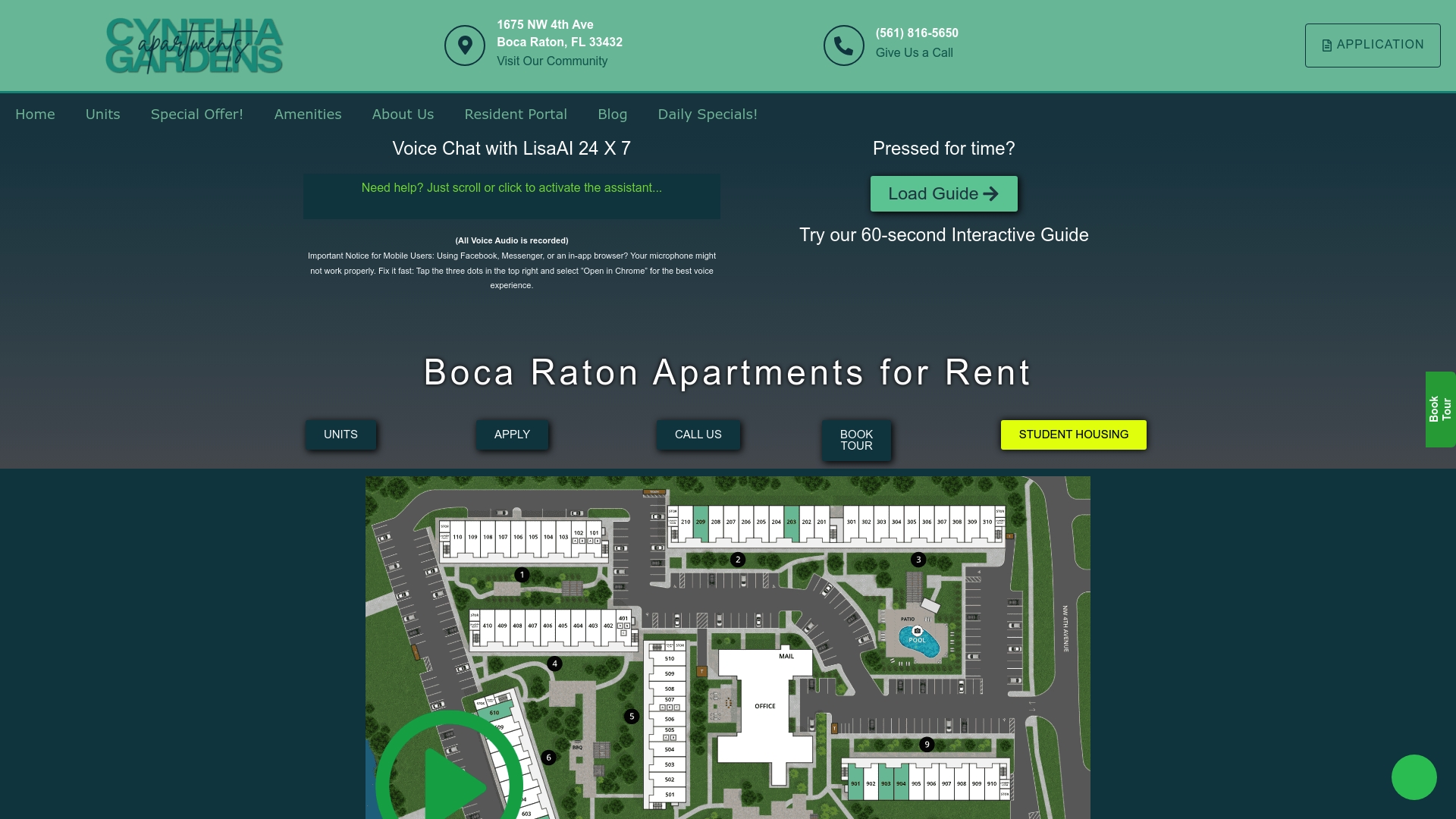
At Cynthiagardens, the one-bedroom apartments in Boca Raton were designed with modern lifestyles in mind. That means real layouts with room to think about how you design a home office, not just where to put a couch. The community offers transparent pricing, no hidden fees, and a tech-forward leasing experience that includes virtual tours and an interactive property map so you can evaluate every unit before you visit.
Explore apartment styles and features to see which layouts give you the most flexibility for a remote work setup. If you are just starting your search, the new apartments guide walks you through exactly what to look for in a work-from-home-ready home.
FAQ
What is the best work-from-home setup for a small apartment?
The most effective setup combines a dedicated work zone (even a corner or closet), an ergonomic chair, and a clear visual boundary between work and living areas. Vertical storage and a foldable desk maximize limited floor space.
How do I separate my workspace in a studio apartment?
Use non-permanent dividers like tension-rod curtains, folding screens, or open-back bookshelves to create a boundary. Translucent options maintain natural light while still providing the psychological separation that supports focus and rest.
Can I have a home office in a one-bedroom apartment?
Yes. A closet conversion, a wall-mounted desk, or a dedicated corner with its own lighting all function as real home offices. The key is consistency: use the space only for work so your brain associates it with focus.
What are renter-friendly wall decor ideas for a home office?
Magnetic photo tiles, peel-and-stick removable wallpaper, Command strip hooks, and tension rods let you personalize your workspace without nails or permanent changes. These options protect your security deposit while still making the space feel intentional.
How much should I spend to set up a work-from-home apartment?
You can build a functional setup for under $300 by prioritizing a quality chair or lumbar support, a simple desk, and basic cable management. Decor and storage upgrades can come gradually without a large upfront investment.
Recommended
- How to Tour Apartments Remotely for Easy Leasing Success
- Apartment organization tips: maximize small spaces in 2026
- Remote Apartment Search: Finding Homes in Boca Raton
- Your Ultimate Work From Home Setup Guide – Luxury Apartments for Rent in Boca Raton | Premium Boca Raton Apartments | Aapartments Boca Raton