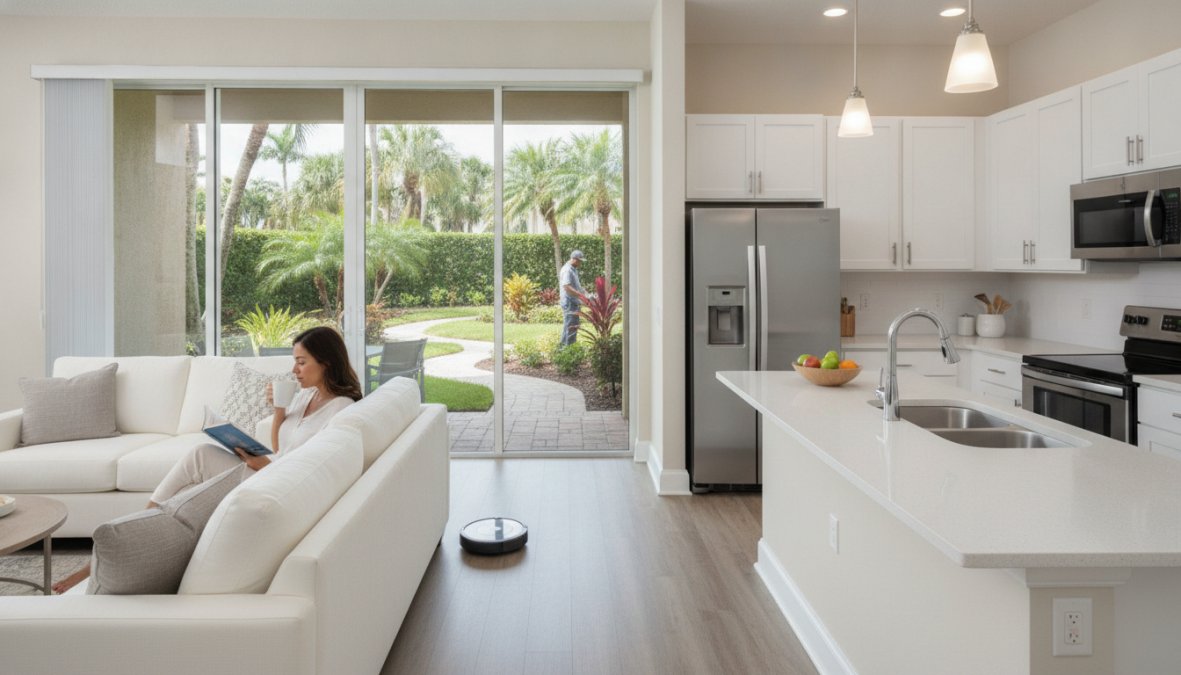
Cynthia Gardens is a residential apartment community in Boca Raton, Florida, offering quiet, garden-style living near Florida Atlantic University, Mizner Park, and Boca Raton’s beaches at 1675 NW 4th Ave, Boca Raton, FL 33432.
Table of Contents
- Why Choose Maintenance-Free Apartment Living: The Essential Benefits
- What Is Included in Maintenance-Free Living
- Benefits of Maintenance-Free Living: Community and Lifestyle
- Pros and Cons of Maintenance-Free Apartments
- Cost of Maintenance-Free Apartments: Understanding the Value
- Maintenance-Free Living in Boca Raton: Finding Your Ideal Community
- Conclusion: Is Maintenance-Free Apartment Living Right for You?
Last Updated: July 21, 2026
Understanding why maintenance-free apartment living appeals to so many people reflects a broader shift in how people prioritize time and mental energy. At Cynthia Gardens in Boca Raton, residents discover how stepping away from homeownership responsibilities transforms not just daily routines, but overall quality of life. This guide explores the genuine benefits of maintenance-free living, what’s included in these communities, and how to determine if this lifestyle suits you.
Why Choose Maintenance-Free Apartment Living: The Essential Benefits
When you opt for maintenance-free apartment living, you gain financial predictability. Unlike homeownership, where a roof replacement costs thousands or an HVAC failure arrives without warning, apartment living comes with transparent, fixed monthly fees covering everything from utilities to maintenance.
The emotional weight of homeownership disappears almost immediately. That nagging worry about foundation settling, gutter cleaning, or system failures vanishes. Instead, you call maintenance and the problem gets resolved, reducing stress significantly.
The time reclaimed is substantial. Lawn care, landscaping, repairs, and maintenance consume dozens of hours annually for homeowners. Maintenance-free living returns those hours to you for hobbies, travel, relationships, or rest.
The real value of maintenance-free living isn’t just outsourcing chores, it’s reclaiming mental bandwidth. When you’re not tracking maintenance schedules or budgeting for surprise repairs, your mind is genuinely freer.
What Is Included in Maintenance-Free Living
Maintenance-free apartment communities vary in offerings, but core services remain consistent. Understanding exactly what’s covered helps you evaluate whether a specific community meets your needs.
Utilities, Housekeeping, and Daily Services
Most maintenance-free communities include utilities in monthly fees: electricity, water, sewer, trash removal, and often internet or cable. This eliminates monthly guessing about usage costs and protects you from rate increases. Housekeeping services typically cover common areas daily or on schedule, with some communities extending interior apartment cleaning to weekly or bi-weekly service.
At Cynthia Gardens, residents enjoy all-inclusive utilities and pristine community spaces. Key question: Are utilities truly all-inclusive, or are there overage charges above a threshold? Some communities cap utility inclusion, charging residents for excess consumption.
Landscaping, Grounds Management, and Accessibility Features
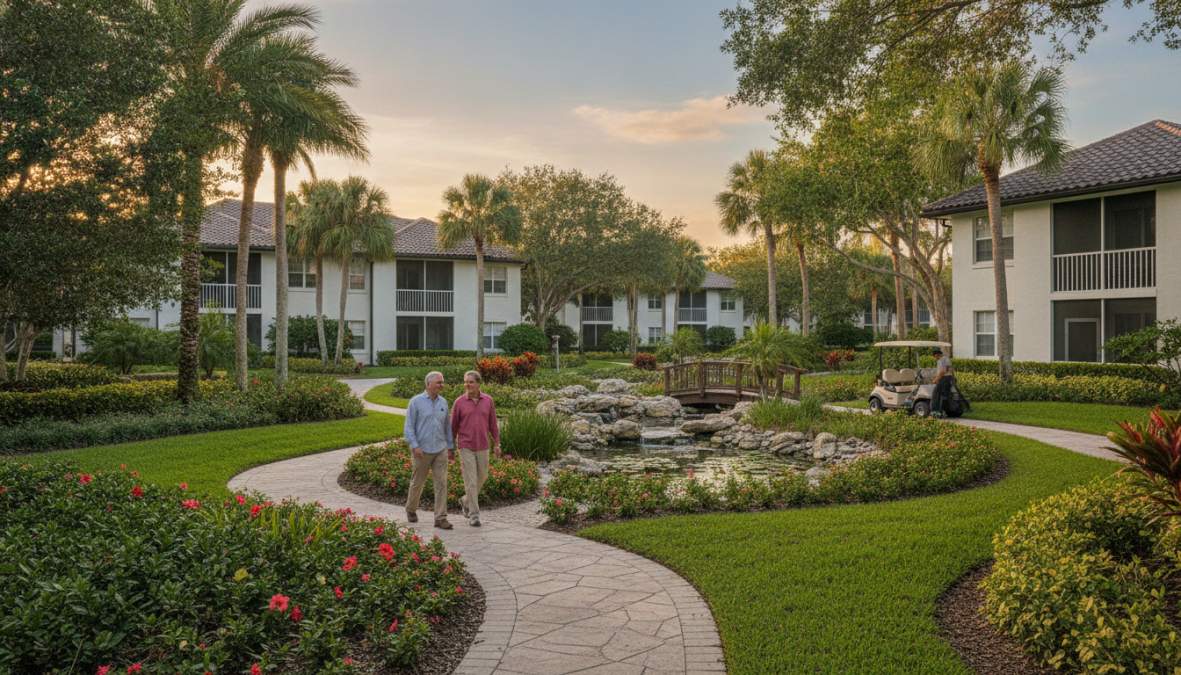
Professional landscaping teams maintain all exterior spaces, lawn mowing, seasonal planting, and general upkeep. In Florida’s climate, this service alone would cost homeowners $1,500-$3,000 annually. Modern maintenance-free communities also maintain accessibility pathways and ensure ADA-compliant walkways are clear and well-lit.
Universal design features define truly excellent maintenance-free living across different life stages and abilities:
- Grab bars and accessible bathrooms: Walk-in showers with non-slip flooring, lever-style faucets, and strategically placed grab bars.
- Accessible parking and entryways: Reserved accessible parking, ramps or level entries, and automatic door openers.
- Smart home and assistive technology: Smart thermostats, voice-activated lighting, and emergency call systems.
- Elevator access and no-step entries: Eliminate stairs and fall risks that homeowners must retrofit at significant cost.
These accessibility features represent hidden homeownership costs. A homeowner installing grab bars, widening doorways, or adding a ramp might spend $3,000-$10,000. In maintenance-free communities, these features are standard and professionally maintained.
Emergency Maintenance and 24/7 Responsiveness
Emergency maintenance is typically available 24/7. A burst pipe at 2 a.m. is handled by professionals without you finding an emergency plumber. Many communities maintain response time guarantees: non-emergency repairs within 24-48 hours, emergency repairs within 2-4 hours.
Ask communities: What constitutes an emergency? Are there after-hours charges? How do you track request status? Communities with transparent, trackable systems tend to have higher resident satisfaction.
Pet-Friendly Maintenance Policies
Most maintenance-free communities allow pets, though policies vary. Some charge additional monthly fees ($25-$75); others implement breed or size restrictions. A truly maintenance-free community for pet owners should include professional carpet cleaning or pet-friendly flooring in base rent, offer designated professionally-maintained pet areas, and have transparent damage policies.
The three pillars of maintenance-free living are predictable costs, professional services, and 24/7 responsiveness. The fourth pillar, universal design and accessibility features built into community infrastructure, is often overlooked but transforms the lifestyle across different life stages and abilities.
Benefits of Maintenance-Free Living: Community and Lifestyle
Advantages extend far beyond eliminating chores. Maintenance-free communities create environments where people naturally connect more deeply.
Access to Community Amenities and Social Engagement
Most maintenance-free communities feature resort-style pools, fitness centers, community dining areas, and social event spaces. These function as the social backbone of the community, encouraging participation in movie nights, fitness classes, and casual gatherings. This built-in social structure is particularly valuable for people transitioning from homeownership, where social connection requires deliberate planning and travel.
The Emotional Transition from Homeownership
Downsizing from a house to an apartment involves emotional shifts beyond logistics. Many people carry deep attachments to homes as repositories of memories and symbols of achievement. However, residents often report that once completed, this transition brings unexpected relief. The emotional burden of maintaining a large property, the responsibility, worry, endless to-do list, lifts. In its place comes freedom.
Accessibility and Universal Design Features
Maintenance-free communities increasingly prioritize accessibility. Elevators, grab bars, accessible parking, and lever-style door handles benefit not just people with mobility challenges but anyone carrying groceries, pushing a stroller, or managing temporary injury. This focus signals that the community has thoughtfully considered resident needs across different life stages.
Pros and Cons of Maintenance-Free Apartments
Key Advantages You’ll Experience
Financially, you gain predictability. Your rent covers utilities, maintenance, landscaping, and amenities. You’re not surprised by a $5,000 roof repair or $2,000 HVAC replacement, making budgeting straightforward and reducing financial anxiety.
Temporally, you reclaim 100+ hours annually, translating to better health, stronger relationships, or meaningful hobbies. Emotionally, you reduce the mental load of homeownership decisions about repairs, contractors, and maintenance schedules, manifesting as lower stress and better sleep.
Potential Drawbacks to Consider
You lose ownership equity, rent payments don’t build equity like mortgage payments do. You have less control over your living environment; you can’t renovate the kitchen or paint the exterior your preferred color. Lease flexibility may be limited, with early termination penalties. Pet policies often carry restrictions or additional fees.
The most common regret among people considering maintenance-free living is underestimating how much they value control over their space. If you need to customize every detail, apartment living may feel constraining.
Cost of Maintenance-Free Apartments: Understanding the Value
Evaluating true maintenance-free living costs requires comparing honestly against actual homeownership expenses, not just the mortgage, but hidden, often-forgotten costs.
The True Annual Cost of Homeownership: A Detailed Breakdown
Homeowners rarely calculate true ownership costs. Beyond mortgage, property taxes, and insurance, expenses are substantial and unpredictable:
| Expense Category | Typical Annual Cost | Notes |
|---|---|---|
| Routine lawn and landscaping | $1,500-$3,000 | Mowing, edging, seasonal planting |
| Gutter cleaning and pressure washing | $300-$600 | 2-3 times annually in humid climates |
| HVAC maintenance | $200-$500 | Annual inspections and filter changes |
| Pest control | $400-$800 | Monthly or quarterly service in warm climates |
| Plumbing and electrical maintenance | $300-$800 | Preventive inspections, minor repairs |
| Appliance repairs and replacement reserve | $500-$1,500 | 10-15 year lifespan |
| Roof inspection and minor repairs | $200-$1,000 | Major replacement $5,000-$15,000 every 20-25 years |
| Painting | $500-$2,000 | Every 5-10 years |
| Subtotal: Routine and Preventive | $3,900-$10,200 | Annual baseline |
| Unexpected repairs | $2,000-$6,000 | Budget 1% of home value annually |
| Time cost (100+ hours) | $2,500 | Opportunity cost |
| Total realistic annual cost | $8,400-$18,200+ | Beyond mortgage, taxes, insurance |
For a $400,000 property, this means $8,400-$18,200 annually in maintenance beyond mortgage payments. Over 20 years, that’s $168,000-$364,000 in hidden costs.
Maintenance-Free Apartment Costs: Predictability vs. Homeownership Variability
A maintenance-free apartment with an all-inclusive monthly fee of $2,200 costs $26,400 annually. Depending on what’s included, this may be comparable to or less than true homeownership costs while eliminating financial unpredictability entirely. The psychological value of knowing exactly what you’ll pay and never facing surprise major repairs is substantial.
Comparative Cost Scenarios: Three Real-World Examples
Scenario 1: The Average Homeowner (Age 65, $400K Home, Florida)
- Mortgage, property taxes, insurance, utilities, maintenance: $2,950/month
- Total: $35,400/year
- Unpredictability: High
Scenario 2: The Maintenance-Free Apartment Resident (Same Age, Similar Location)
- All-inclusive rent: $2,200/month
- Total: $26,400/year
- Unpredictability: None
- Annual savings: $9,000-$12,000
Scenario 3: The Downsizing Homeowner (Selling $400K Home)
- Apartment rent: $2,200/month
- Investment returns on home sale proceeds ($200K net equity at 4%): ~$667/month
- Net housing cost: $1,533/month or $18,396/year
- Plus: 100+ hours annually reclaimed
- Plus: Eliminated financial stress
Scenario 3 reveals why many residents find maintenance-free living financially advantageous when leveraging home sale equity.
Accessibility and Universal Design: The Hidden Cost Homeowners Overlook
Retrofitting a home for accessibility costs significantly:
- Grab bars and safety modifications: $500-$1,500
- Bathroom remodel: $5,000-$15,000
- Ramp installation: $1,500-$3,000
- Stair lift or elevator: $3,000-$15,000
- Smart home safety technology: $1,000-$5,000
- Total: $11,000-$39,000+
In maintenance-free communities, these features are standard and included. This represents a massive hidden advantage for residents planning to age in place.
Pet-Friendly Living: Additional Costs and Considerations
Most maintenance-free communities allow pets with varying policies. For homeowners, pet-related costs include yard maintenance ($200-$500/year), carpet cleaning ($500-$2,000/year), and fencing ($1,500-$5,000 one-time). In truly pet-friendly maintenance-free communities, these costs are absorbed into base rent or minimal pet fees.
The Equity Trade-Off: Rent vs. Build Wealth
Rent payments don’t build equity, but this requires nuance. In the first 5 years of a 30-year mortgage, roughly 80% of payments go to interest, not equity. A homeowner paying $1,500/month might build only $3,000-$5,000 in equity annually after all costs.
A renter paying $2,200/month could invest the difference or enjoy freed-up mental and financial bandwidth. For many residents over 65, peace of mind and time reclaimed outweigh equity-building arguments.
The most common regret is underestimating how much control over space matters or overestimating future equity-building needs. If you’re prioritizing peace of mind, time, and predictability, the financial case for maintenance-free living is strong.
Maintenance-Free Living in Boca Raton: Finding Your Ideal Community
Boca Raton offers several maintenance-free apartment communities. When evaluating options, look beyond marketing materials and assess actual resident satisfaction, maintenance response times, and genuine community engagement.
Cynthia Gardens stands out in the Boca Raton market for refined, welcoming living. The community features modern one-bedroom apartments with high-end finishes, stainless steel appliances, and quartz countertops within a beautiful garden-style setting. The resort-style pool and lush landscaped grounds create an environment where residents naturally gather. Located minutes from FAU and the beach, Cynthia Gardens positions residents perfectly for professional convenience and lifestyle enjoyment.
When evaluating any maintenance-free community in Boca Raton, ask:
- What’s the average response time for non-emergency maintenance requests?
- How long have current residents been living there on average?
- Are utilities truly all-inclusive, or are there hidden charges?
- What happens if you need to break your lease early?
- Can you speak with actual residents about their experience?
Conclusion: Is Maintenance-Free Apartment Living Right for You?
The decision to transition from homeownership to maintenance-free apartment living is significant and not right for everyone. But for people seeking financial predictability, freedom from maintenance responsibility, and community-centered living, it’s transformative.
If you’re drawn to reclaiming time, reducing stress, and enjoying professional maintenance without ownership burden, Cynthia Gardens in Boca Raton offers an ideal entry point. The community combines serene, well-maintained grounds with convenient access to FAU and the beach, ensuring you get both peace and proximity. Schedule a tour today and experience firsthand how maintenance-free living can simplify your daily life while connecting you to a vibrant community.
Frequently Asked Questions
What is included in maintenance-free living?
Maintenance-free living typically includes housekeeping services, utilities, landscaping, grounds management, and responsive maintenance for repairs. Most communities also offer safety features, access to amenities like pools and fitness centers, and transparent costs bundled into a single monthly fee. Specific inclusions vary by community, so it's important to review what each property covers in their all-inclusive package.
Is maintenance-free apartment living cheaper than homeownership?
Maintenance-free living offers financial predictability through fixed monthly fees, eliminating unexpected repair costs that homeowners face. While homeownership includes property taxes, insurance, and unpredictable maintenance expenses, apartment living removes this burden. The true value depends on comparing total costs, but many residents find peace of mind and budgeting certainty worth the investment, especially when factoring in the hidden costs of home maintenance.
What are the benefits of maintenance-free living for busy professionals?
Busy professionals gain significant quality of life improvements through maintenance-free living. You eliminate lawn care, home repairs, and cleaning responsibilities, freeing hours each week for hobbies, social activities, and family time. Financial predictability through fixed monthly fees simplifies budgeting, while community living often provides built-in social engagement and amenities, reducing stress and mental load associated with property ownership.
What are the downsides of maintenance-free apartments?
Potential drawbacks include less control over your living space, monthly fees that may seem high upfront, and possible limitations on customization or pet policies. Some residents find the transition from homeownership emotionally challenging. Additionally, community living means less privacy and potential noise from neighbors. It's important to review lease flexibility, management responsiveness, and actual resident reviews before committing to ensure the community meets your expectations.