
TL;DR:
- The Fair Housing Act bans discrimination in housing sales, rentals, and financing while mandating active efforts to promote fair housing nationwide. It protects seven classes, including race, religion, and disability, and applies broadly to transactions and land-use decisions, with enforcement mainly through HUD, the DOJ, and private organizations. Despite its strength, federal protections can be expanded locally, and timely documentation and awareness are crucial for those facing discrimination.
The Fair Housing Act (42 U.S.C. 3601 et seq.) is the federal law that prohibits discrimination in the sale, rental, and financing of housing and directs federal agencies to affirmatively further fair housing throughout the United States. Two agencies carry primary responsibility for enforcement: the Office of Fair Housing and Equal Opportunity (HUD FHEO) within the U.S. Department of Housing and Urban Development, and the DOJ Civil Rights Division within the U.S. Department of Justice.
The Act’s core protections cover:
- Sale and rental of housing, including apartments, single-family homes, condominiums, and mobile homes
- Mortgage financing and brokerage services, including the secondary mortgage market
- Advertising for housing, whether in print, online, or broadcast
- Housing assistance programs receiving federal funding
- Zoning and land-use decisions that produce discriminatory effects on protected classes
“It is the policy of the United States to provide, within constitutional limitations, for fair housing throughout the United States.” — 42 U.S.C. 3601
Table of Contents
- What does fair housing policy actually cover?
- Who does the Fair Housing Act protect?
- What conduct does the Fair Housing Act forbid?
- How do disability protections work differently?
- When does the Fair Housing Act not apply?
- How does fair housing enforcement actually work?
- How do you file a fair housing complaint?
- What do the numbers say about housing discrimination today?
- Practical tips for tenants and housing providers
- Key Takeaways
- Why fair housing policy deserves more than a passing read
- Useful sources and where to get help
What does fair housing policy actually cover?
The Fair Housing Act was signed on April 11, 1968, one week after the assassination of Dr. Martin Luther King Jr. That timing was not coincidental. Congress designed the law with two distinct purposes: first, to ban discriminatory conduct in housing transactions; second, to impose an affirmative mandate on HUD and all federal executive agencies to actively work toward a nondiscriminatory housing market, not merely refrain from discrimination themselves.
A 1987 federal appellate court decision examined the Act’s legislative history and concluded that the law’s supporters intended it as a means of opening the nation’s housing stock to all persons, regardless of protected status. That “affirmatively further fair housing” (AFFH) mandate has driven decades of regulatory debate and remains central to understanding fair housing policies today.
“This broader goal suggests an obligation that HUD do more than simply not discriminate itself; it reflects the desire to have HUD use its grant programs to assist in ending discrimination and segregation, to the point where the supply of genuinely open housing increases.” — Federal appellate court, 1987 (cited in Congressional Research Service overview)
The settings and transactions the Act covers are broad. Any sale or rental of housing, any mortgage loan or refinance secured by residential real estate, any appraisal, any brokerage service, and any advertising for housing falls within its reach. Federal law sets the floor: state and local laws can expand protections beyond what Congress wrote in 1968, and many do.
Zoning is one area where the Act’s reach surprises people. A municipality that uses zoning ordinances to block group homes for people with disabilities, or that systematically steers affordable housing away from certain neighborhoods, can face a fair housing challenge. The law reaches structural decisions, not just individual transactions.
Who does the Fair Housing Act protect?
The Act protects seven classes of people from discrimination. Congress added to the original list over time: the 1968 law covered race, color, religion, and national origin; sex was added in 1974; disability and familial status followed in 1988.
- Race — any racial group, including multiracial identity
- Color — skin color, which can be distinct from race (a claim may involve discrimination within the same racial group)
- Religion — any religious belief or practice, or lack thereof
- Sex — includes pregnancy discrimination; courts have also interpreted this to cover sexual harassment in housing
- National origin — country of birth, ancestry, or ethnicity
- Familial status — households with children under 18, pregnant people, and those in the process of obtaining custody of a child; HUD FHEO guidance makes clear this protection is broad
- Disability — physical or mental impairments that substantially limit a major life activity, a record of such impairment, or being regarded as having one
Federal law does not expressly prohibit discrimination based on sexual orientation, gender identity, marital status, or source of income. Several bills introduced in the 118th Congress, including H.R. 15 and S. 5, would add these categories, but none have been enacted. Many states and cities have already filled that gap. Florida, for instance, has localities with broader protections than federal law. If you rent or buy in Boca Raton or elsewhere in South Florida, checking your county or city ordinance is worth the five minutes it takes.
Pro Tip: To find out whether your city or county extends fair housing protections beyond the federal seven, search your local government’s website for “fair housing ordinance” or call your local Fair Housing Organization (FHO). The National Fair Housing Alliance (NFHA) maintains a directory of member organizations that can point you to local law.
What conduct does the Fair Housing Act forbid?
Abstract legal language becomes real fast when you see it in practice. The Act prohibits a specific set of behaviors, and each one has a recognizable real-world form.

Refusal to rent or sell is the most obvious violation: a landlord who tells a qualified applicant there are no vacancies when units are available, and does so because of the applicant’s race or religion, has violated the Act. The refusal does not need to be explicit. A pattern of pretextual rejections can be enough.
Different terms and conditions covers situations where a landlord charges higher security deposits, imposes stricter lease terms, or offers fewer amenities to tenants of one protected class than another. The transaction happens, but on unequal terms.
Steering is subtler. A real estate agent who consistently shows Black homebuyers properties only in certain neighborhoods, while showing white buyers a broader range of options, is steering, even if the agent never says anything explicitly discriminatory. The DOJ Civil Rights Division has brought pattern-or-practice cases on exactly this conduct.
Discriminatory advertising is unlawful even when no transaction ever occurs. A rental listing that says “ideal for young professionals” or “perfect for Christian families” signals a preference that excludes protected classes. HUD has issued guidance on advertising language, and the standard applies to online platforms as much as print.
Denial of mortgage financing or different loan terms based on a protected characteristic, a practice historically called redlining, remains illegal. This extends to the secondary mortgage market.
Harassment and hostile housing environments are also covered. A landlord who makes unwanted sexual advances toward a tenant, or who creates a hostile environment based on a tenant’s national origin, violates the Act regardless of whether the tenant is evicted.
“The Fair Housing Act prohibits discrimination in housing because of race, color, national origin, religion, sex, familial status, and disability.” — HUD.gov
Pro Tip: Start a discrimination log the moment something feels wrong. Write down the date, time, what was said or done, who was present, and any contact information for witnesses. Screenshot emails and text messages immediately. This documentation is the foundation of any complaint or lawsuit.
How do disability protections work differently?
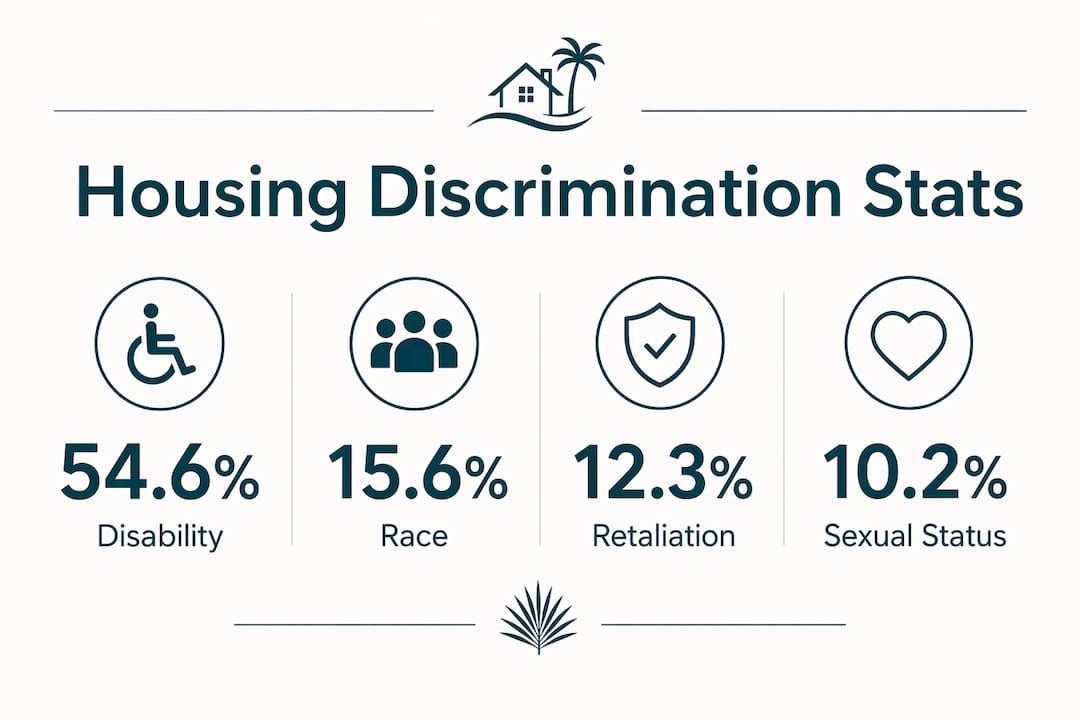
Disability is the single largest category of fair housing complaints filed in the United States, accounting for 54.59% of all complaints in 2024. The rules for disability go beyond simply prohibiting refusal to rent.
Two concepts are central:
- Reasonable accommodation — a change in rules, policies, practices, or services that allows a person with a disability equal opportunity to use and enjoy housing. The classic example: a landlord with a no-pet policy must make an exception for a tenant’s assistance animal when the tenant has a disability-related need for that animal. The animal is not a “pet” under the law, so pet fees and deposits cannot be charged for it.
- Reasonable modification — a structural change to the unit or common areas that a tenant with a disability needs. Installing grab bars in a bathroom, widening a doorway, or adding a ramp are typical examples.
Who pays for modifications? In most private housing, the tenant pays for reasonable modifications. The landlord must permit the work but can require the tenant to restore the unit to its original condition at the end of the lease, within reason. Some state or local programs subsidize modification costs; it is worth asking your local FHO.
The Act also imposes design-and-construction requirements on newly built multifamily housing. Buildings designed for first occupancy after the statutory deadlines must meet specific accessibility standards, including accessible routes, wider doorways, and accessible common areas.
“Determinations about whether an individual with a disability poses a ‘direct threat’ must be individualized, objective, and evidence-based — not based on assumptions or stereotypes.” — DOJ Civil Rights Division guidance
That “direct threat” standard matters. A landlord cannot refuse to rent to someone with a mental health condition by claiming the person is dangerous without conducting an individualized, evidence-based assessment. Speculation and stereotypes do not satisfy the standard.
Common pitfalls:
- Assuming assistance animals are always disallowed because of a no-pet policy — they are not pets under the law
- Thinking a tenant must always absorb the full cost of structural modifications without asking about local assistance programs
- Believing a landlord can deny an accommodation request without engaging in an interactive process with the tenant
When does the Fair Housing Act not apply?
The Act’s exemptions are narrow and fact-specific. Knowing them prevents both over-reliance on protections that do not apply and under-reliance on protections that do.
The HUD FHEO booklet identifies the main federal exemptions:
- Owner-occupied buildings with four or fewer units — a landlord who lives in a duplex, triplex, or four-unit building and rents the remaining units is exempt from most FHA provisions (though not from the prohibition on discriminatory advertising)
- Single-family homes sold or rented by the owner without a broker — a private individual selling their own home without using a real estate agent is exempt, provided they own no more than three such homes and do not use discriminatory advertising
- Private clubs — housing operated by a private membership club for its members is exempt
- Religious organizations — may give preference to members of their religion in housing they operate, provided membership is not restricted based on race, color, or national origin
“Exemptions are narrow and fact-specific; a small owner-occupied property can be exempt in federal terms, but if the building functions like a public rental — advertised widely, managed by an agent — federal protections likely apply.” — HUD FHEO guidance
The housing for older persons exemption deserves its own note. Communities that qualify as “55 and older” housing under the Housing for Older Persons Act (HOPA) may lawfully restrict occupancy to older residents, which means the familial status protection does not apply there. To qualify, at least 80% of occupied units must have at least one resident who is 55 or older, and the community must publish and follow policies demonstrating its intent to be senior housing.
State and local laws may treat these exemptions differently. A small owner-occupied building exempt under federal law may still be covered by a state fair housing statute. Florida’s fair housing law, for example, tracks federal law closely but local ordinances can vary.
How does fair housing enforcement actually work?
Three pathways exist for enforcing fair housing rights: a HUD FHEO complaint, a DOJ action, or a private civil lawsuit. Each has different timelines, triggers, and outcomes.

HUD FHEO is the primary intake point for most individuals. A complaint must be filed within one year of the alleged discriminatory act. HUD investigates, attempts conciliation between the parties, and, if conciliation fails and the complaint has merit, can refer the case to an Administrative Law Judge or to the DOJ for civil litigation.
DOJ Civil Rights Division brings cases in two main circumstances: pattern-or-practice discrimination (a landlord or lender systematically discriminating across many transactions) and referrals from HUD where the case warrants federal court action. The DOJ can also pursue criminal prosecution when force or threats are used to deny fair housing rights.
Private civil lawsuits are an independent option. A victim of housing discrimination can sue in federal or state court without filing a HUD complaint first. The statute of limitations for a private suit is two years from the discriminatory act. Private suits can result in actual damages, punitive damages, injunctive relief, and attorney’s fees.
“DOJ brings cases involving patterns or practices of discrimination and may pursue criminal charges in cases involving force or threats to deny fair housing rights.” — DOJ Civil Rights Division
Remedies available across these pathways include:
- Injunctions — court orders requiring the defendant to stop discriminatory conduct or take corrective action
- Actual damages — compensation for out-of-pocket losses and emotional distress
- Punitive damages — available in private suits where the defendant’s conduct was willful or reckless
- Civil penalties — assessed in administrative proceedings; amounts vary by whether the respondent has prior violations
- Attorney’s fees — available to prevailing plaintiffs in private suits
The one-year filing deadline with HUD is firm. If you suspect discrimination, do not wait to document and file.
How do you file a fair housing complaint?
Filing is straightforward once you know the steps. Here is the sequence:
-
Document everything immediately. Write down dates, times, names, and exactly what was said or done. Save all written communications. Photograph any relevant conditions. Identify witnesses and note their contact information.
-
File with HUD FHEO online, by phone, or by mail. The online complaint portal is at hud.gov/program_offices/fair_housing_equal_opp/online-complaint. You can also call HUD’s Fair Housing hotline at 1-800-669-9777. The complaint must be filed within one year of the discriminatory act.
-
Check whether a state or local Fair Housing Assistance Program (FHAP) agency handles your area. HUD has certified state and local agencies to process complaints under substantially equivalent state laws. Filing with a FHAP agency is equivalent to filing with HUD.
-
Contact a local Fair Housing Organization (FHO). Private nonprofit FHOs processed roughly 75.52% of all complaints in 2024. They often provide faster triage, investigation support, and legal referrals than federal channels alone.
-
Consult a private attorney if your situation warrants it. A private lawsuit can run parallel to or instead of a HUD complaint. If you have strong evidence and significant damages, an attorney experienced in fair housing law can assess whether federal court is the right path.
-
Preserve your evidence throughout the process. Back up digital files in at least two locations. Keep a running log of any new incidents or communications after you file.
Evidence checklist:
- Lease agreements, applications, and rejection letters
- Text messages, emails, and voicemails from the housing provider
- Screenshots of listings or advertisements
- Photos of the unit or property conditions
- Names and contact information of witnesses
- A written timeline of events in chronological order
- Any written denial of an accommodation or modification request
After you file with HUD, expect an initial intake review, followed by an investigation that can take several months. HUD will attempt conciliation. If that fails and the complaint has merit, the case proceeds to an Administrative Law Judge or DOJ referral. Private lawsuits move on their own court schedule.
What do the numbers say about housing discrimination today?
The scale of housing discrimination in the United States is not abstract. The National Fair Housing Alliance (NFHA) reported 32,321 fair housing complaints filed nationwide in 2024, one of the highest totals in recent years.
32,321 fair housing complaints were filed in 2024, with disability representing more than half and race a significant portion of all complaints. — NFHA 2025 Fair Housing Trends Report
| Category | 2024 Complaints | Share of Total |
|---|---|---|
| Disability | 17,645 | 54.59% |
| Race | 5,034 | 15.58% |
| All other bases | 9,642 | 29.83% |
| Total | 32,321 | 100% |
Who processes these complaints matters as much as how many are filed. Private nonprofit FHOs handled approximately three-quarters of all complaints in the most recent year available. FHAP agencies processed 19.26%, HUD itself handled 5.10%, and the DOJ accounted for 0.12%. That distribution means local FHOs are, in practice, the primary enforcement infrastructure for most people who experience discrimination.
NFHA’s 2025 reporting adds a warning: federal funding cuts have forced several community-based FHOs to close, reducing enforcement capacity even as complaint totals rise. For individuals, this means finding and supporting your local FHO before you need it is a practical step, not just a civic one.
Practical tips for tenants and housing providers
For tenants and buyers
- Request accommodations in writing. An oral request is valid, but a written request creates a record. State your disability-related need clearly without necessarily disclosing your diagnosis.
- Know the difference between a pet and an assistance animal. A landlord cannot charge a pet fee or deposit for a legitimate assistance animal. If you face pushback, contact a local FHO or attorney.
- Document suspected discrimination from the first incident, not after a pattern develops. Courts and investigators look at the full record.
- Check local law. Your city or county may protect additional characteristics, such as source of income or sexual orientation, that federal law does not cover. Affordable housing options in your area may be subject to local ordinances that expand your rights.
- Contact your local FHO early. They can advise you before you file, help you gather evidence, and connect you with legal resources.
Pro Tip: If a landlord or agent says something discriminatory verbally, follow up with an email summarizing what was said. “Just confirming our conversation today — you mentioned that the unit is not available to families with children.” This creates a written record without confrontation.
For housing providers
- Use consistent, written screening criteria applied identically to every applicant. Document every decision with the specific criteria that drove it.
- Audit your advertising language. Phrases like “quiet community,” “perfect for couples,” or “ideal for professionals” can signal preferences that exclude protected classes. Stick to descriptions of the unit and its features.
- Create a formal accommodation and modification procedure. When a tenant requests an accommodation, engage in an interactive process, respond in writing, and document your reasoning if you deny the request.
- Train staff regularly. A single employee’s discriminatory statement can create liability for the entire organization. Annual fair housing training is a baseline, not a ceiling.
- Consult counsel before denying an accommodation request. The cost of a brief legal review is far lower than the cost of an administrative complaint or civil suit.
Pro Tip: Standardize your recordkeeping now, not after a complaint arrives. Keep applications, screening decisions, lease terms, and accommodation requests in organized files for at least three years. Consistent records are your best defense and your clearest proof of equal treatment.
Key Takeaways
The Fair Housing Act (42 U.S.C. 3601 et seq.) prohibits housing discrimination across seven protected classes and requires federal agencies to affirmatively work toward equal housing opportunity, with enforcement running through HUD FHEO, the DOJ, private FHOs, and the courts.
| Point | Details |
|---|---|
| Seven protected classes | Race, color, religion, sex, national origin, familial status, and disability are covered under federal law. |
| Disability rules go further | Landlords must permit reasonable accommodations and modifications; direct-threat determinations must be individualized and evidence-based. |
| File within one year | HUD FHEO complaints must be filed within one year of the discriminatory act; private suits allow two years. |
| Local FHOs handle most cases | Private nonprofit fair housing organizations processed about 75.52% of all complaints in 2024. |
| State and local law may expand rights | Many jurisdictions protect additional characteristics; always check your local ordinance. |
Why fair housing policy deserves more than a passing read
Most people treat fair housing law as something they will look up if a problem arises. That is exactly backward. By the time a discriminatory act has occurred, the evidence window is already closing, the filing clock is already running, and the power dynamic has already shifted toward the housing provider.
What strikes me most about the 2024 complaint data is not the total number, 32,321, but the gap between where complaints go and where enforcement capacity actually lives. Three-quarters of complaints are handled by private nonprofit FHOs, organizations that are now losing federal funding even as complaint volumes climb. That is not a bureaucratic footnote. It means the practical infrastructure for enforcing your rights is fragile, locally dependent, and worth knowing about before you need it.
The law itself is genuinely strong. The seven protected classes, the disability accommodation framework, the private right of action, the attorney’s fees provision — these are real tools. But a law is only as useful as the people and organizations equipped to enforce it. For renters in Boca Raton and across South Florida, that means knowing your local FHO, understanding your lease terms, and documenting anything that feels wrong from the first moment.
If you are searching for a rental where fair housing compliance is built into the process, Cynthiagardens offers pet-friendly one-bedroom apartments in Boca Raton with transparent pricing, consistent leasing procedures, and no hidden fees. For complex situations, consult a local fair housing attorney or your nearest FHO — no article replaces professional advice for your specific circumstances.
This article is general information, not legal advice. For guidance on your specific situation, consult a qualified attorney or contact your local fair housing organization.
Useful sources and where to get help
The organizations below are the authoritative starting points for filing complaints, finding legal help, and tracking enforcement trends.
- HUD FHEO Online Complaint Portal — hud.gov/program_offices/fair_housing_equal_opp/online-complaint — File a federal fair housing complaint online; also available by phone at 1-800-669-9777. Best for: initiating a federal complaint.
- DOJ Civil Rights Division — Fair Housing — justice.gov/crt/fair-housing-act-1 — Explains DOJ’s enforcement role, pattern-or-practice cases, and criminal prosecution authority. Best for: understanding DOJ’s scope and referral process.
- National Fair Housing Alliance (NFHA) — nationalfairhousing.org — Publishes annual trends reports and maintains a directory of member FHOs. Best for: finding a local fair housing organization and tracking enforcement statistics.
- Congressional Research Service (CRS) — Fair Housing Act Overview — congress.gov/crs-product/R48113 — Detailed legal overview of the statute, amendments, and pending legislation. Best for: understanding the law’s text, history, and pending changes.
- HUD FHEO Fair Housing Brochure — hud.gov/sites/documents/fheo_booklet_eng.pdf — Plain-language summary of protections, exemptions, and how to file. Best for: sharing with tenants or staff as a quick reference.
- State and Local FHAP Agencies — HUD certifies state and local agencies to process complaints under substantially equivalent laws. Search HUD’s website for the FHAP directory for your state.
- Local Fair Housing Organizations — Your nearest FHO can provide free counseling, help gather evidence, and refer you to legal aid or private attorneys. NFHA’s member directory is the fastest way to find one.
“Housing discrimination is illegal in nearly all housing, including private housing, public housing, and housing that receives federal funding.” — HUD.gov
For readers in the Boca Raton area looking for a rental community with clear, consistent policies, Cynthiagardens’s apartment community rules page outlines how the community operates and what residents can expect from day one.
Recommended
- Affordable Housing for Pet Owners—What Matters Most
- Pet Fee Checklist 2025: What Renters and Landlords Must Know
- What Is Rent Transparency? A Renter’s 2026 Guide
- Find Affordable Housing Apartments for Rent – Luxury Apartments for Rent in Boca Raton | Premium Boca Raton Apartments | Aapartments Boca Raton