Last Updated: November 12, 2026
Quick Summary
Small bedroom lighting works best as layered lighting that combines ambient, task, and accent sources instead of one overhead fixture, so light bounces off multiple surfaces and shadows disappear. Keep ceiling fixtures low-profile and flush-mounted, then add wall sconces, bedside pendants, or plug-in lights to save floor and nightstand space.
- Mount wall sconces 60 to 66 inches from the floor, measured to the center of the fixture.
- A bedroom needs roughly 10 to 20 lumens per square foot for general ambient light.
- Keep color temperature between 2700K and 3000K to keep a bedroom feeling calm.
- In rooms under 120 square feet, keep ceiling fixtures to 12 to 14 inches wide.
- Put bedside and overhead fixtures on separate dimmer switches to control each layer.
Table of Contents
- Why Layered Lighting Beats One Overhead Fixture in a Small Bedroom
- Small Bedroom Ceiling Lighting Ideas That Keep the Room Open
- Bedside Lighting Ideas for Small Bedrooms Without a Nightstand
- Wall Sconces for Small Bedrooms: Where to Mount Them and Why They Work
- Modern Small Bedroom Lighting Ideas for a Clean, Uncluttered Look
- Lumens, Color Temperature, and Dimming: Getting the Light Right
- Lighting Plans for Three Small-Bedroom Layouts
- Renter-Friendly Installation and Electrical Safety
- Frequently Asked Questions
Why Layered Lighting Beats One Overhead Fixture in a Small Bedroom
Small bedroom lighting ideas work best when they spread light across several sources instead of relying on a single ceiling fixture. One overhead light flattens a room, casts shadows into corners, and leaves you with a space that feels smaller than it is. Layered lighting fixes that.
Layered lighting is the practice of combining ambient, task, and accent light so each layer does a different job. Ambient light fills the room. Task light lands where you read or dress. Accent light adds depth along walls and behind the headboard. Layered lighting makes a room with three soft sources read larger than the same square footage under one bright dome.
The reason is simple. Light bouncing off multiple surfaces widens the visual field, and shadows disappear. For renters who want practical storage solutions that pair with a layered setup, our guide to one-bedroom storage ideas that work for renters covers no-drill options.
Small Bedroom Ceiling Lighting Ideas That Keep the Room Open
Ceiling fixtures should sit close to the ceiling and stay visually quiet. A low-profile fixture keeps sightlines clear and stops the eye from catching on hardware overhead.
Flush-Mount and Semi-Flush Fixtures for Low Ceilings
A flush-mount ceiling light hugs the ceiling with almost no drop, which suits rooms with eight-foot ceilings or lower. Semi-flush mount designs hang a few inches below and throw light a bit wider. Choose a shade that matches your wall color so the fixture disappears into the room rather than competing with it.
Bedside Pendants Instead of Table Lamps
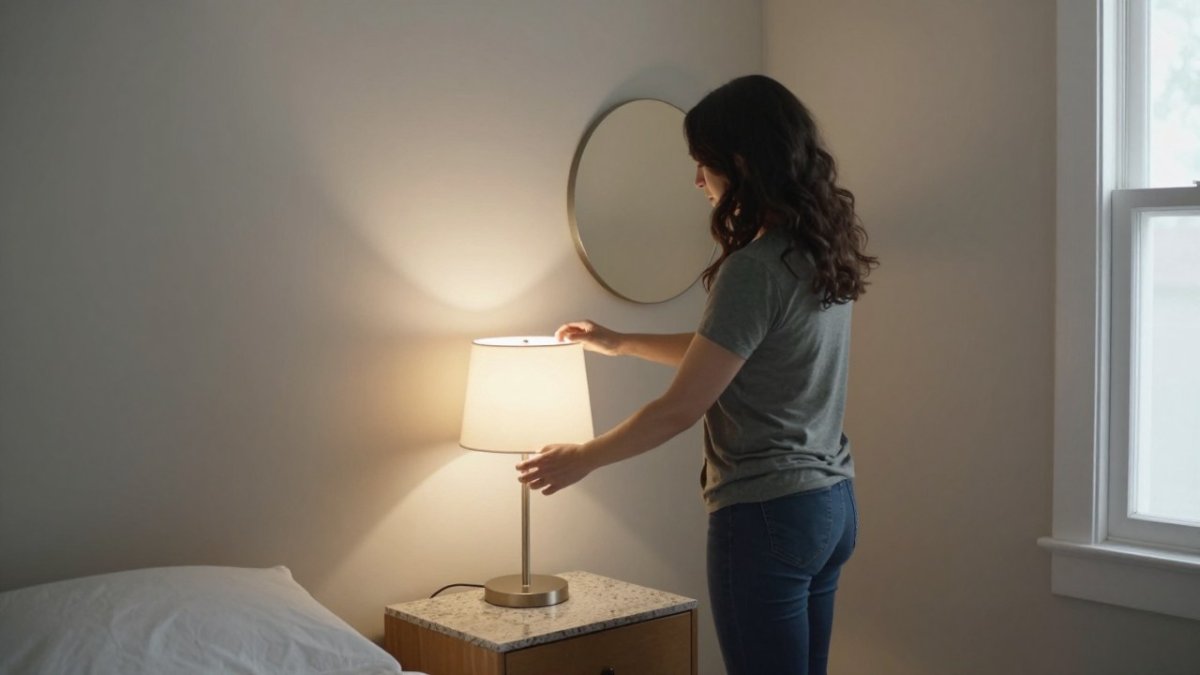
A pendant light hung beside the bed frees the nightstand completely. Suspend it low enough to read by, roughly at eye level when you sit up, and put it on its own dimmer. In a compact room, one well-placed bedside pendant can replace two lamps.
Bedside Lighting Ideas for Small Bedrooms Without a Nightstand
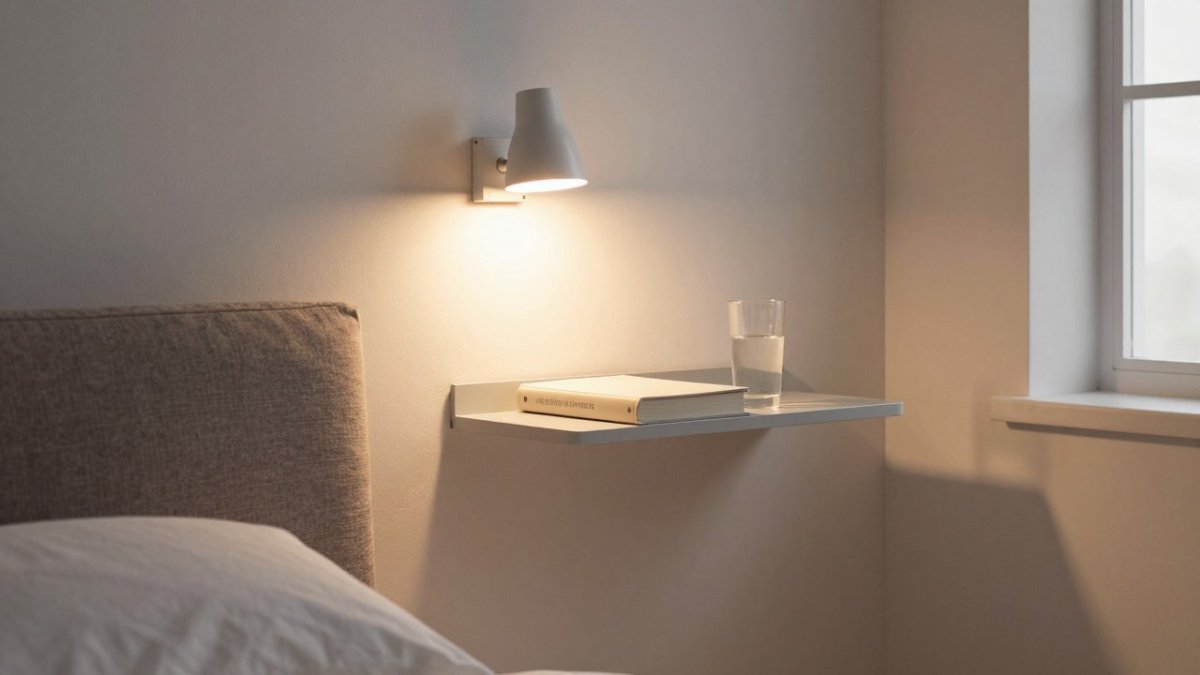
Wall-mounted reading lights solve the no-nightstand problem outright. A swing-arm sconce or a slim LED bar fixed beside the headboard gives you directed task lighting with zero floor footprint.
Mount the fixture about shoulder height when seated, and pick an adjustable arm so the beam lands on your book, not your pillow. A small floating shelf below it can hold a phone and a glass of water, which recovers the surface a nightstand would have provided. If space is tight throughout the room, our guide on how to organize a small bedroom covers the wider storage picture.
Wall Sconces for Small Bedrooms: Where to Mount Them and Why They Work
Wall sconces for small bedrooms work because they use vertical space instead of floor space. Mount them 60 to 66 inches from the floor, measured to the center of the fixture, so the light sits above the mattress and below eye level when standing.
Place sconces in pairs flanking the headboard for symmetry, or use one alone in a corner reading nook. Upward-facing shades bounce light off the ceiling for a softer ambient glow. Downward-facing shades direct light onto a page. Choose the direction based on whether you need task light or atmosphere.
Modern Small Bedroom Lighting Ideas for a Clean, Uncluttered Look
Modern small bedroom lighting ideas favor slim silhouettes and hidden sources, but “clean and uncluttered” only works when the fixtures are specified to the room. A matte black swing-arm sconce with a 1-inch-deep backplate, a paper-thin LED strip tucked behind the headboard, and a scaled-down table lamp with a base under 6 inches in diameter all read as modern because they occupy almost no visual volume. The goal is a clutter-free visual field where every fixture earns its place.
Start with scale. In a room under 120 square feet, a ceiling fixture wider than 12 to 14 inches starts to dominate the ceiling plane. Bedside pendants should have shades no wider than 8 to 10 inches so they do not block sightlines across the bed. A table lamp on a narrow nightstand should top out around 18 to 22 inches tall so the shade sits near eye level when you are seated on the mattress.
Finish and color matter more in small rooms than large ones. Matte black, brushed nickel, and warm brass read as modern without glare; polished chrome and glossy white bounce light and can look busy against a small wall. Match the fixture finish to the door hardware and curtain rod in the room so the eye reads one material story instead of three.
Hidden sources do the heavy lifting in a modern scheme. An adhesive LED strip behind the headboard at 2700K adds a soft glow that makes the wall appear to float, and a dimmable plug-in strip costs far less than a hardwired cove. A slim LED picture light over a single piece of art doubles as accent light without adding a floor or table footprint. That same layered approach can extend to a compact bedside lamp, with LumBrook offering another way to balance a cozy pool of light against the room’s open feel.
Watch out: LED strips with exposed diodes create visible hot spots on the wall. Choose a strip with a diffuser channel or mount it at least 2 inches off the wall surface so the light spreads before it hits paint.
If you are building a multi-use corner in the room, our study nook ideas for a small apartment show how to integrate a desk without crowding the lighting plan.
Lumens, Color Temperature, and Dimming: Getting the Light Right
Match the bulb to the job. A bedroom needs roughly 10 to 20 lumens per square foot for general ambient light, and a reading light wants 400 to 500 lumens focused on the page. For color temperature, warm light in the 2700K to 3000K range keeps a bedroom feeling calm. Cool light above 4000K reads clinical and belongs in a bathroom or kitchen.
Dimming ties the whole scheme together. Put bedside and overhead fixtures on separate dimmer switches so you can drop the ambient layer at night and keep task light where you need it. LED bulbs run cooler and use less energy than incandescent, which matters in a small, closed room.
| Layer | Purpose | Suggested Setting |
|---|---|---|
| Ambient | Fills the room | 10-20 lumens per sq ft, 2700K-3000K |
| Task | Reading, dressing | 400-500 lumens, focused beam |
| Accent | Depth and atmosphere | Low output, dimmable, warm |
Lighting Plans for Three Small-Bedroom Layouts
The right plan depends on the room’s shape. Here are three layouts that work in compact spaces, and our tips for maximizing space in a one-bedroom rental pair well with each.
- Headboard wall layout: a semi-flush ceiling light for ambient, two wall sconces flanking the bed, and one clip-on reading light. Best for rectangular rooms with the bed centered.
- Corner bed layout: a flush-mount ceiling light, one swing-arm sconce over the bed, and a slim floor lamp in the opposite corner. Best for square rooms where the bed tucks into a corner.
- No-nightstand layout: a bedside pendant on a dimmer, an LED strip behind the headboard, and a small accent lamp on a shelf. Best for very tight rooms.
Renter-Friendly Installation and Electrical Safety
Renters should avoid hardwiring anything without written permission from the property manager. Plug-in sconces, adhesive LED strips, and floor lamps deliver most of the layered effect with no drilling and no deposit risk, but the details decide whether the setup is safe and reversible.
Plug-in sconces typically mount with two small screws into drywall or with adhesive-backed brackets, and the cord runs down the wall to the nearest outlet. Choose a model with an in-line switch or a remote so you are not reaching behind the headboard every night. Adhesive LED strips should go on a clean, painted surface, not on textured wallpaper or fresh paint that has not fully cured, or they will peel and take finish with them.
Electrical load is rarely the problem in a bedroom, but outlet count often is. A standard 15-amp bedroom circuit on a 120-volt system supports roughly 1,800 watts, and LED fixtures draw a fraction of that. The real constraint is available outlets: a room with two receptacles may not handle a floor lamp, two plug-in sconces, a phone charger, and a bedside fan at once. A UL-listed power strip with a 15-amp breaker solves the count problem without overloading the circuit.
Cord management is a safety issue, not just an aesthetic one. Run cords along the baseboard or behind furniture, and never tuck them under the mattress or rug where heat can build. For a pendant look without hardwiring, a plug-in pendant hung from a ceiling hook with a swag cord is a common renter workaround, but the cord must clear doorways and walkways.
Watch out: hanging a pendant or adding a hardwired sconce without approval can violate your lease and put your security deposit at risk. If a fixture requires opening a junction box, adding a new switch, or running wire inside the wall, that is electrician work, not renter work, and most leases require landlord approval in writing before any of it begins.
For more reversible upgrades, see our guide on how to upgrade a rental kitchen without renovation.
Boca Raton renters deserve a home where the light works as hard as the layout does. At Cynthia Gardens, our modern one-bedroom apartments feature stainless steel appliances, quartz countertops, and a garden-style setting minutes from FAU and the beach, all with maintenance-free living that lets you focus on everything else. Schedule a tour today and see how a well-planned space feels.
Frequently Asked Questions
How do you light a small bedroom without making it feel cramped?
Use three layers instead of one bright ceiling fixture. A flush-mount or semi-flush ceiling light provides ambient lighting, a wall sconce or bedside pendant handles reading, and a slim accent light adds warmth. Keep fixtures scaled down and close to the wall so they do not eat into visual space. Dimming controls let you shift from bright task lighting to a cozy atmosphere at night without adding more fixtures.
What type of lighting makes a small bedroom look bigger?
Light aimed at walls and ceilings makes a compact room read larger. Wall sconces, bedside pendants hung close to the headboard, and flush-mount ceiling lights that push light upward all expand the sense of visual space. Avoid a single low-hanging fixture that draws the eye down. Warm light around 2700K to 3000K also keeps a small room feeling open and comfortable rather than cave-like.
Are wall sconces a good idea for small bedrooms?
Yes. Wall sconces for small bedrooms free up nightstand and floor space because they mount directly to the wall. Place them about 48 to 60 inches above the floor, or roughly at shoulder height when sitting up in bed, and choose a slim silhouette that projects only a few inches. Hardwired sconces look cleanest, but plug-in versions and battery models work well for renters who cannot modify the walls.
How many lights should a small bedroom have?
Three to four light sources cover most small bedrooms: one ambient ceiling fixture, two bedside lights, and one optional accent such as a slim floor lamp or a small table lamp. More sources at lower brightness beat one bright fixture because you can layer ambient, task, and accent lighting separately. Put everything on dimmers or smart bulbs so the room shifts from functional lighting in the morning to a cozy atmosphere at night.
