
Your rent-to-income ratio is your monthly rent divided by your gross monthly income (before taxes), multiplied by 100. Most landlords want that number at 30% or lower, which is why many ask for income of roughly three times the rent. The ratio is a useful first filter, but it does not tell you whether a lease will feel comfortable once utilities, debt and savings are counted. This guide shows the math, three worked examples, and what to check beyond the percentage.
TL;DR
- Rent-to-income ratio = monthly rent ÷ gross monthly income × 100. A good ratio is 30% or less.
- The 30% rule is a starting point. Judge affordability by what is left after rent, not by the percentage alone.
- At 40% you are above the usual guideline but below the 50% line financial planners warn about, so a tight budget needs a plan.
- Budget for move-in costs too: application, administration and pet fees add up before your first month begins.
- Rent reporting can turn on-time payments into credit history, but only some services report to all three bureaus.
Table of Contents
- What the rent-to-income ratio measures
- Why 30% became the rule
- How landlords use the ratio in screening
- Worked examples: how much rent can I afford?
- Is it bad if rent is 40% of your income?
- The ratio ignores what you actually take home
- Costs the ratio leaves out
- Perspective: what we see from the leasing side
- See what fits at Cynthia Gardens
- Ways to lower your ratio
- Rent reporting: turning on-time rent into credit history
- A quick checklist before you sign
- FAQ
- Sources
What the rent-to-income ratio measures
The ratio answers one question: what share of your pay goes to the landlord every month? It uses gross income, meaning what you earn before taxes and deductions. Landlords prefer gross income because it is easy to verify on a pay stub or offer letter.
The formula:
Rent ÷ gross monthly income × 100 = rent-to-income ratio
Say you earn $5,000 a month before taxes and a one-bedroom costs $1,500. Divide 1,500 by 5,000 and you get 0.30, so your ratio is 30%.
You may also see the flip side, usually called the income-to-rent ratio. It asks how many times your income covers the rent. Income of $5,000 against $1,500 rent is about 3.3 times the rent. Same facts, expressed as a multiple instead of a percentage. A 30% ratio and a 3.33x multiple are the same thing.
Why 30% became the rule
The 30% figure is older than most renters. Earnest traces it to 1969 public housing rules that capped rent at 25% of a tenant’s income, later raised to 30%. It then spread into lending, leasing and personal finance advice.
It survives because it is simple. But a rule built for one housing program says nothing about your student loans, your car payment or whether your city has $15 gym memberships or $150 ones. A National Low Income Housing Coalition researcher quoted by CNBC suggests judging affordability by whether enough income remains after housing to pay for everything else, rather than treating 30% as a hard line.
How landlords use the ratio in screening
When you apply, the leasing office is checking whether the rent is sustainable on your income. Two formats are common.
- A percentage cap. Rent may not exceed about 30% of gross monthly income.
- A multiple of rent. Income must be about 3x the monthly rent. Some landlords state it annually, and the American Apartment Owners Association notes that about 40 times the monthly rent is a common annual requirement.
The requirements vary by property, so read the criteria before you pay an application fee. If your income is irregular or comes from several places, our guide to proof of income for renters lists the documents that usually satisfy a leasing office. Credit is the other half of screening, and our page on the credit check for renters in Florida explains how it affects applicants.
Worked examples: how much rent can I afford?
Here is the math at three salary levels, using the 30% guideline and a stretched 40% ceiling.
| Annual gross income | Monthly gross | Rent at 30% | Rent at 40% |
|---|---|---|---|
| $45,000 | $3,750 | $1,125 | $1,500 |
| $60,000 | $5,000 | $1,500 | $2,000 |
| $75,000 | $6,250 | $1,875 | $2,500 |
| $90,000 | $7,500 | $2,250 | $3,000 |
Take the $75,000 salary people often ask about. Divide by 12 to get $6,250 a month. Multiply by 0.30 and the guideline rent is $1,875. U.S. News describes this the same way: no more than 30% of gross monthly income, as a rule of thumb rather than a law.
Working backward from a specific apartment
The opposite question is often more useful: what do I need to earn for a particular rent? Divide the rent by 0.30, then multiply by 12.
Our one-bedroom apartments in Boca Raton are listed at $1,990 to $2,220 per month. Here is the income each rent needs at different ratios:
| Monthly rent | Income needed at 30% | At 35% | At 40% |
|---|---|---|---|
| $1,990 | $79,600 a year | $68,229 a year | $59,700 a year |
| $2,220 | $88,800 a year | $76,114 a year | $66,600 a year |
These figures show why the 30% guideline and the “40 times the rent” screening rule land in the same place: 40 × $1,990 is $79,600, and 40 × $2,220 is $88,800. If your income sits between the 30% and 40% columns, you are in the zone where the rest of your budget decides the answer.
Is it bad if rent is 40% of your income?
Not automatically, but it leaves less room for error. CNBC’s housing guidance describes 40% as above the usual 30% guideline but below the 50% red line. In the same article, a certified financial planner calls spending half your income on housing a red line, while another says 35% to 39% can work for many households in high-cost areas if they take steps to get back toward 30% over time.
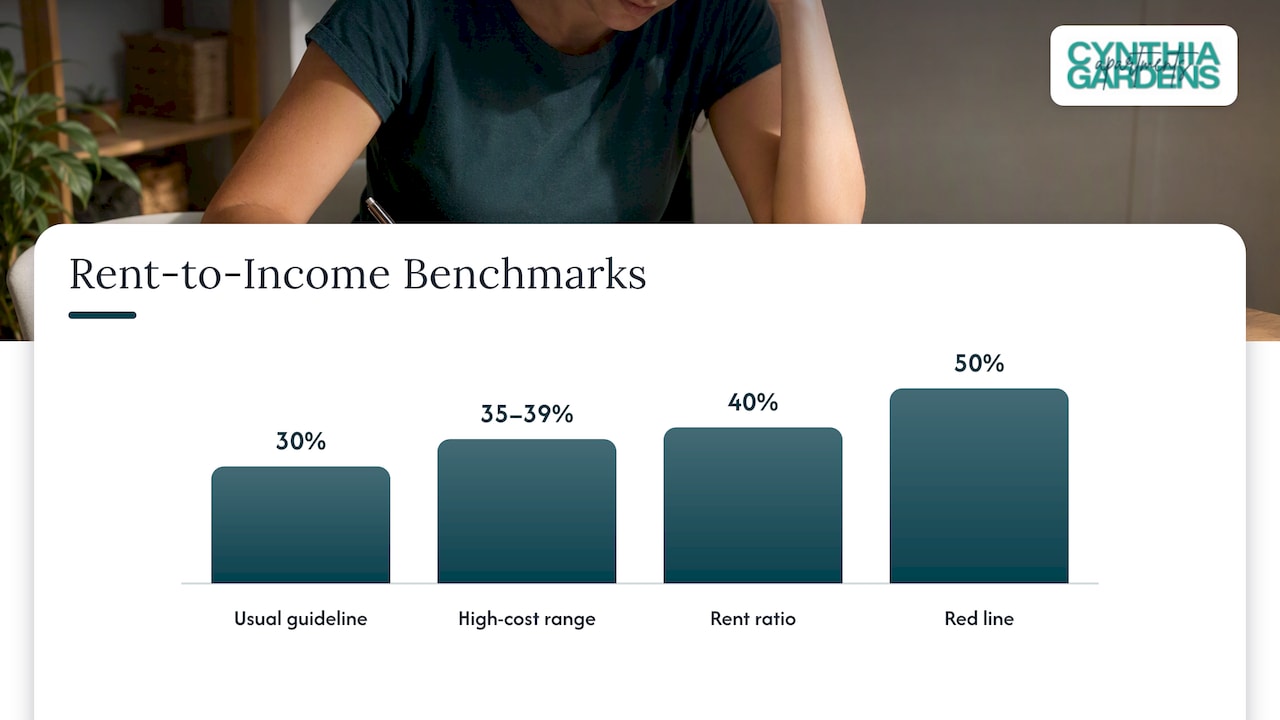
Two cautions apply. First, housing costs do not shrink if you lose a job or a shift. Second, a 40% ratio that comes with no debt and a healthy emergency fund is a very different situation from 40% with a car loan and credit card balances.
If you are at 35% to 40%, consider these questions:
- Do you have three months of essential expenses saved?
- Is your income steady, or does it depend on commissions or hours?
- Can you reduce another big cost, such as transportation, to compensate?
- Is a raise or a second income likely during the lease term?
If you can answer yes to most, a higher ratio may be workable. If not, a lower rent is the safer choice.

The ratio ignores what you actually take home
The ratio uses gross pay, but you pay rent from net pay. Someone earning $6,250 a month gross might take home roughly $5,000 after taxes and deductions, depending on withholding, benefits and retirement contributions. Rent of $1,875 is 30% of the gross but closer to 37% of what lands in your bank account.
NerdWallet suggests a more practical sequence: list what remains after utilities, debt payments and savings goals, research your local market, set a rent range, then stress-test it before you sign. Try the stress test with a real month: subtract rent, then your actual bills, debt minimums, groceries, transportation and the savings you want to keep. If the remainder is negative or razor-thin, the rent is too high no matter what the percentage says.
What about the 50/30/20 rule?
The 50/30/20 rule puts 50% of after-tax income toward needs, 30% toward wants and 20% toward savings, as Chase describes it. It is a good framework for the whole budget, but it is not a rent rule. NerdWallet’s point is that rent competes with groceries, insurance, utilities and minimum debt payments inside the same 50% bucket. So tally your actual needs first, then see how much room rent really has.
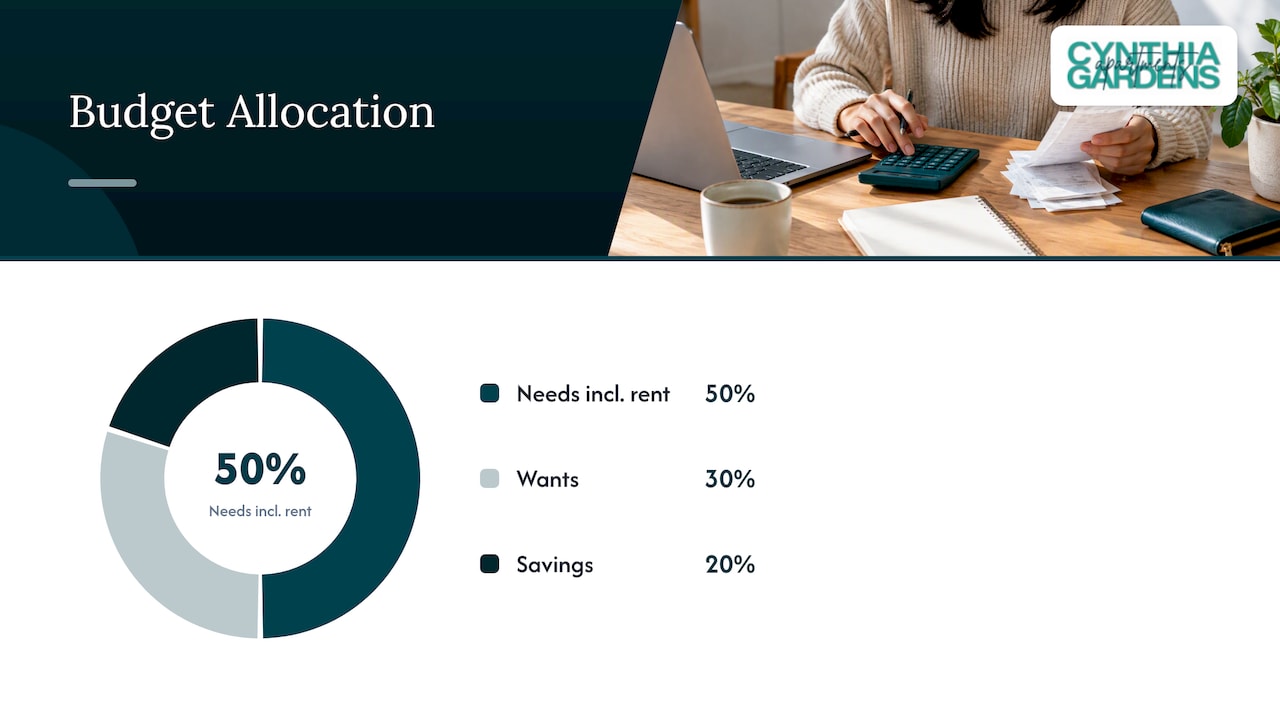
For more budgeting methods tailored to local renters, see our posts on how to budget for rent and budgeting for your first apartment.
Costs the ratio leaves out
Advertised rent is only one line. Freddie Mac notes that utilities, renters insurance, parking, amenity fees, pet costs, moving costs, application fees and the security deposit can materially raise what housing costs you. Before comparing apartments, add these to the monthly figure and to your savings target for move-in.
Application fees are a good example. The CFPB reports that application fees often run $40 to $59 and are frequently paid even if the application is rejected, which is a reason to confirm the income criteria before you apply anywhere.
At Cynthia Gardens, we publish our one-time fees so you can add them up in advance:
| Fee | Amount |
|---|---|
| Non-refundable application fee | $75 per applicant |
| Administration fee | $300 |
| Non-refundable pet fee | $300 to $500 per cat |
| Wire transfer fee | $15 |
| Transfer fee | $500 |
For one applicant with one cat, the application and administration fees come to $375, and the pet fee adds $300 to $500, so $675 to $875 in one-time charges. The wire fee applies only if you pay that way, and the transfer fee only if you move. You can see the full list on our fees page. For furnished stays, our guide to furnished apartment costs covers how the budget changes.
Perspective: what we see from the leasing side
We talk with a lot of renters who have run the 30% math and then stopped. The percentage tells you whether you can qualify. It does not tell you whether you will be comfortable. The students, young professionals and cat owners we lease to tend to have a few big fixed costs, such as a car, loans or a pet, and these decide the outcome more than the ratio does.
Our approach is to put every number on the table early. The rent range, the application fee, the administration fee and the one-time cat fee are all published, and we do not charge ongoing pet rent. When you know the whole cost before applying, you can run the ratio on the real figure instead of a headline price, and you avoid paying to apply for a place that does not fit. If a unit puts you at 35% and you have a plan for it, tell us. If it puts you at 45%, we would rather you wait for a better fit.
— Ayman
See what fits at Cynthia Gardens
If the numbers above point to a rent around $2,000, our one-bedroom apartments in Boca Raton are listed at $1,990 to $2,220 per month, with transparent pricing and no hidden fees. You can tour online, use the interactive property map, and ask our AI chat or voice assistant how a specific unit fits your budget.
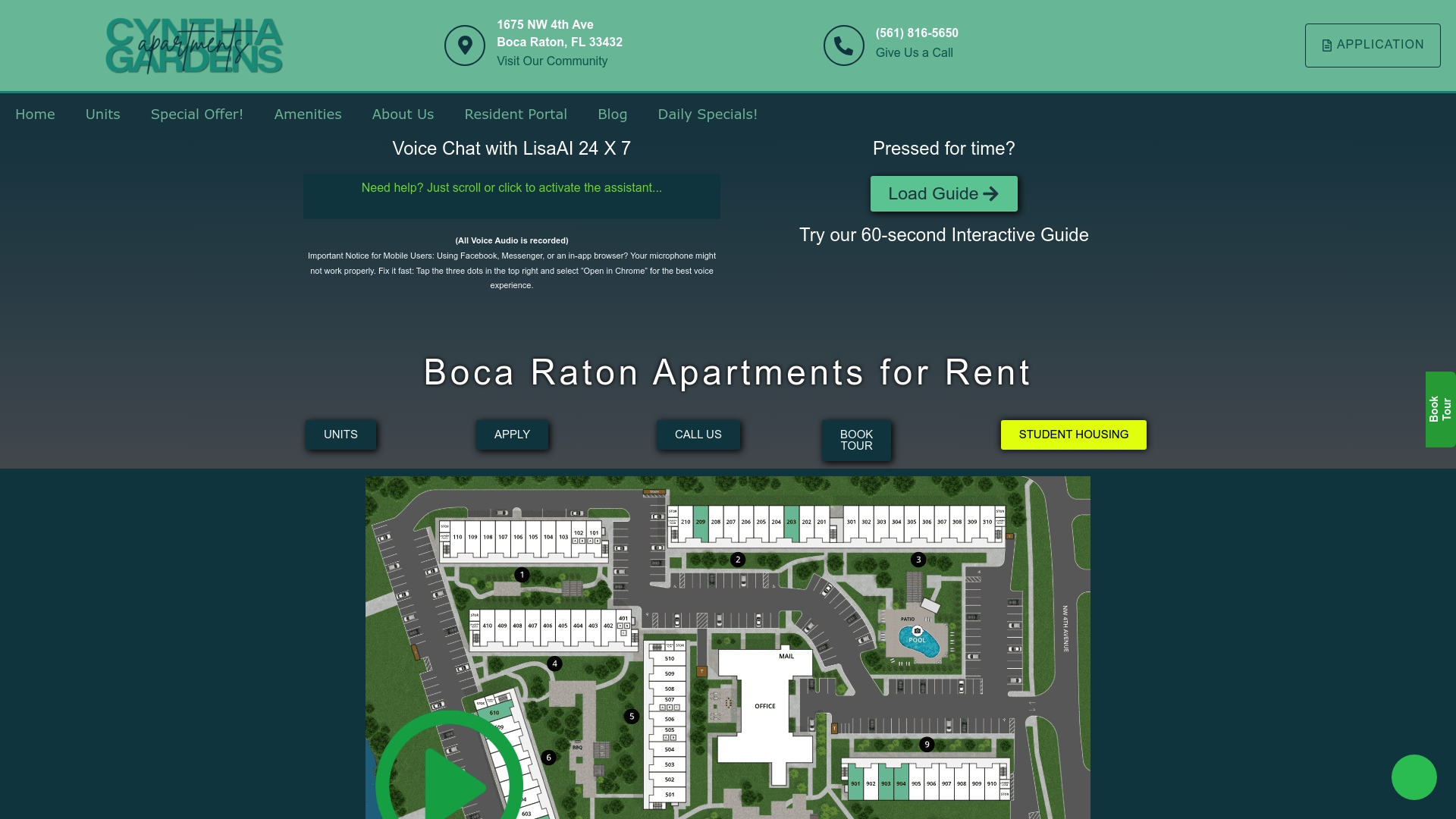
Cat owners pay a one-time fee instead of monthly pet rent, which keeps the recurring ratio cleaner. Browse the pet-friendly one-bedroom options or start from the unit listings.
Ways to lower your ratio
If the apartment you want is above 30%, you have several levers.
- Raise the denominator. Document all income: a second job, freelance work, a stipend or a co-applicant’s pay. A dual-income household can reasonably carry a higher rent.
- Lower the numerator. Compare floor plans, lease terms and locations. Our tips for finding cheaper one-bedrooms in Boca Raton can help.
- Cut other fixed costs. Paying down a car loan or card balance frees more monthly cash than a few dollars off rent.
- Strengthen the application. A stronger credit profile can matter when income is close to the line. See how to improve your credit score for renting.
Rent reporting: turning on-time rent into credit history
Many renters pay thousands of dollars on time each year and get no credit for it. Rent reporting services collect payment data and pass it to credit bureaus so it can show up in your history. According to Experian, fees range from free to monthly subscriptions, with some options free to renters when the landlord pays or through specific features.
Know the limits before you sign up:
- Not every service reports to all three bureaus. Experian explains that positive rental history may only affect scores calculated with that bureau’s data.
- Rent is not a loan. Experian’s own FAQ notes rent is a service payment rather than a credit product, so it is different from a card or loan payment.
- Late payments can be reported too. Reporting records your history, good or bad, so use it only if you pay reliably.
- Screening reports often miss rent history. The CFPB cites industry estimates that only 1.7 to 2.3 percent of renters have rental payment history included in standard tenant screening reports.
When comparing options, check which bureaus receive your data, what you pay each month, whether past payments can be added, and whether your landlord must enroll. Ask your landlord first, since some arrangements require their participation. Which score models your future lender uses matters too, because not all of them use every bureau’s data.
A quick checklist before you sign
- Divide the rent by your gross monthly income and confirm it is near or below 30%.
- Divide it again by your net income to see the real burden.
- Add utilities, renters insurance, parking and pet costs to the rent.
- Total the one-time fees and deposit and confirm you can cover them without draining savings.
- Stress-test the budget with a month of lower income.
- Confirm the landlord’s income and credit criteria before you pay an application fee.
For a deeper local walkthrough, our budgeting tips for renters in Boca Raton put the same steps into practice.
FAQ
What is a good rent-to-income ratio?
A good ratio is 30% or less of your gross monthly income. Many landlords use that as their screening line. If you have little debt and strong savings, a somewhat higher ratio can work, but 30% is the safest starting point.
How much rent can I afford on $75,000 a year?
Your gross monthly income is $6,250, so 30% gives a rent of about $1,875. At 40% the figure is $2,500, which leaves much less room for savings and surprises. Check your take-home pay and fixed bills before you decide where in that range to land.
Is it bad if rent is 40% of my income?
It is above the common guideline but below the 50% level planners call a red line. It can work with steady income, low debt and savings. If your income is variable or you carry heavy debt, aim lower.
Is the 50/30/20 rule good for rent?
It works as a general budget, not as a rent calculator. Rent sits inside the 50% needs bucket with utilities, groceries, insurance and minimum debt payments. Total your real needs first, then see how much rent that bucket can absorb.
Does paying rent on time help my credit?
Only if your rent is reported to a credit bureau, and only for scores that use that bureau’s data. Ask whether your landlord participates in reporting or whether a separate service is an option, and compare fees and the bureaus covered.
Sources
- What Is a Good Rent-to-Income Ratio? (WalletHub)
- How Much of Your Income Should Go to Rent? (NerdWallet)
- How to figure out what you can spend on rent (CNBC, 2023)
- How much to spend on housing, depending on your salary (CNBC, 2024)
- How Much of Your Income Should Go to Rent? (U.S. News)
- How much should I spend on rent? (Earnest)
- Rent to Income Ratio: Formula, 30% Rule, and 3x Rent Guide (AAOA)
- Understanding what you can afford to rent (Freddie Mac)
- How Much of Your Income Should Go to Rent? (Chase)
- Tenant Background Checks Market Report (CFPB, 2022)
- How to Choose a Rent Reporting Service (Experian)
- What Is Experian RentBureau and How Does It Work?
- Rent reporting frequently asked questions (Experian)