
A pet cleaning fee is a charge a landlord, host or business adds because an animal will be on the property. In apartments it usually shows up as a one-time, non-refundable pet fee paid at move-in. Short-term rentals and car rentals use the same words for a different charge: a cleaning fee added after a stay if pet hair or mess is found. Which one you face depends on where you rent. This guide covers all of them, with the most detail on apartments in Florida.
TL;DR
- In an apartment, a “pet cleaning fee” is normally a one-time, non-refundable pet fee. It is not the same thing as a refundable security deposit or monthly pet rent.
- Property managers commonly charge between $150 and $300 per pet, and luxury buildings can charge more. Always get the exact amount in writing before you sign.
- In Florida, a landlord can charge for damage beyond normal wear and tear, but must send written notice within 30 days of move-out to claim part of a deposit.
- Assistance animals (service dogs and emotional support animals with a valid request) are not pets under federal housing rules, so pet fees, deposits and surcharges cannot be charged for them.
- At Cynthia Gardens in Boca Raton, the pet fee is a one-time $300 to $500 per cat, with no ongoing pet rent.
Table of Contents
- What a pet cleaning fee actually is
- What pet fees typically cost
- The math over a one-year lease
- Florida rules on cleaning charges and deposits
- Assistance animals are not pets
- How to avoid a disputed pet charge
- Our perspective: why we charge one fee and no pet rent
- Renting a one-bedroom with a cat in Boca Raton
- Pet cleaning fees outside of apartments
- FAQ
- Sources
What a pet cleaning fee actually is
The phrase is used loosely, so start by separating three different charges that all get lumped together.
| Charge | When you pay | Refundable? | What it is for |
|---|---|---|---|
| Pet fee (often called a pet cleaning fee) | Once, at move-in | No | Extra cleaning, wear and the added risk of having an animal in the unit |
| Pet deposit | Once, at move-in | Usually, minus documented damage | Covers damage a pet actually causes |
| Pet rent | Every month | No | A recurring premium on top of rent |
Housing providers charge pet fees and deposits to cover the added wear and tear or damage that often comes with pets, according to the Florida Department of Agriculture and Consumer Services landlord-tenant guidance. The important word is “non-refundable”. A pet fee is a cost of keeping the animal. You do not get it back if the unit is spotless, and the landlord does not need to prove damage to keep it.
A deposit works the other way. It is your money held as security, and the landlord can only keep what is justified by actual damage. If you want a deeper comparison of the three structures, our guide on pet deposit versus pet rent for Boca renters walks through the math over a full lease.
What pet fees typically cost
Numbers vary widely by property type, so treat any average as a range rather than a rule.
- Apartments: one landlord guide puts the typical one-time pet fee at $150 to $300, with luxury apartments sometimes charging $300 to $500. Treat that as a ballpark.
- Monthly pet rent: many landlords charge a recurring premium, often $25 to $50 a month, according to a June 2026 landlord guide.
- Short-term rentals: hosts commonly charge a pet fee in the range of $25 to $150 per stay.
- Car rentals: renters report charges of $125 or more for pet hair, and disputes over a handful of hairs are common.
The gap between a $75 fee and a $500 fee is not random. Larger animals, multiple pets, older buildings with carpet and newer buildings with premium finishes all push the number up or down.
Why the fee is charged up front
A landlord cannot predict whether your cat will scratch a door frame or leave odor in the carpet. A flat fee spreads that risk across every pet household and covers routine extras: deeper carpet cleaning, odor treatment, air filter changes and allergen removal before the next resident moves in. That is the logic behind it, and it is why you should not expect a refund at move-out.
The math over a one-year lease
The sticker price of a fee tells you little. Compare the full first-year cost.
- Option A: $400 one-time fee, no monthly pet rent. First-year pet cost: $400.
- Option B: $150 one-time fee plus $35 a month in pet rent. First-year pet cost: $150 + (12 x $35) = $570.
- Option C: $300 refundable deposit plus $25 a month in pet rent. First-year pet cost: $600, of which $300 might come back.
These are illustrations, not quotes from any property. They show why a higher up-front fee with no recurring charge can be the cheaper arrangement for a renter who plans to stay a year or more. Our piece on whether pet rent is worth it goes into that trade-off.
Florida rules on cleaning charges and deposits
Florida does not cap pet fees in the sources we reviewed, so the amount is set by the landlord and your lease. What the state does regulate is how a landlord handles your security deposit when you leave.
Damage versus normal wear and tear
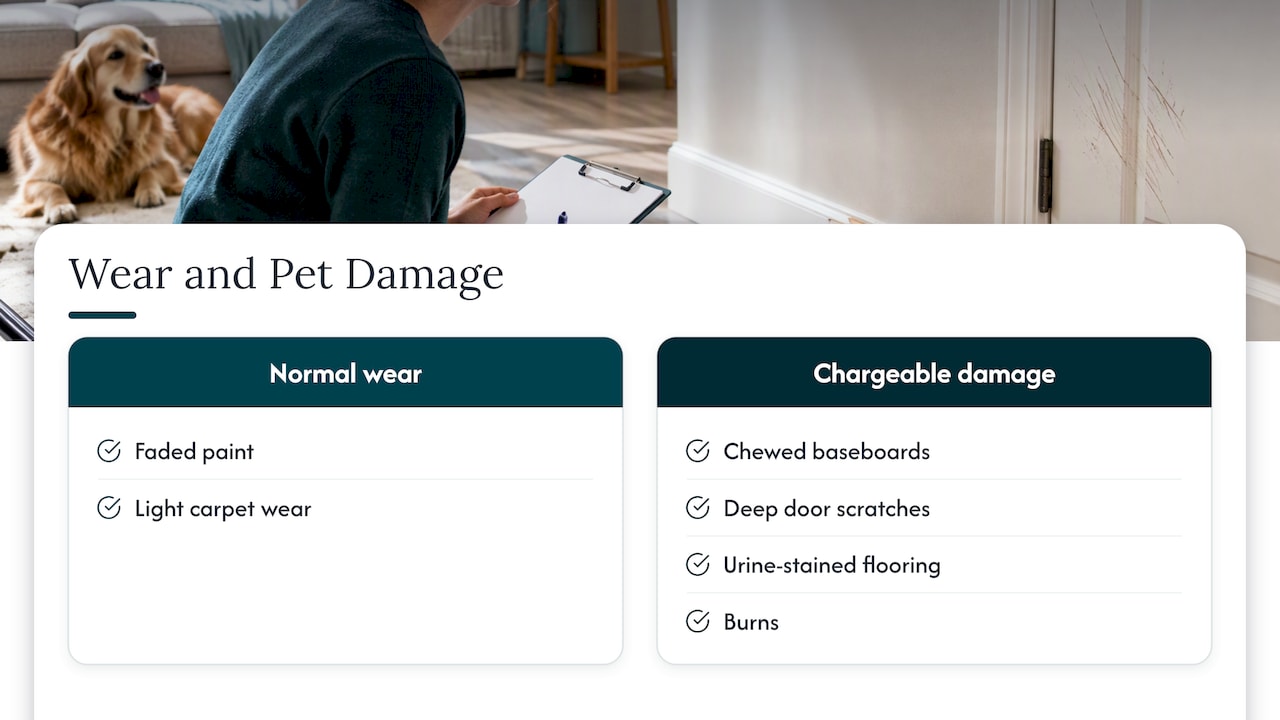
A tenant can be charged for cleaning or repairs when a pet causes damage that goes beyond normal wear and tear, per the state’s landlord-tenant guidance. Faded paint and light carpet wear are normal. Chewed baseboards, deep scratches in doors, urine-stained flooring and burns are not.
The 30-day and 15-day clocks
If a landlord intends to keep any part of a security deposit, written notice must go out within 30 days of the end of the lease, stating the reason. The tenant then has 15 days to object in writing. The statutory notice text, reproduced in Section 83.49 of the Florida Statutes, also says a landlord who misses the 30-day window must return the deposit but may still sue later for damages. So a missed deadline does not erase every claim, but it removes the easy route of simply deducting from your deposit.
Two practical points follow:
- Give your landlord a forwarding address in writing when you move out, so the notice reaches you.
- If you disagree with a claim, object in writing inside the 15 days. Silence lets the landlord collect the claim.
Fees in lieu of a deposit
Florida also lets landlords offer a fee in place of a security deposit. Under Section 83.491, that fee can be a recurring monthly charge or paid on a schedule agreed between landlord and tenant. This is separate from a pet fee, but the two can appear together on a lease, so read each line.
Assistance animals are not pets
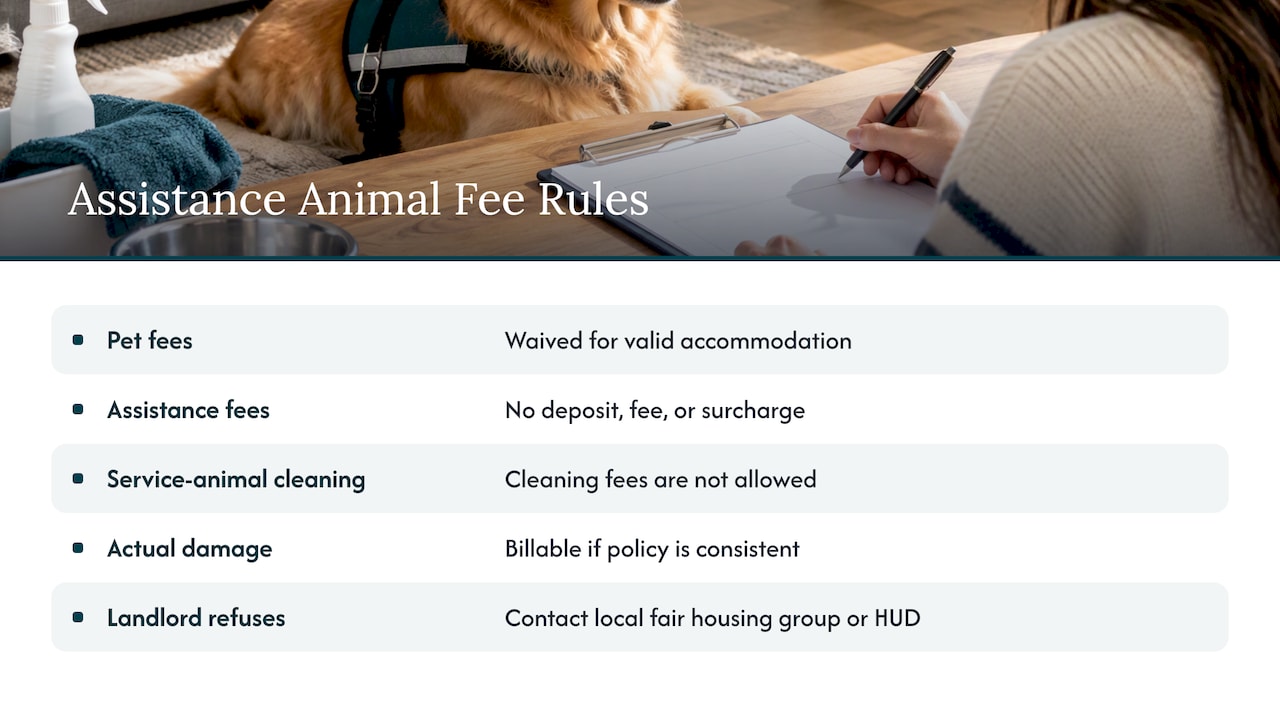
This is the part many renters and even some property managers get wrong. Under the Fair Housing Act, an assistance animal is not a pet. HUD’s guidance explains that a reasonable accommodation can include waiving a pet deposit or fee, and that providers cannot charge a deposit, fee or surcharge for an assistance animal even when they routinely charge for pets. That covers both service dogs and emotional support animals when the accommodation request is valid.
HUD’s own voucher-program chart makes the same point: owners are prohibited from charging fees or deposits as a condition of allowing an assistance animal.
There is a limit. The ADA guidance for businesses says a cleaning fee for a service animal is not allowed, but an entity may charge for actual damage if it charges other customers for the same kind of damage. In a housing setting, that means a tenant with an assistance animal can still be billed for real damage beyond wear and tear, as long as the policy is applied consistently.
If you have an assistance animal and a landlord asks for a pet cleaning fee, put your accommodation request in writing and cite the HUD guidance. If the landlord still refuses, a local fair housing organization or HUD’s Office of Fair Housing and Equal Opportunity is the right place to turn.
How to avoid a disputed pet charge
Most fights over pet charges come from vague paperwork, not bad intent. Before you sign:
- Ask which charges are refundable. Get the answer in writing: fee, deposit and rent each on its own line.
- Check the amount per pet. Some properties charge per animal, others per household.
- Ask about breed, weight and number limits. A cat limit and a dog limit are rarely the same.
- Confirm there is no pet rent if the property says “one-time fee only”.
- Photograph the unit at move-in. Take date-stamped photos of carpet, floors, doors, baseboards and window screens, and keep copies. It is the most effective protection against an unfair damage claim later.
- Keep records of cleaning you do yourself when you leave.
Our questions for leasing pet owners checklist and the pet fee checklist put these questions in a form you can take on a tour.
Moving out with a pet
Plan your exit as carefully as your entry. Vacuum thoroughly, wash pet bedding off site, treat any odor and fix small scratches you can repair cheaply. Give yourself a realistic runway: a 30-day apartment move-out timeline helps you schedule the cleaning, the walkthrough and the key return so nothing gets left to the last weekend. Then walk the unit with your move-in photos and, if possible, with the manager present.
Our perspective: why we charge one fee and no pet rent
We built our pet policy around what we hear from cat owners touring one-bedroom apartments in Boca Raton: they do not mind paying for the extra cleaning a pet brings, but they hate surprises. A monthly pet charge that keeps running for years feels like a toll. A single, clearly stated fee feels like a price.
So at Cynthia Gardens the pet fee is a one-time, non-refundable $300 to $500 per cat, and we do not add ongoing pet rent. We publish the number on our fees page next to the application fee, administration fee and the rest, because transparent pricing is a promise we make to every applicant. Our advice to any renter, here or elsewhere: if a fee is not written down with its purpose and its refundability, ask until it is.
We also think the fee should never be a way to pad the move-out bill. A resident who documents the unit at move-in and leaves it in good condition should have a short, drama-free checkout. That is the standard we aim for.
— Ayman
Renting a one-bedroom with a cat in Boca Raton
If you are a young professional, an FAU student or a graduate student looking for a pet-friendly one-bedroom, the monthly rent is only part of the picture. Our one-bedroom apartments are listed at $1,990 to $2,220 per month on the units page. The one-time costs published on our fees page are:
| Fee | Amount |
|---|---|
| Non-refundable application fee | $75 per applicant |
| Administration fee | $300 one-time |
| Non-refundable pet fee | $300 to $500 per cat |
| Wire transfer fee | $15 |
| Transfer fee | $500 |
You can take a virtual tour, use the interactive property map and ask our AI chat or voice assistant about pet policy before you visit. For a longer look at how we handle animals, read our apartment pet policy and our Boca Raton pet deposit rules guide. When you are ready, start with the one-bedroom apartments and tell us about your cat.
Pet cleaning fees outside of apartments
Search results for this phrase mix housing with other situations, so here is how they differ.
Short-term rentals
A host usually charges a flat pet fee per stay or per animal. It is meant to cover extra cleaning, allergen removal and wear. Read the listing rules before you book, since the fee is often shown only at checkout.
Car rentals and ride-sharing
Here the charge is usually imposed after the fact. Renters report fees of $125 or more for pet hair, sometimes disputed over a very small amount of hair. If you travel with a pet, photograph the interior before and after, and vacuum before return.
Housekeepers and service businesses
A cleaning company can charge more for a home that needs heavy cleaning, but under the ADA guidance for businesses it cannot add a surcharge simply because a person with a disability has a service animal.
FAQ
Why do apartments charge a pet fee?
Because pets raise the chance of wear, odor and damage, and a flat fee covers the extra cleaning and risk without proving specific harm. It is usually non-refundable and separate from the security deposit. The amount and structure are set by the landlord and written into your lease.
Can I be charged a cleaning fee when I move out?
Yes, if the unit is left damaged or dirty beyond normal wear and tear, and your lease allows it. In Florida the landlord must send written notice within 30 days of lease end to claim part of a deposit, and you have 15 days to object in writing. Move-in photos are your best evidence.
Can a landlord charge a pet fee for an emotional support animal?
Not for a valid assistance animal. Under the Fair Housing Act, assistance animals are not pets, so pet fees, deposits and surcharges do not apply. A landlord can still bill for actual damage beyond normal wear and tear if that is its consistent practice.
Is a pet fee refundable?
Generally no. A pet fee is a one-time cost for keeping the animal, while a pet deposit is the refundable one. Ask the landlord to label each charge in your lease so there is no confusion.
Sources
- HUD: Assistance Animals
- HUD: Non-Rent Fees in Housing Choice Voucher and Project-Based Voucher Programs
- Florida Department of Agriculture and Consumer Services: Landlord/Tenant Law in Florida
- Florida Statutes, Section 83.49
- Florida Statutes, Section 83.491
- ADA: Commonly Asked Questions About Service Animals in Places of Business