
A Florida pet addendum is a signed lease attachment that gives written permission to keep a named pet and spells out the rules for it. Refundable pet deposits count as security deposits under Fla. Stat. §83.49, which controls how a landlord holds and returns that money. Service animals and emotional support animals are exempt from pet fees entirely. A template and checklist follow below.
TL;DR:
- Refundable pet deposits in Florida are treated as security deposits, must be held in an interest-bearing account or surety bond, and refunded within 15 days of move-out unless a claim is made.
- Pet addendums must specify each pet’s details and rules in clear, separate line items including deposits, fees, and rent, to avoid disputes and legal issues.
- Service animals and emotional support animals are exempt from pet fees and deposits, but landlords can require proof of disability and vaccination records, not medical history or online registration.
- Moving out disputes often result from undocumented move-in conditions, missed notices, or vague charge labeling, emphasizing the need for thorough documentation.
- Standard lease language and community rules should reference applicable local laws and breed restrictions, with every adult tenant initialing each page to ensure clarity.
Table of Contents
- Pet Addendum Florida: What It Is and When You Need One
- Checklist: What Belongs in a Florida Pet Addendum
- How Are Pet Deposits and Pet Rent Treated Under Florida Law?
- Are Service Animals and ESAs Exempt From Pet Fees in Florida?
- Move-Out Disputes: How to Handle Pet-Related Deductions
- Sample Pet Addendum Template You Can Adapt
- How Cynthia Gardens Applies These Pet Addendum Rules
- An Editorial Note on the Biggest Pet Addendum Mistake
- Cynthia Gardens Makes Pet-Friendly Leasing Simple in Boca Raton
- Sources
Pet Addendum Florida: What It Is and When You Need One
A pet addendum is a separate document that attaches to the main lease and modifies it, granting or clarifying permission for a tenant to keep a specific animal on the property. It doesn’t replace the lease. It adds a layer of pet-specific terms without forcing a full rewrite of the original agreement.
You need one in a few common situations:
- A new tenant is moving in with a pet already, and the base lease is silent on animals.
- A landlord decides to change the pet policy mid-lease and wants to document the new terms through an amendment rather than a verbal understanding.
- A tenant wants to add a second pet or swap one animal for another partway through the lease term.
If the property is part of an HOA or falls under a county ordinance, the addendum needs to reference those rules directly. Miami-Dade’s breed restrictions on certain dogs, for example, override whatever a landlord personally prefers to allow, so an addendum that ignores local law is asking for trouble later.
Checklist: What Belongs in a Florida Pet Addendum
A well-built addendum reads like a short contract, not a vague policy statement. Every animal on the lease needs its own entry, even in a household with multiple pets.
1. Identification fields (one block per animal):
- Name, species, and breed
- Weight and approximate age
- Microchip number or license tag
- A current photo attached to the addendum
2. Behavioral and property rules:
- Leash requirements in common areas
- Waste cleanup obligations
- Noise limits, especially for units sharing walls
- Restrictions on unsupervised time on balconies or patios
3. Financial terms, labeled without ambiguity:
- Refundable pet deposit (state the exact dollar figure and refund conditions)
- Nonrefundable pet fee (state that it will not be returned, full stop)
- Monthly pet rent (a recurring charge, distinct from both of the above)
4. Liability and enforcement clauses:
- An indemnity clause holding the tenant responsible for damage or injury the pet causes
- A renter’s insurance requirement with pet liability coverage
- A removal clause outlining what happens if the pet violates community rules, with a cure period before eviction proceedings start
- A signature block for every adult on the lease
Vague labeling is where most disputes start. Courts and arbitrators tend to rule based on the lease’s own wording, so calling a charge a “deposit” when you mean “fee” creates unnecessary risk for whoever wrote the addendum.
How Are Pet Deposits and Pet Rent Treated Under Florida Law?
Refundable pet deposits fall under the same rules as any other security deposit in Florida. Under §83.49, a landlord must hold that money in a separate interest-bearing or non-interest-bearing account, or post a surety bond, and must tell the tenant in writing within 30 days where the funds sit.
The move-out timeline matters just as much as the holding rules:
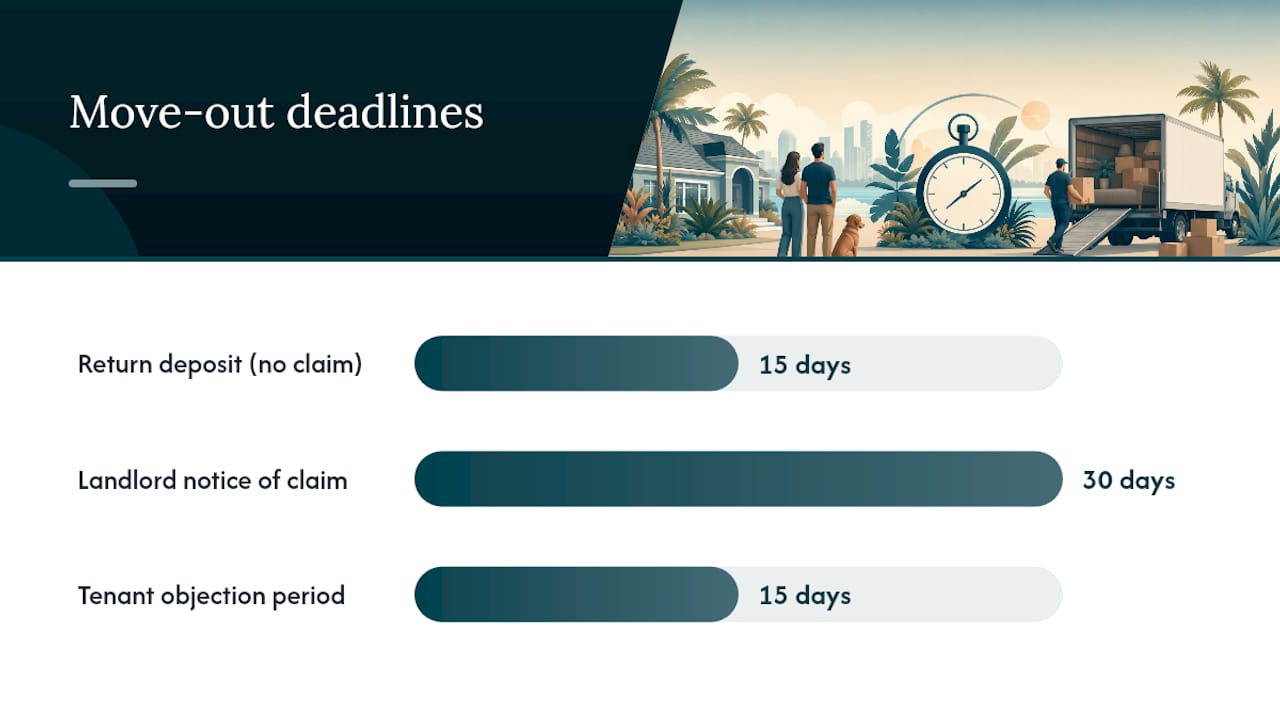
- No claim against the deposit: return it within 15 days of move-out.
- Claiming part or all of it: send written notice of intent to impose a claim within 30 days, and the tenant then has 15 days to object.
Florida sets no statutory cap on pet deposits, pet fees, or pet rent. Market ranges tend to run $200 to $500 per pet for a deposit and $25 to $75 monthly for pet rent, though a tenant offering proof of renter’s insurance with pet liability coverage can sometimes negotiate the number down. A landlord who misses the notice deadlines forfeits the right to deduct from the deposit, though a separate lawsuit for damages is still possible.
Are Service Animals and ESAs Exempt From Pet Fees in Florida?
Yes. Service animals and emotional support animals are not pets under the law, and a landlord cannot charge a pet deposit, pet fee, or pet rent for either one. Fla. Stat. §760.27 and federal fair housing rules both draw a hard line here, and HUD’s guidance on assistance animals spells out exactly what a landlord can and can’t ask for.
What’s allowed:
- Requesting reliable supporting information that establishes a disability-related need, when the disability isn’t obvious.
- Requiring proof of vaccination or local licensing, the same as any other animal.
- Holding the tenant liable for any damage the animal causes, deposit exemption or not.
What’s off the table:
- Demanding medical records.
- Accepting only a specific “registration” certificate purchased online. Federal fair housing law doesn’t recognize those as proof of anything.
Landlords who skip this distinction and charge a blanket pet fee across the board are exposing themselves to a fair housing complaint, not just an awkward conversation.
Move-Out Disputes: How to Handle Pet-Related Deductions
Most pet deposit disputes trace back to a documentation gap that opened at move-in and never got closed. Following a clear sequence protects both sides.
- Document move-in condition. Photograph every room, note existing wear, and have the tenant sign off on a written checklist before the pet ever sets a paw in the unit.
- Collect a forwarding address. The tenant should provide one at move-out; without it, the landlord’s notice obligations under §83.49 still apply but disputes become harder to resolve.
- Decide within the statutory window. If there’s no claim, return the deposit within 15 days. If there is a claim, send written notice of intent within 30 days, itemizing the damage.
- Respond to the notice. The tenant has 15 days to object in writing once that notice arrives.
Tenants disputing a deduction should gather their own move-in photos, any repair receipts, and written communication with the landlord about pet-related issues during the lease term. A move-out cleaning service that documents its work can also help settle disagreements over pet odor or carpet condition before they escalate to small claims court.
Pro Tip: Take video, not just photos, when you walk through the unit at move-in and move-out. A slow pan of each room with a timestamp settles more disputes than a stack of still images ever will.
Sample Pet Addendum Template You Can Adapt
A usable template needs six sections, in this order: identification block, financial terms, behavioral rules, ESA/service animal carve-out language, liability and insurance requirements, and a signature block. Keep the addendum itself to one page, and attach a separate packet with photos and vaccination records so the main document stays readable.
To label charges without ambiguity:
- Write “Refundable Pet Deposit: $[amount], returned per Fla. Stat. §83.49 subject to damage assessment” rather than just “Pet Deposit.”
- Write “Nonrefundable Pet Fee: $[amount], not returned under any circumstance” rather than leaving the word “fee” to imply refundability.
- Write “Pet Rent: $[amount] per month, due with base rent” as its own line item, never folded into the deposit language.
Before anyone signs:
- Confirm the addendum references any HOA or county ordinance that applies to the property.
- Check the animal’s breed against local restrictions and the landlord’s insurer’s exclusion list.
- Attach current vaccination records and a photo of the pet.
- Have every adult tenant initial each page, not just the signature line.
How Cynthia Gardens Applies These Pet Addendum Rules
Cynthia Gardens builds its own pet policy around the same distinctions this guide walks through: refundable deposits, nonrefundable fees, and monthly pet rent all appear as separate, clearly labeled line items, never bundled into one number.
- Every applicant with a pet completes a pet fee checklist before signing, which catches missing vaccination records or breed conflicts early.
- The community’s pet deposit guidance walks Boca Raton renters through how their specific deposit is held and returned.
Comparing that checklist against the sample template above is a fast way to spot gaps in whatever addendum you’re currently using.
An Editorial Note on the Biggest Pet Addendum Mistake
The single most common failure isn’t a missing clause. It’s vague labeling that lets a landlord and tenant walk away from the same sentence with two different understandings of whether money comes back. Every dispute I’ve seen traced through public guidance and statute text comes down to that same gap between what the lease implies and what it actually says.
Label every charge exactly as what it is, keep photographic proof of condition at both ends of the lease, and treat the community rules governing your property as part of the addendum, not a footnote to it.
— Ayman
Cynthia Gardens Makes Pet-Friendly Leasing Simple in Boca Raton
Finding a landlord who actually gets pet paperwork right is harder than it should be. Cynthia Gardens builds transparent, clearly labeled pet terms into every lease from day one, so you’re never guessing whether a charge is refundable or reading fine print to find out later.
Every one-bedroom apartment at Cynthia Gardens comes with straightforward pricing and no hidden fees, and pet owners get a documented, statute-aligned addendum instead of a vague policy tacked onto the lease. Browse the community’s pet-friendly one-bedroom apartments to see current availability, or take a virtual tour before scheduling a visit in person. If you’re ready to see what a fair, well-documented pet policy actually looks like on paper, start your application today.
Sources
- Florida Statutes §83.49 – Deposit money or advance rent; duty of landlord and tenant (2025)
- HUD — Assistance animals and the Fair Housing Act
Recommended
- Understanding Pet Deposit Rules for Boca Raton Apartments: A Renter’s Guide – Luxury Apartments for Rent in Boca Raton | Premium Boca Raton Apartments | Aapartments Boca Raton
- Pet Policy Updates in 2025: What Boca Raton Renters Need to Know
- Pet Fee Checklist 2025: What Renters and Landlords Must Know
- Rental pet agreements: A Boca Raton renter’s guide