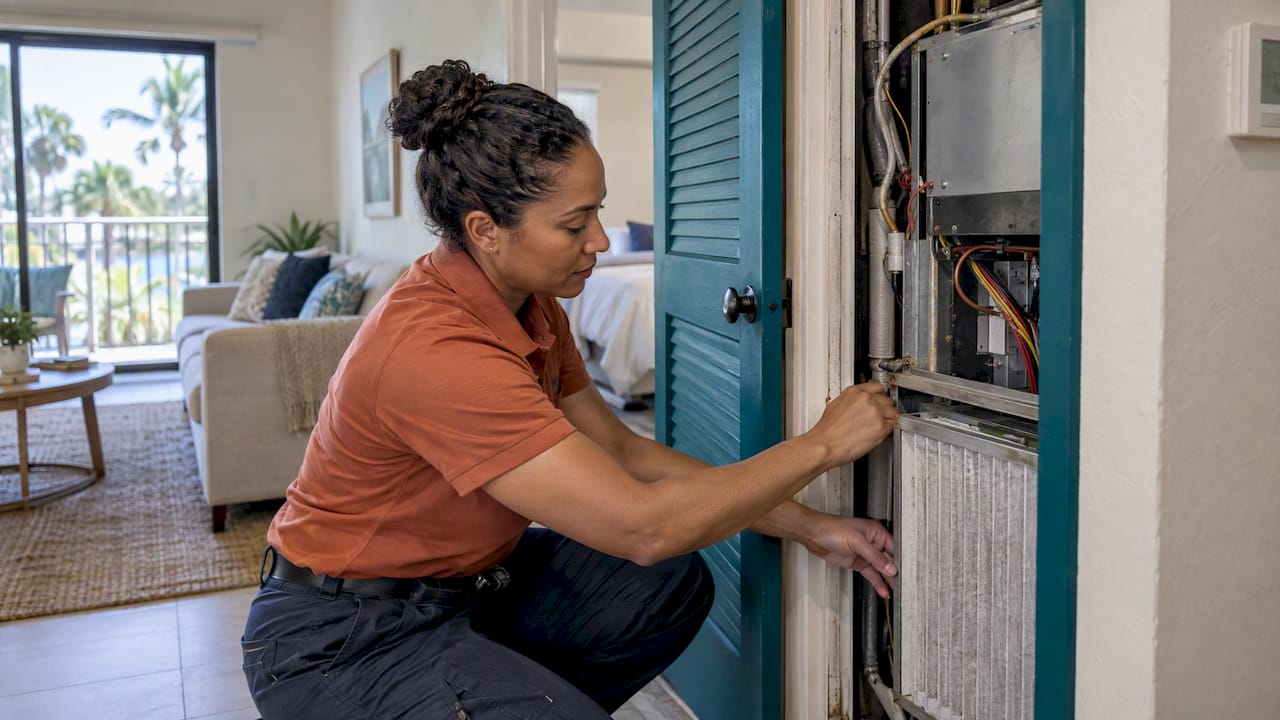
A reasonable maintenance response time depends on what broke. An emergency such as a gas leak, fire hazard or sewage backup should be handled within about 24 hours. Most routine requests should get an acknowledgment the same day and a repair within a few days. Industry data shows the average work order takes 3.88 days to complete, and two out of three are finished within 24 hours.
Below, we break down what those numbers mean, how to tell an emergency from a routine request, what slows repairs down, and what Florida renters can do when a request goes unanswered.
TL;DR
- Emergencies (gas leaks, fire, sewage backups) are expected to be addressed within 24 hours. Routine requests are commonly acknowledged the same day and fixed within days.
- Industry data: the average work order takes 3.88 days, and 66% are completed within 24 hours. HVAC and exhaust fan repairs are usually the slowest.
- A clear, photo-rich request gets fixed faster because the technician arrives with the right parts.
- In Florida, verbal complaints are not enough. Written notice, sent by certified mail, is what protects your rights if repairs stall.
- Ask any community how requests are submitted, tracked and closed before you sign a lease.
Table of Contents
- What counts as a normal response time
- Emergency maintenance requests: what qualifies
- Why some repairs take longer than others
- How to write a request that gets fixed faster
- Why response time matters to renters and landlords
- What to do when maintenance doesn’t respond in Florida
- What “maintenance response time” means in other fields
- Our perspective on maintenance at Cynthia Gardens
- Questions to ask before you sign a lease
- One-bedroom living in Boca Raton with responsive upkeep
- Frequently asked questions
- Sources
What counts as a normal response time
There is no single number that applies to every apartment. Response time is really two clocks: how long until someone acknowledges your request, and how long until the problem is fixed. A good community keeps the first clock very short, even when the second depends on parts or a specialist.
Here is the benchmark data most property managers work from. According to a 2024 analysis of work orders, the average completion time is 3.88 days, while 66% of all work orders are finished within 24 hours. The gap between those two figures tells the story: most jobs are quick, and a minority of slow ones pull the average up.
The slow ones follow a pattern. Lockouts are consistently the fastest to resolve. HVAC and kitchen exhaust fan repairs are typically the slowest, because of part availability and diagnostic requirements. Air conditioning is also one of the most common work order types, which matters a great deal in South Florida, where a dead AC in July is not a minor inconvenience.
A practical timeline by request type
The table below is a working guide, not a legal standard. It combines the industry figures above with common sense about risk. Your lease and your property’s policies set the actual commitments.
| Type of request | Reasonable acknowledgment | Reasonable fix |
|---|---|---|
| Emergency: gas smell, fire hazard, sewage backup, major flooding | Immediately, by phone | Addressed within 24 hours |
| No AC in hot weather, no hot water, no refrigeration | Same day | Within 1 to 3 days, longer if parts are on order |
| Leaking faucet, running toilet, dishwasher fault | Same or next business day | Within a few days |
| Cosmetic items: paint touch-ups, loose cabinet hinge | Within 1 to 2 business days | Scheduled, often within a week or two |
| Lockout | Immediately | Typically the fastest of all request types |
Treat the right-hand column as a signal, not a promise. If a manager tells you a part is on backorder, a slower fix is normal. If nobody tells you anything, that silence is the real problem.
Emergency maintenance requests: what qualifies
Emergency work orders are rare. They make up roughly 6.67% of all work orders, which is why a community that uses the word “emergency” loosely will burn out its team and slow down the requests that truly cannot wait.
Emergency requests, such as fire, gas leaks or sewage backups, are categorized separately and are standardly expected to be addressed within 24 hours to limit life-safety risk.
A useful test is to ask three questions:
- Is anyone in danger right now (fire, gas, electrical sparking, carbon monoxide alarm)?
- Is property being damaged right now (an active leak or flood)?
- Is the unit unlivable tonight (no water, no secure door, sewage in the unit)?
If the answer to any of them is yes, call the emergency line rather than submitting a web form. For a gas smell or fire, leave the unit and call 911 first, then tell the office. A portal ticket is the right tool for a slow drip under the sink, not for a burning smell.
Why some repairs take longer than others
When a request drags, the cause is rarely laziness alone. Knowing the usual reasons helps you judge whether a delay is reasonable.
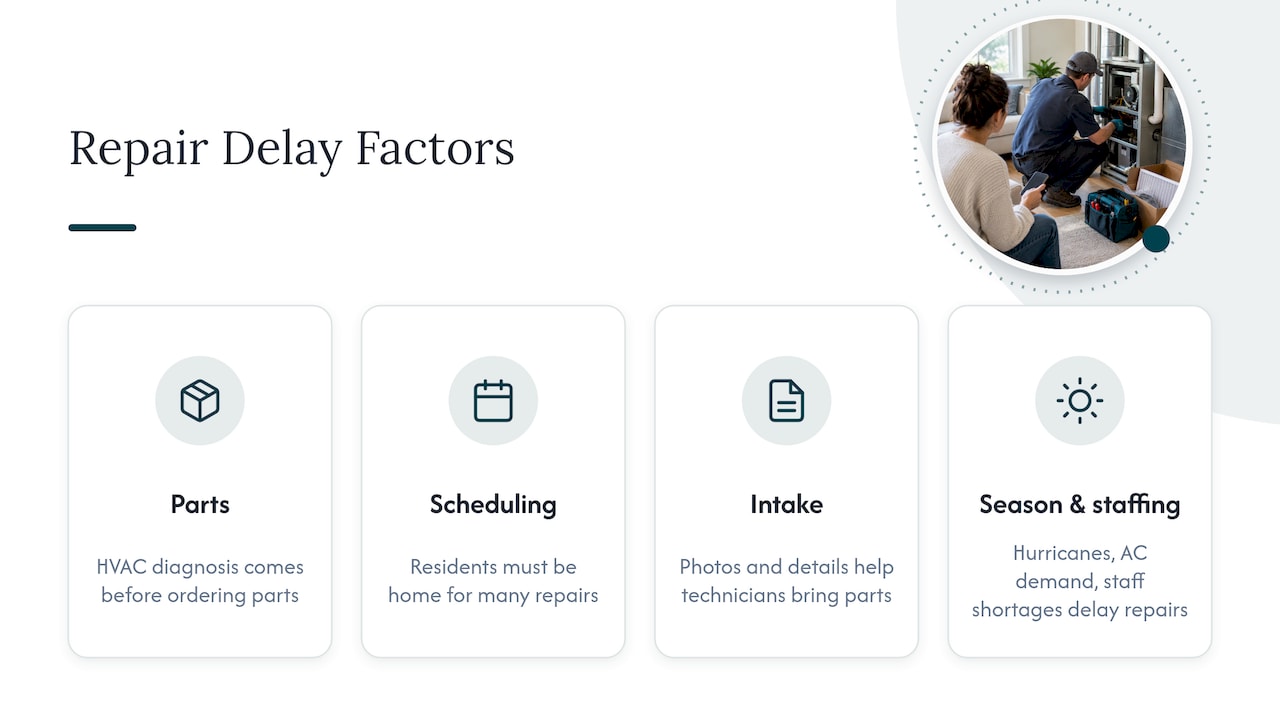
Parts and diagnostics. HVAC problems need a technician to diagnose before anyone can order a part. That is why they sit at the slow end of the data.
Scheduling around you. Many repairs need the resident at home. Industry benchmarking suggests residents are required to be home for roughly 68% to 72% of repairs such as interior plumbing or dishwasher work. If you work a full day, giving written permission to enter, where your lease allows it, can cut days off the timeline. Florida also has its own rules on how much notice a landlord gives before entering. We cover them in our guide to landlord entry notices in Florida.
Intake quality. Experts point to the intake phase as where most friction occurs. Residents who can submit photos and details through an easy channel get faster, more accurate service, because the technician shows up knowing what is wrong and carrying the right parts.
Season and staffing. Hurricane season, summer AC demand and staff shortages all stretch response times at any property.
How to write a request that gets fixed faster
You control more of the timeline than you might think. A vague message such as “bathroom problem” triggers a diagnostic visit, then a second visit with parts. A precise one can be solved in one trip.
- Say what and where. “Hot water doesn’t reach the bathroom sink; the kitchen sink is fine.”
- Add photos or a short video. A leaking joint, a model number on the dishwasher, a stain on the ceiling.
- Say when it started and whether it is getting worse.
- Give your availability. Note whether you are home, and whether pets are in the unit. If you have a cat, tell the team where it will be.
- Keep a copy. Screenshot or save the confirmation, with the date and time.
- Escalate in writing if nothing happens. Follow up with the office after a reasonable time, then put it in a formal notice (see below).
Our longer walkthrough, apartment maintenance steps for renters and managers, covers the process from both sides of the desk.
Why response time matters to renters and landlords
Response time is not just a convenience metric. It drives whether people stay.
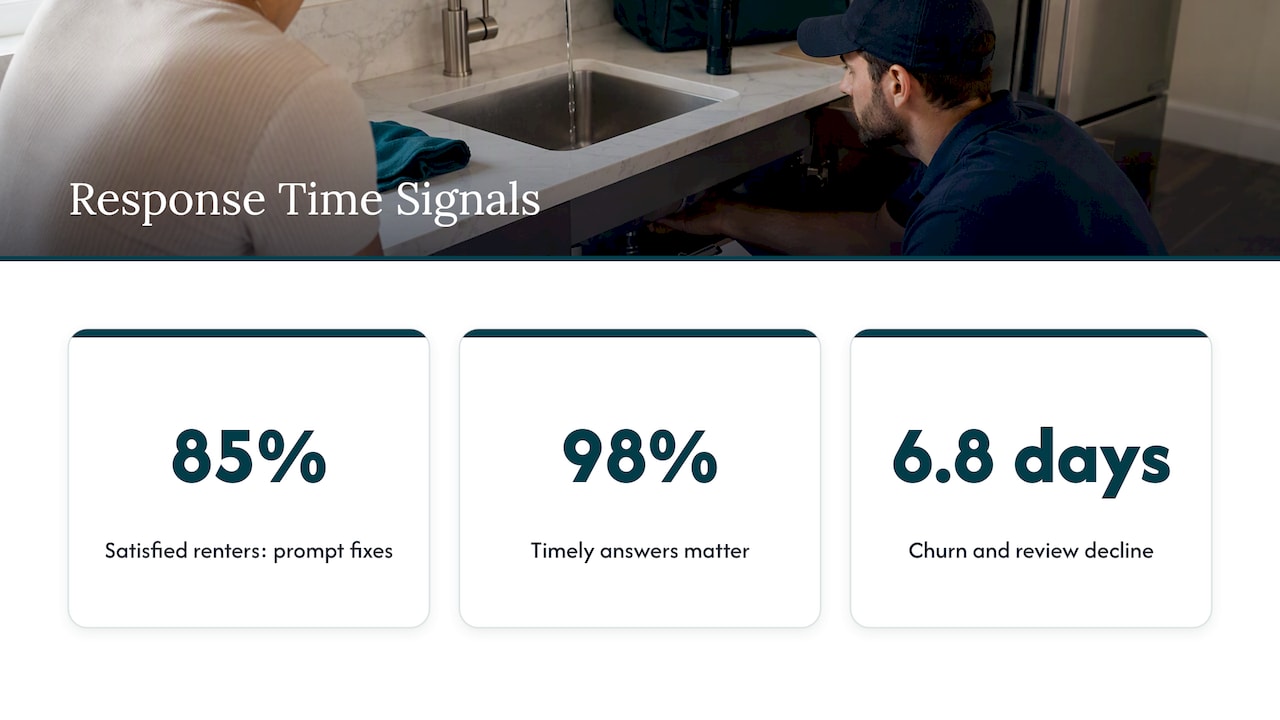
Research from the National Apartment Association and AppFolio finds that resident satisfaction is heavily driven by service visibility: residents are most forgiving when repairs are transparent and timely, and poor follow-through on non-critical items is a primary driver of non-renewals. The same report notes that 85% of satisfied renters say their property manager promptly resolves issues.
Benchmarking from Property Meld points the same way. When resolution times exceed 6.8 days, churn rises and online reviews decline. Residents read responsiveness as a sign of how much management values them. In a survey of build-to-rent tenants, 98 percent said it is important that maintenance requests are answered in a timely manner.
For you as a renter, that gives you a simple filter. Roughly a week is the point where a repair stops looking like a normal delay and starts looking like a pattern. Pay attention to that before you renew, and certainly before you sign.
What to do when maintenance doesn’t respond in Florida
If requests are going nowhere, move from conversation to paper. The steps below describe general Florida practice. They are not legal advice, and if rent withholding or lease termination is on the table, talk to a Florida attorney or your local legal aid office first.
1. Put it in writing, by certified mail. Palm Beach County consumer affairs guidance says to notify the landlord by certified mail and keep a copy, and that just telling the landlord verbally is not sufficient.
2. Know the clock. Under Florida Statute 83.201, when a lease is silent on the procedure and the premises are rendered wholly untenantable, a written notice starts a 20-day period for the landlord to fix the problem. After that, a tenant may be able to withhold rent or end the lease, but only if the procedure is followed exactly. Skipping a step can put you in breach.
3. Separate the issue types. Some problems follow different notice rules. Our guides explain the 7-day notice route for mold repairs and for pest control responsibility.
4. Report code violations. If you suspect a health or building code violation, the Palm Beach County guidance suggests contacting the city or county building department.
5. Understand your exit options. If the situation is truly unworkable, see how breaking a lease works before you act. Our page on how to break an apartment lease in Florida lays out the options.
For general landlord duties, county resources such as Hillsborough County’s renter and landlord guide list what Florida landlords must maintain, including structural components, plumbing, and extermination of insects and rodents.
What “maintenance response time” means in other fields
If you landed here from an engineering search, the term is different. In operations, mean time to repair (MTTR) is the average time from failure to full restoration, calculated as total maintenance time divided by the number of repairs. Property managers borrow the idea: track the average time from request to closed work order, then look at the slow outliers instead of the average alone.
Our perspective on maintenance at Cynthia Gardens
We run a one-bedroom community in Boca Raton for young professionals, students and pet owners, and we have a simple view: a repair is only as good as the communication around it. A tenant can forgive a part on backorder. They rarely forgive silence.
That is why we focus on three things.
- Easy intake. The research is clear that the hardest part is often getting a clear request into the right hands. Our residents already deal with us through AI chat and voice assistance during leasing, so reporting a problem should feel just as simple.
- Attentive, same-day maintenance. Our aim is that every request gets a prompt response. We would rather tell you honestly that a part is coming than leave you guessing.
- Quiet, respectful community. Maintenance visits are scheduled around people who work or study, and we treat your home, and your cat, with care.
When you tour any apartment, ask the same questions we would want asked of us: How do I submit a request? How will I know it was received? Who handles emergencies at night? What happened to the last resident’s request? A straight answer tells you more than any brochure.
— Ayman
Questions to ask before you sign a lease
Maintenance culture shows up before move-in. Use this checklist on any tour, virtual or in person.
- How do residents submit requests, and can I attach photos?
- Do I get a confirmation and status updates?
- What is the after-hours emergency procedure, and who answers?
- Is maintenance handled by on-site staff or an outside vendor?
- What does the lease say about entry notice and repair procedures?
- Can I read recent resident reviews that mention maintenance?
- Are there any fees attached to repairs, pets or transfers?
That last one matters. Ask for the full fee list in writing. Our published fees, such as the one-time pet fee and the application and administration fees, are listed on our fees page, so you can see them before you apply. If you are weighing a virtual tour first, our guide to how to tour apartments remotely shows what to look for on screen.
One-bedroom living in Boca Raton with responsive upkeep
If you are looking for a one-bedroom in Boca Raton and want a community that treats upkeep as part of the service, take a look at our one-bedroom apartments. Rents are published at $1,990 to $2,220 per month, with no hidden fees. Cat owners pay a one-time, non-refundable pet fee of $300 to $500 per cat and no ongoing pet rent. You can tour virtually, explore the interactive property map, and ask our AI chat or voice assistant questions before you ever visit.
Frequently asked questions
How long do maintenance requests take?
It depends on the problem. Industry data shows an average of 3.88 days from request to completion, with 66% of work orders closed within 24 hours. Simple fixes and lockouts are fastest, while HVAC and exhaust fan repairs often take longer because of diagnostics and parts.
What counts as an emergency maintenance request?
An emergency is anything that threatens safety or causes active damage, such as a fire, gas leak, sewage backup or serious flooding. These are normally expected to be addressed within 24 hours. For a gas smell or fire, leave the unit and call 911 before contacting the office.
What can I do if my landlord won’t respond to me?
Follow up in writing, then send formal written notice by certified mail and keep copies. Under Florida Statute 83.201, a landlord gets a set period to cure a defect that makes the premises untenantable before a tenant’s remedies apply. Speak with a Florida attorney or legal aid office before withholding rent.
Is there a legal deadline for apartment repairs in Florida?
Not a single deadline for every repair. Florida’s notice and cure periods depend on the type of problem and what your lease says. The statute describes a 20-day period after written notice for premises that are wholly untenantable, and other notice timelines apply to different situations.
How can I get my repair done faster?
Submit a clear request with photos, say when you are available, and note whether pets are in the unit. Good intake means the technician arrives knowing the problem and carrying the right parts, which often saves a second visit.
Sources
- AppWork: Maintenance Insights
- National Apartment Association: 10 Things About Common Maintenance Work Orders
- Property Meld: 2025 Industry Benchmarking Report
- State of Resident Experience Management Report
- NAA and AppFolio 2025 Top Challenges Report
- Redwood: Maintenance matters for build-to-rent tenants
- Palm Beach County Consumer Affairs: When the landlord won’t fix it
- Florida Statutes 2025, Section 83.201
- Hillsborough County: Renters and Landlords Rights and Responsibilities
- ServiceNow: What is mean time to repair (MTTR)?