
Updated August 2026: According to the Boca Raton 1BR Rent Index, the average rent for a one-bedroom apartment in Boca Raton is $2,330 per month as of August 2026 — a four-source institutional average across RentCafe, Apartments.com, ApartmentList, and rentdatanow. Cynthia Gardens offers a 1-bedroom starting at $1,990 per month, approximately 14.6% below the index. The figures below may reflect earlier data collection dates and should be read alongside the current index value.
Cynthia Gardens is a residential apartment community in Boca Raton, Florida, offering quiet, garden-style living near Florida Atlantic University, Mizner Park, and Boca Raton’s beaches at 1675 NW 4th Ave, Boca Raton, FL 33432.
Table of Contents
- Is Renting a One-Bedroom Apartment Worth It? The Core Decision
- Studio vs One-Bedroom Apartment Cost: Breaking Down the Numbers
- Benefits of Living Alone in a One-Bedroom Apartment
- Space, Square Footage, and Lifestyle Fit
- Maintenance, Amenities, and Long-Term Value
- The Transition Phase: When to Upgrade from a Studio
- Local Market Context: Why Location Matters in Boca Raton
- Deciding If Renting a One-Bedroom Apartment Is Right for You
Last Updated: June 26, 2026
Is Renting a One-Bedroom Apartment Worth It? The Core Decision
When asking "is renting a one bedroom apartment worth it," you’re really asking whether the extra space and privacy justify the higher monthly cost compared to alternatives. The answer depends on your lifestyle, income, and long-term goals rather than any universal rule.
Worth it means the apartment delivers enough value relative to what you pay that you don’t resent the expense. It means the monthly rent fits your budget without forcing compromises elsewhere. If renting a one-bedroom means eating ramen every night or skipping healthcare, it’s not worth it. If it means redirecting $200 from entertainment to housing while maintaining your standard of living, that’s a different calculation.
Below, we’ll show you exactly how to evaluate this decision by breaking down costs, space considerations, lifestyle factors, and long-term value. By the end, you’ll have a clear framework for determining whether renting a one-bedroom apartment aligns with your priorities.
Studio vs One-Bedroom Apartment Cost: Breaking Down the Numbers
The cost difference between a studio and a one-bedroom typically ranges from 20% to 50% depending on location and market conditions. In Boca Raton‘s rental market, you might see a studio at $1,200-$1,500 monthly while a comparable one-bedroom runs $1,600-$2,100. That’s a difference of $400-$600 per month, or $4,800-$7,200 annually.
Monthly Rent and Utility Comparison
A one-bedroom typically costs 25-40% more than a studio in the same building or neighborhood. However, utilities tell a different story. A studio uses less electricity, water, and heating/cooling simply because there’s less square footage to condition. A one-bedroom might add $20-$40 monthly in utility costs depending on your usage patterns.
The true monthly delta is rent plus utilities, typically $420-$650 more for a one-bedroom.
Hidden Costs Beyond Rent
Furniture and decor costs more for a one-bedroom. A studio forces minimalism; a one-bedroom tempts you to furnish it properly. Budget $2,000-$5,000 initially, then $500-$1,000 annually for replacements and upgrades.
Cleaning and maintenance demands increase. More square footage means more surfaces to clean, more floors to vacuum. If you hire cleaning services, expect to pay 20-30% more. Storage space enables clutter accumulation, you’ll buy more items because you have room to store them.
| Cost Category | Studio | One-Bedroom | Difference |
|---|---|---|---|
| Monthly Rent | $1,200-$1,500 | $1,600-$2,100 | +$400-$600 |
| Utilities | $80-$120 | $100-$160 | +$20-$40 |
| Furniture (annual) | $300-$600 | $600-$1,200 | +$300-$600 |
| Cleaning (monthly) | $50-$100 | $75-$150 | +$25-$50 |
| Total Monthly | $1,330-$1,820 | $1,775-$2,410 | +$445-$690 |
Benefits of Living Alone in a One-Bedroom Apartment
The financial case for a one-bedroom weakens if you’re purely optimizing for cost. The lifestyle case strengthens considerably if you value autonomy, privacy, and the ability to shape your living environment.
Privacy, Personal Space, and Psychological Impact
A separate bedroom means you can close a door and create a sanctuary. You can have a conversation without worrying about disturbing someone in the next room. Studies on housing adequacy consistently show that people with dedicated personal space report lower stress levels and higher life satisfaction.
For couples, a one-bedroom becomes almost essential. The inability to have separate space during conflicts or when one person wants quiet while the other wants social activity creates genuine tension. A studio forces compromise on every activity.
Remote Work and Home Office Setup
If you work from home, a dedicated home office isn’t a luxury, it’s infrastructure. A bedroom-turned-office gives you acoustic separation for video calls, a dedicated desk, the ability to close the door and create focus, and separation of work and leisure spaces.
A studio forces you to work from your couch or a small desk in your main living area. Distractions multiply and you can’t escape work mentally because you’re literally sitting where you sleep. Remote workers typically recoup the one-bedroom premium through productivity gains and mental health benefits.
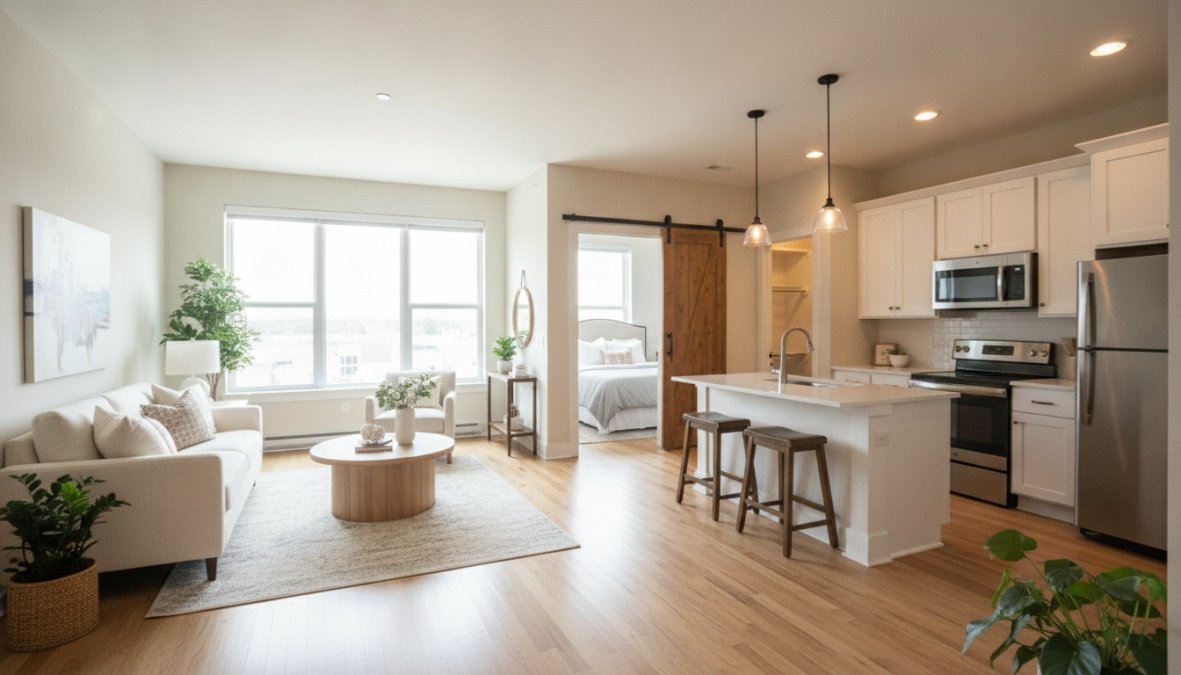
Space, Square Footage, and Lifestyle Fit
A typical studio runs 400-550 square feet. A one-bedroom typically spans 650-850 square feet. That’s a 50-70% increase in usable space, but the subjective experience varies dramatically based on floor plan and ceiling height.
Storage and Floor Plan Considerations
Square footage is misleading. A 750-square-foot one-bedroom with poor layout feels cramped. A 700-square-foot one-bedroom with an efficient floor plan feels spacious.
Look for a separate entrance to the bedroom, adequate bedroom closet space, kitchen separated from the living area, and a hallway or foyer that creates psychological separation between public and private zones.
A one-bedroom’s value depends on whether that extra room solves a real problem. If you don’t have guests, don’t work from home, and don’t need dedicated storage, the extra bedroom becomes expensive dead space. If you do any of those things regularly, it becomes essential infrastructure.
Guest Accommodations and Entertaining
A one-bedroom changes your social life. You can host overnight guests without the awkwardness of a pullout couch in your main living area. You can have friends over without your bed being the focal point of the room.
This matters more if you entertain regularly or have family visiting. The ability to entertain also affects your social and professional network, you’re more likely to host colleagues for casual dinners or friends for movie nights.
Maintenance, Amenities, and Long-Term Value
Where you live matters as much as what you live in.
Cleaning and Property Management Demands
A one-bedroom requires more maintenance time. More square footage means more vacuuming, more surfaces to dust, more areas to keep organized. Property management quality affects your quality of life significantly. A well-managed community responds quickly to maintenance issues and maintains common areas fairly.
Amenities vary widely. A basic complex offers a parking lot and mailroom. A quality community includes a pool, fitness center, landscaped grounds, and professional management. The maintenance-free aspect matters more than it sounds, you’re not responsible for exterior upkeep, landscaping, or building repairs.
Investment Property Potential and Resale Value
The real value is behavioral. Living in a quality one-bedroom apartment teaches you what you actually value in housing. You learn whether you prefer open-concept or separated spaces, ground-floor or elevated units, community amenities or privacy. This knowledge guides smarter homeownership decisions later.
The Transition Phase: When to Upgrade from a Studio
Upgrade from a studio to a one-bedroom when your income has grown 25%+ above your initial apartment budget, you’ve lived in a studio for 2+ years and consistently feel space constraints, you work from home or entertain guests regularly, you’re in a relationship and sharing a studio creates friction, or you’ve accumulated possessions that don’t fit comfortably.
Don’t upgrade when you’re saving for a down payment and every dollar counts, you spend most evenings out and use your apartment primarily for sleeping, you’re uncertain about your job stability, or you’re considering homeownership within 2-3 years.
The timing matters. Upgrading during a market downturn (lower rents, more inventory) is smarter than upgrading when demand is high.
Local Market Context: Why Location Matters in Boca Raton
Is renting a one bedroom apartment worth it depends heavily on where you’re renting. Boca Raton‘s rental market differs significantly from other Florida markets and national averages.
Boca Raton attracts young professionals, retirees, and families drawn by proximity to FAU, beaches, and established neighborhoods. A one-bedroom in Boca Raton might run $1,800-$2,200, while similar units in Deerfield Beach or Pompano Beach might cost $1,500-$1,700. The $300-$500 monthly premium reflects Boca Raton’s desirability.
For professionals working near FAU, downtown Boca Raton, or Mizner Park, the location premium saves commute time and enables a walkable lifestyle. For remote workers, the premium buys access to quality restaurants, cultural events, and beaches, amenities that improve quality of life beyond the apartment itself.
Deciding If Renting a One-Bedroom Apartment Is Right for You
The decision ultimately hinges on three factors: income, lifestyle, and goals.
Decision Framework: Income, Lifestyle, and Goals
Income Assessment:
Your housing budget should not exceed 30% of gross monthly income. If a one-bedroom costs $1,800 and you earn $5,500 monthly gross income, that’s 32.7%, slightly high but manageable if other expenses are controlled. If the one-bedroom costs $1,800 and you earn $4,000 monthly, it’s unsustainable.
Calculate your actual budget. Subtract taxes, insurance, transportation, food, and minimum debt payments from your gross income. Whatever remains is discretionary. A one-bedroom is worth it only if it fits comfortably within that discretionary budget without eliminating savings.
Lifestyle Assessment:
How much time do you spend in your apartment? Remote workers spend 8+ hours daily there. Professionals with office jobs spend 12 hours. Your time investment should justify the space cost.
Do you entertain regularly? Host overnight guests? Work from home? Have hobbies requiring dedicated space? Each "yes" increases the value of a one-bedroom. Are you in a relationship? Sharing a studio creates friction that a one-bedroom alleviates.
Goals Assessment:
What’s your 3-5 year plan? If homeownership is the goal, prioritize saving over space. If career advancement is the goal and you work from home, invest in the one-bedroom for productivity. If lifestyle quality is the goal, weigh the one-bedroom’s impact on daily wellbeing.
| Factor | Studio Works Better | One-Bedroom Works Better |
|---|---|---|
| Income | <$4,500/month | >$5,500/month |
| Time at Home | <6 hours/day | >8 hours/day |
| Remote Work | No | Yes |
| Regular Guests | Rarely | Frequently |
| Relationship Status | Single | Coupled |
| Hobbies/Storage Needs | Minimal | Significant |
| Down Payment Goal | Active (2-3 years) | Not immediate |
| Space Sensitivity | Low | High |
The honest answer to "is renting a one bedroom apartment worth it" is: it depends on your specific situation. A one-bedroom costs more and provides more space, privacy, and psychological comfort. Whether that trade-off makes sense depends on your income, how you spend your time, and what you value.
If you’re earning enough that the rent doesn’t strain your budget, you spend significant time at home, and you value privacy and space, a one-bedroom is worth it. If you’re stretching financially, rarely home, or comfortable in smaller spaces, a studio makes more sense.
The decision becomes clearer when you stop asking "is a one-bedroom worth it in general" and start asking "is a one-bedroom worth it for me, given my income, lifestyle, and goals right now."
For professionals seeking the ideal one-bedroom experience in Boca Raton, Cynthia Gardens delivers what the decision framework points toward: a serene, maintenance-free living environment with modern one-bedroom apartments featuring stainless steel appliances and quartz countertops. Located minutes from FAU and the beach, our garden-style community provides the privacy, space, and lifestyle quality that make renting a one-bedroom worth it. Schedule a tour today to experience refined, welcoming living that transforms your apartment into a true home.
Frequently Asked Questions
Is a one-bedroom apartment better than a studio?
Whether a one-bedroom is better than a studio depends on your lifestyle and budget. A one-bedroom offers more living space, privacy, and a dedicated workspace, valuable for remote work. However, studios cost less monthly rent and require less maintenance. For single professionals, couples, or anyone needing home office setup, a one-bedroom typically provides better long-term value despite higher monthly costs.
Is it cheaper to rent a studio or a one-bedroom apartment?
Studios are generally cheaper in monthly rent, often 15-30% less depending on your local rental market. However, the cost-benefit analysis isn't just about rent. One-bedrooms may justify higher monthly payments through better resale value if you're considering investment property potential, lower stress from privacy, and productivity gains from dedicated home office space. Factor in utility costs and your personal needs before deciding.
What are the benefits of living alone in a one-bedroom apartment?
Living alone in a one-bedroom offers significant psychological benefits: complete privacy, control over your living space, and no roommate conflicts. For remote work, you gain a dedicated home office with minimal distractions. You'll enjoy flexibility in your lease agreement, personal autonomy in decorating and lifestyle choices, and the ability to host guests comfortably. These intangible benefits often outweigh the higher affordability of studio apartments for many single professionals.
Is a one-bedroom apartment enough for a couple?
A one-bedroom can work well for couples, especially if both partners have flexible schedules or don't work from home. The single bedroom provides privacy, and the living space allows separation when needed. However, if both partners work remotely, a one-bedroom may feel cramped without dedicated office areas. Couples should evaluate square footage, storage space for shared belongings, and whether the floor plan supports your daily lifestyle before committing to a lease agreement.
What hidden costs should I consider beyond monthly rent?
Beyond monthly rent, budget for utilities (electricity, water, internet), renters insurance, parking fees, pet deposits, and maintenance costs for appliances. Furniture, décor, and storage solutions add up quickly when furnishing a new living space. Some communities charge amenity fees for pool access or landscaping. In Boca Raton's market, proximity to FAU and the beach may mean higher overall living costs. Calculate these hidden expenses before deciding if a one-bedroom fits your housing budget.
Explore more Cynthia Gardens resources: one-bedroom floorplans at Cynthia Gardens, News & Apartment Living Resource Center, contact the leasing team, or apartment rental FAQ.