Table of Contents
- Is Renters Insurance Worth It for Apartments? The Verdict
- What Does Renters Insurance Cover?
- Average Cost of Renters Insurance and What Affects Your Premium
- Renters Insurance vs. Landlord Insurance: What’s the Difference?
- Real-World Claim Scenarios: When Renters Insurance Pays Off
- Coverage Gaps and What Renters Insurance Doesn’t Cover
- Is Renters Insurance Worth It? Pros, Cons, and Your Decision
- Building Your Inventory: A Practical Tool for Claims
Last Updated: July 9, 2026
Is Renters Insurance Worth It for Apartments? The Verdict
Renters insurance is worth it for most apartment dwellers. A typical policy costs $12-$25 monthly yet covers personal property worth thousands of dollars. According to the National Association of Insurance Commissioners, the average renter’s claim runs around $3,000, far exceeding annual premiums. Since most landlord policies cover only the building structure, not your belongings, a single fire, theft, or water damage incident can cost thousands to replace.
However, renters insurance isn’t universally necessary. If you own minimal possessions, live in a low-crime area, and have emergency savings to cover replacements, you might skip it. For most people, particularly those in urban apartments, those with expensive electronics or furniture, or those without substantial savings, renters insurance delivers genuine financial protection.
Key Factors That Determine Value
The most important variable is the total value of your personal property. Calculate what you’d need to replace if everything disappeared: furniture, electronics, clothing, books, and kitchen items. If that number exceeds $5,000, insurance becomes economically rational.
Your location matters significantly. Apartments in high-crime neighborhoods see more theft claims. Older buildings with aging plumbing experience more water damage. Note that standard renters insurance doesn’t cover floods; you’d need a separate flood policy. If your building has a history of fires or electrical problems, liability protection becomes more valuable.
Your financial cushion determines whether you can self-insure. If you have $10,000 in emergency savings and could replace everything without hardship, insurance is optional. If you’d struggle to replace a laptop or furniture, insurance protects against financial disaster. The deductible matters too, choosing $500 instead of $250 lowers your premium but means you cover more out-of-pocket when claims happen.
Many landlords require renters to carry liability insurance before signing a lease. Most landlord requirements specify $100,000 in liability protection, which costs only a few dollars more monthly than basic coverage.
Before deciding whether to buy, add up the replacement cost of your five most valuable items: laptop, phone, furniture, clothing, and entertainment equipment. If that total exceeds $2,000, insurance likely pays for itself within two years.
What Does Renters Insurance Cover?
Renters insurance protects two main categories: your personal property and your liability to others.
Personal Property Coverage
Personal property coverage reimburses you when your belongings are damaged, destroyed, or stolen. This includes furniture, electronics, appliances you own, clothing, books, and sports equipment. Coverage applies whether the loss happens inside your apartment or elsewhere, if your laptop is stolen from a coffee shop, most policies reimburse you.
Most policies cap personal property coverage at $30,000-$40,000 total. High-value items like jewelry, artwork, or collectibles often have sub-limits of $1,500-$2,500. If you own expensive watches or art collections, you may need scheduled items coverage, which covers specific valuables at full replacement value.
Two coverage types exist: actual cash value (reimbursement accounting for depreciation) and replacement cost coverage (reimbursement for buying a new equivalent item today). Replacement cost coverage costs roughly 10-15% more monthly but protects you better against inflation and depreciation.
Water damage from burst pipes, overflowing washing machines, or leaking roofs is covered. However, flood damage from external water sources is specifically excluded.
Liability Protection and Additional Living Expenses
Liability protection covers you if someone is injured at your apartment and sues for medical costs or damages. Standard liability limits are $100,000-$300,000. Most apartment dwellers need only $100,000-$150,000. Liability coverage typically adds only $3-5 monthly.
Additional living expenses (loss of use) covers temporary housing, meals, and other costs if your apartment becomes uninhabitable due to a covered loss. Most policies limit this to 10-20% of your personal property coverage limit, typically $3,000-$8,000 total.
Average Cost of Renters Insurance and What Affects Your Premium
Renters insurance premiums range from $12 to $30 monthly for most apartment dwellers. The national average hovers around $18 per month, making annual costs roughly $200-250 for standard coverage.
Location is the primary driver. Apartments in high-crime urban areas cost more than those in suburban or rural locations. Building age and construction matter too, older buildings with aging electrical systems or wooden construction carry higher risk and thus higher premiums.
Your claims history affects pricing. Multiple claims in the past five years result in higher premiums. Going claim-free for several years often qualifies you for discounts. The deductible you choose directly impacts monthly cost.
How Credit Score Impacts Your Rate
Your credit score influences renters insurance premiums significantly. Insurance companies use credit-based insurance scores to predict claim likelihood. Someone with excellent credit (750+) might pay $15 monthly, while someone with poor credit (below 620) might pay $25 for identical coverage, a 67% premium increase.
Strategies to mitigate this impact include paying your premium annually instead of monthly for discounts, bundling renters insurance with auto or other policies, and comparing quotes across multiple insurers. Different companies weight credit scores differently, and shopping around often reveals significantly better rates.
If your credit score is below 650, request quotes from at least five insurers. Premium differences can exceed $100 annually.
Renters Insurance vs. Landlord Insurance: What’s the Difference?
Landlord insurance covers the building structure, landlord liability, and loss of rental income. It does not cover tenants’ personal belongings. Your landlord’s insurance protects the walls, floors, and roof. Your renters insurance protects everything inside.
Renters insurance covers personal property, personal liability (you’re responsible for guest injuries), and additional living expenses for the tenant. A fire destroys your apartment: the landlord’s insurance pays to rebuild the structure. Your renters insurance reimburses you for destroyed furniture, electronics, and clothing. The landlord’s insurance doesn’t reimburse you for your belongings.
Some landlords require tenants to carry renters insurance as a lease condition. This protects the landlord by ensuring that if you cause damage to the building, your liability coverage pays for repairs rather than the landlord’s insurance absorbing the cost.
Real-World Claim Scenarios: When Renters Insurance Pays Off
A renter returns from work to find their apartment broken into. Laptop, tablet, jewelry, and handbags are gone, roughly $4,200 in losses. Without renters insurance, they absorb this loss entirely. With a $250 deductible policy, they pay $250 and the insurance reimburses $3,950.
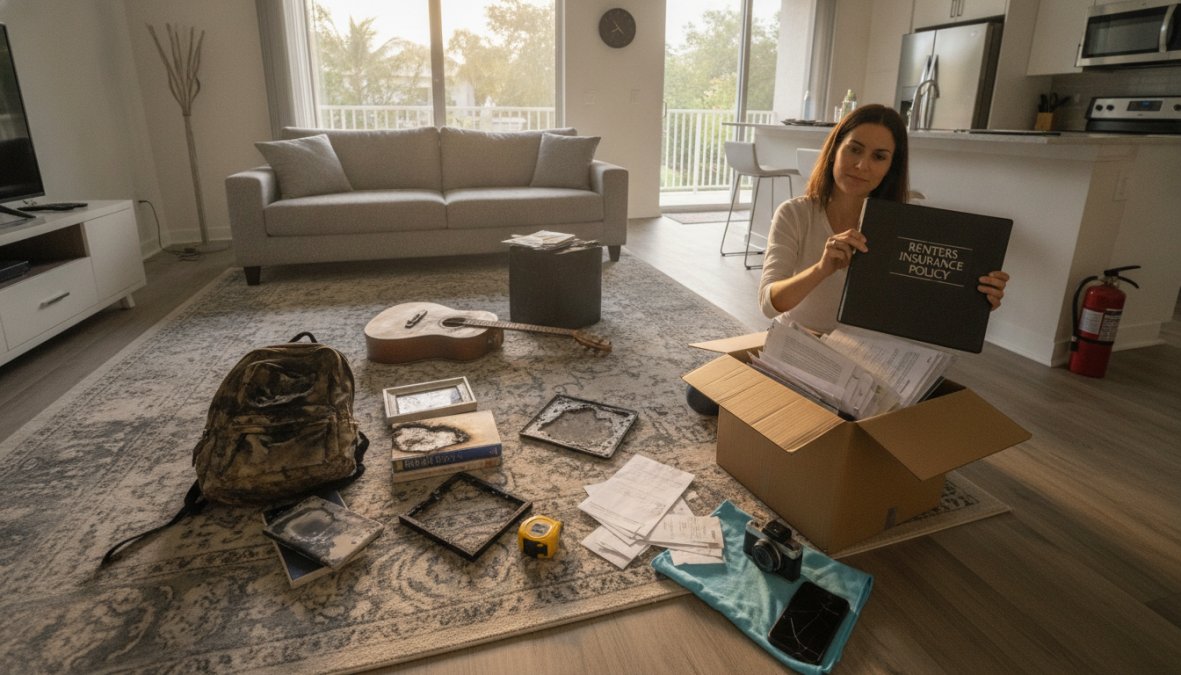
Water damage from a burst pipe is common in older buildings. The renter’s hardwood furniture, electronics, and clothing are soaked. Mold begins growing within days. Remediation costs $3,000, plus $2,500 in damaged belongings. Renters insurance covers the belongings ($2,250 after deductible) and additional living expenses if the apartment is uninhabitable during mold remediation.
Roommate Coverage and Subletting Considerations
If you have a roommate, each of you needs your own policy covering your own belongings. A single policy covers only the named insured’s property. Each person living in the apartment needs their own policy if they want their belongings protected.
Many renters insurance policies exclude or limit coverage if you sublet part of your apartment. Some insurers void coverage entirely if you sublet. If you plan to sublet, disclose this to your insurer before signing a lease with a subtenant; hiding subletting and then filing a claim can result in claim denial.
Coverage Gaps and What Renters Insurance Doesn’t Cover
Understanding what renters insurance excludes prevents costly surprises when you need to file a claim.
Flood damage is the most significant exclusion. Standard renters insurance doesn’t cover losses from external water sources, heavy rain, overflowing rivers, or storm surge. If you live in a flood-prone area, flood insurance is essential and sold separately, often through the National Flood Insurance Program.
Earthquake damage is excluded in most policies. Wear and tear, maintenance failures, and gradual damage aren’t covered. If your roof leaks slowly over months, that’s maintenance negligence, not a covered loss.
Valuable items have sub-limits. A $30,000 policy might cap jewelry coverage at $1,500. Roommate or subtenant belongings aren’t covered under your policy. Business equipment and inventory aren’t covered either.
Is Renters Insurance Worth It? Pros, Cons, and Your Decision
Renters insurance is essential if your landlord requires it in your lease, if a lender requires it as a condition of financing furniture or electronics, or if you have minimal emergency savings and couldn’t replace your belongings. It’s also critical if you host people frequently and someone could be injured at your apartment.
You absolutely need it if you live in a high-crime area where theft is common. Insurance makes sense where risk is elevated.
If you own minimal possessions and could replace everything for under $2,000 with savings to cover that, insurance becomes optional. If you live in a very safe, low-crime area with a modern building and minimal fire or water damage risk, insurance is less urgent.
The honest truth: renters insurance is inexpensive enough that skipping it makes sense only if you’re genuinely in the optional category. At $18 monthly, the annual cost is $216. If you own more than $2,000 in belongings, insurance pays for itself in a single claim.
The decision hinges on three questions: What’s the replacement cost of everything you own? Can you afford to replace it from savings? Is your landlord requiring it? If the first answer exceeds $3,000, the second is “no,” or the third is “yes,” renters insurance is worth it.
Building Your Inventory: A Practical Tool for Claims
Creating a detailed inventory of your belongings with replacement costs transforms the claims process from a guessing game into straightforward reimbursement.
| Item Category | Examples | Estimated Replacement Cost |
|---|---|---|
| Electronics | Laptop, phone, tablet, TV, speakers | $3,200 |
| Furniture | Bed, sofa, dining table, chairs, shelves | $2,800 |
| Clothing | Winter coats, professional wear, everyday items | $1,500 |
| Kitchen | Appliances, cookware, dishes, utensils | $800 |
| Bedroom | Bedding, pillows, mattress, nightstands | $1,200 |
| Bathroom | Towels, shower caddy, personal care items | $300 |
| Books, media | Books, vinyl records, DVDs, games | $600 |
| Sports, hobby equipment | Bicycle, exercise equipment, instruments | $1,000 |
| Decorations, art | Wall art, plants, decorative objects | $400 |
| Total Estimated Value | $11,800 |
Creating this inventory takes 2-3 hours but saves weeks of frustration if you file a claim. Take photos or videos of each room, opening drawers and closets to document contents. For expensive items, keep receipts or price quotes. Store this inventory digitally (cloud backup) and physically (printed copy).
When you file a claim, provide this inventory immediately. Adjusters use it to calculate reimbursement. With documentation, claims process faster and settlements are higher. Update your inventory annually or whenever you make significant purchases.
For renters in Boca Raton and throughout Florida, renters insurance addresses a genuine gap in protection that landlord policies leave uncovered. The modest monthly cost shields you from financial devastation if theft, fire, water damage, or liability claims occur. Your belongings deserve protection, and so does your financial security.
Frequently Asked Questions
What does renters insurance actually cover in an apartment?
Renters insurance typically covers personal property (furniture, electronics, clothing), liability protection if someone is injured in your apartment, and additional living expenses if your unit becomes uninhabitable. Personal property coverage protects your belongings against theft, fire, smoke, and vandalism. Liability protection covers medical bills or legal fees if a guest is injured and sues you. However, coverage exclusions often include flood, earthquake, and damage caused by your own negligence.
How much does renters insurance typically cost per month?
Renters insurance costs vary based on location, coverage limits, deductible amount, and your credit score. Pricing depends on factors like the value of your personal belongings, the insurance carrier you choose, and your claims history. For current pricing and quotes tailored to your situation, contact your insurance provider directly or visit Cynthia Gardens's website for recommendations on local carriers serving Boca Raton.
Is renters insurance worth it if my landlord has insurance?
Yes. Your landlord's policy covers the building structure and their liability, not your personal belongings. A landlord policy protects the dwelling, but leaves your furniture, electronics, and other items unprotected. Renters insurance is separate and essential for your own financial protection. Additionally, if you cause damage that affects other units, renters liability coverage can protect you from legal claims.
Does my credit score really affect renters insurance premiums?
Yes, many insurance carriers use credit scores to assess risk and determine your premium. A lower credit score may result in higher rates. If you're concerned about this impact, shop around with multiple carriers, some weight credit scores differently than others. Maintaining good credit and a clean claims history can help you secure better rates over time.
What happens if I don't have renters insurance and something gets stolen or damaged?
Without renters insurance, you bear the full financial loss. If your apartment is burglarized, catches fire, or experiences water damage, you'll need to pay out-of-pocket to replace your belongings. You also won't have liability protection if someone is injured in your home. This can lead to significant debt, especially for high-value items like electronics or jewelry. Peace of mind through insurance coverage is often worth the modest monthly cost.