Cynthia Gardens is a residential apartment community in Boca Raton, Florida, offering quiet, garden-style living near Florida Atlantic University, Mizner Park, and Boca Raton’s beaches at 1675 NW 4th Ave, Boca Raton, FL 33432.
Table of Contents
- Is Apartment Living Right for You? Key Factors to Consider
- Pros and Cons of Apartment Living Explained
- Apartment vs House Living: Which Fits Your Needs
- Questions to Ask Before Renting an Apartment
- Remote Work and Pet Ownership in Apartment Living
- Sustainability and Psychological Factors in Urban Living
- Making Your Final Decision: Is Apartment Living Right for You
- Conclusion
Last Updated: June 30, 2026
Is Apartment Living Right for You? Key Factors to Consider
Determining whether apartment living suits you requires honest self-assessment across lifestyle, finances, and personal preferences. The decision isn’t about apartment living being universally "right" or "wrong", it’s about fit. Someone who values walkability and minimal maintenance will experience apartment living entirely differently than someone who prioritizes land ownership and equity building.
The biggest mistake people make is [choosing based on a single factor](/best-house-rental-website/), usually cost. Apartment living involves tradeoffs across finances, lifestyle, maintenance, and psychology. Weight all of them equally before deciding.
Understanding Your Lifestyle Priorities
Your daily habits should drive this decision more than any other factor. Do you commute to an office, work from home, or travel frequently? Do you entertain large groups or prefer quiet time alone? These patterns reveal whether apartment living aligns with how you actually live.
Apartment living works best for people with these patterns: frequent travel, urban exploration, minimal entertaining, and flexibility to relocate. If your lifestyle requires hosting large gatherings or you spend weekends in a garage workshop, apartment living creates friction.
Remote work changes the equation significantly. A 700-square-foot apartment feels cramped on video calls eight hours daily, and noise from shared walls becomes problematic. Before deciding, spend a week working from your potential apartment to test the reality.
Your lifestyle determines whether apartment living feels like freedom or constraint. If your daily patterns require space, privacy, or customization, apartment living will frustrate you regardless of financial benefits.
Financial Readiness Assessment
Apartment living costs less directly, no mortgage, property taxes, or major repairs, but includes hidden expenses renters often overlook. Start with the obvious: rent, utilities, renters insurance, and parking. Compare this to homeownership costs: mortgage, property taxes, insurance, maintenance reserves, and HOA fees.
The real financial question is opportunity cost. Money you don’t spend on a down payment stays in your investment portfolio, earning returns. But after five years in an apartment, you own nothing. After five years in a house, you own a significant portion of the property.
Renters often underestimate moving costs. Deposits, moving trucks, and setup expenses add up quickly. If you move every two years, these transition costs erode the financial advantage of renting.
Pros and Cons of Apartment Living Explained
Primary Advantages of Apartment Living
Apartment living delivers genuine benefits for the right person. Maintenance freedom means you don’t fix roofs, replace HVAC systems, or handle foundation issues. Your monthly housing cost stays predictable. A leaking pipe? Call the landlord.
Flexibility is the second major advantage. You can relocate without selling property. If a job opportunity emerges or a neighborhood stops working for you, you leave at lease end. This mobility appeals to people in career transition or avoiding homeownership commitment.
Location proximity matters more in apartments. Most complexes cluster near urban centers, transit hubs, and commercial districts. You’re minutes from restaurants, gyms, and cultural venues. Walking replaces driving.
Community amenities come built-in: pools, fitness centers, and organized events create ready-made social infrastructure. The financial entry point is lower, no down payment or closing costs, just first month’s rent and a security deposit.
Significant Drawbacks to Evaluate
Noise from shared walls is real and underestimated. Neighbors above, below, and beside you mean you hear footsteps, conversations, and music. If you’re sensitive to noise or work from home on calls, this becomes a daily frustration.
Privacy limitations extend beyond sound. Shared hallways and common areas mean constant low-level exposure to other residents. Your comings and goings are visible.
Customization constraints frustrate people who want to modify their space. You can’t paint walls, install shelving, upgrade appliances, or landscape. Your space stays exactly as the landlord designed it.
Pet policies vary dramatically and often cost extra. Some buildings prohibit pets entirely; others allow them with deposits and monthly fees. Shared walls mean neighbors hear your pet, creating tension.
Storage limitations are real. Apartments offer less closet space and no attic or basement. Minimalism becomes a practical requirement.
The lack of equity is the long-term financial drawback. After ten years of rent payments, you own nothing. After ten years of mortgage payments, you own a significant portion of an appreciating property.
| Advantage | Drawback | Impact |
|---|---|---|
| No maintenance responsibility | Shared wall noise | Daily frustration if noise-sensitive |
| Flexibility to relocate | No equity building | Significant long-term financial difference |
| Lower entry cost | Customization limits | Frustration if you want control |
| Built-in community amenities | Privacy constraints | Ongoing loss of solitude |
| Proximity to urban services | Pet policy restrictions | Added costs and limitations |
| Predictable monthly costs | Storage limitations | Requires minimalist approach |
Apartment vs House Living: Which Fits Your Needs
Cost of Living and Financial Impact
The financial comparison requires honesty about what you actually spend. Rent appears simple, but add utilities, renters insurance, parking, and furniture replacement, and the total grows. Homeownership includes a hidden benefit: you’re building equity. Each mortgage payment includes principal that builds ownership.
However, equity comes with costs renters avoid: property taxes, homeowners insurance, HOA fees, and maintenance reserves. Homeowners typically spend 1-2% of their home’s value annually on maintenance and repairs. A $400,000 house requires $4,000-$8,000 per year in upkeep.
The real question is: where will you be in ten years? If you’re staying in one place, building equity through homeownership likely wins financially. If you’re relocating or uncertain about long-term plans, apartment living’s flexibility makes financial sense.
Maintenance Responsibilities and Privacy
Apartment living means you don’t maintain the building, but you also can’t control anything. The landlord decides when to repaint or upgrade appliances. You live with their timeline and standards.
Homeownership flips this equation. You maintain everything, which is time-consuming and expensive, but you control everything. You paint whatever color you want and renovate on your timeline.
The maintenance responsibility difference is significant for people in their sixties and seventies. Climbing ladders or dealing with roof leaks becomes physically difficult. Apartment living’s maintenance-free model becomes increasingly valuable with age.
Questions to Ask Before Renting an Apartment
Essential Questions About Location and Amenities
Before signing a lease, answer these questions: How far is your workplace, and what’s the actual commute time during peak hours? Drive it yourself during rush hour, don’t trust estimates.
What’s within walking distance? Grocery stores, pharmacies, restaurants, parks, and fitness centers matter if you walk regularly.
What’s the noise environment? Visit the apartment at different times: morning, afternoon, evening, and weekend. Listen for traffic noise, construction, and neighbor activity. Noise is the number-one apartment living complaint.
What are the neighborhood safety statistics? Crime rates and community perception matter.
What’s the proximity to parks, beaches, or outdoor recreation? For people who exercise outside, location near these amenities changes quality of life.
Critical Questions About Lease Terms and Community
Read your lease carefully and ask: What’s the lease length, and are you comfortable with that commitment? What happens when the lease renews, do you have rate protection, or can rent increase significantly?
What utilities are included, and what do you pay separately? What are the pet policies, parking arrangements, and complaint resolution process?
What’s the community culture? Visit during evening or weekend hours. Do residents seem friendly? Do common areas feel maintained?
Spend as much time reading and understanding the lease as you spend evaluating the physical space. Hidden fees and unfavorable renewal terms can erase financial advantages.
Remote Work and Pet Ownership in Apartment Living
Creating a Functional Home Office Space
Remote work in apartments requires intentional design. You need a dedicated workspace that separates work from living, even in 600 square feet. A corner desk in the bedroom works; a folding table in the living room doesn’t.
Sound matters more in apartments. If you’re on video calls eight hours daily, your neighbors hear you. Soundproofing solutions (acoustic panels, heavy curtains, carpeting) help but don’t eliminate the problem.
Lighting is critical. Natural light from a window improves focus and mood. If your apartment lacks good natural light, invest in quality task lighting and full-spectrum bulbs.
Internet reliability matters. Confirm that high-speed internet is available and reliable before signing a lease.
Navigating Pet Policies and Shared Walls
Pet ownership in apartments requires compromise. Most buildings allow pets with restrictions: size limits (under 25 pounds is common), breed restrictions, and monthly pet rent ($25-75 per pet). Some charge one-time pet deposits ($300-500).
The real issue is shared walls. Your dog barks, neighbors hear it, they complain, and management gets involved. If you have a dog that barks frequently, apartment living creates ongoing conflict.
Cats are generally less problematic. They’re quieter, and most buildings accept them.
Before getting a pet in an apartment, honestly assess whether you can manage the constraints. Can you exercise your dog enough that it doesn’t bark excessively? Can you handle monthly pet rent? Can you accept that your pet’s noise affects neighbors?
Some apartment communities actively welcome pets with dog parks and pet-washing stations. If you have or want a pet, prioritize buildings with pet-friendly infrastructure.
Sustainability and Psychological Factors in Urban Living
Energy Efficiency and Environmental Impact
Apartment living often carries a lower environmental footprint than single-family homes. Shared walls reduce heating and cooling needs compared to houses with four exposed exterior walls. A well-insulated apartment building uses less energy per resident than a detached house.
However, not all apartments are efficient. Older buildings with poor insulation and aging HVAC systems waste energy. Newer construction typically outperforms older buildings.
Urban location reduces transportation emissions. Apartment residents typically drive less, walk more, and use public transit more than suburban homeowners. This compounds significantly over years.
Psychological Impact of Shared Walls and Community
Living with shared walls creates a subtle psychological shift. You’re aware of neighbors constantly. For some people, this feels like community. For others, it feels like a loss of privacy.
Research shows that people adapt to shared-wall living within 3-6 months. However, some people never adapt. If you’re noise-sensitive or value solitude, apartment living remains frustrating long-term.
Community in apartments is optional. You can be completely anonymous or engage with common areas and develop friendships. This flexibility appeals to introverts who want community without obligation.
The psychological benefit of lower maintenance responsibility is underestimated. Homeowners carry mental load about aging systems. Apartment renters lack this burden. However, apartment living creates different mental load: lease renewal anxiety and lack of control.
| Psychological Factor | Apartment Living | House Living |
|---|---|---|
| Privacy and solitude | Lower (shared walls) | Higher (private property) |
| Maintenance stress | None (landlord’s responsibility) | Significant (owner’s responsibility) |
| Control over space | Limited (lease restrictions) | Complete (your property) |
| Community connection | Optional and accessible | Requires effort to build |
| Stability and permanence | Lower (lease-dependent) | Higher (ownership-based) |
| Financial anxiety | Renewal-focused | Equity-focused |
Making Your Final Decision: Is Apartment Living Right for You
The decision comes down to weighting these factors against your actual life, not your ideal life.
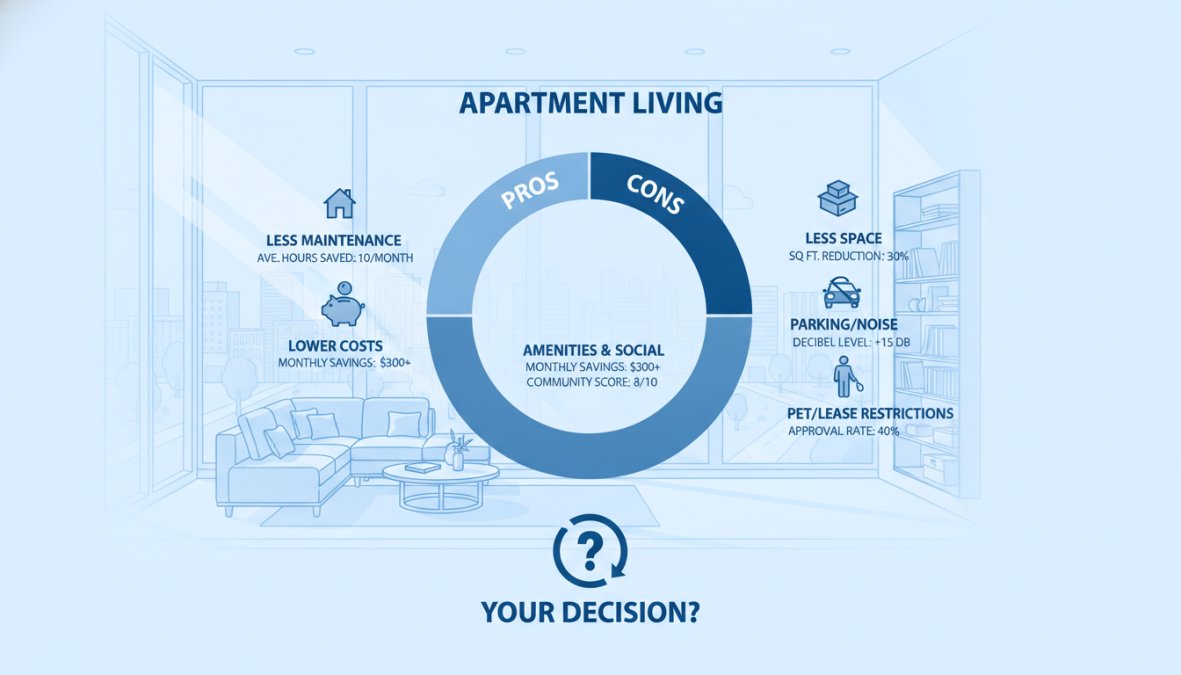
Create a personal scorecard. List factors that matter most: maintenance responsibility, location flexibility, financial cost, privacy, control over space, community access, and long-term equity. Score apartment living and house living on each factor using a 1-10 scale.
Spend time in your potential apartment. Work from the space if you’ll work remotely. Walk the neighborhood at different times. This real-world testing reveals what spreadsheets can’t.
Consider your timeline. If you’re staying in one location for ten years or more, house ownership likely makes financial sense. If you’re uncertain about location or job, apartment living’s flexibility wins.
Honestly assess your noise sensitivity. This is the biggest apartment living complaint and isn’t negotiable.
Think about your stage of life. Young professionals often thrive in apartments. People with children often prefer houses. Older adults often return to apartments for maintenance-free living.
Conclusion
Apartment living is right for you if you value flexibility, minimal maintenance, urban proximity, and lower entry costs more than ownership equity, complete privacy, and unlimited customization. It’s wrong if you need space, customization, privacy, and long-term equity building more than flexibility and low maintenance.
This decision isn’t permanent. Many people live in apartments for a season, then transition to houses. Others live in houses for decades, then downsize to apartments.
If apartment living aligns with your priorities, communities like Cynthia Gardens in Boca Raton demonstrate what modern apartment living offers. Garden-style communities with one-bedroom apartments featuring stainless steel appliances and quartz countertops, combined with resort-style pools and maintenance-free living just minutes from FAU and the beach, deliver the refined lifestyle that transforms apartment living from compromise to genuine advantage. Schedule a tour today and experience whether this community matches your vision of apartment living.
Frequently Asked Questions
What are the main financial benefits of apartment living compared to homeownership?
Apartment living typically offers lower upfront costs, no down payment or closing costs, and predictable monthly rent. You avoid property taxes, homeowner's insurance, and maintenance expenses. Utility costs are often lower due to smaller square footage and shared building infrastructure. However, rent increases with lease renewals, while mortgage payments remain fixed. Consider your long-term financial goals when evaluating whether apartment living or homeownership aligns with your budget and investment strategy.
How do I know if apartment living is right for me versus a house?
Choose apartment living if you value flexibility, maintenance-free living, proximity to urban amenities, and lower financial commitment. Apartments work well for professionals, remote workers, and those seeking walkability to shops and restaurants. Houses suit families needing space, privacy, and long-term equity building. Consider your lifestyle priorities: Do you prefer community amenities and convenience, or more square footage and autonomy? Your commute, pet ownership needs, and work situation should also influence this decision.
What questions should I ask before signing a lease agreement?
Ask about lease terms, rent increases, pet policies, utility costs, parking, and community amenities. Clarify maintenance responsibilities, noise policies, and neighbor density. Inquire about walkability to your workplace and local landmarks. Understand your tenant rights regarding repairs and security deposits. Ask about the property management responsiveness and any hidden fees. Visit during different times to assess noise levels and shared spaces. These questions help ensure the apartment meets your lifestyle needs and financial expectations.
Can I work remotely in an apartment, and are there noise concerns?
Yes, apartments can support remote work with proper planning. Create a dedicated home office in a quiet corner, use noise-canceling headphones, and establish boundaries with neighbors. Consider buildings with better soundproofing and ask about noise policies before renting. Shared walls mean potential noise from neighbors, so test the space during different hours. Apartments near parks or quieter neighborhoods tend to have lower noise levels. Storage solutions help keep your workspace organized in limited square footage, essential for maintaining productivity.
What are the downsides of apartment living I should seriously consider?
Common downsides include noise from shared walls, limited privacy, no control over building maintenance, pet restrictions, and lease agreement constraints. You lack equity building and face rent increases over time. Storage is limited, and customization options are restricted. Shared amenities may feel crowded, and you depend on landlords for repairs. Parking can be expensive or unavailable. Community density means less personal outdoor space. Assess whether these trade-offs outweigh the benefits of convenience, flexibility, and lower maintenance responsibilities for your lifestyle.
The apartment versus house decision ultimately reflects how you want to spend your time, money, and attention. Neither choice is universally right. The right choice is the one that aligns with your actual life, not the life you think you should want. Answer the questions honestly, test the reality, and trust your assessment.
Explore more Cynthia Gardens resources: floorplans at Cynthia Gardens, News & Apartment Living Resource Center, contact the leasing team, or apartment living FAQ.