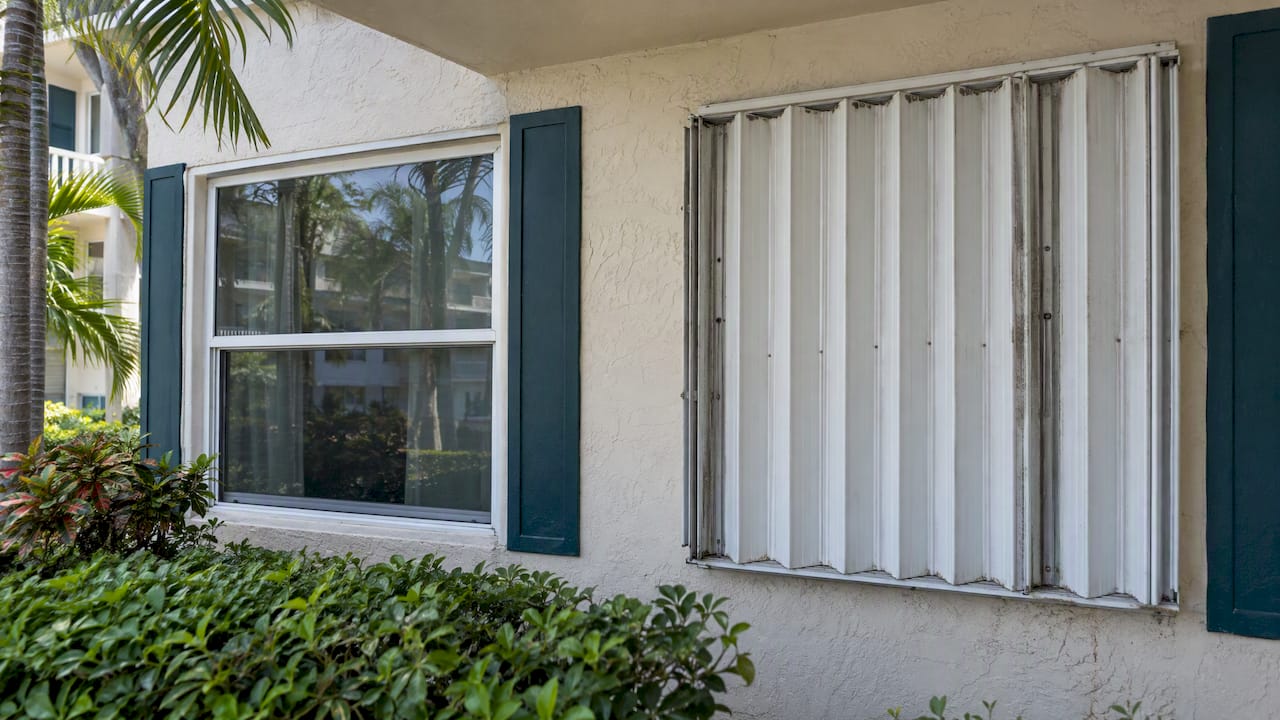
Impact glass is the better protection if you can get it: it is always on, needs no one to show up and close it, and passes the same large-missile test that rated shutters do. Hurricane shutters are usually cheaper per opening and just as code-compliant when they are rated and closed in time. For a renter in Boca Raton the question is usually less “which should I buy?” and more “what does my building have, what can I ask for, and what do I do with the rest?” This guide answers both.
TL;DR
- Both impact-rated glass and impact-rated shutters can satisfy Florida code in windborne debris regions. The difference is that glass is permanent and shutters must be deployed.
- “Hurricane-resistant” on a label is not the same as impact-rated. Look for a Florida Product Approval or Miami-Dade Notice of Acceptance.
- Renters generally cannot swap windows or bolt on shutters themselves. The building owner or association decides, so ask before you sign.
- Sliding glass doors are a weak point either way, so protect them first and keep your own preparations (insurance, documents, pet plan) in order.
Table of Contents
- What impact glass and hurricane shutters actually are
- What Florida code requires
- Head-to-head comparison
- Where each option wins
- Why one weak opening matters
- What this means if you rent
- A renter’s pre-storm checklist
- Our perspective
- Looking for a one-bedroom in Boca Raton?
- How to compare buildings when you tour
- Common mistakes
- FAQ
- Sources
What impact glass and hurricane shutters actually are
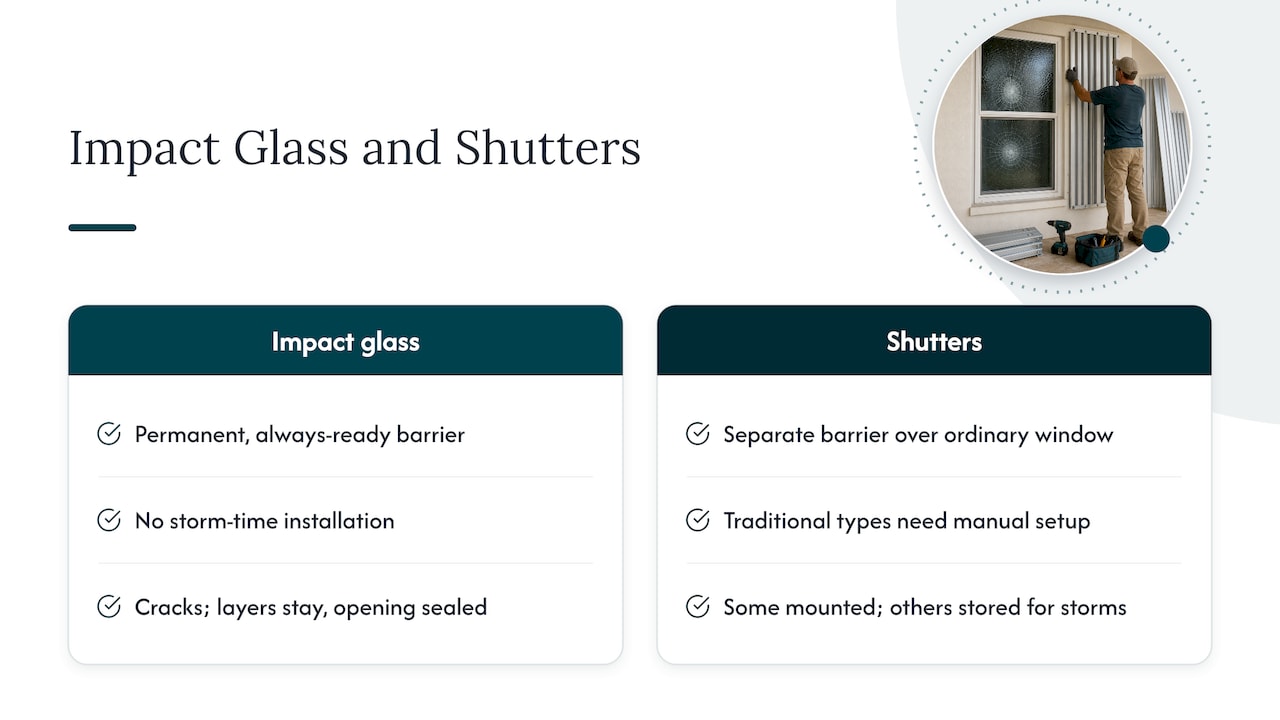
Impact glass is a window or door unit built with laminated glass, typically two panes bonded to a tough interlayer, set in a reinforced frame. When something hits it, the glass may crack, but the layers stay together and the opening stays sealed. You live with it every day like a normal window.
Hurricane shutters are a separate barrier that sits over an ordinary window. They come in several types: accordion shutters that slide along tracks, roll-down shutters, panels that bolt on, and clear polycarbonate versions. Some are permanently mounted and closed by hand or motor. Others are stored and installed only when a storm approaches.
The core distinction, as the Insurance Institute for Business & Home Safety describes it, is that impact-resistant windows are a permanent, always-ready barrier, while traditional shutters typically need manual installation and removal, which can be a logistical headache in the final hours before a storm.
Neither is a magic shield against water. IBHS also cautions that wind-driven rain will likely get past window and door seals in a severe hurricane, because testing criteria for water intrusion are often exceeded by real storms. Plan for a towel-and-bucket level of wet, not a flood-proof room.
What Florida code requires
Florida defines windborne debris regions as areas within one mile of the coast where the design wind speed is 130 mph or greater, or anywhere the design wind speed is 140 mph or greater. In those zones, every glazed opening must be impact-resistant or protected by an impact-protective device such as a shutter. So the code treats the two options as equals on paper.
The word “rated” carries weight. The state’s hurricane retrofit guide explains that products are called impact rated when they have resisted a 9-pound 2×4 lumber missile striking end-on at 34 mph. To meet code in a debris region, the product also needs a valid Florida Product Approval or a Miami-Dade Notice of Acceptance. A window sold as “storm” or “hurricane-style” without that paperwork may do nothing for code or for your insurer.
Head-to-head comparison
| Factor | Impact glass | Hurricane shutters |
|---|---|---|
| Protection when you are away | Always on | Only if closed or installed |
| Effort before a storm | None | Install or close every panel, then reopen after |
| Up-front cost | Higher (replaces the window) | Lower (added over the window) |
| Daily use | Normal window, light and view | Blocks light when closed |
| Security and noise | Helps every day | Helps while closed |
| Energy | Depends on glass spec | Little effect unless closed |
| Can a tenant change it? | Rarely | Rarely, and often restricted |
| Code compliance | Yes, if approved product | Yes, if approved product |
We have deliberately not quoted installed prices. Quotes vary by opening size, frame type, county permit fees and the year, and the figures floating around online come mostly from contractors who sell the work. Get at least two written quotes from licensed installers if you are a homeowner.
Where each option wins
Impact glass: the “set it and forget it” choice
The strongest argument for impact glass is human, not technical. Shutters protect a home when someone remembers to deploy them, and a storm forecast can shift fast. FEMA’s guidance on shutters over garage doors makes the same point: it is an active mitigation measure, so a person must be available to close and secure them before the event and open them after. If you travel for work, study abroad over the summer, or evacuate early, impact glass keeps working without you.
It also does quiet work the rest of the year: sound reduction, security, and a normal view. And a window upgrade can help your power bill. The U.S. Department of Energy reports that low-E storm window retrofits can cut annual HVAC energy use by 10% to 33%, though that figure is about storm-window retrofits, not every impact unit. If energy costs matter to you, our piece on energy-efficient apartments in Boca Raton covers what to look for.
Shutters: the budget-friendly layer
Shutters are often cheaper per opening and can be added to an existing building without replacing windows. That is why so many older Florida multifamily buildings use them. A rated, well-maintained system that gets closed on time protects as well as glass against flying debris. The weak points are human: missing panels, hardware that has corroded, nobody on site to close them, and no light inside once they are down.
The mix-and-match reality
Many buildings use both: impact glass on some openings, shutters on others. That is fine for code, but not for insurance discounts if one opening is left unprotected. Citizens Property Insurance notes that wind mitigation discounts require all glazed openings to be fully protected with products meeting Florida or Miami-Dade approval. Those discounts apply to the wind portion of a homeowner policy, so they matter to owners and associations, not to a renter’s policy.
Why one weak opening matters
IBHS advises protecting every door and window, not only the ones facing the wind. The reason is physics: if one large opening fails, internal pressure can rise rapidly, which can lead to roof failure and damage to the whole structure. That is why a building-wide approach beats a patchwork.
Sliding glass doors deserve special attention. IBHS found that up to 60% of sliding glass doors can be damaged in hurricanes, regardless of whether they are shuttered, which makes them among the most vulnerable points in a home. If your apartment has a patio slider, ask how it is rated and protected, and keep furniture and blinds away from it during a storm.
What this means if you rent
Most of the decisions above are not yours. In an apartment you normally cannot replace windows or mount shutters on the exterior. The owner or association decides, and in managed communities, Florida’s regulator has held that boards must adopt shutter specifications that comply with building codes. That same record describes owners who install code-compliant protection, shutters or impact glass, being generally eligible for assessment credits. That is condo-owner territory, but it shows how the rules treat both options as equivalent when they meet code.
So as a renter, your job is to ask the right questions before you sign a lease:
- Which openings are protected, and with what? Impact glass, rated shutters, or neither? On every window and the patio door?
- Who deploys shutters, and when? If the answer is “residents,” find out how the hardware works and where panels are stored.
- What does the lease say about storms? Look for evacuation notices, access rules and who is responsible for water damage.
- What happens to your belongings? The building’s insurance does not cover your things. See what renters insurance actually costs in Florida.
- What is the pet plan? Cats need a carrier, supplies and documents ready. Our pet hurricane plan for Florida renters walks through it.
Never install anything on the exterior of your unit without written permission. Even temporary adhesive film or plywood can breach your lease or association rules.
A renter’s pre-storm checklist
Whatever your building uses, these steps are within your control:
- Move furniture, electronics and anything valuable away from windows and sliding doors.
- Photograph your belongings and keep receipts and your policy details in a waterproof pouch or in cloud storage.
- Bring in or tie down balcony items. Loose chairs and planters become windborne debris.
- Keep towels near windowsills and the slider, expecting some water to seep in.
- Charge phones and power banks, and fill the car’s tank.
- Know your evacuation zone and follow local emergency management instructions. Do not assume a shuttered unit is safe to shelter in if officials order you out.
- Prepare your pet’s carrier, food, medication and vaccination records.
For the outdoor side of preparation, including what to do with plants and loose items, see our guide on preparing outdoor areas for hurricane season.
Our perspective
We talk with renters every week who are moving to South Florida for the first time, often for a job or for FAU, and hurricane protection is one of the first things they ask about after rent. Our honest view is that the best protection is the kind you do not have to think about. Permanent impact-rated glass wins that test, and shutters earn their place when they are rated, maintained and actually closed.
But for a renter, the more useful lens is transparency. You should know before you sign what protects your unit, who is responsible for it, and what your lease says about storms, the same way you should know every fee up front. That is the standard we hold ourselves to on pricing, and we think it applies to storm readiness too. Ask us any question about the building and the lease. We would rather you have a clear answer than a pleasant surprise.
Don’t treat the choice between glass and shutters as the whole plan, either. A rented one-bedroom in a well-maintained community, a renters insurance policy, a packed go-bag and a pet plan will do more for you than any single product debate.
— Ayman
Looking for a one-bedroom in Boca Raton?
If you are comparing apartments with storm season in mind, we publish our rent and fees openly. Our one-bedroom apartments are listed at $1,990 to $2,220 per month. The one-time fees are on our fees page: a $75 non-refundable application fee per applicant, a $300 administration fee, and for cats a non-refundable pet fee of $300 to $500 per cat, with no ongoing pet rent. You can tour virtually, use the interactive map, and ask our chat or voice assistant about the lease before you visit. Prefer a conversation? Start from our main site and tell us what you need to know.
How to compare buildings when you tour
A short script helps, whether you tour in person or online.
Ask for specifics, not reassurance
“Is the building hurricane-safe?” gets a yes every time. Better questions: “Are the windows and slider impact-rated, and is that documented?” and “If shutters are used, who installs them and how much notice do residents get?” A building that has the answer ready usually has the process ready too.
Look at the hardware
On a tour, look at window frames, tracks and any shutter housings. Heavy corrosion, painted-shut tracks or missing panels suggest deferred maintenance. Same-day maintenance response, which we focus on, matters here because small leaks and damaged seals are much cheaper to fix before a storm than after.
Read the storm clauses
Check how the lease handles evacuation, building access after a storm, and rent during repairs. Our guides on lease agreements and moving to Florida help you read the fine print and plan the whole move.
Weigh apartment versus house
If you are choosing between renting an apartment and a house, remember that a single-family rental may leave you responsible for more storm prep, such as installing panels yourself. We compare the trade-offs in apartment living vs. house rental in Florida.
Common mistakes
- Trusting the label. “Hurricane” on a window box means little without an approval number. Check for Florida Product Approval or a Miami-Dade Notice of Acceptance.
- Protecting only the front. A single unprotected opening can undo the rest, as IBHS explains above.
- Forgetting the slider. It is the most commonly damaged opening.
- Assuming dry means safe. Even good products can let some water in.
- Waiting for the warning. Shutter installation lines and supply runs start early. If your building relies on deployed panels, find out the schedule in August, not when a storm has a name.
- Skipping renters insurance. Your landlord’s coverage protects the building, not your belongings.
FAQ
Which is better, impact windows or shutters?
Impact windows are better for convenience and always-on protection, since nobody has to install or close anything. Shutters can be more affordable and offer equivalent code protection when they are rated and deployed correctly. The best choice depends on budget, who will be on site before a storm, and whether you own or rent.
Are impact windows allowed in Florida apartments?
Yes, impact-rated windows are allowed and in debris regions they are one of the two code-accepted ways to protect openings, the other being rated shutters. In a rental, the owner or association decides what is installed, not the tenant. Ask the leasing office what your unit has.
Can I put up my own hurricane shutters in a rental?
Not without written permission. Exterior changes are usually controlled by the owner and, in managed communities, by association rules that must follow building codes. Ask in writing before you buy or mount anything, and ask what the community already provides.
Will impact glass or shutters lower my renters insurance?
Not typically. Wind mitigation discounts, as Citizens describes them, apply to the wind portion of homeowner policies. Ask your own insurer how your building’s protection affects a renters policy.
Sources
- IBHS: Hurricane Ike, Nature’s Force vs. Structural Strength
- IBHS: The Untold Story of Hurricane Harvey
- Florida Hurricane Retrofit Guide: Debris Impact Standards
- Citizens Property Insurance: Mitigation Policy Discounts
- FEMA: Best Practices for Minimizing Wind and Water Infiltration Damage, Hurricane Michael
- FEMA P-2181, Fact Sheet 3.2: Wall Systems and Openings
- U.S. Department of Energy: Window Treatments, the Undervalued, Highly Efficient Energy-Efficiency Measure
- Florida DBPR arbitration order on hurricane protection in a condominium