TL;DR:
- Renting in Boca Raton involves more than just the listed rent, including upfront costs and recurring utilities that significantly impact affordability. Applying flexible budgeting guidelines like net income-based calculations and strategic location choice helps renters avoid financial strain and find suitable apartments. Building a personalized rental budget through detailed expense tracking and scenario testing enables confident, sustainable housing decisions in South Florida’s competitive market.
You find a gorgeous one-bedroom in Boca Raton, the price looks right, and then the application asks for first month, last month, and a security deposit. Suddenly you need $4,500 before you even own a single piece of furniture. That kind of sticker shock trips up a lot of young professionals and students every year, and it usually happens because the listed rent was only part of the story. This guide walks you through every real cost involved, shows you which budgeting rules actually work in South Florida’s market, and gives you a repeatable process to set a rent target you can live with confidently.
Table of Contents
- Understand what goes into your rent budget
- Choose the right rule: 30% guideline and beyond
- Build your customized rental budget
- Smart strategies to keep rent affordable in Boca Raton
- Why personal cash flow should trump rent-to-income ratios
- Find your next apartment and start your smart budget
- Frequently asked questions
Key Takeaways
| Point | Details |
|---|---|
| Budget all costs | Count both upfront and recurring expenses to avoid hidden rental surprises. |
| Rules are guides, not limits | The 30% rule and HUD benchmarks are starting points—tailor them to your own situation. |
| Personalize your workflow | Track your real cash flow and use it to set a practical rent target. |
| Leverage local timing | Moving off-season or farther from the city center can make your Boca Raton rent much more affordable. |
| Choose trade-offs wisely | Adjust lifestyle expenses or housing choices so your budget supports your goals, not just your rent. |
Understand what goes into your rent budget
Before jumping into budgeting, it is essential to pinpoint every expense that will impact your total monthly and upfront housing cost. Most people look at the advertised price, multiply by twelve, and call it a plan. That works fine until move-in day.
A solid rent budget covers two distinct categories: one-time upfront costs and recurring monthly costs. Mixing them up is how renters end up overdrafting their checking account in week one.
One-time upfront costs typically include:
- Security deposit (often equal to one month’s rent)
- First and last month’s rent (required by many Boca Raton landlords)
- Application and admin fees
- Moving costs, truck rentals, or movers
- Utility setup fees or deposits (electricity, water, internet)
- Renters insurance (first premium often due upfront)
Recurring monthly costs add up alongside your rent payment:
- Electric and water utilities (South Florida AC bills can run $80 to $150 monthly)
- Internet service ($50 to $80 per month in most Boca Raton zip codes)
- Renters insurance (roughly $15 to $25 monthly)
- Parking fees, if not bundled in the lease
- Pet fees or pet rent, if applicable
- Trash, pest control, or HOA-type fees passed through to tenants
Understanding rental affordability in Boca helps you see just how wide the gap can get between listed rent and total housing cost in this market.
RentCafé defines a move-in budget as a plan that outlines all costs associated with starting a new rental, including deposits, utilities, and moving expenses, not just the monthly lease price. That framing is important. Your rent budget and your move-in budget are two separate documents, and you need both.
| Cost category | One-time or monthly | Typical range (Boca Raton) |
|---|---|---|
| Security deposit | One-time | $1,200 to $2,000 |
| First/last month rent | One-time | $2,400 to $4,000 |
| Moving expenses | One-time | $300 to $1,500 |
| Utilities (electric, water) | Monthly | $100 to $200 |
| Internet | Monthly | $50 to $80 |
| Renters insurance | Monthly | $15 to $25 |
| Parking | Monthly | $0 to $100 |
Use a rent affordability calculator to stress test your numbers before you sign anything. Punch in the realistic totals, not the optimistic ones.
Pro Tip: Build two budget rows in a spreadsheet. Label one “move-in month” and one “steady-state monthly.” The move-in month will almost always be two to three times your regular monthly housing cost. Knowing that number in advance removes the panic.
Choose the right rule: 30% guideline and beyond
Once you know all your costs, the next step is to decide how much you can sustainably spend on rent by choosing a budgeting guideline that fits your actual income.
The 30% rule is the most widely cited standard in personal finance. The math is simple: multiply your gross monthly income by 0.30, and that is supposedly your maximum rent payment. Experian describes the 30% rule as spending no more than 30% of gross monthly income on rent. Gross means before taxes, which is actually a generous calculation that can overestimate what you can really afford.
Here is how the numbers play out at different income levels common among Boca Raton entry-level professionals and graduate students:
| Annual gross income | Monthly gross | 30% rule max rent | 50/30/20 needs cap |
|---|---|---|---|
| $35,000 | $2,917 | $875 | $1,458 |
| $50,000 | $4,167 | $1,250 | $2,083 |
| $65,000 | $5,417 | $1,625 | $2,708 |
| $80,000 | $6,667 | $2,000 | $3,333 |
The 50/30/20 approach, where 50% of take-home pay covers needs (including rent), gives you a slightly different and often more realistic ceiling.
Realtor.com research using HUD’s 2024 Fair Market Rents shows that renters spending less than 30% of income on housing are generally considered cost-stable, while those above 50% face what HUD classifies as “severe” cost burden. That 50% threshold is where savings disappear and financial emergencies become catastrophic.
“If you are spending more than half your income on rent, you are one car repair away from a missed payment.”
The 30% rule was originally designed as a federal housing policy guideline in the 1960s, intended for low-income assistance programs, not as a universal personal finance rule. That matters because Boca Raton’s median rent has climbed significantly, and a blanket percentage does not account for your student loans, your car payment, or your savings goals.
The better starting point is net income (take-home pay after taxes). If you earn $50,000 a year but take home $38,000, your realistic rent ceiling is closer to $950 per month under a strict 30% net calculation, not $1,250. That difference of $300 per month adds up to $3,600 over a year.
Check out the affordable housing workflows that work specifically for Boca Raton renters navigating this gap between gross and net income calculations.
Pro Tip: Always run the 30% calculation on your net income, not gross. It feels more restrictive at first, but it reflects what you can actually spend after the government takes its share.
Build your customized rental budget
With these guidelines in mind, here is how to create a rent budget built for your life, not just a formula.
Zumper advises tracking spending for at least 30 days, listing all expected renter expenses, and using rent calculators or worksheets to compare your target rent side by side with your current budget. Here is that workflow broken into clear steps:
- Track every dollar you spend for 30 days. Use your bank app’s export feature or a free budgeting tool like Mint or YNAB. You need real data, not guesses.
- Separate your expenses into fixed and variable. Fixed expenses include car payments, student loans, and subscriptions. Variable expenses include groceries, dining out, and entertainment.
- Add up all expected renter-specific costs. Use the table from the previous section as your checklist. Include utilities, insurance, and deposits.
- Set a preliminary rent target. Start with 30% of your net monthly income and see how it sits against your real spending.
- Run three scenarios. Calculate your monthly financial picture at your target rent, at $100 above it, and at $100 below it. See what changes in each scenario.
- Identify what you are willing to cut. If a slightly higher apartment makes sense for your quality of life, decide what recurring expense you will reduce to offset it.
- Lock in your actual rent ceiling. This is the number you will not exceed when searching, no matter how nice the finishes look.
Earnest recommends a realistic budget specific to your cash flow rather than relying on a generic percentage. That personalization step is what separates people who thrive in their new apartment from those who spend twelve months stressed about money.
Tools that make this easier:
- Google Sheets with a simple income minus expenses template
- YNAB (You Need A Budget) for envelope-style budgeting
- The rent affordability calculator for quick scenario modeling
- Your bank’s built-in spending categorization features
- Mint for automatic expense tracking and alerts
Once your budget is set, find tips for apartment deals in the Boca Raton market to stretch your dollar further during the actual search.
The most common mistake renters make at this stage is treating the budget as a ceiling rather than a target. If your scenarios show you can comfortably afford $1,300 per month but a great apartment is available at $1,150, bank that $150 difference toward your emergency fund or savings goal. Your budget is not just about what you can spend. It is about building financial momentum.

Smart strategies to keep rent affordable in Boca Raton
Now let’s apply your budgeting plan. These are proven ways to keep your rent within reach right here in Boca Raton.
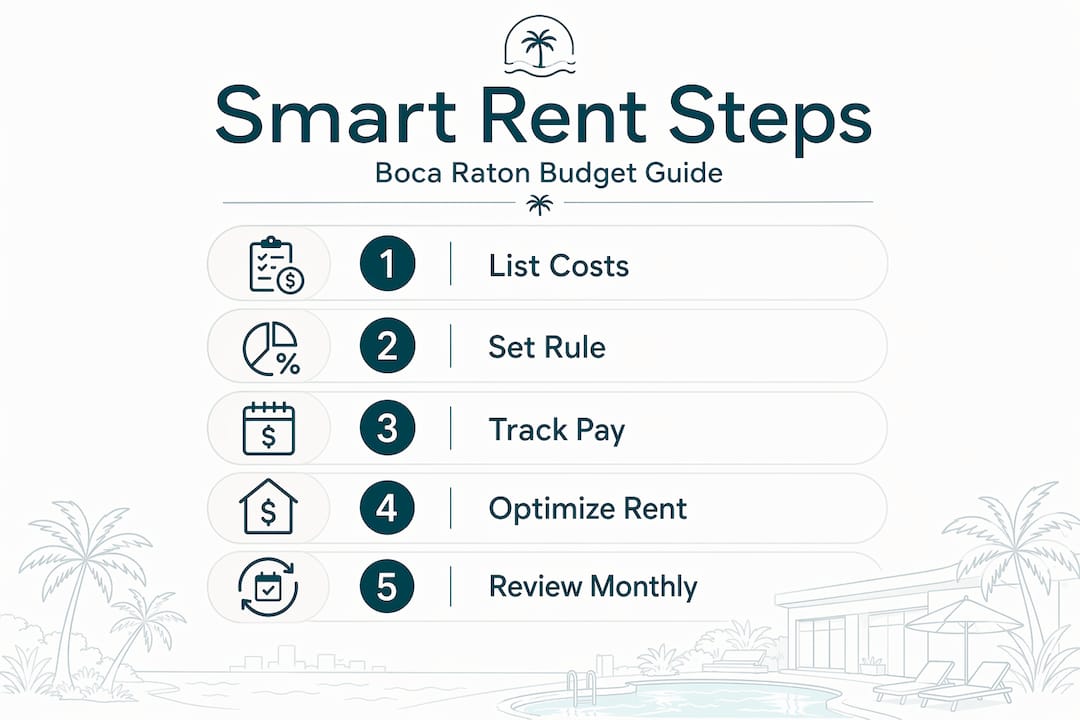
Apartments.com data shows that rent in Boca Raton’s city center tends to run significantly higher than in surrounding neighborhoods, and that adjusting both location and timing is one of the most effective ways to find a cheaper one-bedroom apartment in this market.
Location strategies that actually save money:
- Look at neighborhoods west of I-95 rather than oceanside or downtown addresses. The cost difference can be $200 to $400 per month for comparable square footage.
- Consider ZIP codes just outside Boca Raton’s most popular corridors, such as areas bordering Deerfield Beach or Delray Beach. You may still get Boca Raton conveniences at lower rent.
- Walk score matters for your budget too. Living within distance of grocery stores and transit can reduce your car and rideshare costs significantly.
Explore affordable Boca neighborhoods that offer quality living without the premium price tag attached to the most sought-after zip codes.
Timing strategies:
- December through March is Boca Raton’s tourist and snowbird season. Counterintuitively, this is when some landlords offer move-in specials because they are competing against seasonal short-term rentals for long-term tenants.
- The end of the month is traditionally when landlords are most motivated to fill vacancies quickly, which can create negotiating room.
- Lease start dates in the summer tend to carry the highest prices because student and professional relocation demand peaks between May and August.
Negotiation strategies:
- Ask directly about move-in incentives. Many apartment communities will offer one free month or a reduced deposit for applicants who can commit quickly or have strong credit.
- Offer a longer lease term (18 months instead of 12) in exchange for a lower monthly rate. Landlords value predictability.
- Bundle any additional costs you can. Parking and storage fees are often negotiable, especially if you are a qualified applicant.
Look at affordable Boca apartments to compare current options and identify which communities are running incentives.
Pro Tip: When you tour an apartment, ask the leasing agent directly: “What specials are you running right now, and what is your typical vacancy rate?” Their answer tells you exactly how much negotiating power you have.
Why personal cash flow should trump rent-to-income ratios
Here is the uncomfortable truth about every rent budgeting guide you have read, including this one: the percentages are starting points, not answers. We see renters who follow the 30% rule precisely and still end up financially stressed. We also see renters who spend 38% of gross income on rent and thrive because they know their numbers cold and made deliberate trade-offs everywhere else.
PBS NewsHour reports that the 30% rule can still be useful but may be less applicable for people at different points on the income distribution, and in high-cost markets it often is not realistic for young adults. The key insight is building a budget that fits your specific cash flow and goals, not a formula designed during a different era of housing prices.
The renters who genuinely struggle are not the ones who spent 33% instead of 30%. They are the ones who used a percentage rule as a substitute for actually knowing their monthly cash flow. If your take-home pay is $3,200 and you have $900 in fixed non-rent obligations, your real available budget for rent and living is $2,300, regardless of what any ratio says.
NerdWallet emphasizes treating cash-flow essentials as the real constraint and deciding what you can cut, whether subscriptions, dining out, or travel, rather than assuming a single rent-to-income percentage automatically produces a workable life budget. That framing is far more honest about how monthly finances actually work.
The trade-off conversation is where real budgeting happens. Would you rather spend $150 more per month to live alone versus having a roommate? That question is not about percentages. It is about your values, your sleep quality, your work schedule, and your savings timeline. Protecting your emergency fund from rent pressure is not optional. An empty emergency fund turns any minor financial surprise into a crisis.
In Boca Raton’s market specifically, the flexibility comes from working within comfortable apartment options that offer transparent pricing so you can plan accurately instead of getting surprised by fees after signing.
“Your rent should work for your life, not the other way around.”
Find your next apartment and start your smart budget
Ready to put your rent budget into action? You now have the framework: a clear picture of all your costs, a rent ceiling based on real cash flow, and location and timing strategies built for Boca Raton.
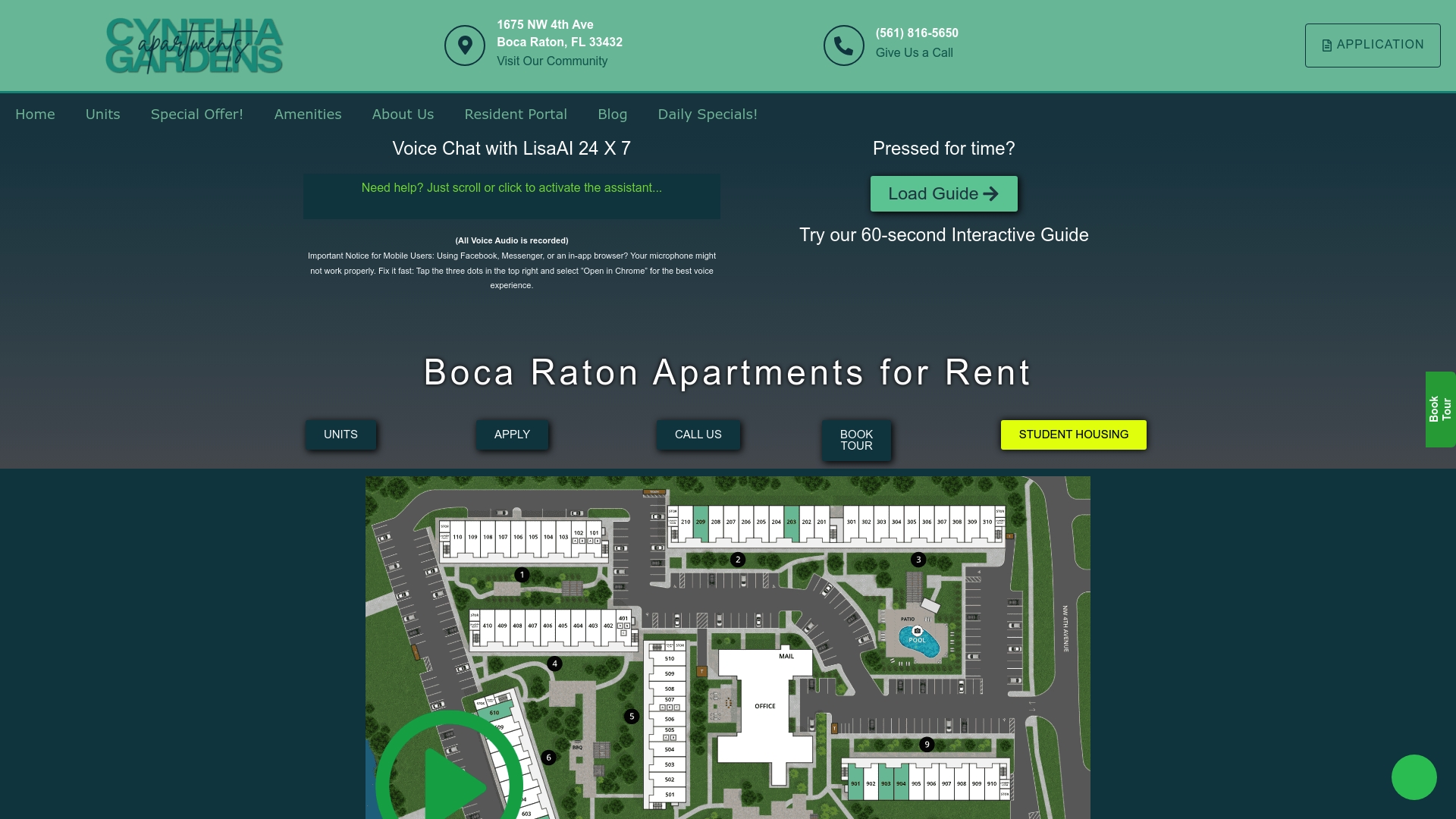
At Cynthia Gardens, we built our entire leasing process around renters who want clarity before they commit. Our pet-friendly one-bedroom apartments come with transparent, all-in pricing so you can run your budget scenarios with accurate numbers. No surprise fees. No guessing. Browse our affordable Boca Raton apartments to see current availability, or explore our apartment styles and features to find the layout that fits your lifestyle. Our virtual tours, AI chat support, and interactive property map are available right now so you can start your search on your own schedule.
Frequently asked questions
What is the first step to budget for rent if I’m moving to Boca Raton?
Start by listing all upfront and monthly costs tied to your move, not just the lease price but also deposits, utilities, and moving fees. RentCafé defines a move-in budget as a plan covering all costs associated with starting a new rental, so build that full picture before you set your rent ceiling.
Are there months when rent is cheaper in Boca Raton?
Yes, off-season months like December through March often see lower rents and more move-in specials. Apartments.com notes that timing your search around the off-peak season and choosing locations farther from the city center are both effective ways to find cheaper rent.
Is the 30% rent rule realistic for students and entry-level professionals?
It is a useful starting point, but in high-rent areas the best approach is a personalized budget based on your actual cash flow. PBS NewsHour reports that the 30% rule is often not realistic for young adults in high-cost markets, so adapting it to your specific income situation is essential.
What if my desired apartment is above the recommended affordability ratio?
Consider trade-offs like getting a roommate or reducing other fixed costs to stay within a safe budget and protect your savings. PBS NewsHour advises planning for realistic trade-offs when rent approaches affordability thresholds so your emergency fund and savings goals do not get squeezed.
How do I know if I can really afford a specific rent price?
Compare all housing and living costs side by side with your take-home pay using a rent calculator or worksheet. Zumper recommends tracking current spending for at least 30 days, listing all expected renter expenses, and setting a rent target to compare against your actual budget.
Recommended
- Proven ways to save on rent in Boca Raton: 2026 guide
- Smart budget hacks for affordable living in Boca Raton
- Smart Renting: Tips for Finding the Best Boca Apartment Deals – Luxury Apartments for Rent in Boca Raton | Premium Boca Raton Apartments | Aapartments Boca Raton
- How to Rent Apartment in Boca Raton: Step-by-Step Guide