
Yes, you can rent an apartment with no credit history. Having no score is not the same as having a bad one, and landlords can approve you on other proof that you pay your bills: steady income, references, a larger deposit or a co-signer. Fannie Mae says no standard credit score is required to rent, and requirements vary by landlord and region. This guide covers what to gather, how soft and hard checks differ, how a credit freeze fits in, and what Florida renters should watch in fees and deposits.
TL;DR
- No credit history means no score, which is different from a low score. Many landlords will approve you on income, references and rental or payment records.
- Gather pay stubs or bank statements, ID, proof of on-time bills and references before you apply, and ask early whether a larger deposit or a co-signer can stand in for a score.
- Ask who runs the screening. A check you start yourself is usually a soft inquiry, while a landlord-started check may be a hard one.
- If you have a credit freeze, lift it temporarily before applying.
- In Florida, security deposits have no legal cap, so ask for every fee and deposit in writing before you pay an application fee.
Table of Contents
- What “no credit history” means to a landlord
- What landlords check instead of a score
- What to show when you have no credit or rental history
- Deposits, co-signers and guarantors
- Soft vs. hard credit checks: what hits your score
- Credit freeze and renting: lift it before you apply
- Be careful with “no credit check” listings
- Florida: deposits, fees and screening rules
- How to start building credit while you rent
- Our perspective
- Apply at Cynthia Gardens in Boca Raton
- FAQ
- Sources
What “no credit history” means to a landlord
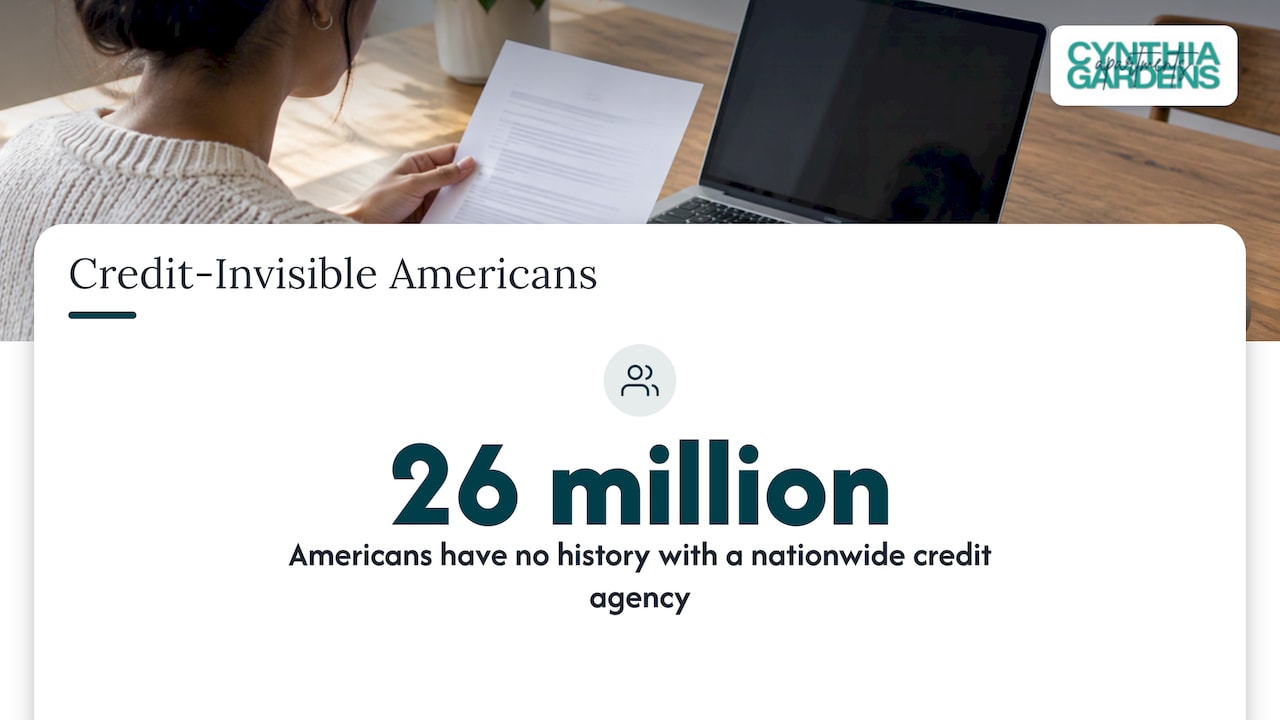
People with no credit file are often called “credit invisible.” The Consumer Financial Protection Bureau found that 26 million Americans, about one in ten adults, have no credit history with a nationwide credit reporting agency. If you are a recent graduate, a student, a newcomer to the country or someone who has only used debit and cash, you are in large company.
The lack of a score is not, by itself, grounds for a landlord to deny housing. Experian notes, however, that when several applicants compete for the same unit, someone with a strong score may be chosen, and many landlords ask credit-invisible applicants for a higher security deposit. So the goal is simple: give the landlord enough other evidence that the score stops mattering.
What landlords check instead of a score
A rental application is rarely just a credit number. Fannie Mae lists the usual pieces: identity, employment, income, credit and criminal-background screening. Landlords may ask for government-issued ID, employment details, pay stubs, an offer letter, bank statements, 1099 tax forms or other ways to verify income.
That means your application can be strong in four of five areas even if the credit line is blank. Income is the biggest lever. A common benchmark landlords use is a monthly income that is a multiple of the rent, and the multiple differs from one property to the next, so ask what the building uses. Our guide to proof of income for renters walks through which documents work for salaried, hourly and self-employed applicants, and our list of documents needed to rent an apartment covers the rest of the packet.
What to show when you have no credit or rental history
Massachusetts Legal Help, a professional legal-aid resource, suggests that renters without credit or a rental record provide alternative proof of reliability. The items it names are:
- Records of car-loan, utility, cellphone or insurance payments
- Letters from employers, clergy or shelter staff
- Pay stubs or bank statements
- A co-signer, if you can get one
Turn that into a one-folder application packet:
- Income proof. Your last two to three pay stubs, or an offer letter if you start soon. Freelancers can use bank statements and 1099 forms.
- Bank statements. Show a steady balance and that rent would not strain your budget.
- Payment records. Twelve months of on-time phone, utility or insurance payments make a useful substitute for a credit file.
- References. An employer, a professor or internship supervisor, and a previous landlord if you have one. Ask them in advance, and give them a heads-up that someone may call.
- A short cover note. Two or three sentences: who you are, where you work or study, and that you have no credit file because you have never borrowed.
Being upfront helps. A plain, honest explanation reads better than a gap the landlord discovers on their own.
Deposits, co-signers and guarantors
Fannie Mae advises applicants to ask whether a guarantor, co-signer or larger security deposit can substitute for credit that does not meet the landlord’s standard. Treat it as a negotiation you start, not a penalty you wait for.
| Option | What it is | Best when |
|---|---|---|
| Larger deposit | You put more money down up front | You have savings but no co-signer |
| Co-signer or guarantor | Someone with credit agrees to cover the rent if you can’t | A parent or relative is willing and able |
| Strong income proof | Pay stubs, offer letter, bank statements | You are employed and earn comfortably above the rent |
| References | Employer and former landlord vouch for you | You have a work or rental track record |
A co-signer takes on real financial responsibility, so have an honest conversation before asking. For a deeper look at the full set of tactics, see our seven strategies for finding an apartment without credit.

Soft vs. hard credit checks: what hits your score
A soft inquiry does not affect your score. A hard inquiry can. TransUnion’s SmartMove explains that when the renter starts the release of their own screening data, it is treated as a soft inquiry and does not change the score, while a landlord-initiated check may be a hard inquiry that can lower it.
So the same screening can be soft or hard depending on who starts it. Before you pay an application fee, ask two things:
- Who runs the screening, you or the property?
- Will it show as a soft or hard inquiry on my file?
If you have no file, a hard pull is mostly a non-event, since there is little score to lower. But if you are building credit, avoid several hard pulls from several applications in a short span. Our overview of the credit check for renters in Florida explains the Florida side in more detail.
Credit freeze and renting: lift it before you apply
A freeze stops a credit reporting agency from releasing your report. Massachusetts’s official guidance says a freeze may need to be temporarily lifted before you apply to rent, and that it does not affect your credit score. It exists to block new-account identity theft.
If you froze your file and then apply for an apartment, the screening company may return nothing, and the application can stall. Ask the landlord which agency they use, then lift the freeze with that agency for the window you need and re-freeze afterward. If you have no credit history at all, there may be no file to freeze, but check before you assume.
Be careful with “no credit check” listings
Larger apartment complexes and management companies usually have stricter requirements, and Experian notes that people with no credit may have better luck with an individual landlord who can be more flexible, or through the Housing Choice Voucher program. SoFi cautions that advertised “no-credit-check” apartments can signal a problem unit, a difficult landlord or a scam.
Practical rules that protect you:
- Never wire money or pay a deposit for a unit you haven’t seen, in person or through a verified live tour.
- Get the lease, fees and deposit terms in writing before paying anything.
- Be wary of any listing that asks for payment before any application.
Our guide on spotting virtual tour scams lists six checks to run before you send money.
Florida: deposits, fees and screening rules
Florida renters should know a few things up front.
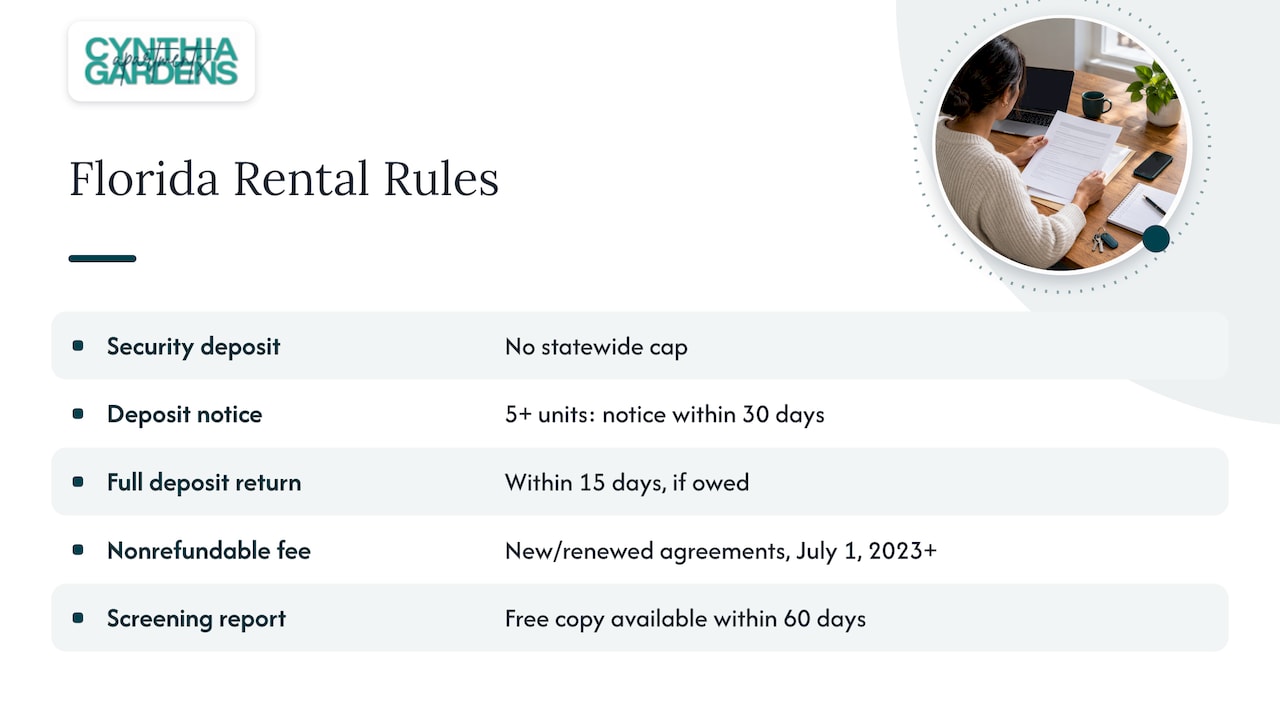
No cap on security deposits. The state’s rules let a landlord ask for whatever deposit it sees fit, and a tenant can negotiate it, according to a Florida rental guide. That is why a no-credit applicant should ask exactly how much the deposit will be.
Where the deposit is held. Landlords must keep it in a separate account at a Florida bank or post a surety bond. Landlords with five or more units must give written notice of where it is held within 30 days, and if you are owed the full deposit, it must be returned within 15 days.
Nonrefundable fee instead of a deposit. A 2023 Florida law allows a landlord to offer a nonrefundable fee, including monthly fees, in place of a deposit. It applies to agreements entered into or renewed on or after July 1, 2023. You can pay the regular deposit instead of the fee at any time, and the fee does not change your duty to pay rent or damages.
Application fees. Florida law permits them, and landlords should disclose the amount, whether it is refundable and how it is used. Fees often offset the costs of credit reports, background checks and eviction searches. There is no general statewide cap on ordinary application fees.
If you are denied. A landlord that rejects you based on a screening report must name the reporting company and explain your right to a free copy within 60 days and to dispute errors. If that happens, read how to handle a rental application denial for your next steps.
How to start building credit while you rent
You don’t need a score to get approved, but one will make your next move easier. SoFi says adding a utility in your name or becoming an authorized user on someone’s card can begin establishing credit, though a score may take six months or more to generate. Start early, keep every bill on time, and your next application will be simpler. Our page on the credit score for apartment rental shows how scores factor into approval.
Our perspective
We hear from a lot of first-time renters: students, young professionals starting a first job, people who simply never needed a credit card. Our view is that a missing score tells you very little about whether someone pays rent on time, and that the application process should be clear enough that nobody guesses.
That is why we publish our fees. Our one-bedroom apartments in Boca Raton are listed from $1,990 to $2,220 per month, and the one-time charges are on one page: $75 non-refundable application fee per applicant, $300 administration fee, $15 wire transfer fee and $500 transfer fee. Cat owners pay a one-time non-refundable pet fee of $300 to $500 per cat, with no ongoing pet rent. We work to leave no hidden fees.
If you are applying with no credit history, come with your income proof, references and any payment records, and ask us what we can work with. A quick conversation before you apply saves you an application fee and a lot of worry.
Ayman
Apply at Cynthia Gardens in Boca Raton
If you are looking for a one-bedroom in Boca Raton, our community is built for young professionals, FAU students and cat owners. We offer virtual tours and an interactive property map, so you can see the apartment before you commit, plus online leasing with AI chat and voice assistance. Browse current one-bedroom apartments and pricing, and see every one-time charge on our fees page.
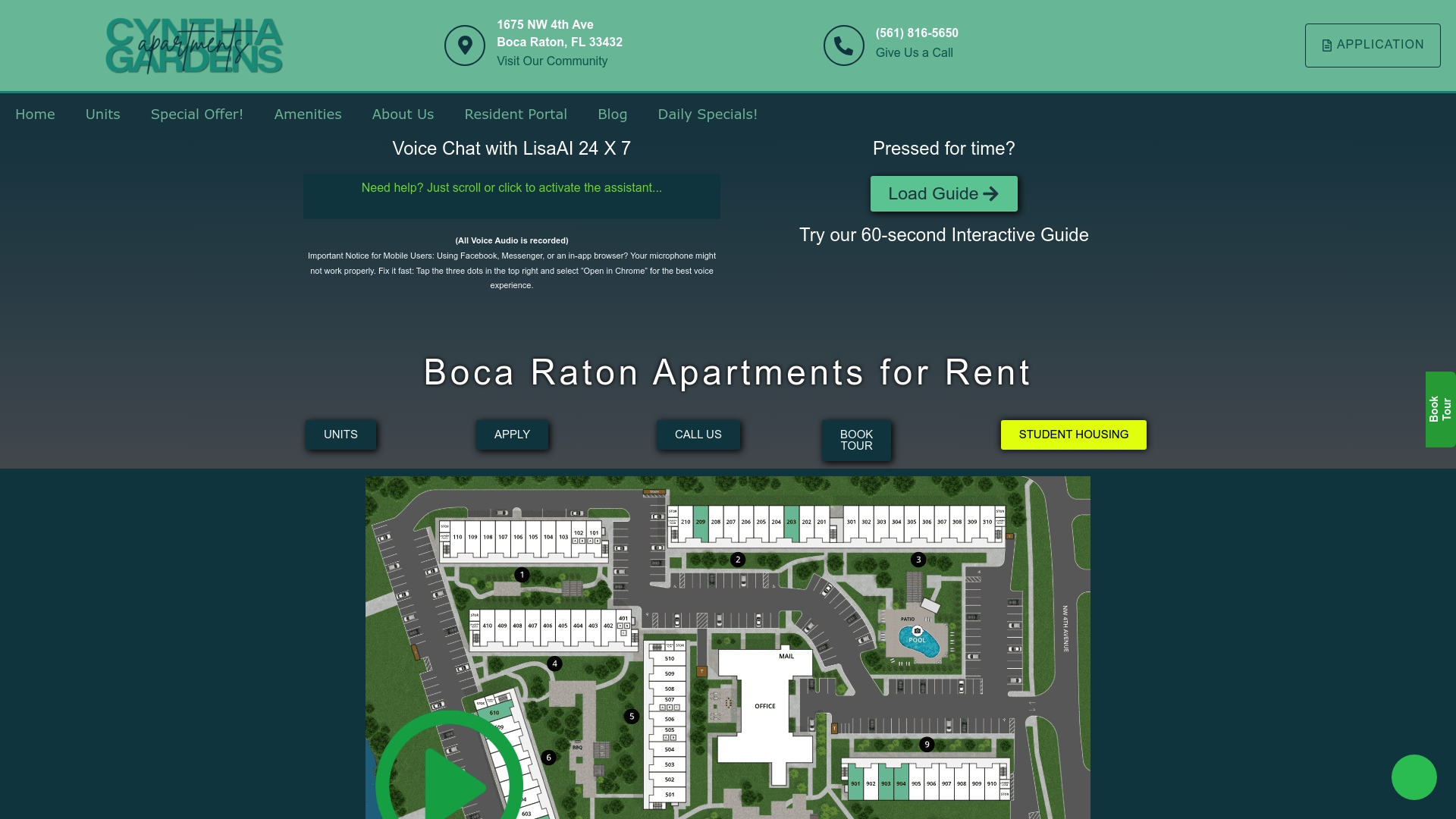
If you want to compare how credit fits with other approval factors, our page on apartments without a credit check is a good next stop. Bring your documents, ask your questions, and we will walk you through the process.
FAQ
Can I rent an apartment with no credit history?
Yes. Landlords set their own standards, and there is no standard credit score required for renting. Strong income proof, references, payment records, a larger deposit or a co-signer can all take the place of a score. Smaller landlords may be more flexible than large complexes.
Does a soft credit check affect my score?
No. A soft inquiry does not change your credit score. A check you start yourself is generally treated as soft, while one a landlord starts may be hard. Ask who is running the check before you pay for it.
Will a credit freeze block my apartment application?
It can. A freeze prevents the credit agency from releasing your report, so you may need to lift it temporarily before applying. It does not affect your score, and you can re-freeze afterward. Ask the landlord which agency they use.
How much deposit can a Florida landlord ask for?
Florida sets no legal cap on security deposits, so the amount is whatever the landlord asks and you can negotiate. A landlord may also offer a nonrefundable fee instead of a deposit, and you can choose the regular deposit at any time. Get the amount in writing.
What if I have no rental history either?
Use employer references, a professor or supervisor letter, and records of on-time utility, phone or insurance payments. A co-signer can also help. Explain your situation briefly and honestly in your application.
Sources
- Fannie Mae: What to Know Before Applying for a Lease
- CFPB: 26 Million Consumers Are Credit Invisible
- Experian: Is it Bad to Have No Credit Score?
- Experian: Can I Rent an Apartment Without a Credit Check?
- Massachusetts Legal Help: Rental History
- TransUnion SmartMove: Tenant FAQs
- Mass.gov: Freeze your credit
- SoFi: How to Rent an Apartment With No Credit
- Florida Senate: 2023 Bill 494 Analysis
- Nolo: Landlord-Tenant Laws in Florida
- KSN Law: Rental Application Process in Florida
- Legal Clarity: Florida Rental Application Fee Laws
- Florida rental guide on renting without credit history