
Last Updated: November 3, 2026
Quick Summary
The long term rental market in Florida beach towns is being reshaped by supply growth, softening coastal rents, and investors rethinking where stable income comes from. Available rental listings nationwide are projected to grow 4.6% in 2026, with occupancy forecast to ease by about 1% as that supply lands.
- Fort Walton ranked first in Florida for gross yield at 17.0% between October 2025 and September 2026.
- Naples rents fell 1.6% year over year and Fort Myers fell 4.9% in mid-2026.
- Florida rental supply growth from 2013 to 2023 concentrated in units above $1,200 per month.
- Miami Beach requires minimum stays of six months and one day for certain residential properties.
- West Boca and Central Boca units tend to hold tenants two to three years.
Table of Contents
- What the Long Term Rental Market in Florida Beach Towns Looks Like Now
- Beach Towns Where Long Term Rentals Still Produce Yield
- Average Rent for Beachside Apartments in Florida
- Boca Raton Long Term Apartment Rentals: The Hyper-Local Picture
- Maintenance-Free Living Boca Raton Renters Actually Get
- Rules, Taxes and Lease Terms That Shape Coastal Returns
- Long Term Versus Short Term Rentals in Beach Towns
- Book a Tour of a Boca Raton Rental Built for the Long Term
- Frequently Asked Questions
What the Long Term Rental Market in Florida Beach Towns Looks Like Now
The long term rental market in Florida beach towns is being reshaped by supply growth, softening coastal rents, and investors rethinking where stable income actually comes from.
The long term rental market is the segment of housing where tenants sign leases of roughly a year or more, as distinct from nightly and weekly vacation rentals. Available rental listings nationwide are projected to grow 4.6% in 2026, per StayFi’s 2026 vacation rental statistics, and occupancy is forecast to ease by about 1% as that supply lands.
Here is the tension most guides skip. Supply is rising fastest at the higher end. The Shimberg Center for Housing Studies at the University of Florida found that Florida’s rental supply growth between 2013 and 2023 concentrated in units renting above $1,200 per month.
At Cynthia Gardens, we are a garden-style community in Boca Raton, minutes from FAU and the beach, serving long-term residents. Below, we break down where yields hold, what rents look like, and which rules shape the math.
Beach Towns Where Long Term Rentals Still Produce Yield
Yield still exists on the coast, but it is uneven. Fort Walton ranked first in Florida for gross yield at 17.0% between October 2025 and September 2026, according to BNBCalc’s Florida investment yield rankings. That is a striking number, and it rewards owners who bought into a market before pricing caught up.
Three factors separate towns that still produce yield from those that do not:
- Entry price relative to rent. A market where the median home costs 15 times annual rent will not cash flow, no matter how strong seasonal demand looks.
- Regulatory stability. Towns with clear permit rules and predictable enforcement attract long-hold investors.
- Diversified local economy. Beach towns with year-round employment, not just tourism, keep occupancy steadier in the off-season.
Average Rent for Beachside Apartments in Florida
There is no single beachside rent figure, because coastal pricing splits sharply by region. In Southwest Florida, mid-2026 data showed Naples rents down 1.6% year over year and Fort Myers down 4.9%, per RentCafe data reported by True Patriot Property Management. Those declines signal a market correcting after several years of aggressive increases.
For official benchmarks, the HUD Fiscal Year 2026 Fair Market Rents publish rent standards by municipality, and they remain the most reliable starting point for comparing one coastal submarket against another.
Why Coastal Rents Diverge From Inland Rents
That premium is not permanent. When supply expands, the coastal premium compresses first at the top of the market. Renters gain, and landlords competing for long-term tenants win on finishes, amenities, and maintenance response rather than location alone.
For a local benchmark and a budget calculator built around Boca Raton’s $2,940 median rent, see our Boca Raton rent planning guide. It lays out studio-to-three-bedroom costs side by side.
Boca Raton Long Term Apartment Rentals: The Hyper-Local Picture
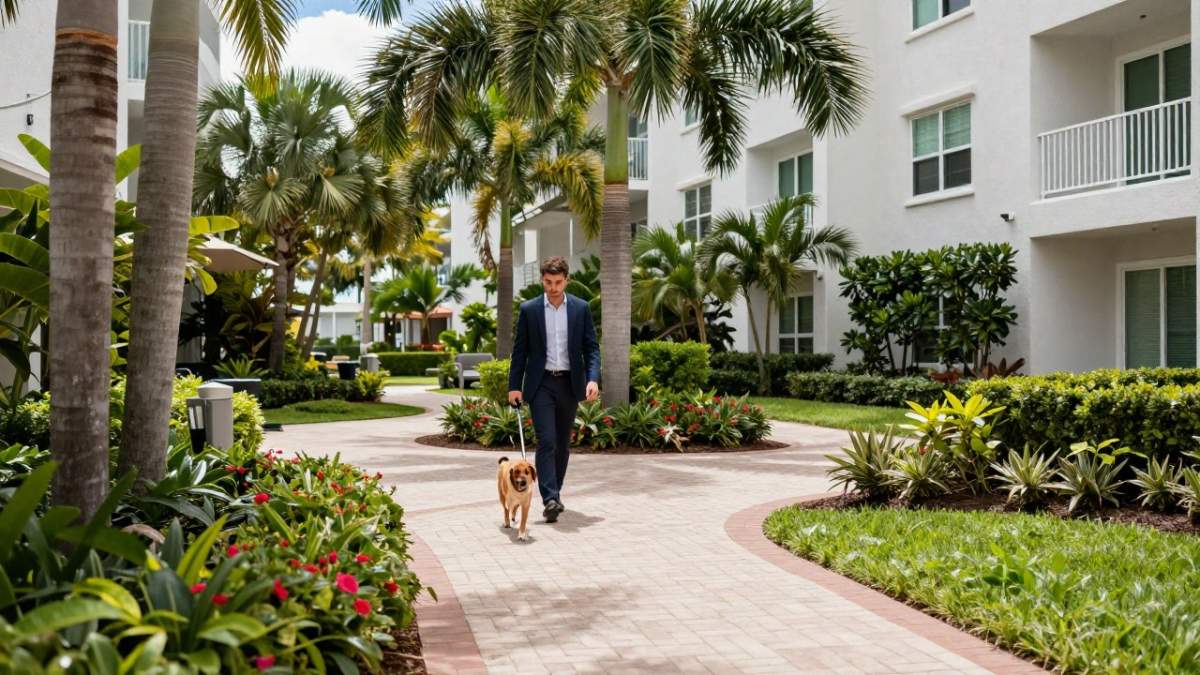
Boca Raton sits in Palm Beach County. That gap matters for anyone evaluating Boca Raton long term apartment rentals, because the city contains several distinct submarkets with different price floors, HOA structures, and demand profiles.
Graduate students, tech and finance commuters, and relocating professionals often look for a quiet street, reliable maintenance, and a stable residence.
Neighborhood-Level ROI Inside Boca Raton
Returns inside Boca Raton vary more by neighborhood than by city. Units near the university corridor trade lower rents for near-zero vacancy, while properties closer to the beach command premiums but carry higher insurance and HOA costs that erode net yield. The table below is the framework we use when comparing submarkets; rent ranges are drawn from active long-term listings and should be re-checked before underwriting. Because seasonal demand can shift the balance between occupancy and carrying costs, compare long-term yields with the distinct economics of renting for snowbirds.
| Submarket | Typical long-term rent range | Vacancy profile | Carrying-cost profile | Long-term fit |
|---|---|---|---|---|
| Near-campus (FAU corridor, Spanish River Blvd area) | Lower end of city range | Very low, driven by academic calendar | Moderate HOA, older stock | Strong for steady occupancy; higher turnover at graduation |
| East Boca near the water (Mizner Park, Palmetto Park Rd to the beach) | Highest in the city | Low but price-sensitive | Highest insurance and HOA | Best for capital appreciation; weakest net yield |
| Central Boca near I-95 and Tri-Rail (Congress Ave, Yamato Rd) | Mid-range | Balanced | Moderate | Best rent-to-occupancy balance for commuters |
| West Boca (441 corridor, west of the Turnpike) | Mid-to-lower range | Balanced, family-driven | Lower insurance, newer stock | Strong for longer tenures and family renters |
Three mechanics drive the differences more than headline rent:
- HOA rental caps and waitlists. Many Boca Raton condominium associations limit the number of rented units and require a waitlist before an owner can lease. A unit that looks like a strong yield on paper can sit vacant for months while the association processes a rental application. Confirm the cap and waitlist position before you buy.
- Insurance pass-through. East Boca properties carry windstorm premiums that can run several times the West Boca equivalent for similar square footage. Landlords who cannot pass the full cost through see net yield compress even when gross rent is highest.
- Tenant tenure. Near-campus units turn over on the academic calendar, while West Boca and Central Boca units tend to hold tenants two to three years. A two-year average tenure cuts turnover cost and vacancy loss roughly in half compared with an annual-turnover unit.
For owners, the practical framework is straightforward:
- Near-campus submarkets: lower rent per unit, minimal vacancy risk, higher turnover.
- East Boca near the water: higher rent, higher carrying costs, stronger capital appreciation.
- Central Boca near I-95 and Tri-Rail: balanced rent and occupancy, appealing to commuters.
- West Boca: lower insurance and newer stock, best for family renters who stay put.
For a local benchmark and a budget calculator built around Boca Raton’s $2,940 median rent, see our Boca Raton rent planning guide. It lays out studio-to-three-bedroom costs side by side.
Maintenance-Free Living Boca Raton Renters Actually Get
Maintenance-free living in Boca Raton means the landlord handles repairs, landscaping, and exterior upkeep, and the tenant’s monthly obligation stays fixed apart from utilities. For long-term renters, that predictability is worth more than most listings admit.
A long-term lease transfers maintenance risk to the owner, but only if the owner actually responds. For the full picture of what maintenance-free living includes locally, read our complete guide to maintenance-free living in Boca Raton. A common renter mistake is signing without asking two questions: what the average maintenance response time is, and who handles after-hours emergencies.
At Cynthia Gardens, maintenance-free living is the core of the offer: a garden-style community with modern one-bedroom apartments, stainless steel appliances, quartz countertops, a resort-style pool, and lush landscaped grounds, all managed so residents are not coordinating contractors on a Saturday.
Watch out: “maintenance-free” in a listing sometimes means only exterior upkeep, with in-unit repairs billed back to the tenant. Confirm the boundary in the lease.
Rules, Taxes and Lease Terms That Shape Coastal Returns
Regulation is where coastal rental math gets decided, and Florida law cuts both ways. Under Florida Statutes Section 509.032(7)(b), local governments are generally limited in how far they can prohibit vacation rentals, but municipalities retain real authority over certain residential districts. Miami Beach, for example, enforces ordinances requiring minimum stays of six months and one day for certain residential properties, per city ordinance. That single rule explains a trend worth understanding: some investors are shifting toward mid-term rentals of 31 days or more to sidestep strict short-term ordinances, as noted in recent Florida real estate investment commentary. Longer leases also reduce turnover costs and stabilize cash flow.
For tenants, the lease terms that matter most are renewal clauses, early-termination penalties, and deposit structure. Ask for all three in writing before you sign.
Long Term Versus Short Term Rentals in Beach Towns
The choice between long and short term comes down to what you are optimizing for: income stability or gross revenue potential. Long-term leases trade peak-season upside for predictable monthly cash flow, lower marketing spend, and less exposure to market volatility.
| Factor | Long Term Rental | Short Term Rental |
|---|---|---|
| Income stability | Predictable monthly rent | Seasonal, variable |
| Vacancy risk | Low, annual turnover | High, weekly turnover |
| Operating cost | Lower, no furnishing or cleaning | Higher, furnishings and management |
| Regulatory exposure | Minimal | Permit and ordinance risk |
| Best for | Passive income, capital preservation | Active operators, yield optimization |
Short-term rentals can produce higher gross revenue in strong markets, but the operating burden is real: furnishing, cleaning, guest screening, and platform fees all eat into margin. Long-term rentals suit investors who want an asset class that runs quietly in the background.
For renters, the same logic applies in reverse. A long-term lease in a well-managed community delivers stability that a rotating vacation rental cannot.
Book a Tour of a Boca Raton Rental Built for the Long Term
The long term rental market in Florida beach towns rewards people who read it carefully. Whether you are renting or underwriting, look past gross numbers to net outcomes.
At Cynthia Gardens, we built our community for exactly that kind of resident. Modern one-bedroom apartments with stainless steel appliances and quartz countertops, a resort-style pool, and lush landscaped grounds, minutes from FAU and the beach in Boca Raton.
Get started with Cynthia Gardens and schedule a tour today to see the community for yourself. Browse Boca Raton apartments for long-term renters and book a tour.
Frequently Asked Questions
Is it more cost-effective to rent long term in a Florida beach town?
Usually yes. A long term lease spreads the cost of coastal housing across twelve months instead of peak-season nightly rates, and it removes turnover costs like cleaning fees and booking commissions. A long term lease also protects you from seasonal rate swings, since monthly rent stays fixed for the lease term.
How does the rental market in Boca Raton compare to other Florida beach towns?
Boca Raton sits between the two extremes. Southwest Florida markets such as Naples and Fort Myers posted year-over-year rent declines of 1.6% and 4.9% in mid-2026, while Fort Walton led the state for gross yield at 17.0% between October 2025 and September 2026. Boca Raton’s diversified economy, FAU presence and commuter access to I-95 and Tri-Rail support steadier occupancy than pure tourism towns, so the long term rental market here trades peak yield for consistency.
What should I look for when searching for a long term beachside apartment?
Check four things: lease length and early-termination terms, what maintenance the landlord covers, pet policy including breed restrictions and monthly fees, and total move-in cost beyond first month’s rent. Ask whether the building enforces quiet hours and how maintenance requests are tracked. In a garden-style community, ask about wall construction and unit placement if noise matters. Confirm proximity to transit routes you actually use, then compare the monthly rental against your cash flow, not just the headline rate.
What amenities are essential for long term living in a Florida coastal community?
Long term residents get more value from practical amenities than resort extras. Look for in-unit appliances including a full kitchen, assigned or covered parking, on-site maintenance, and outdoor space you will use year-round. A pool matters in Florida heat, and landscaped grounds support daily walks and pets. Confirm whether water, trash and pest control are included, since those recurring costs add up. Maintenance-free living Boca Raton renters describe usually means those items are handled without a separate service call.
The right long-term rental is the one whose numbers and maintenance promises hold up after you move in. Come walk the grounds, meet the team, and ask us the hard questions about response times, lease flexibility, and pet policy before you commit.
