Median rent in Boca Raton hit $2,940 a month as of July 2026, well above the national median. That figure moves a lot depending on bedroom count and ZIP code, and different trackers report different numbers for the same market, so treat any single figure as a starting point rather than the final word.
TL;DR:
- Rent for larger units varies significantly by ZIP code, with the highest prices in 33432 and lower costs inland in 33428 and 33433.
- Actual rental prices often exceed government benchmarks like HUD’s, especially when luxury properties are included in tracker data.
- Seasonal demand, local school quality, and land scarcity are the main factors driving higher rents in Boca Raton in 2026.
- To budget effectively, renters should aim for a gross income of at least $101,000 to $118,000 annually, with extra costs for utilities and move-in fees.
- Average rent figures are often misleading; ZIP code and unit size are more relevant for accurate rent expectations.
Table of Contents
- Average Rent Boca Raton: What You’ll Pay by Bedroom Count
- Rent by Neighborhood: Where the ZIP Code Changes Everything
- How Boca Raton Rent Compares to the National Average and Nearby Cities
- What’s Driving Boca Raton Rents Higher in 2026
- Budgeting for Boca Raton Rent: What You’ll Really Need to Earn
- Cynthia Gardens: A Straightforward One-Bedroom Option in Boca Raton
- Why the “Average Rent” Number Is Often Misleading
- Sources
Average Rent Boca Raton: What You’ll Pay by Bedroom Count
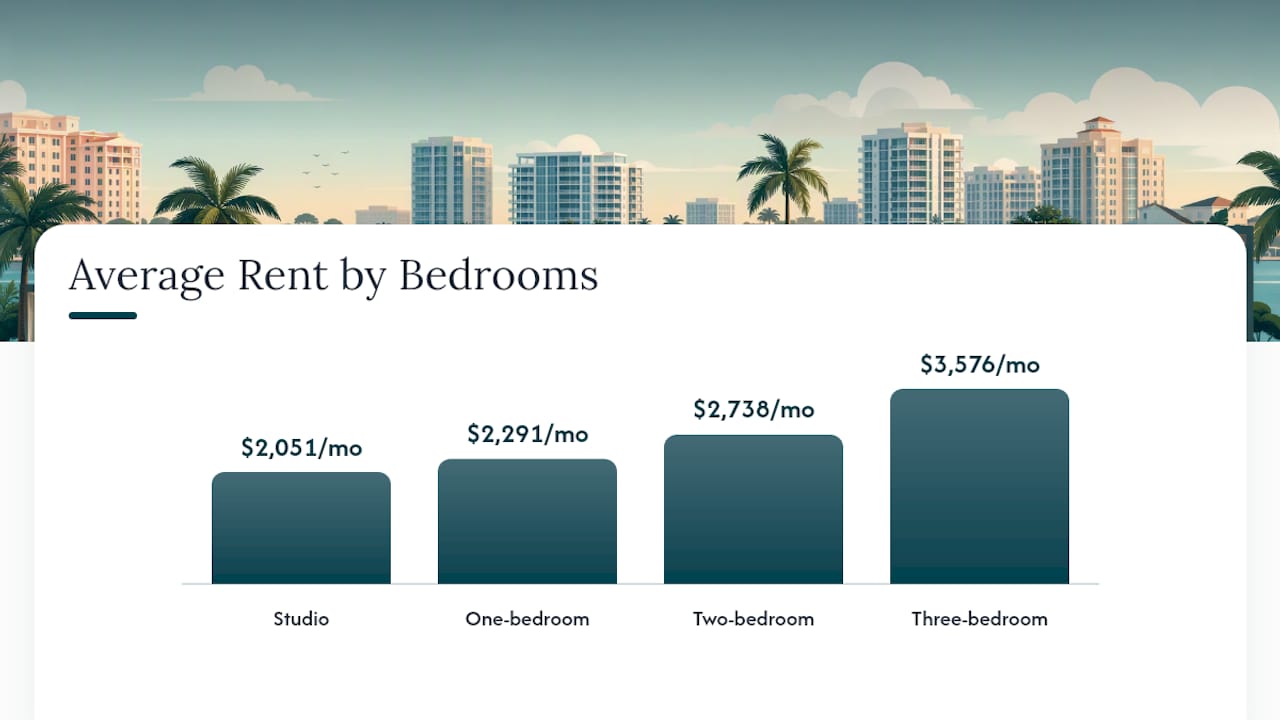
The bedroom breakdown matters more than the citywide average, because a studio and a three-bedroom in the same city can differ by $1,500 a month or more. According to RentDataNow’s July 2026 figures, here’s what renters are paying by unit size:
- Studio: around $2,051/month
- One-bedroom: around $2,291/month
- Two-bedroom: around $2,738/month
- Three-bedroom: around $3,576/month
Those numbers sit close to what HUD’s fair-market rent data shows for the area. HUD’s FY2026 small-area benchmarks put two-bedroom units between roughly $1,910 and $3,210, depending on ZIP code, with a countywide median around $2,870. That’s a wide range for the same bedroom count, and it’s the reason two renters can quote wildly different “average rent” figures and both be right.
Other trackers add even more spread. Zillow’s market-trends dashboard has shown averages closer to $3,150 in some snapshots, while Average-rent reported figures between $2,492 and $2,825 depending on how many units it sampled that month. The gap usually comes down to which properties get counted. Luxury towers near the beach and single-family homes listed as rentals pull the average up, while older garden-style communities pull it down. When you compare numbers, check whether a tracker includes those higher-end outliers or sticks to standard apartment stock.
Rent by Neighborhood: Where the ZIP Code Changes Everything
Boca Raton’s rent map isn’t flat. Coastal ZIP codes and areas near top-rated schools carry a real premium over inland neighborhoods just a few miles away, and that spread is often bigger than the difference between bedroom counts.
The most affordable stretch runs through 33433 and 33428, both inland and farther from the beach. The priciest ZIP is consistently 33432, home to downtown, Mizner Park, and direct beach access. If you’re weighing a $600 monthly difference against a 15-minute commute, that’s the real tradeoff most renters in this city end up making. Renters chasing lower rent should also check school zoning before committing. A cheaper ZIP two miles from an A-rated school district can still cost more in the long run if you’re raising kids and need to relocate later. For a deeper walk through neighborhood tradeoffs, Cynthiagardens’ guide to Boca Raton pricing by area breaks down commute times and access points ZIP by ZIP.
How Boca Raton Rent Compares to the National Average and Nearby Cities
Boca Raton’s rent runs meaningfully above the national median, and it’s also pricier than several of its closest neighbors:
- Boca Raton’s median sits around $2,940/month, well above the U.S. median rent for comparable apartment stock.
- Delray Beach and Deerfield Beach typically post lower averages, often several hundred dollars less per month for similar unit sizes.
- The gap between HUD’s fair-market benchmark (around $2,870 for a two-bedroom) and live asking rents shown by trackers like Zillow illustrates why government data tends to lag what’s actually on the market.
Budget with the higher, live-market number in mind, not the government benchmark, since that’s what you’ll actually be quoted.
What’s Driving Boca Raton Rents Higher in 2026
New apartment construction is finally catching up with demand in a few pockets of the city, which is starting to slow rent growth and give renters slightly more room to negotiate than they had a year or two ago. Seasonal demand still swings hard. Winter arrivals and the snowbird season push competition up between November and March, while summer tends to bring more availability and better concessions.
The bigger forces are structural and won’t change soon. Boca Raton’s public schools rank among the strongest in Palm Beach County, and that alone keeps family demand high in specific ZIP codes. Coastal access and a genuinely limited supply of developable land cap how much new inventory can ever come online. If you’re flexible on timing, summer is the better window to ask a landlord for a reduced rate, waived fees, or a free month on a longer lease.
Budgeting for Boca Raton Rent: What You’ll Really Need to Earn
Most renters should keep rent between 30% and 35% of gross monthly income. At the citywide median of $2,940, that means aiming for roughly $8,400 to $9,800 in gross monthly income, or somewhere around $101,000 to $118,000 a year, depending on how tight you want your budget.
- Calculate your target rent first. Multiply your gross monthly income by 0.30 to 0.35 to find your ceiling.
- Add in the extras. Budget for electricity, water or sewer if not included, renter’s insurance, and parking, which together often add $150 to $300 a month.
- Plan for move-in costs. Security deposits, application fees, and sometimes a broker fee can add up to two or three months of rent upfront.
Pro Tip: Ask upfront whether utilities, parking, and pet fees are bundled into the quoted rent. A “cheaper” listing with hidden add-ons can end up costing more than a transparent one at a slightly higher base price.
Cynthia Gardens: A Straightforward One-Bedroom Option in Boca Raton
Cynthiagardens focuses on one-bedroom apartments with transparent pricing and no hidden fees, which matters in a market where add-on costs regularly blur the real monthly number. The community is pet-friendly and built for renters seeking straightforward leases without surprises. Prospective renters can tour units virtually and use an interactive property map to compare layouts before ever stepping on-site, an approach that lines up with W3C accessibility standards for digital experiences. In a market where speed matters, that kind of upfront clarity can help shorten the search process.
Why the “Average Rent” Number Is Often Misleading
The single biggest mistake renters make with rent data is treating one number as gospel. A citywide average blends studio apartments in aging buildings with penthouse rentals near the water, and that blend tells you almost nothing about what you, specifically, will pay for a one-bedroom in a specific ZIP code.
Conventional advice tells renters to “check Zillow” and call it done. That’s incomplete. Zillow’s asking-rent snapshots run higher than HUD’s benchmarks precisely because HUD measures a broader mix of unit quality, while asking-rent sites capture whatever happens to be listed that week, often skewed toward newer, pricier stock. Neither number is wrong. They’re measuring different things.
What renters should prioritize first isn’t the citywide figure at all. It’s the ZIP-level range and the bedroom-specific number, cross-checked against at least two sources. Boca Raton’s condo boards also sometimes cap rentals or require board approval, a detail almost no rent tracker mentions but one that can derail a lease after you’ve already signed. Verify that before you fall in love with a listing.
— Ayman
Sources
These figures pull from RentDataNow’s July 2026 city data, HUD’s FY2026 fair-market rent tables, and live tracker snapshots from Zillow and Rentometer. HUD numbers are government benchmarks updated annually, while asking-rent trackers update daily or weekly, so check the live sites for the freshest snapshot.
- Average Rent in Boca Raton, FL (July 2026): $2,940/mo
- Boca Raton HUD fair-market rent summary
- Average Rental Price in Boca Raton, FL