A holding deposit reserves an apartment before you sign a lease. A security deposit is paid after you sign, and it covers damage or unpaid rent at the end of the tenancy. The first buys you time, and it can be forfeited if you walk away. The second is your money held in trust, and in Florida it is tightly regulated. Mixing them up is how renters lose a few hundred dollars they never needed to lose.
Below, we walk through how each one works, what Florida law says about security deposits, where “surety bond” and “fee in lieu of deposit” fit in, and what to get in writing before you pay anything.
TL;DR
- A holding deposit (also called a holding fee) takes a unit off the market while your application is processed. It is paid before the lease is signed.
- A security deposit is paid after signing and is meant to be returned, minus documented damage or unpaid rent.
- Holding deposits typically run $100 to $400, and whether you get them back depends on the cancellation terms you sign.
- In Florida, a landlord must return your security deposit within 15 days of move-out, or send written notice of a claim within 30 days.
- A “surety bond” can mean two different things. Know which one you are being asked about before you pay.
Table of Contents
- The core difference in one table
- What a holding deposit actually does
- What a security deposit does, and what Florida requires
- The “surety bond” question
- A worked example
- Questions to ask before you pay anything
- Perspective: how we think about deposits and fees
- Pet owners: a third category to watch
- Students and furnished leases
- Renting a one-bedroom in Boca Raton with us
- FAQ
- Sources
The core difference in one table
| Holding deposit | Security deposit | |
|---|---|---|
| When you pay | Before the lease is signed | After (or at) lease signing |
| Purpose | Reserves the unit while the application is finalized | Covers damage or unpaid rent at the end of the lease |
| Typical size | $100 to $400 | Often around one month’s rent, though amounts vary by landlord |
| Refundable? | Depends on the written terms and on why the deal ends | Yes, minus lawful deductions |
| Governed by | Your reservation or application agreement | In Florida, Fla. Stat. § 83.49 |
| What happens if you move in | Usually credited toward the security deposit or rent | Held until you move out |
The table hides one trap. A holding deposit is the landlord’s protection against lost rent. A security deposit is protection against damage. They solve different problems, so they follow different rules.
What a holding deposit actually does
When a community approves you conditionally, the unit still has to sit empty while paperwork, income checks and a lease are finalized. A holding deposit pays for that wait. Apartments.com’s landlord guidance describes it as a sum that signals serious intent and acts as insurance for a landlord who takes the rental off the market.
That framing matters to you. If you back out, you are not being charged for damage that never happened. You are compensating the landlord for the weeks the unit was not available to anyone else.
Where the money goes if you move in
In practice, a holding deposit is usually applied toward your security deposit once you are approved and sign. Some communities apply it to the first month’s rent instead. Do not assume. The industry guidance above notes that many leasing offices set a short window, often 24 to 48 hours, during which you can cancel without losing the money. After that, the deposit may be kept as a cancellation fee.
Where the money goes if you walk away
This is where most disputes start. Whether you get a holding deposit back depends on three things:
- What the paperwork says. The receipt or reservation agreement should state whether the amount is refundable.
- Who ended the deal. A landlord who denies your application or fails to deliver the unit is in a very different position from a renter who simply changes their mind.
- The timing. Cancel inside the grace window and you are usually in better shape than if you cancel a week later.
Florida’s landlord-tenant law (Chapter 83) governs security deposits in detail, but it does not spell out holding deposits the same way. General explainers such as this Florida holding deposit overview treat them as a separate payment from rent and security deposits. That means your written agreement carries most of the weight. Read it before you pay.
What a security deposit does, and what Florida requires
A security deposit is money you hand over as security for performance of the rental agreement. It is yours until the landlord has a lawful reason to claim some of it.
Florida is specific about what happens to that money. Under § 83.49, the landlord must hold it in one of three ways:
- a separate non-interest-bearing account in a Florida bank, for your benefit;
- a separate interest-bearing account in a Florida bank; or
- a surety bond posted with the clerk of the circuit court, conditioned on the landlord’s compliance with the statute.
If the landlord uses the interest-bearing or bond route, the statute sets rules on how interest is paid to you. The landlord must also tell you in writing, within 30 days of receiving the money, how it is being held. That notice names the bank or states which method is used.
The 15/30 rule at move-out
The part that protects you most is the deadline. According to the Florida Bar’s consumer guidance, a landlord must return the full deposit within 15 days after you leave, or send written notice of an intent to claim within 30 days. A landlord who misses that notice window can lose the right to make a claim against the deposit.
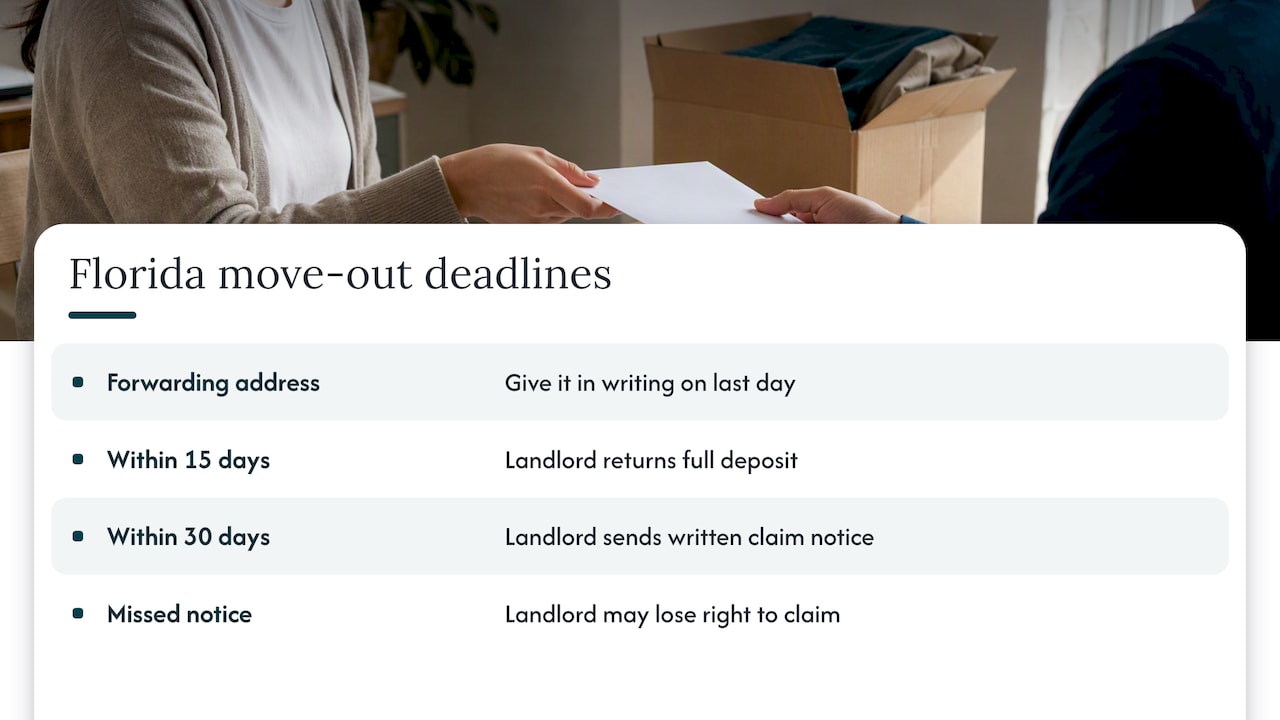
The Florida Bar material also points to a mistake renters make all the time: not giving the landlord a forwarding address in writing. Without it, the notice requirement becomes harder to enforce, and you can end up losing your chance to object to charges. Put your new address in writing on your last day, and keep a copy.
We have more detail on this in our guides to the Florida move-out charges and 15/30/15 rule and Florida security deposit law. If you already have a disagreement, start with how to handle security deposit disputes.
The “surety bond” question
People searching for a surety bond on an apartment are usually asking one of two things. The answers are very different.
Meaning one: the landlord’s bond
As described above, Florida lets a landlord satisfy its deposit-holding duty by posting a surety bond rather than keeping your money in a bank account. In that case you still paid a normal security deposit. The bond is the landlord’s compliance mechanism, and it exists for your protection if the landlord mishandles the funds. You do not buy it, and it does not replace your deposit.
Meaning two: a bond or fee instead of a deposit
Some landlords let you skip the lump-sum deposit and pay a smaller non-refundable charge instead. Florida regulates this one directly. Under § 83.491, a landlord may offer a “fee in lieu of a security deposit,” and the statute says the fee is not a security deposit. Two details from the statute are worth knowing:
- The landlord has to notify you in writing that you can pay a security deposit instead.
- A landlord that offers the option cannot use your choice to pay the fee as a reason to approve or deny your application.
The tradeoff is simple. A deposit is money you can get back. A fee is gone when you pay it, so you are not building anything you can recover at the end of the lease. It lowers your move-in cost and raises your total cost over time. Run the numbers for your lease term before you choose. For a wider look at options, see our piece on alternatives to traditional security deposits.
A worked example
Say you are renting a one-bedroom at $2,000 a month.
- You are conditionally approved and the community asks for a $300 holding deposit to take the unit off the market.
- You sign the lease within the agreed window. The $300 is credited toward your security deposit, so you owe the remainder at signing.
- You move out a year later, leave a written forwarding address, and the landlord has 15 days to return the deposit or 30 days to send a written claim.
Now the other path. You pay the $300, then take a job in another city three days later, after the cancellation window closed. If your agreement says the holding deposit is non-refundable after that point, you have paid $300 for a unit you never lived in. That is a fair outcome only if you were told clearly up front, which is why the written terms matter more than the label on the payment.
Questions to ask before you pay anything
Most of the trouble in this area comes from ambiguity about when the “holding” period ends and the tenancy begins. Settle it in writing before money moves:
- Is this payment refundable, partly refundable, or non-refundable?
- What exactly is the cancellation window, and how do I cancel?
- If my application is denied, do I get everything back?
- Will this be credited to my security deposit or to my first month’s rent?
- By what date must the lease be signed?
- Will you give me a written receipt stating all of the above?
Also confirm what you are being charged under which name. A “holding fee,” “application fee,” “administration fee” and “security deposit” are four different things with four different rules. Application and administration fees are typically non-refundable, and they are not interchangeable with a deposit.
Perspective: how we think about deposits and fees
We run a one-bedroom community in Boca Raton for young professionals, students and pet owners, and the same complaint reaches us again and again: renters feel ambushed by charges that were never explained. That is why we publish our fees in one place and keep them plain.
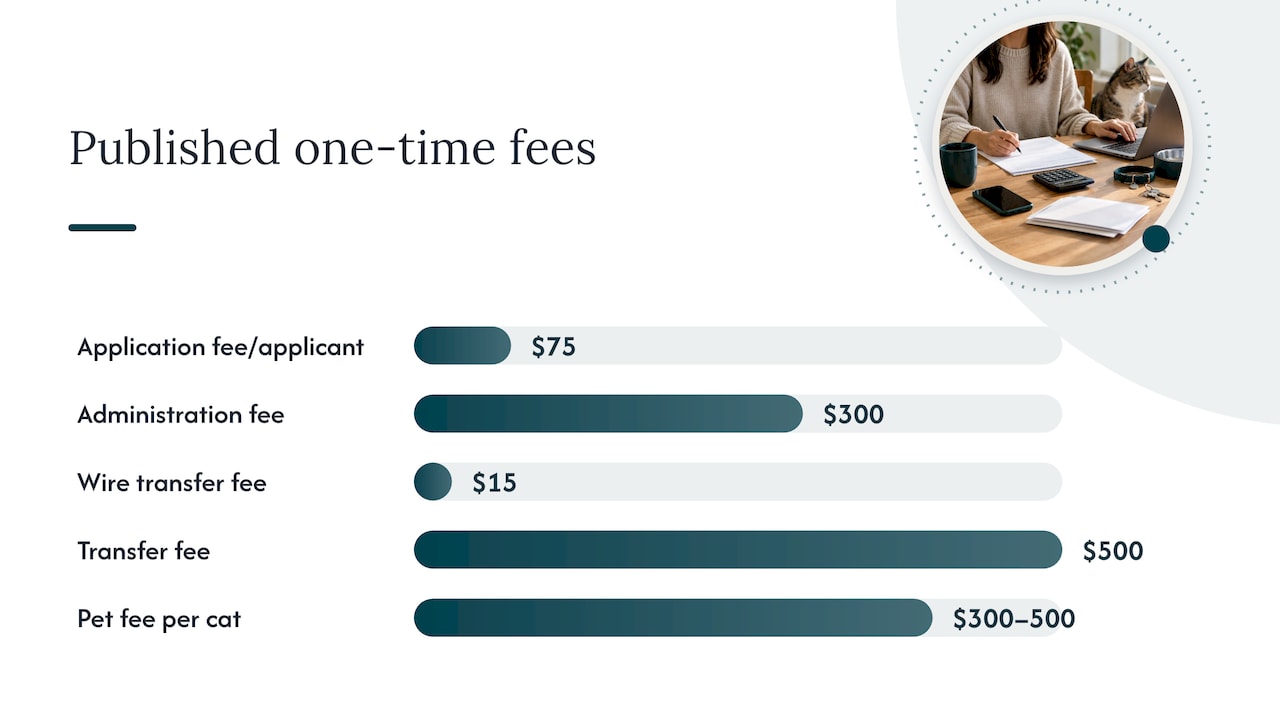
Our published one-time charges are a $75 non-refundable application fee per applicant, a $300 administration fee, a $15 wire transfer fee, a $500 transfer fee, and a non-refundable pet fee of $300 to $500 per cat. The full list is on our fees page. We do not charge ongoing pet rent for cats, so the pet fee is a one-time cost and not a monthly one.
Our advice to any renter, whether or not you end up with us, is the same. Never pay a reservation amount you cannot afford to lose until you are sure about the apartment. Ask which payments come back and which do not, and get the answer on paper. Treat any payment described only verbally as one you may not see again.
— Ayman
Pet owners: a third category to watch
If you have a cat, you may meet a third kind of charge. A refundable pet deposit works like a security deposit and comes back if there is no pet damage. A non-refundable pet fee does not come back, and it is not a deposit. Neither of them is a holding deposit. Ask which one a community uses before you compare total move-in costs. Our explainer on the refundable pet deposit covers the difference, and our pet-friendly one-bedroom guide shows how that plays out in Boca Raton.
Students and furnished leases
Students and anyone on a short or furnished lease should expect deposit rules to differ from a standard unfurnished one-year lease. Furnished units often carry a larger deposit because there is more inside to protect. Our guide to furnished apartment deposits and your rights explains what to expect. If you are applying from out of town or from campus, ask early about how a reservation is handled when you cannot tour in person, and read up on spotting virtual tour scams before wiring any money to a stranger. Wire fraud is a common way for renters to lose a deposit permanently, and no cancellation clause will help you then.
Renting a one-bedroom in Boca Raton with us
Our one-bedroom apartments are listed at $1,990 to $2,220 per month. You can see current availability, take a virtual tour and use the interactive property map on our one-bedroom apartments page. If you want to know how any payment will be handled before you apply, ask our leasing team. Our AI chat and voice assistance are available for exactly that kind of question, and we would rather you ask first than find out later.
FAQ
Do you get a holding deposit back?
It depends on the written terms. If you sign the lease, the deposit is normally credited toward your security deposit or rent. If you cancel after a short grace window, often 24 to 48 hours, the landlord may keep it. Ask for a receipt that says which applies.
Is a holding deposit the same as a security deposit?
No. A holding deposit is paid before the lease to reserve the unit, while a security deposit is paid after signing to cover damage or unpaid rent. In Florida, only the security deposit is governed by the detailed handling and return rules of § 83.49.
Is a holding deposit normal?
Yes, it is a common practice, especially in competitive markets. Amounts typically fall between $100 and $400. A much larger figure, such as $1,000 for a studio, is worth questioning. Ask what it is for and how it is refunded.
Can I pay a fee or bond instead of a security deposit in Florida?
Only if the landlord chooses to offer it. Under § 83.491, a landlord may offer a fee in lieu of a deposit, but it is not required to. The fee is not a security deposit, so you do not get it back. The landlord must also tell you in writing that you can pay a regular deposit instead.
How long does a landlord have to return a security deposit in Florida?
Fifteen days after you move out to return it in full, or 30 days to send written notice that it intends to make a claim. Give your forwarding address in writing so the notice reaches you.
Sources
- What Is a Holding Deposit? (Apartments.com)
- Rights and Duties of Tenants and Landlords (The Florida Bar)
- Florida Statutes § 83.49, Deposit money or advance rent (The Florida Senate)
- Florida Statutes § 83.491, Fee in lieu of security deposit (Online Sunshine)
- Florida Tenant Holding Deposit Rules (tenant-rights.com)