
Boca Raton itself cannot ban a dog based on its breed. Florida law took that power away from every city and county in the state. But your landlord, your HOA, and your renters insurance carrier still can, and often do, restrict breeds or set weight limits in their own contracts. If you have a service animal or emotional support animal, those private restrictions generally don’t apply to you.
TL;DR:
- Local governments can no longer regulate dogs by breed or weight due to Florida law, but private entities like landlords and HOAs retain the authority to enforce breed or size restrictions through contracts.
- Landlords and HOAs typically restrict breeds such as pit bulls, Rottweilers, and Dobermans, often with weight limits, and enforcement can include fines or eviction threats.
- Assistance or emotional support animals are exempt from breed and weight restrictions under the Fair Housing Act, requiring individualized evaluation rather than blanket bans.
- Lease agreements, CC&Rs, and community rules specify breed and weight restrictions, which are primarily driven by liability insurance requirements rather than property preferences.
- Prospective renters should obtain written policies, record the community’s governing documents, and gather documentation to improve odds of accommodations or exemptions.
Table of Contents
- Does Boca Raton have breed restrictions?
- What can landlords, HOAs, and condos still restrict?
- Do assistance animals get exceptions?
- Practical steps before you sign a lease with a pet
- What are Boca Raton’s local dog rules for parks and permits?
- How Cynthia Gardens handles pet policy in Boca Raton
- Why clear pet policies matter more than breed bans
- Finding a pet-friendly apartment that’s upfront about its rules
- Sources
Does Boca Raton have breed restrictions?
No, not from the city or county. Boca Raton and every other Florida municipality lost the authority to regulate dogs by breed, weight, or size when SB 942 took effect on October 1, 2023. That single change reshaped how “breed restrictions” actually work here, and it’s the reason this topic confuses so many renters searching for a straight answer.
Before the bill passed, Florida operated under a patchwork system left over from a 1990 grandfather clause. That clause let a handful of cities that already had breed-specific ordinances on the books keep enforcing them, even after the state passed a broader breed-neutral standard. Miami-Dade County was the best-known example, having banned pit bulls and pit bull mixes since 1989. SB 942 erased that exception entirely.
What the law actually says. Florida Statute 767.14 now requires that any local animal-safety regulation apply equally regardless of breed, weight, or size. Cities and counties cannot pass a new ordinance targeting, say, pit bulls or Rottweilers, and the ones that already had such ordinances had to stop enforcing them.
That doesn’t mean local governments lost all authority over dangerous dogs. They kept plenty:
- Declaring an individual dog “dangerous” based on documented bite history or aggressive behavior
- Requiring licensing, registration, and rabies vaccination for all dogs regardless of breed
- Enforcing leash laws, noise ordinances, and general nuisance codes
- Setting behavior-based consequences (muzzling, confinement, or removal) after a specific incident
The distinction matters because it separates what the government can regulate from what private parties can still restrict. A municipality can’t tell you your German Shepherd is banned because of its breed. A landlord, on the other hand, operates under a completely different set of rules, which is where most Boca Raton renters actually run into breed-based pet policies.
Miami-Dade repealed its pit bull ordinance in direct response to the new preemption, ending a rule that had stood for over three decades. That repeal is the clearest evidence of how far the state law reaches: even a county with one of the oldest breed bans in the country had no legal room left to keep it.
What can landlords, HOAs, and condos still restrict?
Plenty. State preemption governs government regulation, not private contracts, and a lease or a homeowners association’s governing documents are private contracts you agree to when you sign or buy in.
Restrictions typically show up in three places:
- Lease pet addendums. Most apartment leases in Boca Raton include a separate pet section or addendum listing approved and excluded breeds, along with weight caps.
- Recorded CC&Rs. Condo and HOA communities record covenants, conditions, and restrictions with the county. These often list breed or weight limits directly, or grant the board authority to set them.
- Board rules and amendments. Some restrictions aren’t in the original recorded documents at all. A board can adopt or update a rule administratively, sometimes annually, which makes it easier to change but also easier to miss if you only read the original CC&Rs.
Common excluded-breed lists in Florida rental housing tend to include pit bull type dogs, Rottweilers, Dobermans, German Shepherds, and certain husky or malamute mixes, with weight caps that typically fall within a moderate range commonly used in pet policies, according to legal analysis of Florida’s breed rules. Every property sets its own list, so don’t assume one building’s rules match the next one over.
Enforcement has teeth. A landlord who discovers an undisclosed restricted breed can deny a lease renewal, issue fines under the lease terms, or in some cases require the animal’s removal. HOAs work similarly but operate under Florida Statute 720.305, which generally caps fines at $100 per violation with a set aggregate ceiling for continuing violations, and requires notice and an opportunity to be heard before a fine takes effect.
Insurance is the quiet driver behind most of this. A property’s liability carrier frequently maintains its own excluded-breed list, and landlords adopt that list wholesale rather than negotiate a custom policy. That means the “restriction” you’re reading in a lease addendum may not reflect the landlord’s personal preference at all. It reflects an underwriting decision made by an insurance company that has never met your dog. Boards sometimes tie pet-addendum language directly to the community’s liability policy, updating it whenever the carrier changes terms.
Pro Tip: Ask specifically whether the breed list comes from the landlord’s own policy or the insurance carrier’s exclusions. If it’s insurance-driven, ask whether you can supply proof of a separate liability policy or a canine good citizen certification to get an exception. Some carriers will accept this; many won’t, but it costs nothing to ask before you assume the door is closed.
Do assistance animals get exceptions?
Yes, and this is the exception that overrides almost everything above. Under the Fair Housing Act, HUD guidance treats assistance animals as a reasonable accommodation, not a pet, which means breed and weight restrictions generally cannot be applied to a verified service animal or emotional support animal.
A housing provider can’t deny a service dog or ESA simply because it’s a breed on the property’s excluded list. Any denial has to rest on individualized, objective evidence about that specific animal, such as a documented history of aggressive behavior, not a blanket assumption based on breed alone.
If you need to request that accommodation, here’s the general process:
- Identify your need clearly. State that you have a disability-related need for the animal, either in writing or verbally, when you apply or once you’re already a resident.
- Provide documentation if requested. For a service animal trained to perform a specific task, providers generally cannot demand documentation. For an emotional support animal, a letter from a licensed health care provider is standard.
- Submit the request in writing. Even when a verbal request is legally sufficient, a written record protects you if a dispute arises later.
- Allow a reasonable review period. Housing providers can take a short, reasonable amount of time to review documentation before responding.
- Follow up if denied. A denial must cite specific, individualized reasons. If a provider cites breed alone, that’s a strong indicator the denial doesn’t meet the legal standard.
Landlords and boards can still deny an animal that poses a direct, documented threat, or a request that would create an undue financial or administrative burden. Those exceptions are narrow, and breed alone doesn’t satisfy them.
Practical steps before you sign a lease with a pet
Most breed-restriction problems in Boca Raton happen after move-in, not before, because renters skip a few basic checks during the application process. Here’s the order that actually protects you.
- Get the full pet policy in writing before you apply. Ask for the lease’s pet addendum or the community’s pet policy page directly rather than relying on a verbal answer from a leasing agent. Written language is what holds up if a dispute happens later.
- Request the recorded CC&Rs, not just a summary. If you’re looking at a condo or HOA community, ask for the actual recorded covenants and any amendments, plus recent board minutes. A board rule adopted last year might not appear in the original recorded document.
- Ask who sets the excluded-breed list. Find out whether the restriction comes from the property owner, the HOA board, or the liability insurance carrier. This tells you how negotiable it might be and who has authority to grant an exception.
- Ask about enforcement history. A leasing office that has actually enforced its pet policy against tenants tells you more than a policy that’s never been tested.
- Gather supporting documentation for your dog. A DNA test showing your dog’s actual breed composition can help if a dog is denied for merely looking like a restricted breed. It isn’t universally accepted, according to legal guidance on apartment breed restrictions, but pairing it with a separate liability insurance policy has overturned denials in some cases.
- Keep vaccination, licensing, and behavior records current. Rabies certificates, county licensing, and any temperament testing or canine good citizen certification all strengthen your position if a policy gets challenged.
- Know when to escalate. If you believe a denial violates the Fair Housing Act, or if an HOA fine seems procedurally improper under Florida Statute 720.305, that’s the point to contact a housing attorney or Palm Beach County’s code enforcement, not the point to argue informally with a property manager.
Pro Tip: Before you tour a single unit, decide whether the rule you’re dealing with lives in the recorded CC&Rs, a recorded amendment, or an administrative board rule. Recorded documents are much harder to challenge or change. An administrative rule adopted by a board vote is often easier to appeal, and sometimes easier to get waived for an individual case.
A detailed pet-policy resource can walk you through exactly what a lease addendum should include before you sign, and a pet-deposit guide breaks down what fees are actually legal to charge versus what’s negotiable.
What are Boca Raton’s local dog rules for parks and permits?
Beyond housing, Boca Raton and Palm Beach County have their own practical rules worth knowing, separate from anything in your lease.
- Off-leash parks require permits in some cases. Local off-leash dog areas, including sites like Spanish River Park’s dog beach access, typically require dogs to be current on vaccinations and may charge different fees for residents versus non-residents.
- Check county listings before you go. Palm Beach County’s official dog park listings are the most reliable source for current hours, leash rules, and behavior expectations, since individual park rules can change.
- Household dog limits vary by jurisdiction and community. Boca Raton’s municipal code and Palm Beach County’s code may set different caps on how many dogs a single household can keep, and an HOA or condo association can impose a stricter limit on top of that.
- Leash laws apply everywhere except designated off-leash zones. This is enforced regardless of breed, size, or weight, consistent with the state’s breed-neutral approach to animal regulation.
None of these local practicalities involve breed. They’re about behavior, vaccination status, and headcount, which is exactly the direction Florida’s preemption law pushed every level of government.
How Cynthia Gardens handles pet policy in Boca Raton
Cynthia Gardens is a pet-friendly apartment community in Boca Raton, and we built our pet policy to answer the questions this article covers before you ever have to ask them. Instead of burying breed or weight language in fine print you discover after signing, our pet policy resource spells out what’s allowed, what documentation we need, and what fees apply, upfront.
We also lean on our tech-forward leasing tools to make this easier to check before you commit to an in-person visit. Our virtual tours let you see the actual one-bedroom units and pet-friendly common areas, our interactive property map helps you scope out proximity to parks and walking areas, and our AI chat support can answer specific pet-policy questions in real time rather than waiting on a callback.
If you need a reasonable accommodation for a service animal or emotional support animal, our leasing team works through that request directly and individually, exactly as the Fair Housing Act requires, rather than applying a blanket breed list to every applicant regardless of circumstance. That means the conversation about your specific animal happens with a real person, on your timeline, not buried in a lease clause you find on move-in day.
Why clear pet policies matter more than breed bans
The debate over breed restrictions almost always gets framed as a fight between dog owners and everyone else. That framing misses the actual problem. A breed ban punishes an animal for genetics it never chose, while a poorly written, vague pet policy punishes everyone, including the landlord, when a dispute eventually lands in front of a judge or a fair housing complaint.
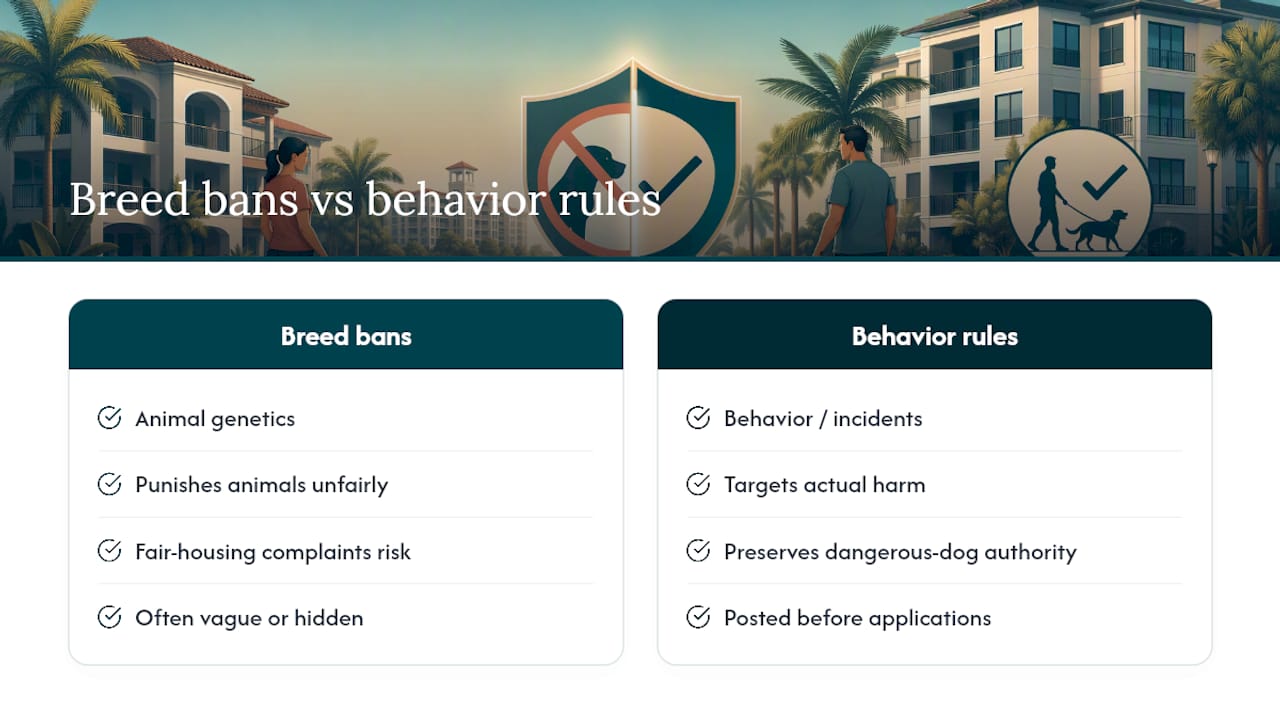
Behavior-based rules work better in multiunit housing for a simple reason: they target the thing that actually causes harm. A German Shepherd with a documented bite history is a real risk. A German Shepherd with no incident history, current vaccinations, and a calm temperament is not, regardless of what breed list some insurance underwriter compiled five years ago. Florida’s own statute recognizes this distinction, which is why it preserved dangerous-dog authority while stripping breed-specific authority.
Property managers and HOA boards who post their pet rules clearly, before a single application gets submitted, save themselves the headache of disputes down the line. Vague or hidden restrictions don’t reduce liability. They just delay the conflict until move-in day, when it’s far more expensive to resolve. Transparency isn’t a courtesy here. It’s the cheaper option.
— Ayman
Finding a pet-friendly apartment that’s upfront about its rules
You’ve now got the full legal picture: the state can’t ban breeds, but the property you’re applying to can still set its own rules, and the way those rules get written matters as much as what they say. Cynthia Gardens takes a different approach than the buildings that bury pet terms in an addendum you don’t see until lease signing. Our pet policy is published, specific, and available before you tour, so you know exactly where your dog stands before you spend a Saturday driving between properties.
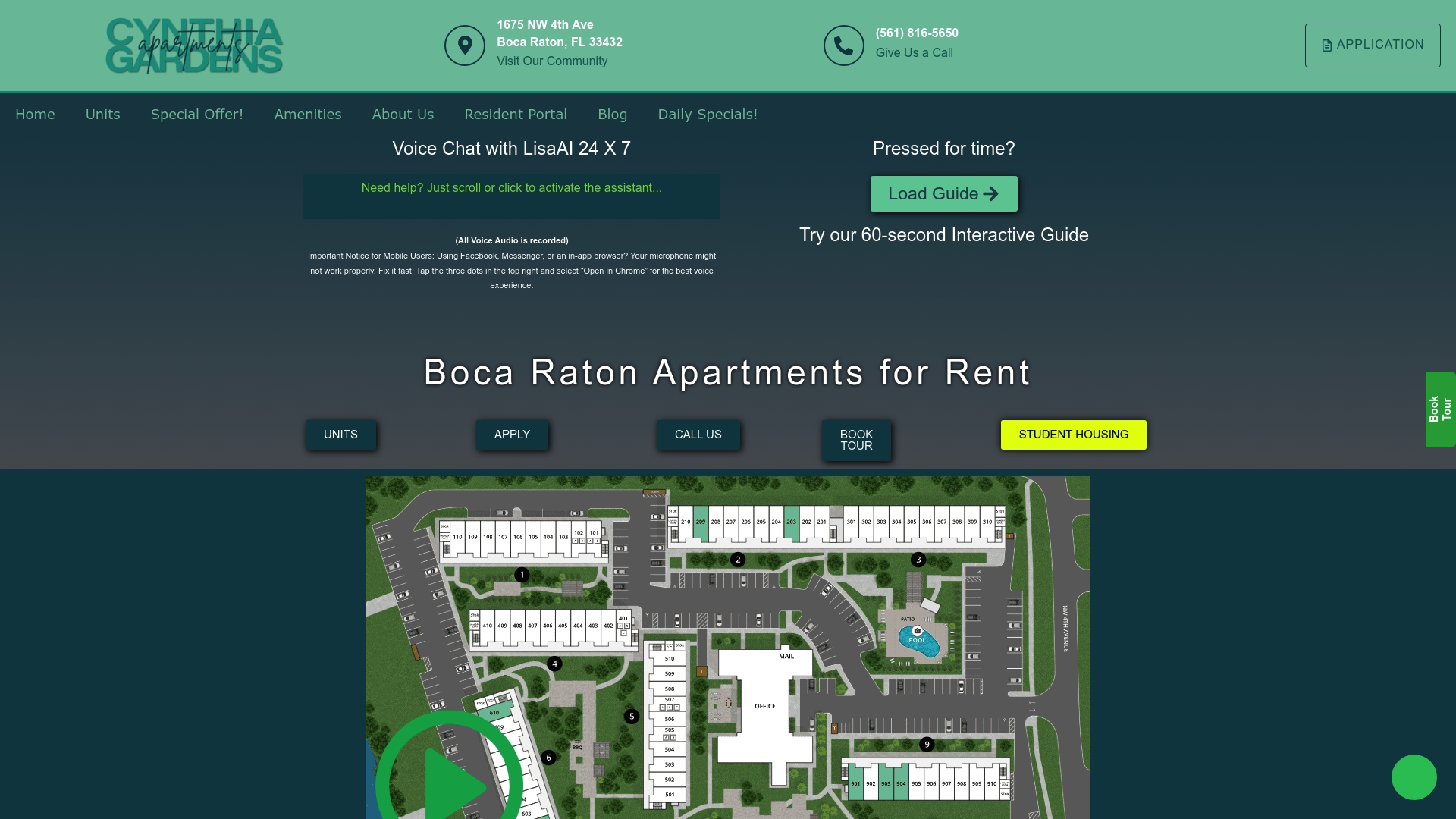
We offer pet-friendly one-bedroom apartments with transparent pricing and no hidden fees, which extends to pet deposits and any breed-related documentation we ask for. Our leasing process runs through virtual tours, an interactive property map, and AI chat support, so you can confirm whether your dog fits our policy before you ever set foot on the property. If you have a service animal or ESA, our team handles that accommodation request directly and individually.
Ready to check availability for your dog? Visit our pet-friendly apartment complex page to review current pet policy details and schedule a virtual tour today.