Table of Contents
- Boca Raton’s Political Leanings: The Moderate Reality
- Palm Beach County Political Demographics and Voter Trends
- Boca Raton Voter Registration Statistics and Party Affiliation
- Election Results and Electoral Trends
- The Snowbird Effect and Generational Political Divide
- Neighborhood-Level Variance in Political Climate
- What This Means for Your Relocation Decision
- Conclusion
Last Updated: August 14, 2026
Boca Raton’s Political Leanings: The Moderate Reality
Is Boca Raton more liberal or conservative? The answer is neither, and that’s what makes understanding this city’s political identity so important for anyone considering a move here. Boca Raton sits firmly in the moderate center of the political spectrum, a characteristic that distinguishes it from many other Florida communities. The city has developed a reputation as a swing district within Palm Beach County, attracting residents across the political spectrum who value quality of life, education, and economic opportunity over rigid ideological alignment.
This moderate positioning isn’t accidental. Boca Raton’s demographics, voter registration patterns, and electoral history reveal a community that resists easy categorization. Young professionals relocating here, graduate students at Florida Atlantic University, and established residents tend to approach politics pragmatically rather than ideologically. Understanding where Boca Raton actually stands politically matters if you’re evaluating whether the community aligns with your own values and preferences.
For those considering relocation to Boca Raton, whether for work in tech and finance, graduate studies, or simply seeking a well-established residential environment, the city’s moderate political climate offers a balanced community atmosphere. The political landscape here reflects diversity in both demographics and voter preferences, creating a place where civic engagement takes many forms.
Palm Beach County Political Demographics and Voter Trends
Palm Beach County has undergone significant demographic shifts over the past decade, and these changes directly shape Boca Raton‘s political environment. The county itself leans slightly blue in presidential elections, but that aggregate number masks substantial variation within individual municipalities. Boca Raton’s position within the county is more centrist than the county as a whole, with substantial independent voter populations and meaningful Republican representation alongside Democratic strongholds.
The demographic composition of Palm Beach County includes a significant retiree population, the so-called "Snowbird effect", that has historically influenced electoral patterns. Boca Raton, while home to many seasonal residents, also attracts younger professionals and families who maintain year-round residency. This creates a more stable voter base than pure seasonal communities. The county’s Hispanic population has grown substantially, bringing new political perspectives and priorities that emphasize economic opportunity, education, and community stability rather than strict party loyalty.
County-level political trends show increasing political polarization at the state and national level, yet Boca Raton itself has resisted some of this polarization. Voter registration data reveals that while both major parties maintain strong presences, no party dominates overwhelmingly. This balance creates an environment where municipal elections often turn on local issues, infrastructure, schools, development, and quality of life, rather than national party talking points.
The broader Palm Beach County political demographics reflect a region in transition. Younger voters, particularly those in tech and finance sectors working in Miami or elsewhere, tend toward more progressive positions on social issues while maintaining fiscally conservative instincts. This generational divide appears clearly in Boca Raton’s voting patterns, where age becomes a stronger predictor of political preference than party affiliation alone.
Boca Raton Voter Registration Statistics and Party Affiliation
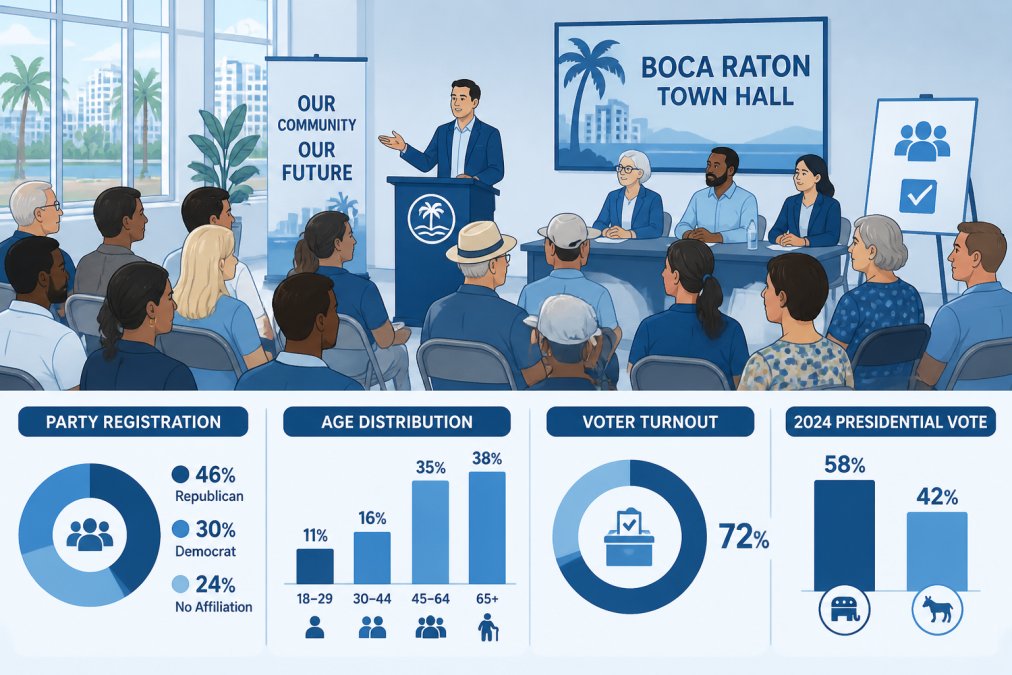
Boca Raton voter registration statistics tell a story of genuine political diversity. The city does not have overwhelming registration advantages for either major party. Democratic registration slightly exceeds Republican registration, but the gap is not dramatic, typically in the 35-40% Democratic to 30-35% Republican range, with the remainder either no party affiliation or minor parties. These numbers fluctuate with registration drives and demographic changes, but the pattern of rough balance has persisted across multiple election cycles.
No party affiliation voters represent a growing segment of Boca Raton’s electorate. These independent voters often decide local elections and frequently swing between parties based on specific candidates and issues rather than ideological consistency. This independent voter population reflects the city’s pragmatic character, residents who prioritize competence and results over partisan loyalty.
The party affiliation breakdown in Boca Raton differs meaningfully from surrounding areas. Some neighborhoods within the city lean more conservative, while others trend liberal, but the municipality as a whole maintains this centrist equilibrium. For someone relocating to Boca Raton seeking a quiet, well-established community, this voter registration pattern suggests a politically engaged but not ideologically rigid population.
Boca Raton’s voter registration statistics also reflect the city’s educational profile. The presence of Florida Atlantic University brings younger voters with different registration patterns than the broader retiree population. This educational and age diversity within the city creates natural political tension that prevents any single ideology from dominating local discourse. Residents who value intellectual engagement and diverse perspectives often find Boca Raton’s political environment appealing precisely because it resists monolithic thinking.
Election Results and Electoral Trends
Historical election results in Boca Raton reveal a consistent pattern: the city votes slightly left of the state average but significantly less left than major urban centers like Miami or Fort Lauderdale. In recent presidential elections, Boca Raton has supported Democratic candidates, but margins have been modest, typically 5-10 percentage points rather than the 20+ point margins seen in core urban areas. This voting pattern confirms Boca Raton’s identity as a swing district within the broader county context.
Local elections in Boca Raton often produce different outcomes than national elections, suggesting voters separate local governance from national party politics. City council races frequently feature candidates who emphasize pragmatic management, fiscal responsibility, and quality-of-life issues rather than national party platforms. This local focus has produced relatively stable governance and cross-party cooperation on municipal matters.
Electoral trends show modest shifts over time. The city has become somewhat more Democratic-leaning than it was two decades ago, reflecting broader demographic changes including education level increases and generational turnover. However, this leftward drift has been gradual and incomplete, Boca Raton remains far more politically balanced than comparable coastal cities in other states.
Ballot measures and referendum results in Boca Raton often pass with broad support, indicating community consensus on practical matters. School funding measures, infrastructure bonds, and environmental protections typically receive bipartisan support. This suggests that beneath partisan registration differences, Boca Raton residents share substantial common ground on community priorities.
The Snowbird Effect and Generational Political Divide
The Snowbird effect significantly influences Boca Raton’s political character, though perhaps less dramatically than in other South Florida communities. Many seasonal residents maintain voter registration in northern states, so they don’t appear in Boca Raton’s official voter rolls despite spending substantial time here. Those who do register as Boca Raton voters tend to be retirees with more conservative fiscal preferences but variable social policy views. This seasonal population brings political diversity that prevents any single ideology from calcifying.
Generational political divide within Boca Raton appears sharply in survey data and electoral behavior. Younger residents, particularly those in tech and finance sectors, tend toward more progressive positions on social issues, climate policy, and regulation. Older residents, especially retirees, prioritize fiscal conservatism, property rights, and traditional governance approaches. This generational divide exists within both major parties, creating complex political coalitions that don’t align neatly with national party structures.
The presence of Florida Atlantic University amplifies this generational divide. FAU brings thousands of younger voters to Boca Raton, many of whom hold more liberal views on social issues than the broader population. Graduate students seeking affordable, convenient housing near campus represent a cohort with different political priorities than established homeowners. This demographic reality shapes local politics in ways that pure voter registration statistics cannot capture.
Snowbird residents who maintain year-round residency in Boca Raton often bridge generational divides. Many are retirees with decades of professional experience who approach local politics pragmatically. They’ve lived through multiple political eras and tend to resist ideological extremism. Their presence contributes to Boca Raton’s moderate political culture, even when their individual policy preferences might lean conservative or liberal.
Understanding Boca Raton’s generational political divide is crucial if you’re relocating. Younger professionals often find community among like-minded peers in specific neighborhoods, while established residents value stability and proven governance. The city’s moderate character means both groups coexist without the intense polarization seen in more ideologically homogeneous communities.
Neighborhood-Level Variance in Political Climate
Political climate varies meaningfully across Boca Raton’s neighborhoods, even though the city as a whole maintains moderate positioning. Some residential areas near FAU and downtown Boca Raton trend more liberal, while neighborhoods in the western portions of the city lean more conservative. This neighborhood-level variance reflects differences in resident age, education level, income, and length of tenure in the community.
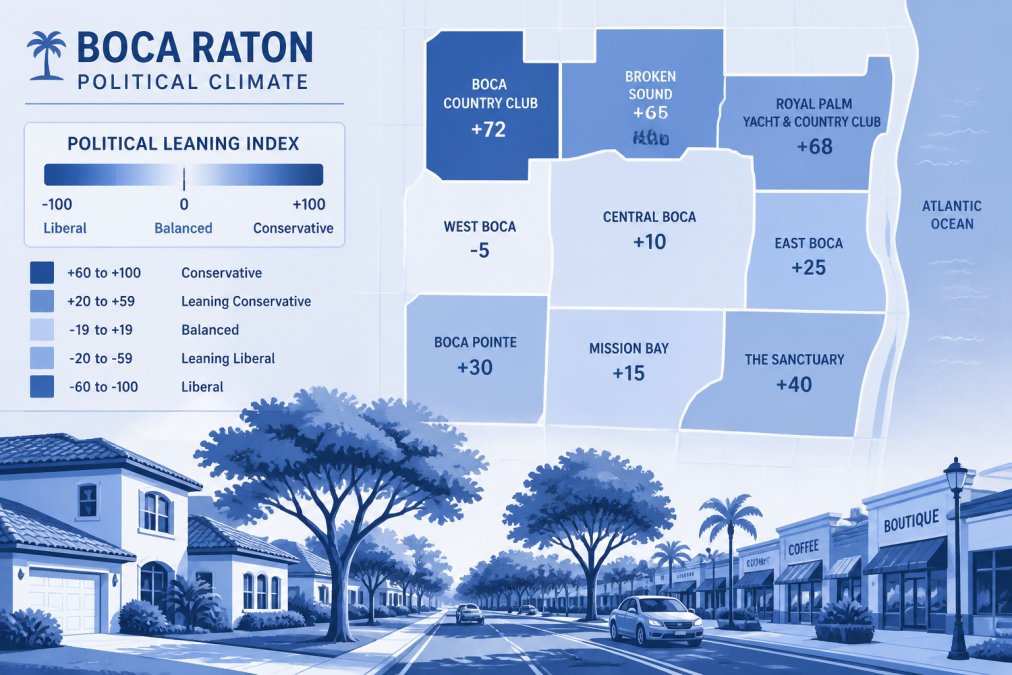
Downtown Boca Raton and areas immediately surrounding FAU show more liberal-leaning voter patterns, reflecting the younger demographic concentration. These neighborhoods feature more renters, students, and early-career professionals who tend toward progressive positions on social issues and urban development. Local ballot measures in these areas often show stronger support for density, transit-oriented development, and environmental protections.
Western neighborhoods in Boca Raton, particularly those with larger single-family homes and longer-established residents, demonstrate more conservative-leaning patterns. These areas prioritize property rights, low-density zoning, and traditional community character. Residents here often oppose rapid development and prefer incremental change. Their political preferences emphasize fiscal responsibility and limited government intervention in neighborhood affairs.
Central Boca Raton neighborhoods represent the true moderate core of the city. These established residential areas contain mixed demographics, retirees, established families, and younger professionals coexisting. Voter behavior in these neighborhoods is genuinely unpredictable based on party registration alone. Candidates and issues determine outcomes more than partisan affiliation.
For someone relocating to Boca Raton, understanding neighborhood-level political variance matters practically. If you prioritize a quiet, well-established community with like-minded residents, specific neighborhoods will feel more aligned with your preferences than others. Garden-style communities like Cynthia Gardens, positioned in established residential areas with convenient access to local landmarks, tend to attract residents seeking stability and community engagement without ideological intensity.
Boca Raton’s neighborhood-level variance means your actual lived political experience depends heavily on which area you choose. Downtown feels more progressive; western areas more conservative; central neighborhoods genuinely moderate. This granular variation is one reason the city maintains overall balance despite individual neighborhoods leaning left or right.
What This Means for Your Relocation Decision
Understanding Boca Raton’s moderate political positioning should factor into your relocation decision, particularly if you’re sensitive to community political culture. The city offers something relatively rare in contemporary America: a genuinely mixed political environment where neither ideology dominates overwhelmingly. This creates both advantages and considerations depending on your own political preferences.
If you’re relocating from a highly polarized community, Boca Raton’s moderate character may feel refreshingly pragmatic. Local politics focus on practical governance, school quality, infrastructure maintenance, development decisions, public safety, rather than cultural warfare. City council meetings feature substantive debate rather than ideological posturing. This governance style appeals to professionals and families who prioritize competence over partisan loyalty.
For those seeking a community aligned with specific political values, Boca Raton offers neighborhood-level options. Liberal-leaning residents find community near downtown and FAU. Conservative-leaning residents thrive in western neighborhoods. Moderates find the city’s center genuinely welcoming. The point is that political preference doesn’t determine whether you can find compatible community in Boca Raton, it just shapes which neighborhoods feel most naturally aligned.
Young professionals relocating for tech or finance work often appreciate Boca Raton’s moderate culture. These careers attract politically diverse talent, and the city’s balanced environment accommodates varied perspectives without requiring ideological conformity. Graduate students at FAU or Palm Beach State College find peer communities with progressive leanings, but the broader city doesn’t enforce that perspective on the entire population.
Pet owners, single renters, and commuters working in tech or finance should consider that Boca Raton’s moderate political climate generally translates to practical, competent municipal governance. Zoning decisions, permitting processes, and community services tend to operate efficiently because they’re not hostage to ideological battles. This pragmatic governance style creates the stable, well-maintained environment that attracts quality-of-life focused relocators.
Do not assume Boca Raton is politically neutral, no city is. If you hold strong ideological preferences, research specific neighborhoods before committing. Downtown and FAU areas lean liberal; western neighborhoods lean conservative. The city’s overall moderation masks real neighborhood-level variation that affects daily community experience.
Conclusion
Boca Raton is fundamentally moderate, neither consistently liberal nor conservative, but rather a swing district community where pragmatism and local governance priorities shape politics more than national party loyalty. The city’s voter registration statistics show rough party balance, its electoral history reveals modest Democratic leanings without overwhelming margins, and its neighborhood-level variance means your actual political experience depends on where you settle within Boca Raton itself.
For relocating professionals, graduate students, and families seeking a well-established residential environment with convenient access to education and employment, Boca Raton’s moderate political character offers genuine advantages. The city prioritizes competent governance, quality schools, and community stability over ideological purity. If you’re evaluating Boca Raton as a relocation destination, consider not just the city’s overall political positioning but which specific neighborhoods align with your preferences and values.
Communities like Cynthia Gardens exemplify what draws people to Boca Raton: serene, maintenance-free living in an established neighborhood with convenient access to FAU, the beach, and local landmarks. The residents here represent Boca Raton’s true character, diverse in background and political preference, united by commitment to quality of life and community engagement. Schedule a tour today to experience firsthand how Boca Raton’s moderate, pragmatic community culture creates an effortless Florida lifestyle for professionals and individuals seeking a quiet, well-maintained residential environment.
Frequently Asked Questions
Is Boca Raton considered a swing district or is the political leanings firmly established?
Boca Raton sits in a swing district within Palm Beach County, meaning the area has competitive representation and can shift between election cycles. While the city leans blue overall, it's not a stronghold for either party. This competitive nature reflects the community's moderate political spectrum and diverse voter base, making local and municipal elections particularly influential in shaping the political climate.
What are the main demographic factors influencing Boca Raton's political landscape?
Age, education level, and migration patterns shape Boca Raton's political makeup. The city has a significant population of retirees and snowbirds, younger professionals, and graduate students, each bringing different political perspectives. Census data shows higher education attainment correlates with blue-leaning tendencies, while the seasonal nature of the population creates fluctuating voter turnout and engagement patterns throughout the year.
How does the political climate vary between neighborhoods in Boca Raton?
Political leanings differ noticeably by neighborhood. Downtown and near-campus areas tend to lean more progressive, while residential enclaves and country club communities may skew conservative. Precinct data reveals these neighborhood-level variances, making it important to research your specific area if local governance and ballot measures matter to your relocation decision.
What's the voter registration breakdown between Democrats, Republicans, and no party affiliation in Boca Raton?
Boca Raton voter registration statistics show a plurality of registered Democrats, followed by Republicans, with a growing number of no party affiliation and independent voters. This distribution reflects broader trends in Florida and the county. The increasing proportion of unaffiliated voters demonstrates the area's moderate political identity and suggests bipartisan appeal in local governance and municipal elections.