
Florida Statute s. 83.49 controls every security deposit and qualifying advance rent in a residential lease. The law gives landlords three options for holding funds, requires written disclosure within 30 days of receipt, and sets a strict timeline: return the deposit within 15 days if you make no claim, or send a written notice of intent to claim within 30 days if you do. Tenants then have 15 days to object in writing. Miss any of those deadlines and the consequences are real. The Florida Department of Agriculture and Consumer Services (FDACS) recommends that tenants document unit condition with dated photos or video at move-in and provide a forwarding address at move-out. Landlords should send all notices by certified mail or email where authorized under s. 83.505.
Key Takeaways
Florida Statute s. 83.49 gives landlords three holding options, sets a strict 15/30/15-day timeline, and forfeits the landlord’s claim entirely if the required written notice is not sent within 30 days of lease termination.
| Point | Details |
|---|---|
| Controlling statute | Florida Statute s. 83.49 governs all residential security deposits and qualifying advance rent statewide. |
| Three holding options | Non-interest account, interest-bearing account (tenant gets 75% of average or 5% simple interest), or surety bond (5% interest owed). |
| 15/30/15-day timeline | Return within 15 days if no claim; send written notice within 30 days if claiming; tenant has 15 days to object. |
| Documentation is decisive | Dated photos, video, and a signed move-in report are the most effective evidence in any dispute. |
| Forfeiture for missed notice | A landlord who skips or delays the required 30-day written notice forfeits the right to keep any part of the deposit. |
Table of Contents
- What Florida security deposit law actually covers
- How landlords must hold your deposit: the three legal options
- The exact move-out timeline you need to know
- What landlords can and cannot deduct
- Steps tenants should take to protect their deposit
- What to do when a landlord wrongfully withholds your deposit
- What happens to your deposit when the property is sold
- How interest on deposits is calculated
- Modern documentation tools that hold up as evidence
- A perspective on what actually matters in deposit disputes
- Sources
What Florida security deposit law actually covers
Florida Statute s. 83.49 governs security deposits and advance rent for residential tenancies statewide. It applies to any money a tenant pays as a security deposit and to any advance rent that covers a period beyond the next immediate rental period.
That last distinction matters more than most people realize. If a tenant pays first and last month’s rent upfront, the “last month” portion is advance rent covering a future period, so it falls under s. 83.49 and must be held and disclosed the same way as a security deposit. Advance rent for the very next rental period is different: the landlord can disburse it to their own account once that period begins. A practical example: a tenant signs a 12-month lease and pays January and December rent at signing. January rent is the next immediate period and can be deposited normally. December rent is advance rent for a later period and must be held under the statute’s rules until that month arrives.
Florida places no statutory cap on how much a landlord can charge for a security deposit. The market is the practical constraint. Landlords renting in Boca Raton or anywhere else in Florida can charge two months’ rent, three months’ rent, or more, as long as the amount is stated in the lease.
Key scope points:
- The statute covers residential leases only; commercial tenancies follow different rules.
- Both the deposit amount and any qualifying advance rent must be disclosed and held under s. 83.49.
- Tenants can read the full statute text at the Florida Senate’s official statutes page or the Florida House statutes portal.
- For pet-deposit rules specific to Boca Raton rentals, see pet deposit rules for Boca Raton apartments, which explains how pet charges interact with the security-deposit framework.
How landlords must hold your deposit: the three legal options
Florida law gives landlords exactly three ways to hold a security deposit or qualifying advance rent. Choosing any other method is a statutory violation.
Option 1: Separate non-interest-bearing account
The landlord deposits funds in a separate Florida financial institution account that holds only tenant deposits, no commingling with operating funds. The tenant earns no interest. This is the simplest option and the one most individual landlords use.
Option 2: Separate interest-bearing account
The landlord holds funds in a separate interest-bearing account. The landlord keeps the remainder. No commingling with other funds is permitted.
Option 3: Surety bond
Instead of a bank account, the landlord posts a surety bond with the clerk of the circuit court in the county where the property is located. The bond amount must equal the total deposits held, up to $50,000 per county. Landlords operating in five or more counties may post a single statewide bond with the Secretary of State for up to $250,000 in total deposits.
Key figure: The county surety bond cap is $50,000; the statewide multi-county bond cap is $250,000, per s. 83.49.
The 30-day disclosure duty
Regardless of which option the landlord chooses, the landlord must notify the tenant in writing within 30 days of receiving the deposit. That notice must state the name and address of the financial institution or bonding entity, which holding method is being used, and the rate of interest (if any). If the landlord later changes the holding method or depository, another written notice is required within 30 days of the change. Routine bank mergers are the only exception to the change-notification rule.
The exact move-out timeline you need to know
The 15/30/15 structure is the core of Florida’s deposit-return procedure. Get these dates wrong and the consequences fall hard on whichever party missed them.
| Event | Deadline | Who Acts |
|---|---|---|
| Lease ends, no claim intended | Return deposit within 15 days | Landlord |
| Lease ends, claim intended | Send written notice of claim within 30 days | Landlord |
| Tenant receives claim notice | Object in writing within 15 days | Tenant |
| Tenant does not object | Landlord remits balance within 30 days of original notice | Landlord |
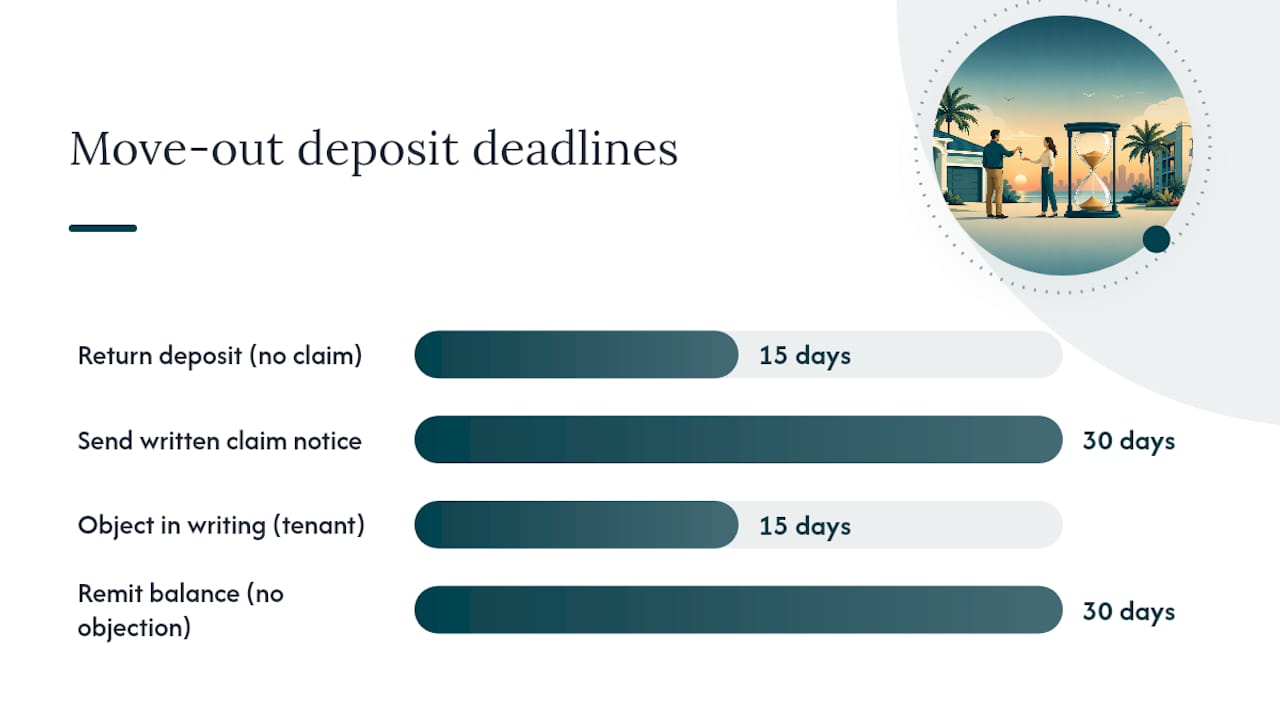
The 30-day clock for the landlord’s notice of claim starts at lease termination, not at the tenant’s move-out date. Those two dates can differ, so landlords should track the lease end date specifically.
What the notice must say
The statute requires the landlord’s notice to be “substantially the following form”:
FDACS warns that a generic email or vague notice often fails to meet this standard and can cost the landlord the right to impose any claim at all. The notice must be sent by certified mail or, where the lease and s. 83.505 authorize it, by email.
The forfeiture consequence
If the landlord fails to send the proper written notice within 30 days, the landlord forfeits the right to impose any claim against the deposit. The full deposit must be returned. The landlord can still sue the tenant separately for damages after returning the deposit, but the deposit itself is gone as a remedy. Courts treat the statutory notice requirement as jurisdictional to the right to claim, not a technicality.
Delivery tips:
- Send by USPS certified mail with return receipt requested.
- Email is permitted only if the lease or a separate written agreement authorizes it under s. 83.505.
- Keep the tracking number or email delivery confirmation as proof of timely sending.
What landlords can and cannot deduct
The legal test is straightforward: deductions are limited to tenant-caused damage beyond normal wear and tear, unpaid rent, and other charges the lease specifically authorizes (such as unpaid utilities or early-termination fees).
Deductible charges (examples):
- Broken fixtures, doors, or windows caused by the tenant
- Holes in walls beyond minor nail holes
- Stains or burns on carpet or flooring that go beyond ordinary use
- Excessive cleaning costs when the unit is left in an unreasonable condition
- Unpaid rent or late fees if the lease authorizes them
- Unpaid utility charges if the lease makes the tenant responsible
Not deductible (normal wear and tear examples):
- Faded or scuffed paint from ordinary living
- Minor carpet wear from foot traffic over a standard tenancy
- Small nail holes from hanging pictures
- Gradual deterioration of appliances through normal use
The distinction between damage and wear and tear is where most disputes start. A carpet worn thin after five years of normal use is wear and tear. A carpet stained by a pet accident is damage. Landlords who want their deductions to hold up in court should attach an itemized statement to any notice of claim, with line-item charges and supporting receipts or contractor estimates.
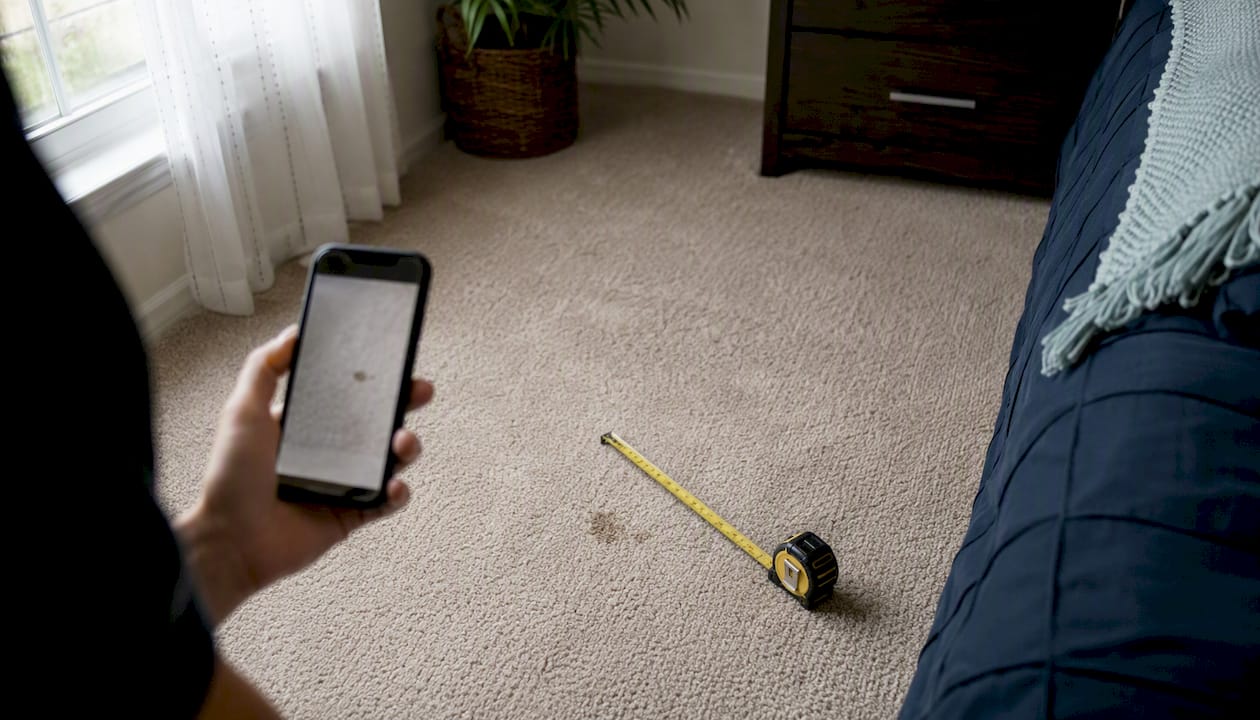
Pro Tip: Take photos of every item you plan to deduct for, with a ruler or common object for scale. A photo of a stain next to a coin is far more persuasive in small claims court than a written description alone.
For a deeper look at how pet-related charges interact with the deposit, the Cynthiagardens guide to security deposits covers the basics landlords and tenants both need.
Steps tenants should take to protect their deposit
The best deposit protection happens before you sign and on the day you move in, not after a dispute starts.
Before and at move-in:
- Do a walk-through with the landlord or property manager before you accept the keys. Walk every room together.
- Take timestamped photos and short video clips of every wall, floor, appliance, fixture, and window. Do this the same day you get access.
- Complete a written move-in condition report, sign it with the landlord, and keep a copy. If the landlord won’t sign, send them a written summary by email the same day.
- Keep copies of all keys, fobs, and parking passes you receive, along with any receipts for repairs or cleaning done before you moved in.
- Review the lease for any pre-existing damage disclosures and make sure they match what you actually see.
At move-out:
- Clean the unit thoroughly and make minor repairs (replace burned-out bulbs, patch small nail holes if required by the lease).
- Collect receipts for any professional cleaning or repairs you pay for.
- Give the landlord your forwarding address in writing, by email or certified mail. FDACS specifically recommends this step because the landlord’s 30-day notice clock runs to your last known address.
- Request a move-out walk-through if the landlord offers one, and document the unit’s condition again with photos and video.
- Keep your move-in photos, move-out photos, and all lease documents together in one folder.
If you receive a notice of claim:
Send a written objection within 15 days of receiving the landlord’s notice. Use certified mail with return receipt, or email if your lease and s. 83.505 authorize it. A short objection might read:
Keep proof of delivery. Your 15-day window is strict.
Pro Tip: Use the Cynthiagardens move-in inspection checklist to make sure you cover every room and document every pre-existing condition before your landlord can attribute it to you.
What to do when a landlord wrongfully withholds your deposit
If the landlord misses the 30-day notice deadline or refuses to return a deposit they have no legal basis to keep, you have several enforcement routes.
Step-by-step:
- Send a written demand letter to the landlord by certified mail. State the amount owed, cite s. 83.49, and give a deadline of 10 to 14 days to respond.
- Gather your documentation packet: the lease, move-in condition report, move-in and move-out photos, the landlord’s notice (or proof they sent none), and all certified-mail tracking records.
- File a complaint with FDACS if the landlord is unresponsive. FDACS handles landlord-tenant complaints and can provide guidance on next steps.
- Contact a local legal aid organization if you need free or low-cost legal help. Florida Legal Services and county-level legal aid societies serve tenants who meet income guidelines.
- File in small claims court if the demand letter produces no result.
Small claims basics:
- Florida small claims court handles disputes up to $8,000 (exclusive of costs, interest, and attorney fees).
- File in the county where the property is located.
- Bring: the lease, your deposit-disclosure notice from the landlord, move-in and move-out photos, certified-mail tracking, and any written communications.
- The forfeiture rule is a powerful tool: if the landlord never sent the required 30-day notice, present that fact clearly. The Florida Senate statute text is your primary citation.
On attorney fees and damages:
Florida law allows a court to award attorney fees to the prevailing party in a security deposit dispute. If a landlord wrongfully withholds a deposit and you win in court, you may recover the deposit plus court costs and, depending on the circumstances, attorney fees. The exact outcome depends on the facts and the court’s findings, so consult a licensed Florida attorney if the amount at stake justifies it.
What happens to your deposit when the property is sold
Property sales and management changes are a common source of deposit confusion. Florida law addresses this directly in s. 83.49(7).
When ownership transfers or a new rental agent is designated:
- The transferor (seller or outgoing agent) must transfer all deposits and qualifying advance rent to the new owner or agent, along with accurate accounting records.
- The new owner or agent must provide written receipt of the transferred funds.
- Once the new party provides that written receipt, the transferor is released from all holding obligations under the statute.
The rebuttable presumption
Florida law creates a rebuttable presumption that the new owner received the deposit, but this presumption is limited to one month’s rent. If your deposit is larger than one month’s rent, the presumption only covers up to that amount. For anything above it, you need actual written documentation of the transfer.
Practical steps for tenants after a sale or management change:
- Ask the new owner or property manager for written confirmation that your deposit was received and the amount on record.
- Request updated contact information for where future notices should be sent.
- If you used a surety bond arrangement, contact the county clerk to verify the bond status under the new owner.
- If the new owner cannot produce documentation of the transfer, send a written demand for accounting. If that fails, a small claims filing or FDACS complaint is the next step.
How interest on deposits is calculated
Interest applies only when the landlord holds the deposit in an interest-bearing account or posts a surety bond. If the landlord uses a non-interest-bearing account, no interest accrues for the tenant. Many landlords choose the non-interest option precisely to avoid the calculation and recordkeeping burden.
The two interest methods (interest-bearing account):
The landlord elects one of two calculations:
- 75% of the annualized average interest earned on the account during the tenancy
- 5% simple interest per year
Landlords must keep records of interest paid. Tenants who believe interest is owed should request a written accounting. If the landlord refuses, that refusal can be raised in a small claims proceeding or an FDACS complaint.
Modern documentation tools that hold up as evidence
The gap between winning and losing a deposit dispute often comes down to documentation quality, not the merits of the underlying claim. A landlord with a legitimate damage charge loses it without photos. A tenant with a valid objection loses it without proof of the unit’s condition at move-in.
Practical tools and workflows:
- Smartphone photos with timestamps: Shoot in the native camera app and do not edit or re-save the files. Editing strips EXIF metadata, which carries the date, time, and device information courts find useful. Back up originals to cloud storage (Google Photos, iCloud, or Dropbox) immediately after shooting.
- Short video walkthroughs: A 2–3 minute continuous video of every room, narrated with the date and address, is harder to dispute than individual photos because it shows context and continuity.
- Signed digital move-in checklists: Use a PDF or a property management app that captures both parties’ signatures with a timestamp. Email the completed form to yourself and the landlord the same day.
- Virtual tour exports: If the property was marketed with a virtual tour, request a copy or screenshot the tour with a timestamp. This can establish the unit’s baseline condition before you moved in.
- Cloud backup with original files: Store originals in at least two locations. Never delete the originals even after uploading.
To request digital records from a landlord or property manager, a simple written request works: “Please provide a copy of any move-in inspection report, photos, or virtual tour on file for unit [number] as of [move-in date].” Send it by email so you have a timestamped record of the request and any response.
FDACS guidance specifically recommends the in-person walk-through and dated photographic evidence as the most effective tools for contesting wrongful withholding.
Pro Tip: If you expect a serious dispute, save your photos in both JPEG and a lossless format (TIFF or PNG), and note the file hash (a free tool like HashMyFiles generates this). A matching hash proves the file has not been altered since it was created.
For a full room-by-room documentation workflow, the Cynthiagardens move-in inspection guide walks through exactly what to check and record.
A perspective on what actually matters in deposit disputes
Most deposit disputes are not really about the law. Both sides usually know the rules by the time they’re arguing. The real problem is almost always missing documentation on one side or the other.
Landlords who lose deposit claims in small claims court rarely lose because the damage wasn’t real. They lose because they can’t prove the tenant caused it, or because they missed the 30-day notice deadline by a few days and forfeited their right to claim. The statute’s notice requirements are not suggestions. Courts enforce them strictly, and a landlord who sends a vague email instead of the required statutory notice language has effectively handed the tenant their deposit back.
Tenants who fail to recover wrongfully withheld deposits usually have the same problem in reverse: no move-in photos, no signed condition report, no proof of what the unit looked like when they arrived. A landlord can then attribute pre-existing damage to the departing tenant, and without documentation, the tenant has no counter-evidence.
The practical takeaway is that both sides benefit from clear, timestamped documentation and timely, written communication. A landlord who sends the proper notice on day 28, with itemized charges and photos, is in a strong legal position. A tenant who objects in writing on day 14, with move-in photos attached, is equally protected.
Cynthiagardens operates on exactly this model: transparent deposit handling, digital move-in reports, and clear written communication at every stage. Residents can explore apartment styles and features at Cynthiagardens to see how that commitment to transparency carries through the entire leasing experience.
Sources
These are the primary and official resources for reading the statute and getting plain-English guidance:
- Landlord/Tenant Law in Florida
- 2025 Statutes 0083.49 | Florida House of Representatives
- Chapter 83 Section 49 – 2025 Florida Statutes – The Florida Senate
- Florida Statute 83.49 Security deposit rules explained – LegalClarity
This article provides general legal information about Florida security deposit rules and is not a substitute for advice from a licensed Florida attorney. Confirm current statute text and any procedural requirements with the official sources above or a qualified legal professional.
Recommended
- What Is a Security Deposit? Your Complete Guide – Luxury Apartments for Rent in Boca Raton | Premium Boca Raton Apartments | Aapartments Boca Raton
- Understanding Pet Deposit Rules for Boca Raton Apartments: A Renter’s Guide – Luxury Apartments for Rent in Boca Raton | Premium Boca Raton Apartments | Aapartments Boca Raton
- Security Deposit Explained: Renter Rights and How to Protect Yours
- Refundable Pet Deposit: What Renters Need to Know