Cynthia Gardens is a residential apartment community in Boca Raton, Florida, offering quiet, garden-style living near Florida Atlantic University, Mizner Park, and Boca Raton’s beaches at 1675 NW 4th Ave, Boca Raton, FL 33432.
TL;DR:
- Preparing a safe room, using a familiar carrier, and following a gradual introduction plan help prevent stress and escape during moving. Starting early with veterinary visits, carrier habituation, and packing essential supplies reduces post-move behavioral issues. The 3-3-3 rule guides owners through the timeline of a cat’s adjustment, emphasizing patience and behavioral cues over strict schedules.
Move your cat successfully by setting up a locked safe room before movers arrive, transporting in a familiar carrier, and following the 3-3-3 adjustment framework (3 days to decompress, 3 weeks to show personality, 3 months to feel at home). These three steps, backed by ASPCA guidance, do more to prevent escape and behavioral setbacks than anything else you’ll read.
Quick dos:
- Lock your cat in a designated safe room before the first mover walks through the door
- Transport in a carrier your cat already knows and associates with meals
- Keep feeding times, play sessions, and litter location unchanged throughout the chaos
Quick don’ts:
- Never let your cat roam while doors are open during loading or unloading
- Don’t wash scent-heavy bedding before the move — familiar smells are a comfort anchor
- Avoid forcing interaction during the first 72 hours in the new space
If your cat refuses to eat or use the litter box soon after arrival, contact your veterinarian immediately. Keep your microchip registration information and local animal control contact saved before moving day. Cynthiagardens, a pet-friendly apartment community in Boca Raton, Florida, is a trusted local resource for cat owners navigating a residential move.
Table of Contents
- What are the best moving tips for cat owners before the move?
- How do you choose and train your cat to use a carrier?
- What should you do on moving day to keep your cat safe?
- What are the U.S. travel rules and logistics for moving with a cat?
- How do you help your cat settle into a new home?
- Special cases: outdoor cats, multi-cat households, kittens, and seniors
- Your complete moving timeline and cat essentials checklist
- Key Takeaways
- The part most moving guides get wrong
- Cynthiagardens: pet-friendly apartments built for cat owners in Boca Raton
- Useful sources for cat owners planning a move
What are the best moving tips for cat owners before the move?
Start four to six weeks out, not the week before. That window is what separates a smooth transition from a cat who hides for a month.
Weeks 6–4 before moving:
Schedule a vet visit to update vaccinations, confirm your microchip registration, and get a recent photo on file. For interstate moves, USDA APHIS state-to-state requirements vary significantly — your vet needs to issue a Certificate of Veterinary Inspection (CVI), and timing requirements differ by state. Start that paperwork conversation early.
Weeks 4–2 before moving:
Begin carrier habituation (details in the next section). Leave moving boxes out in the living space so your cat adjusts to the visual and scent changes gradually. Cats read their environment constantly; a house full of unfamiliar cardboard is its own stressor if introduced all at once.
Week 1 before moving:
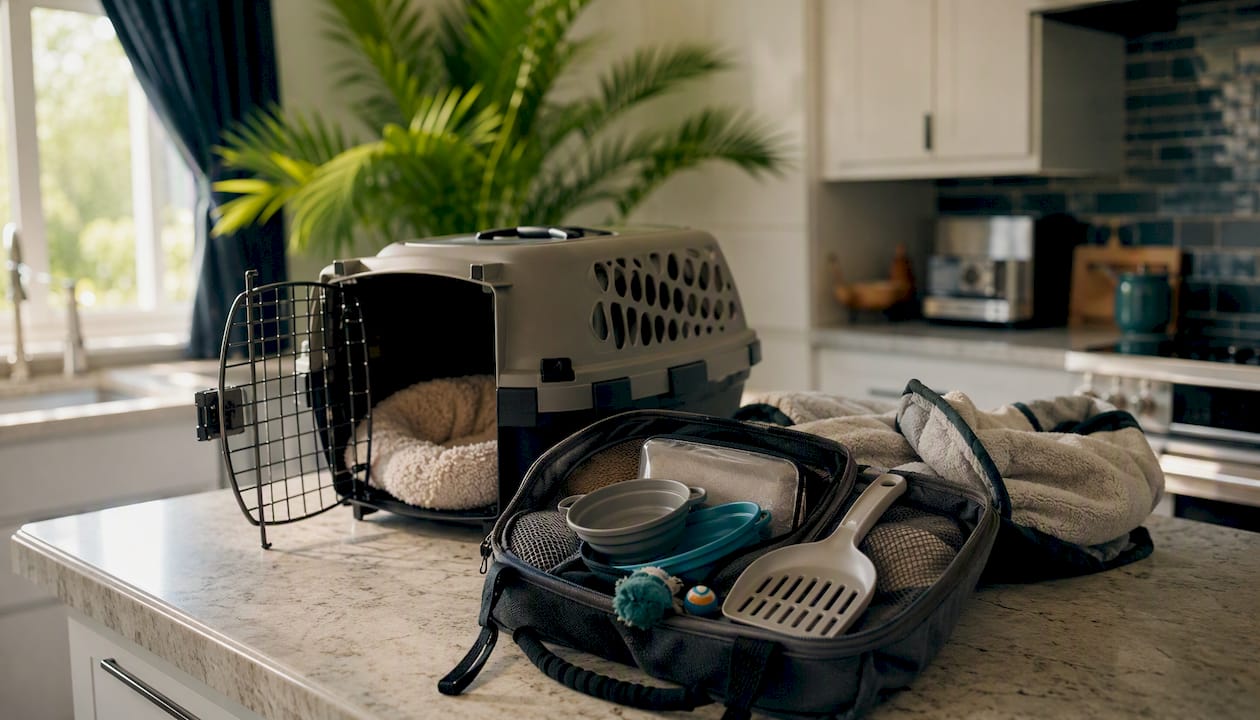
Assemble your cat’s travel kit: food, medications, litter, bowls, favorite toys, unwashed bedding, and a recent photo with microchip info written on the back. Keep this bag separate from the moving boxes so it’s accessible on day one. Do not wash the bedding. The scent on it is doing real work — pheromone products like Feliway and familiar scents together reduce stress reactions before and after the move.
Maintain your cat’s routine without exception. Same feeding times, same play sessions, same litter location until the day you physically move it. Cats rely on predictable schedules far more than most owners realize, so maintaining routines during packing can help reduce the move’s stress.
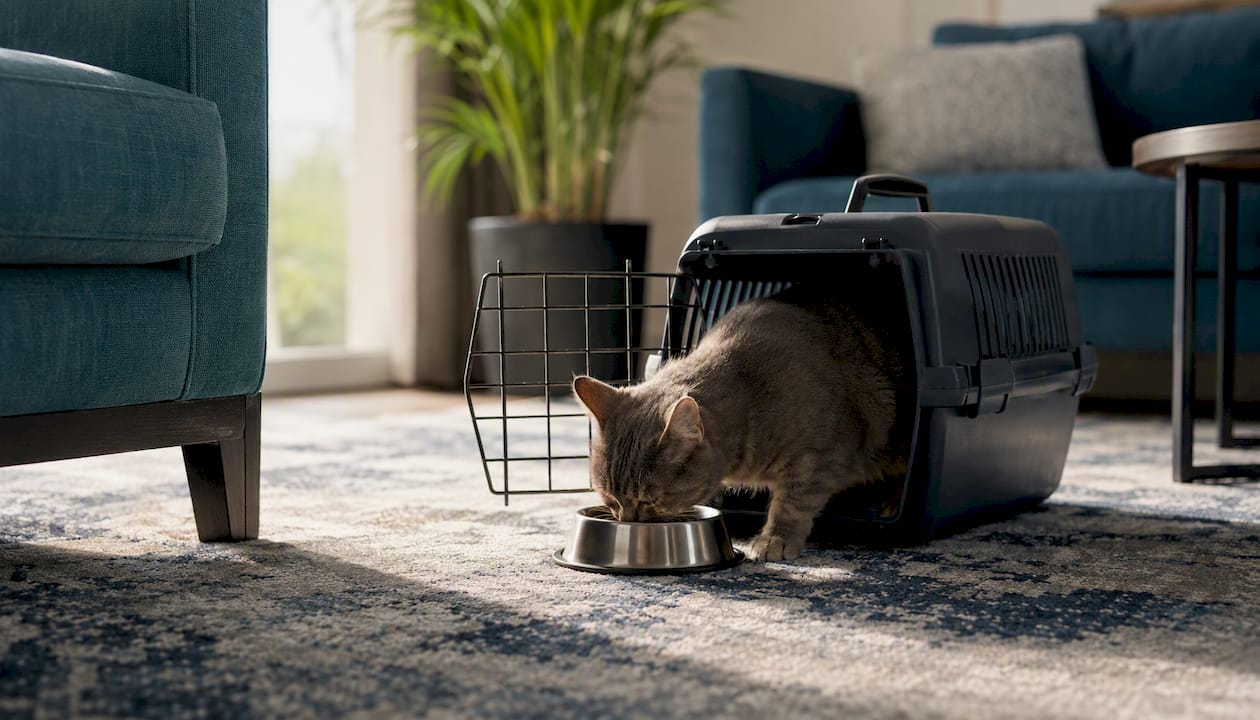
Pro Tip: Place your cat’s meals just inside the carrier door starting four weeks out. Move the bowl progressively further inside each day. By moving week, your cat will walk in voluntarily — which makes loading on moving day almost effortless.
How do you choose and train your cat to use a carrier?
The carrier is the single piece of equipment that determines how your cat experiences moving day. Get it wrong and you’re wrestling a panicked animal into a plastic box at 7 AM.
What to look for in a carrier
- Size: Your cat should be able to stand, turn around, and lie down comfortably. Too large and the cat slides around; too small and it’s a punishment.
- Hard-sided vs. soft-sided: Hard-sided carriers are more secure for car travel and airline cargo. Soft-sided carriers are often required for airline cabin travel — check your airline’s specific dimensions before buying.
- Access points: Top-loading carriers let a vet or owner lift the cat out without a struggle. Front-loading works for cats who walk in willingly.
- Secure latches: Test them. A latch that pops open on a bumpy road is a real danger.
- Ventilation: Mesh panels on at least two sides keep airflow adequate in warm weather.
Step-by-step carrier training plan
- Place the carrier in a room your cat uses daily, door open, with familiar bedding inside.
- Drop treats near the entrance for two to three days without closing the door.
- Move meals inside the carrier. Let the cat eat there without any door interaction.
- Once the cat enters freely, close the door for 30 seconds, then open it. Increase duration daily.
- After a week of closed-door comfort, carry the carrier to another room and back.
- Do a short car ride — around the block — with the carrier secured by a seatbelt.
Vet-recommended carrier preparation consistently shows that habituation reduces transport-related stress and the risk of accidents during travel. The car ride simulation step is the one most owners skip, and it’s the one that matters most on moving day.
On sedation: many veterinarians advise against routine sedatives for air travel specifically, as they can cause respiratory and cardiovascular complications at altitude. If your cat has severe travel anxiety, ask your vet about gabapentin, which some vets recommend for ground transport after a proper consultation. Never medicate without that conversation first.
What should you do on moving day to keep your cat safe?
Moving day is the highest escape-risk moment of the entire process. The safe-room protocol is non-negotiable.
Setting up the safe room:
Choose a room that will be emptied last — a bathroom or bedroom works well. Set it up the night before with everything your cat needs. Post a clear, large sign on the door: “CAT INSIDE — DO NOT OPEN.” Lock it if the door has a lock. Brief every mover and helper before they start.
What goes in the safe room:
- Litter box (clean, familiar litter)
- Food and fresh water
- The carrier with the door open and bedding inside
- A hiding spot (a box on its side, a covered bed)
- One scratching surface
- A worn shirt or unwashed blanket for scent comfort
- A Feliway diffuser if you have one
For movers and helpers — the short version:
Do keep all exterior doors and windows closed whenever you’re not actively moving something through them. Do not open the safe-room door for any reason. If a mover needs to know where something is, you answer — they don’t go looking.
Pro Tip: Drape a light blanket over the carrier during transport. It reduces visual stimulation and mimics the covered, den-like environment cats feel safest in. Leave one end open for airflow.
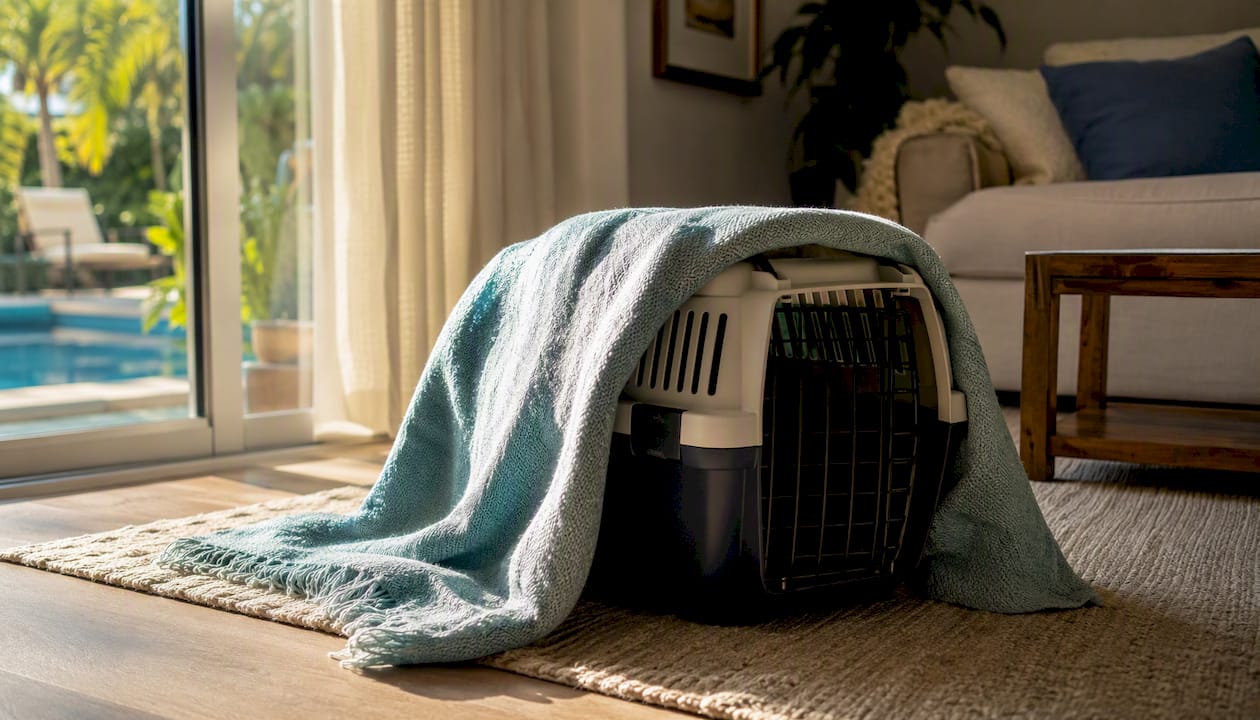
Calming options beyond scent: a pheromone diffuser running in the safe room for 24 hours before moving day gives it time to saturate the space. For the car ride, keep the carrier secured with a seatbelt on the back seat, away from direct sun and air conditioning vents.
What are the U.S. travel rules and logistics for moving with a cat?
Car vs. plane: the honest comparison
Car travel is almost always less stressful for cats than flying. You control the temperature, the stops, and the pace. For drives under eight hours, most cats tolerate travel reasonably well with proper carrier prep. For longer drives, plan rest stops where you can offer water inside the carrier without opening it in a parking lot.
Flying is more complicated. Cabin travel (carrier under the seat) is far preferable to cargo, which exposes cats to temperature swings, noise, and handling stress. Airlines set their own carrier dimension rules, and they differ — measure your carrier and check the specific airline’s policy before booking. The AVMA’s travel guidance recommends consulting your vet before any air travel, particularly for brachycephalic breeds like Persians, who face elevated respiratory risk.
U.S. interstate paperwork checklist
- State-specific requirements: — USDA APHIS maintains state-by-state rules. Hawaii and a few other states have additional quarantine or testing requirements — check six weeks out, not six days.
Ask your vet specifically about anti-nausea strategies for travel. Some cats vomit from motion; withholding food for three to four hours before a car trip often helps. Your vet can advise on whether any calming medication is appropriate for your cat’s health profile.
How do you help your cat settle into a new home?
The 3-3-3 framework
The 3-3-3 rule from VCA Animal Hospitals gives you a realistic timeline: expect roughly 3 days to decompress, 3 weeks to start showing personality, and 3 months to genuinely feel at home. These are guidelines, and individual cats may adjust in as little as a few days or may take up to six months or more to fully settle in.
Room-by-room introduction plan
Days 1–3: The cat stays in the safe room. Keep the door closed, visit calmly, and let the cat approach you. Don’t force it. The goal here is scent-marking — the cat needs to rub its face on surfaces and establish that this small space is safe before anything else happens.
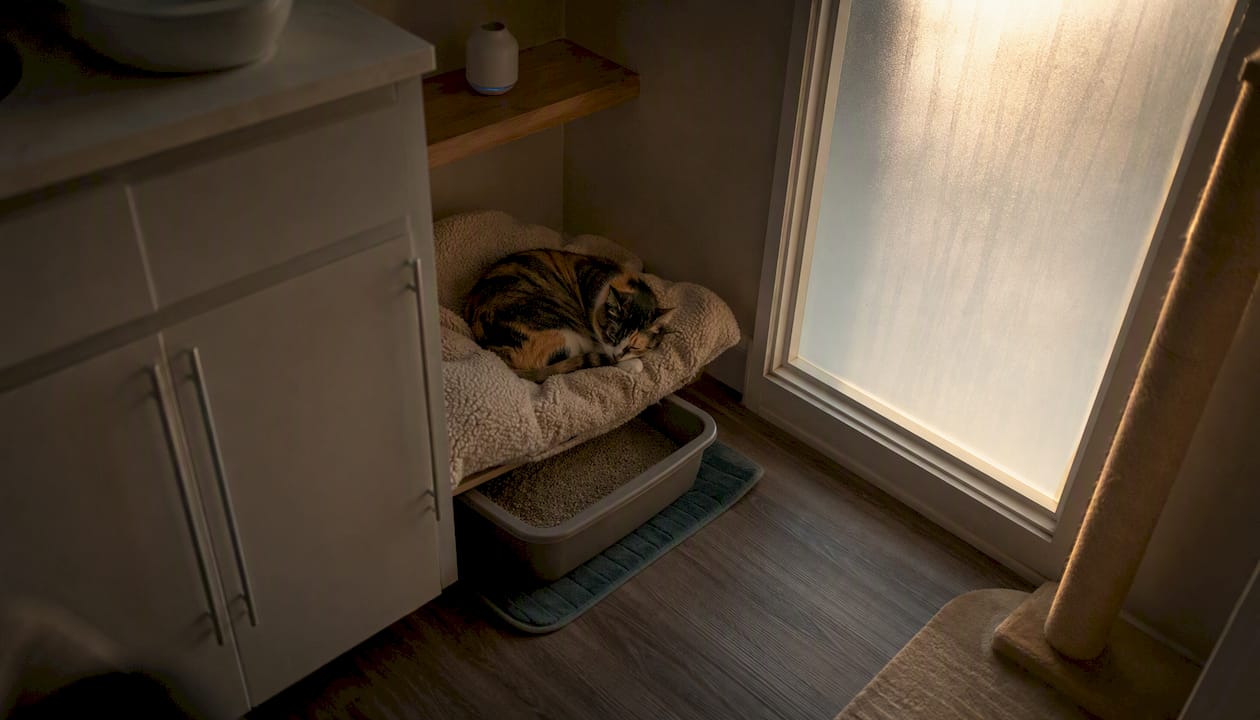
Days 4–7: Open the safe-room door and let the cat explore one adjacent room at a time, supervised. Keep the litter box in the safe room until the cat is consistently using it, then move it toward its permanent location — about one foot per day — to prevent confusion and litter-box avoidance.
Week 2 onward: Add rooms progressively. Watch for normal eating, litter use, and relaxed body language (slow blinks, stretched-out resting, grooming). Those signals, not the calendar, tell you when to expand access.
Pro Tip: Before letting your cat into any room, get on the floor and look at it from cat height. Check window screens, balcony doors, and gaps behind appliances. A screen that looks secure from standing height can pop out under a cat’s weight. For renter-safe fixes, the cat-proofing guide at Cynthiagardens covers 10 steps that won’t cost you your security deposit.
Call your vet if your cat hasn’t eaten, drunk water, or used the litter box within 24–48 hours of arrival. Stress-induced urinary issues in particular can escalate quickly.
Special cases: outdoor cats, multi-cat households, kittens, and seniors
Outdoor cats
Outdoor cats face the highest escape risk during a move. Keep them strictly indoors for at least three to four weeks after arrival — long enough to establish scent territory and learn the new space. Before allowing outdoor access, confirm the microchip is registered to your new address and that the collar tag shows a current phone number. Leash training for supervised outdoor sessions is worth starting during the indoor adjustment period.
Multi-cat households
- Set up separate safe rooms if space allows — inter-cat stress during a move can undo months of established harmony.
- Reintroduce cats to each other in the new home as if they’re meeting for the first time: scent swapping first, then visual access through a cracked door, then supervised shared space.
- Watch for resource guarding around litter boxes and food bowls; add an extra of each during the adjustment period.
Kittens and senior cats
Kittens adapt faster but tire more easily; keep travel sessions short and check that the carrier is warm enough. Senior cats often have underlying conditions that stress can aggravate — a pre-move vet check is especially important, and any medications need to be packed and accessible, not buried in a moving box. Ask your vet whether the stress of travel warrants a short-term supportive supplement.
Considering professional pet transport?
If you’re moving across multiple states or internationally, professional pet transporters are worth evaluating. Check for USDA APHIS registration, ask for references, confirm they require health certificates, and get the transport conditions in writing (temperature control, stop frequency, emergency protocols).
Your complete moving timeline and cat essentials checklist
The table below maps the key milestones from eight weeks out through the first three months.
| When | Task | Why it matters |
|---|---|---|
| 8–6 weeks out | Vet visit, microchip update, start interstate paperwork | CVI and state requirements take time; don’t rush this |
| 6–4 weeks out | Begin carrier habituation; leave boxes out | Gradual exposure lowers the stress baseline before moving day |
| 2–1 weeks out | Assemble cat travel kit; confirm new-area vet contact | Prevents last-minute scrambles; gives you a local vet on day one |
| Moving day | Safe room set up first; sign on door; cat secured until movers leave | Escape prevention is the single highest-stakes task of the day |
| Days 1–3 | Safe room only; monitor eating, drinking, litter use | First 72 hours set the tone for the entire adjustment |
| Days 4–7 | Gradual room expansion; move litter box one foot per day | Prevents litter avoidance and territorial anxiety |
| Week 2 onward | Full home access when behavioral cues confirm readiness | Behavioral readiness, not the calendar, drives the timeline |
Cat essentials packing list (keep this bag accessible, not in the moving truck)
- Three to five days of food (wet and dry if your cat eats both)
- Medications with dosing instructions written on the bag
- Litter and a small portable litter box
- Food and water bowls
- Carrier with familiar bedding inside
- Two or three favorite toys
- Unwashed blanket or worn shirt
- Recent photo of your cat with microchip number on the back
- Vet records and vaccination certificates
- New-area vet contact and local animal control number
For a broader apartment setup checklist once you arrive, the pet owner apartment checklist at Cynthiagardens covers safe, affordable living specifics worth reviewing before you unpack.
Key Takeaways
A successful cat relocation requires a locked safe room on moving day, a carrier your cat already trusts, and a staged room-introduction plan guided by behavioral cues rather than a fixed calendar.
| Point | Details |
|---|---|
| Safe room is non-negotiable | Set it up before movers arrive, lock it, and post a sign — escape risk peaks during loading and unloading. |
| Carrier training takes weeks | Start four weeks out using meal-based positive association; a familiar carrier cuts transport stress significantly. |
| 3-3-3 is a guideline, not a law | Expect approximately 3 days to decompress, 3 weeks to show personality, and 3 months to feel at home — but some cats may adapt in just a few days while others may take six months or longer. |
| Interstate paperwork starts early | USDA APHIS CVI requirements vary by state; schedule the vet conversation at least six weeks before an interstate move. |
| Cynthiagardens for pet-friendly housing | Cat owners relocating to Boca Raton can explore pet-inclusive apartments and affordable housing options at Cynthiagardens. |
The part most moving guides get wrong
Most cat-moving advice focuses on the move itself. The real problem is what happens in the first two weeks after.
Owners rush the room-introduction phase because the cat seems fine — eating, using the litter box, even purring. So they open the whole apartment on day four. Then the cat stops eating on day six, starts eliminating outside the box on day nine, and the owner is baffled.
What actually happened: the cat was managing, not settled. Those are different states. A cat that’s managing is suppressing stress responses because it has no choice. A cat that’s settled has scent-marked enough territory to feel genuinely secure. The behavioral signals — slow blinks, stretched-out resting, voluntary grooming in open spaces — are the difference. You can’t fake those.
The other thing guides underestimate is the importance of the owner’s behavior during the adjustment period. Cats read anxiety from the people around them. If you’re hovering, checking on the cat every 20 minutes, and narrating your concern out loud, the cat picks that up. Calm, brief, predictable visits to the safe room do more good than extended worried check-ins.
Pet-friendly housing makes this easier in ways that aren’t obvious until you’re living it. An apartment with secure window screens, maintenance staff who know not to prop doors open, and a community that doesn’t treat your cat as a liability removes a whole category of stress from the post-move period. That’s worth factoring into your housing search before you sign a lease.
Cynthiagardens: pet-friendly apartments built for cat owners in Boca Raton
Relocating with a cat is hard enough without also worrying about whether your new apartment actually works for both of you. Cynthiagardens offers one-bedroom apartments in Boca Raton with transparent pet policies, no hidden fees, and amenities designed with pet owners in mind — secure windows, maintenance practices that keep your cat safe, and a leasing process you can complete remotely through virtual tours and AI chat support.

For cat owners moving from out of state, the ability to tour apartments virtually means you can confirm screen security, layout, and pet-friendly features before you commit to a lease. Before signing anywhere, check for: pet deposit structure (refundable vs. non-refundable), weight or breed restrictions, pet amenity access, and whether maintenance staff follow pet-safe protocols. Cynthiagardens covers all of these clearly, upfront.
Ready to find a home your cat will actually settle into? Explore pet-friendly apartments in Boca Raton at Cynthiagardens and schedule a virtual tour today.
Useful sources for cat owners planning a move
- USDA APHIS — State-to-State Pet Travel Requirements: The primary source for interstate CVI and vaccination documentation rules. Check this before any cross-state move.
- ASPCA — Moving With Your Pet: Covers preparation steps, pet-proofing the new home, and travel safety basics.
- VCA Animal Hospitals — 3-3-3 Rule for Cat Adoption: The clearest explanation of adjustment timelines and what to expect at each stage.
- AVMA — Traveling With Your Dog or Cat: Authoritative guidance on travel safety, including air travel risks for brachycephalic breeds.
- PreventiveVet — Bringing a New Cat Home: Practical behavior guidance on safe-room setup and avoiding common settling mistakes.
- Humane Society of Sonoma County — 3-3-3 Guidelines for Cats: Shelter-based perspective on adjustment timelines, including what “average” looks like vs. outliers.
- SF SPCA — Moving With Your Cat: Concise, shelter-tested guidance on confinement, territory, and gradual introduction.
Recommended
- Cat Care in Apartments: Your Step-by-Step Workflow
- Apartment viewing with cats: stress-free guide for Boca pet owners
- Moving to Your New Apartment: The Ultimate Checklist – Luxury Apartments for Rent in Boca Raton | Premium Boca Raton Apartments | Aapartments Boca Raton
- apartment moving tips: 7 hacks for a smoother move – Luxury Apartments for Rent in Boca Raton | Premium Boca Raton Apartments | Aapartments Boca Raton