
Cynthia Gardens is a residential apartment community in Boca Raton, Florida, offering quiet, garden-style living near Florida Atlantic University, Mizner Park, shopping, dining, and the beaches.
TL;DR:
- A security deposit is refundable money held by a landlord to ensure lease compliance and cover damage.
- Timely move-in and move-out documentation, along with understanding legal deadlines, protect tenants’ funds.
A security deposit is money you pay a landlord before moving in, held as financial security for performance of the rental agreement and to cover unpaid rent or damage beyond normal wear and tear. In most cases, it is fully refundable when you leave the unit in good condition. Under Florida Statutes § 83.49, if your landlord does not intend to make any claim, the deposit must be returned promptly after move-out. Missing the required notice window results in the landlord forfeiting the right to keep any part of it.
Three things you can do right now to protect that money:
- Walk through the unit on move-in day and complete a written condition checklist, signed by both parties.
- Take time-stamped photos or video of every room and share copies with your landlord within the first seven days.
- Confirm your forwarding address in writing before you move out, and save every lease document, receipt, and written communication.
Table of Contents
- What Is a Security Deposit, and What Does It Actually Cover?
- Who Holds Your Deposit and Where Does the Money Go?
- What Can a Landlord Legally Deduct from Your Deposit?
- How Do You Tell Normal Wear and Tear from Real Damage?
- How Do Deposit Rules Differ by State and City?
- When Does Your Landlord Have to Return the Deposit?
- Move-In and Move-Out Checklist to Protect Your Deposit
- How to Dispute Deductions and Get Your Money Back
- Key Takeaways
- What Most Renters Get Wrong About Security Deposits
- Renting at Cynthiagardens: Deposit Policies You Can Read Before You Sign
- Useful Sources for Verifying Deposit Rules
What Is a Security Deposit, and What Does It Actually Cover?
A security deposit is a refundable sum, typically collected at lease signing, that the landlord holds “as security for performance of the rental agreement.” That legal phrase matters: the money is yours until the landlord can prove a legitimate reason to keep part of it.
Common uses landlords are permitted to draw from the deposit:
- Unpaid rent left at the end of a tenancy
- Repairs for tenant-caused damage beyond normal wear and tear (a broken door hinge, a cracked tile from a dropped object)
- Excessive cleaning after abandonment, when the lease specifically assigns that cost to the tenant
- Unpaid utilities when the lease makes the tenant responsible for them
“A deposit can be used for unpaid rent, agreed lease fees, and repairs for damage caused by the tenant; landlords cannot deduct for normal wear and tear.” — BressLaw, Florida landlord-tenant guidance
Security deposit vs. nonrefundable fee vs. last month’s rent: A security deposit is refundable and governed by statute. A nonrefundable fee (sometimes called an administrative or amenity fee) is not a deposit at all and cannot be recovered. Advance or last month’s rent is applied to a specific rental period and is not held as security. Mixing these up on a lease is a common source of disputes.
Some landlords now offer a fee-in-lieu-of-deposit program as an alternative to a traditional refundable deposit. Under Florida legislation such as CS/SB 494, these programs require written disclosure and give tenants termination rights, but the fee itself is typically nonrefundable. Before agreeing to one, compare the total annual cost of the fee against what a refundable deposit would cost you if returned in full. For more on how these alternatives work, the guide on deposit alternatives covers surety bonds and insurance options in plain language.
Who Holds Your Deposit and Where Does the Money Go?
The landlord acts as custodian of your deposit, not the owner. That distinction matters because it creates legal accountability from the moment you hand over the funds.
Under Fla. Stat. § 83.49, Florida landlords must choose one of three holding methods:
- Non-interest-bearing account: A separate account at a Florida financial institution, kept entirely apart from the landlord’s own funds. You earn no interest, but the money is protected from commingling.
- Interest-bearing account: Also separate, but you are entitled to a fair portion of the annual interest rate on the account, or a fixed simple interest rate per year, whichever the landlord elects.
- Surety bond: The landlord posts a bond with the circuit court clerk up to specified limits and pays interest at a statutory rate.
Your lease or a written notice delivered within 30 days of receiving your deposit must disclose which method the landlord uses. If the landlord later moves the deposit to a different bank or changes the holding method, a new notice is required within 30 days of that change. No notice of a change can weaken the landlord’s position in any later dispute.
Pro Tip: Ask for the deposit-holding disclosure in writing before you sign. If the lease does not specify the holding method, request a separate written statement. This one document can be decisive if a dispute reaches small-claims court.

What Can a Landlord Legally Deduct from Your Deposit?
Landlords have a defined list of allowable deductions, and anything outside that list is improper. The clearest line is between tenant-caused damage and normal wear and tear.
Allowed deductions:
- Unpaid rent at lease termination
- Repairs for physical damage the tenant caused (holes punched in walls, broken fixtures, stained carpet from a spill)
- Excessive cleaning costs, when the lease assigns that responsibility and the unit was left in genuinely unsanitary condition
- Unpaid utility balances the lease assigns to the tenant
Not allowed:
- Repainting walls because of minor scuffs or fading from sunlight
- Replacing carpet that simply aged out over a long tenancy
- General cleaning after a normal occupancy
“Normal wear and tear is not deductible. Landlords may only charge for damage that goes beyond what is expected from ordinary use of the property.” — BressLaw, Florida landlord-tenant guidance
Pet-related damage sits in its own category. If you have a pet, the lease may include a separate pet deposit or addendum. Scratches on hardwood floors from claws, chewed baseboards, or urine staining in carpet are typically chargeable. For a detailed breakdown of how pet deposits work in Boca Raton specifically, the pet deposit rules guide is worth reading before you sign any pet addendum.
How Do You Tell Normal Wear and Tear from Real Damage?
This is where most deposit disputes actually live. The line is not always obvious, but three factors help clarify it: how long you lived there, the item’s age and expected lifespan, and whether the condition existed before you moved in.
Practical examples:
- Carpet worn thin in a high-traffic hallway after a three-year tenancy = wear and tear. Carpet burned by a cigarette or stained by pet urine = damage.
- Paint faded from sunlight or marked with minor scuffs = wear and tear. Large holes from anchors or nails, or paint deliberately altered = damage.
- A loose door hinge after years of normal use = wear and tear. A door frame cracked from being slammed = damage.
The age of the item matters too. A landlord cannot charge you the full replacement cost of a ten-year-old carpet when its useful life was already nearly exhausted. Courts and arbitrators typically prorate repair costs against the item’s remaining lifespan.
Pro Tip: On move-in day, photograph every existing mark, stain, and scratch at close range with your phone’s timestamp visible. Upload the photos to a cloud folder and email the link to your landlord that same week. If a dispute arises later, that email creates a dated, shared record that is very hard to argue against.
How Do Deposit Rules Differ by State and City?
No two states handle security deposits exactly the same way, and some cities layer additional rules on top of state law. The main variables are deposit caps, interest requirements, how the money must be held, and whether fee-based alternatives are permitted.
| Rule dimension | Florida (Fla. Stat. § 83.49) | New York City (NYC rent-stabilized) | California |
|---|---|---|---|
| Deposit cap | No statutory cap; market practice involves deposits commonly based on multiple months’ rent | 1 month’s rent (rent-stabilized units) | 2 months’ rent (unfurnished); 3 months’ (furnished) |
| Interest owed to tenant | Yes, under interest-bearing or surety bond option | Yes, at a rate set annually by NYC | No statutory interest requirement |
| Return deadline | 15 days (no claim) or 30-day notice of claim | 14 days after move-out | — |
| Holding method | Separate account or surety bond required | No specific holding method mandated | No specific holding method mandated |
Florida does not cap how much a landlord can charge. Florida Statutes § 83.49 leaves the amount to market negotiation, and landlords commonly request 1–3 months’ rent. New York City and California both impose hard caps.
“Florida law does not limit deposit sizes; landlords commonly request deposits equal to 1–3 months’ rent, and the holding method chosen determines whether the tenant earns interest.” — Florida Statutes § 83.49
Always verify your specific city or county rules. Rent boards in cities like New York, Los Angeles, and San Francisco publish their own tenant guides with local timelines and caps that override state defaults.
When Does Your Landlord Have to Return the Deposit?
Timing is everything here, and Florida’s deadlines are strict. Under Fla. Stat. § 83.49:
- Shortly after you vacate: the landlord must return the full deposit if no claim is being made.
- Within a statutory notice period after you vacate: the landlord must send written notice of intent to impose a claim.
- After receiving that notice: you must object in writing if you dispute the deductions.
The landlord’s notice must follow a specific statutory form, stating the amount claimed and the reason. If the landlord misses the 30-day window entirely, Florida law is unambiguous: the right to impose any claim is forfeited, and the full deposit must be returned.
“If the landlord fails to give the required written notice within the 30-day period, he or she forfeits the right to impose a claim upon the security deposit.” — Florida Statutes § 83.49(3)(a)
Providing your forwarding address in writing before you leave is not optional if you want this process to work in your favor. Many disputes arise simply because the landlord claims the notice was sent but the tenant never received it. A written forwarding address, confirmed by email, removes that ambiguity.
Move-In and Move-Out Checklist to Protect Your Deposit
Move-in steps:
- Request and complete a written move-in condition checklist with the landlord or property manager present.
- Take time-stamped photos or video of every room, including inside closets, under sinks, and around appliances.
- Note any existing damage on the checklist and get the landlord’s signature confirming it.
- Save your signed lease, any pet or cleaning addenda, and the deposit-holding disclosure in one folder.
- Ask in writing how and where your deposit is held, and confirm the holding method matches what the lease states.
- Email copies of your photos to the landlord within seven days of move-in to create a shared, dated record.
Move-out steps:
- Deep-clean the unit, paying attention to appliances, bathrooms, and floors.
- Repair any damage you caused: fill nail holes, replace broken fixtures, address pet damage.
- Return all keys, fobs, and access cards on or before your last day.
- Provide your forwarding address in writing, by email or certified letter, before you leave.
- Request a walk-through inspection with the landlord and ask for a written list of any proposed deductions before you hand over the keys.
- Keep a copy of every communication, receipt, and photo through the entire deposit-return window.
Pro Tip: During the move-out walk-through, take a second round of photos with the same phone you used at move-in. Side-by-side timestamps showing the unit’s condition on day one and your last day are the strongest possible evidence in a dispute.
For a full step-by-step approach tailored to Boca Raton renters, the apartment securing guide covers the process from application through move-out.
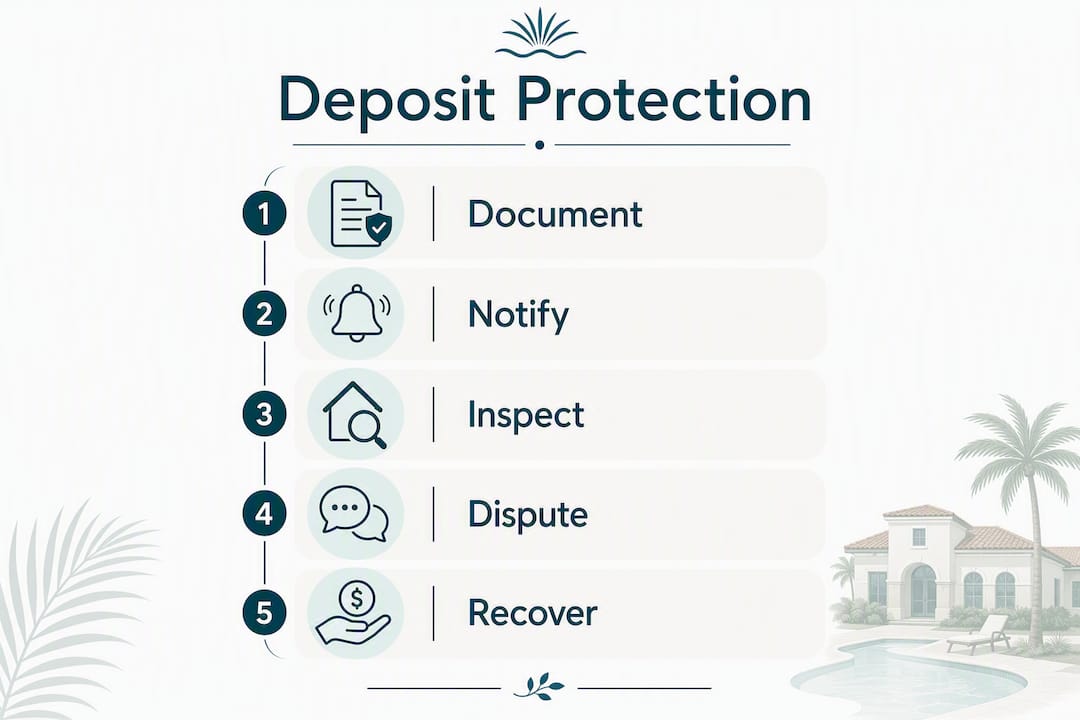
How to Dispute Deductions and Get Your Money Back
If your landlord withholds part or all of your deposit and you believe the deductions are improper, work through these steps in order.
Step 1: Request an itemized statement. If you did not receive one with the landlord’s notice, ask for it in writing. Florida law requires the landlord to specify the reason and amount for each deduction.
Step 2: Send a written demand letter. Address it to the landlord, state the amount you believe is owed, attach copies of your move-in photos and checklist, and give a deadline for response (typically 10–14 days). Keep the tone factual, not emotional. A basic demand letter looks like this:
Step 3: File a complaint with FDACS. The Florida Department of Agriculture and Consumer Services handles landlord-tenant complaints and can apply pressure without requiring you to go to court.
Step 4: File in small-claims court. Florida small-claims court handles disputes up to $8,000. You will need: copies of your lease, the deposit receipt, move-in and move-out photos, your demand letter, and any written communication with the landlord. Filing fees are modest and vary by county. The statute of limitations for most Florida contract claims is five years, but act sooner while evidence is fresh.
Mediation is worth considering before court if the disputed amount is relatively small and you want a faster resolution. Many counties offer low-cost or free mediation services for landlord-tenant disputes.
Key Takeaways
A security deposit is refundable money held by your landlord to cover unpaid rent or tenant-caused damage, and strict statutory deadlines govern when and how it must be returned.
| Point | Details |
|---|---|
| Definition and refundability | A security deposit is held as security for lease performance and is refundable when you leave the unit in good condition. |
| Florida return deadlines | Landlords must return within 15 days (no claim) or send written notice of a claim within 30 days; missing that window forfeits the right to any deduction. |
| Wear and tear vs. damage | Faded paint and worn carpet are not chargeable; holes in walls, burns, and pet staining are. Prorating by item age matters in disputes. |
| Documentation is decisive | Time-stamped move-in photos shared with the landlord within seven days and a signed checklist are the strongest protection you have. |
| Cynthiagardens approach | Cynthiagardens publishes clear deposit policies upfront, with no hidden fees, so renters know exactly what they owe and what to expect at move-out. |
What Most Renters Get Wrong About Security Deposits
The conventional wisdom says “just clean the place and you’ll get your deposit back.” That is incomplete advice, and it costs renters money every year.
The real risk is not a dirty apartment. It is a paper trail that does not exist. A landlord who wants to withhold a deposit does not need to prove you caused damage; they need only assert it convincingly enough that you cannot disprove it. Without dated photos and a signed move-in checklist, you are arguing your memory against theirs. Courts tend to side with whoever has documentation.
There is also a timing trap that most tenants miss. Florida’s 30-day notice rule is a powerful protection, but only if you know it exists. A landlord who sends a vague letter after 35 days has already forfeited the right to any claim, yet tenants who do not know the statute often accept partial refunds without question. Reading the relevant section of your state’s landlord-tenant statute before you sign a lease takes about 20 minutes and can save you hundreds of dollars.
One more thing worth saying plainly: asking your landlord how the deposit is held before you sign is not adversarial. It is a reasonable question, and a landlord who cannot or will not answer it is telling you something useful about how the tenancy will go.
Renting at Cynthiagardens: Deposit Policies You Can Read Before You Sign
Cynthiagardens is a Boca Raton apartment community built around the idea that renters should know exactly what they are paying and why, before they commit to anything. Deposit terms, pet policies, and fee structures are spelled out in the leasing documents, not buried in the fine print.
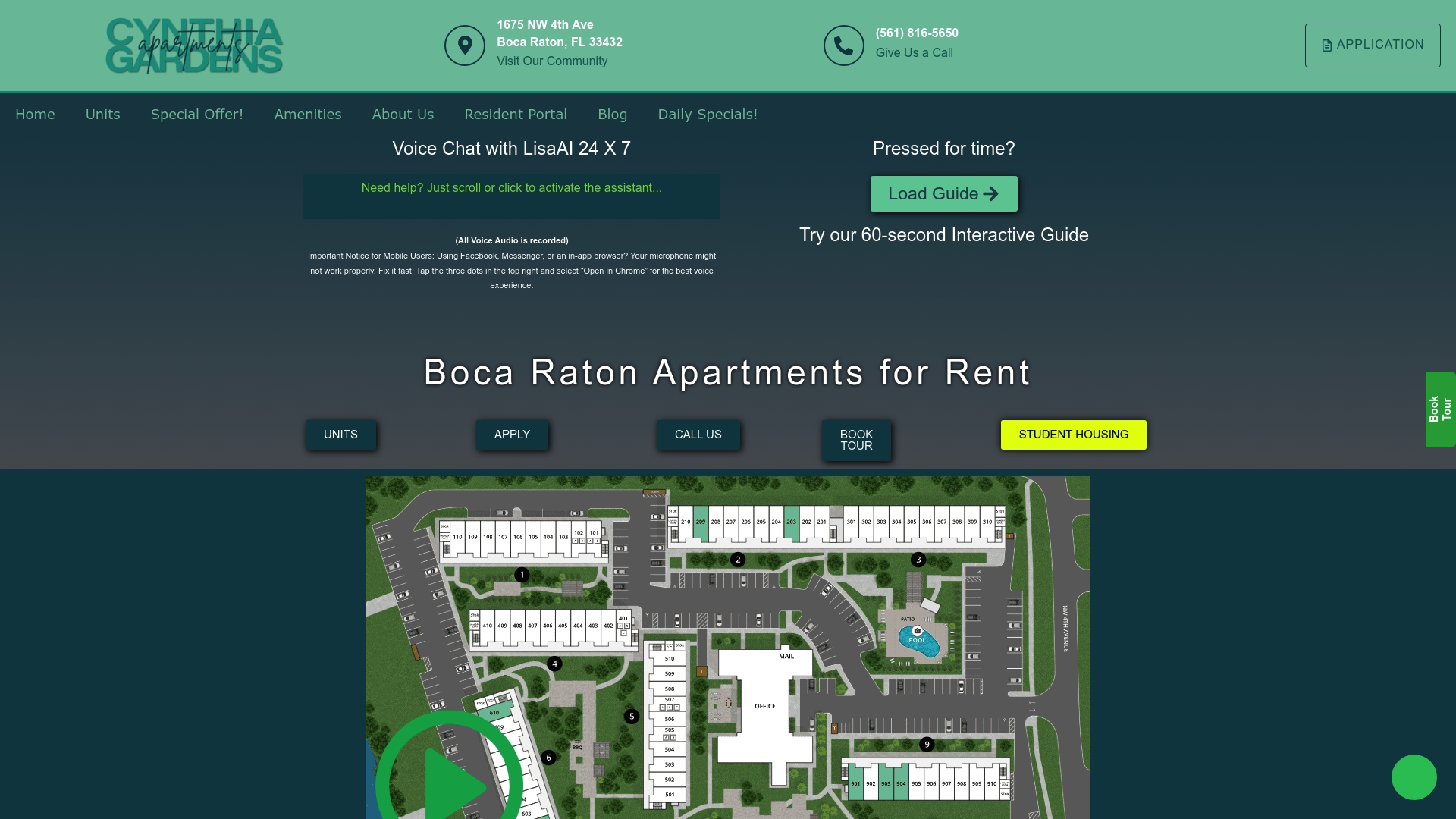
For young professionals, students, and pet owners who want a one-bedroom apartment in Boca Raton without the guesswork, Cynthiagardens offers transparent pricing, no hidden fees, and a leasing process you can start online with AI chat support and a virtual tour. View apartment styles and features to see current availability, or review the community rules and policies to understand exactly how deposits and fees are handled before you apply.
Useful Sources for Verifying Deposit Rules
- Florida Statutes § 83.49 (2025): The primary statute governing deposit holding, notice requirements, timelines, and interest rules for Florida landlords. Start here for any Florida-specific question.
- Florida Department of Agriculture and Consumer Services (FDACS): Plain-language explanation of the 15/30-day return process, complaint filing options, and tenant rights. Use this to file a complaint if your landlord does not comply.
- LegalClarity — Florida Statute 83.49 Explained: A detailed breakdown of holding options, interest rules, and what happens when landlords miss statutory deadlines.
- CS/SB 494 Bill Analysis (Florida Senate): Covers fee-in-lieu-of-deposit programs, disclosure requirements, and tenant termination rights under Florida’s alternative deposit legislation.
- BressLaw — What Can a Landlord Deduct in Florida?: Practical breakdown of allowable vs. prohibited deductions, with Florida-specific context on wear and tear.
Laws differ by state, and some cities add rules on top of state law. If you rent outside Florida, check your state’s landlord-tenant statute and your local rent board’s published guidelines for the timelines, caps, and interest rules that apply to your situation.
Recommended
- What Is a Security Deposit? Your Complete Guide – Luxury Apartments for Rent in Boca Raton | Premium Boca Raton Apartments | Aapartments Boca Raton
- Pet Deposit Guide for Renters: Know Your Rights
- Alternatives to Traditional Apartment Security Deposits
Related Apartment Living Guides
- Cynthia Gardens News & Apartment Living Resources
- Cynthia Gardens Floorplans & Availability
- Contact Cynthia Gardens
- Cynthia Gardens Homepage
Press Coverage
Cynthia Gardens press releases and media coverage are distributed through major news outlets. The latest release, “Cynthia Gardens Launches Apartment Living Resource Center for Boca Raton Renters” (published August 3, 2026), is available in the Cynthia Gardens News Center and was distributed to outlets including Business Insider, Yahoo Finance, Associated Press, Benzinga, Apple News, and GlobeNewswire, with coverage indexed by Google, Google News, Bing, and Yahoo search engines.
Explore Cynthia Gardens
Learn more about apartment living in Boca Raton on the Cynthia Gardens homepage, browse available floorplans, or contact the leasing team with questions about renting in Boca Raton.