
TL;DR:
- Rent stabilization limits annual rent increases and guarantees lease renewal protections tied to the apartment’s legal history.
- It applies to specific units based on location and building age, offering predictability and moderate landlord flexibility.
Rent stabilization is a legal framework that caps how much a landlord can raise your rent each year while guaranteeing your right to renew your lease. Unlike a blanket freeze on rents, it works through annual percentage limits set by local governing boards, giving both tenants and landlords predictable ground rules. Cities like New York City, jurisdictions across California, and over 100 municipalities in New Jersey operate under some form of this system. If you are searching for affordable housing or trying to understand your rights in a current lease, knowing how rent stabilization works is the single most practical step you can take.
What is rent stabilization and how does it work?
Rent stabilization is a regulatory system attached to specific apartment units, not to individual tenants. That distinction matters more than most renters realize. When you move into a stabilized unit, the protections travel with the apartment’s legal history, not with you personally. Rent stabilization is tied to the unit’s registered rent history, and the lease rider you sign at move-in is the primary legal document establishing those protections.
In practice, the system works through three core mechanisms: annual rent increase caps, mandatory lease renewal offers, and eviction protections. Local rent guidelines boards, such as New York City’s Rent Guidelines Board, vote each year on the maximum percentage a landlord can raise rent on a one-year or two-year lease. Landlords cannot exceed that cap unless specific, documented exceptions apply.
Here is how the process typically unfolds for a tenant in a stabilized unit:
- Receive a renewal offer. Landlords must offer lease renewal 90 to 150 days before your current lease expires. Missing this window is a landlord violation, not a tenant problem.
- Choose your lease term. You generally have the right to select a one-year or two-year renewal, and the applicable rent increase cap differs for each.
- Accept or negotiate within 60 days. Tenants have 60 days to respond to the renewal offer. Silence does not forfeit your rights, but acting promptly protects you.
- Confirm the rent increase is within guidelines. Compare the proposed increase against the current year’s published guideline. Any amount above it requires documented justification.
- Check for improvement surcharges. Landlords can add rent increases for Individual Apartment Improvements, but these are formula-driven and capped at 1/168th or 1/180th of renovation costs depending on building size.
Eligibility criteria vary by location. In New York City, stabilization generally covers buildings with six or more units built before 1974, and stabilized units represent roughly 44% of the city’s entire rental stock. California’s AB 1482 applies a statewide cap to most buildings over 15 years old. New Jersey leaves the rules to individual municipalities, creating a patchwork of local ordinances.
Pro Tip: Ask your landlord for the rent stabilization lease rider before signing anything. If they cannot produce one for a unit that should be covered, contact your local housing authority immediately.

What are the key differences between rent stabilization and rent control?
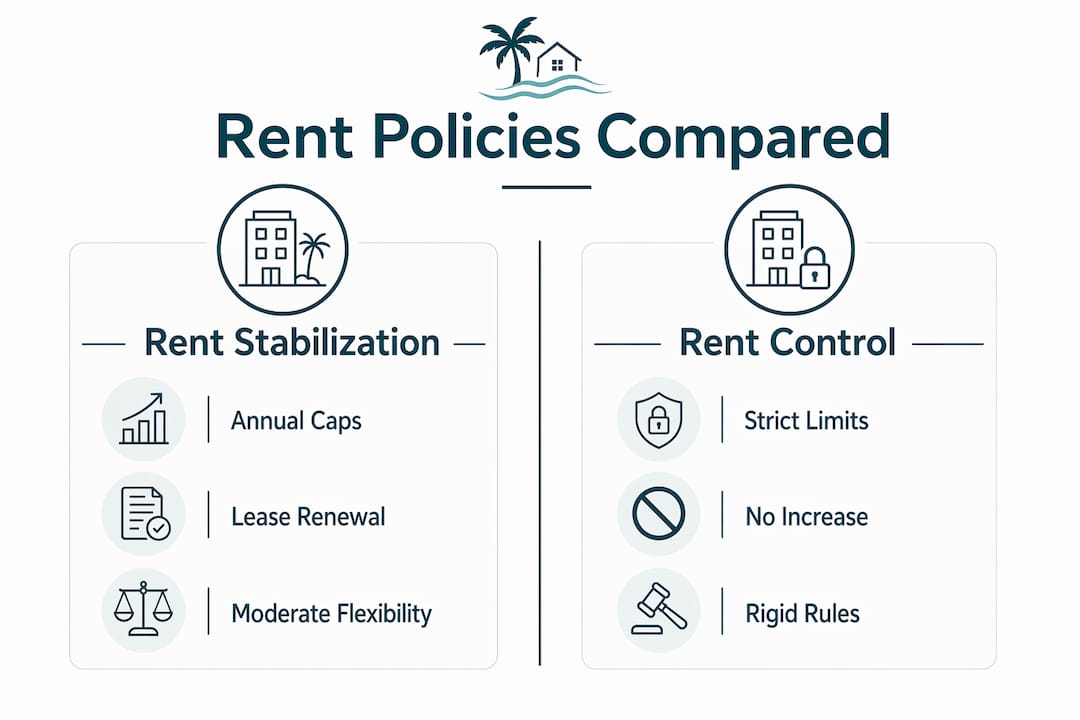
Rent stabilization and rent control are not the same policy. Conflating them leads renters to either overestimate or underestimate their protections. Rent stabilization was designed to balance tenant affordability with a landlord’s ability to maintain buildings and earn a reasonable return. Rent control, by contrast, typically freezes rent at a historic base level with little or no annual adjustment.
The table below captures the most important distinctions:
| Feature | Rent stabilization | Rent control |
|---|---|---|
| Rent increases | Allowed annually within board-set guidelines | Often frozen or severely restricted at historic levels |
| Tenant protections | Lease renewal rights, eviction protections | Similar protections, sometimes stronger |
| Landlord flexibility | Moderate; improvement surcharges permitted | Very limited; fewer allowable increases |
| Prevalence | More common; used in NYC, California, New Jersey | Less common; older cities like San Francisco, Los Angeles |
| Unit coverage | Tied to building age and unit count | Often tied to pre-war or older housing stock |
The practical difference for you as a renter is predictability versus rigidity. Under stabilization, you know rent will go up each year, but within a published, transparent limit. Under strict rent control, your rent may stay flat for years, but the unit supply tends to shrink because landlords have less incentive to maintain or rent those properties. Housing economists broadly agree that stabilization creates fewer market distortions than hard rent control, which is why it has become the more widely adopted policy in recent decades.
A common misconception is that rent stabilization prevents all rent increases. It does not. What it prevents is arbitrary or excessive increases that outpace local guidelines.
What are the benefits and limitations of rent stabilization for renters?
The clearest benefit of rent stabilization is cost predictability. You can budget 12 months ahead knowing the maximum your rent can legally increase. That kind of financial visibility is genuinely rare in unregulated rental markets where landlords can raise rents by any amount between leases.
Beyond cost, stabilization delivers several concrete protections:
- Lease renewal rights. Your landlord cannot simply decline to renew your lease without a legally approved reason, such as nonpayment or owner occupancy.
- Eviction protections. Stabilized tenants cannot be removed to make way for a higher-paying tenant. This directly reduces displacement risk, particularly in gentrifying neighborhoods.
- Elimination of vacancy decontrol. Recent legislative changes have closed vacancy decontrol loopholes, meaning a unit cannot be permanently removed from the stabilization system simply because it became vacant and rents hit a certain threshold.
- Rent history transparency. You have the right to request your unit’s rent history, which shows what previous tenants paid and whether the current rent is legally registered.
- Regulated improvement surcharges. Landlords must provide detailed cost documentation if they claim an Individual Apartment Improvement increase, and those increases are capped by formula, not set arbitrarily.
The limitations are real too. Stabilization does not cap the initial rent when you first sign a lease. A landlord can charge whatever the market will bear at move-in. Your protections kick in at renewal, not at the start of your tenancy. Additionally, understanding the difference between your preferential rent and your legal regulated rent is critical. Since 2019, increases apply only to preferential rent actually paid, which protects tenants from sudden jumps to a higher legal rent. But many tenants do not know which number appears on their lease, and that confusion can cost them money.
Pro Tip: Pull up your lease right now and find two numbers: the preferential rent and the legal regulated rent. If you only see one number, ask your landlord in writing to clarify which it is. This single step can prevent a surprise rent hike at renewal.
For context on how increases compare to market trends, reviewing average rent increase data for your area gives you a benchmark against which to measure any proposed hike.
How can renters verify if their apartment is rent stabilized?
Verifying your unit’s stabilization status is not complicated, but it requires you to check the right documents in the right order. Many tenants assume their landlord will tell them. Landlords are not always forthcoming, and some are not even aware of their own obligations.
Start with these steps:
- Read your lease rider. The rent stabilization lease rider is a legal requirement in covered units. A missing lease rider may signal an unregistered unit or a landlord violation. Do not sign a lease without confirming whether a rider should be attached.
- Check official government databases. In New York, the New York State Division of Housing and Community Renewal (DHCR) maintains a public registration database. You can look up your building’s registration status and your unit’s rent history online at no cost.
- Request your rent history. In NYC, you can request a unit’s complete rent history from DHCR. This document shows every registered rent going back years and confirms whether the unit is legally stabilized.
- Understand preferential vs. legal rent. Your lease should list both figures. The distinction between preferential and legal rent determines how much your landlord can raise your rent at renewal, so knowing both numbers is non-negotiable.
- Document every renewal offer. Keep copies of every lease renewal offer you receive, including the date it arrived. If a landlord fails to offer renewal within the required window, that is a violation you can report.
If your unit’s status is unclear after checking these sources, contact a local tenant rights organization. Groups like the Metropolitan Council on Housing in New York City offer free guidance and can help you file a complaint with DHCR if needed. Understanding transparent lease agreements is a skill that pays off far beyond rent stabilization situations.
Key takeaways
Rent stabilization protects tenants through annual increase caps, mandatory lease renewal rights, and eviction protections tied to the apartment unit, not the individual tenant.
| Point | Details |
|---|---|
| Stabilization is unit-based | Protections follow the apartment’s legal history, not the tenant who moves in. |
| Annual caps are board-set | Local rent guidelines boards publish the maximum allowable increase each year. |
| Lease rider is required | A missing rider in a covered unit signals a potential landlord violation worth reporting. |
| Preferential vs. legal rent | Know both figures on your lease to understand the true ceiling on your next increase. |
| Rent control is stricter | Stabilization allows annual increases within limits; rent control often freezes rents entirely. |
Why renters underestimate rent stabilization until it’s too late
I have spent years watching renters treat rent stabilization as background noise, something to skim past in a lease packet. That is a costly mistake. The tenants who benefit most from stabilization are the ones who read the rider before signing, pull their rent history on day one, and keep a paper trail of every renewal offer. The ones who struggle are those who assume their landlord will handle compliance correctly.
The most counterintuitive thing I have learned is that stabilization does not make housing cheap. It makes rent predictable. Those are very different things. A stabilized apartment in Manhattan can still cost $3,000 a month. What stabilization gives you is the certainty that next year it will not jump to $4,200 without legal justification. For long-term renters, that predictability compounds into real financial security over time.
My honest advice: do not wait until renewal season to understand your rights. Verify your unit’s status the week you move in, document everything in writing, and treat your lease rider as the most important document in your apartment. If something looks wrong, a tenant rights organization can help you act before a violation becomes a crisis. Understanding lease renewal rights in your specific market is the foundation of every other protection you have.
— Ayman
Transparent leasing at Cynthiagardens: no surprises, ever
Cynthiagardens is a modern apartment community in Boca Raton, Florida, built around one principle: you should always know exactly what you are paying and why. Every lease at Cynthiagardens comes with clear pricing, no hidden fees, and straightforward terms you can read without a law degree. While rent stabilization laws vary widely by state and city, the spirit behind them, predictability and fairness, is built into how Cynthiagardens operates by default. Explore available apartment styles and take a virtual tour to see exactly what your rent covers before you sign a thing.
FAQ
What is the definition of rent stabilization?
Rent stabilization is a local or state policy that limits how much a landlord can increase rent annually on qualifying units while granting tenants the right to lease renewal and eviction protections. It is tied to the apartment unit, not the individual tenant.
Who qualifies for rent stabilization?
Eligibility depends on local law. In New York City, stabilization generally applies to buildings with six or more units built before 1974. California’s statewide law covers most buildings older than 15 years. Check your local housing authority’s database to confirm your unit’s status.
Is rent stabilization the same as rent control?
No. Rent stabilization allows annual rent increases within board-set guidelines and gives landlords moderate flexibility. Rent control typically freezes rent at a historic level with little or no adjustment, making it a stricter and less common policy.
Is rent stabilization legal?
Yes. Rent stabilization is legal in states and cities that have enacted enabling legislation, including New York, California, New Jersey, Oregon, and others. Federal law does not prohibit it, and courts have consistently upheld local stabilization ordinances.
How do I find out if my apartment is rent stabilized?
Request your unit’s rent history from your state or city housing authority, such as New York’s DHCR, and check whether your lease includes a rent stabilization rider. A missing rider in a unit that should be covered is a reportable violation.
Recommended
- What Is Rent Transparency? A Renter’s 2026 Guide
- What to Look for in Rental Apartments: A 2026 Guide – Luxury Apartments for Rent in Boca Raton | Premium Boca Raton Apartments | Aapartments Boca Raton
- How to Find Affordable Apartments A Renter’s Guide – Luxury Apartments for Rent in Boca Raton | Premium Boca Raton Apartments | Aapartments Boca Raton
- What Is the Average Rent Increase for Tenants – Luxury Apartments for Rent in Boca Raton | Premium Boca Raton Apartments | Aapartments Boca Raton