TL;DR:
- Boca Raton one-bedroom rents range from $1,897 to $2,373 monthly, including hidden costs.
- Students should budget no more than 25 to 30 percent of gross income for total housing costs.
- Sharing units, choosing all-inclusive leases, and verifying expenses help manage affordability.
Rent in Boca Raton is not cheap, and if you’re a full-time FAU student, that reality hits fast. The average one-bedroom rent in Boca Raton sits between $1,897 and $2,373 per month, which can easily exceed what most students earn from part-time work or receive in financial aid. Without a clear plan, housing costs can spiral and put your entire semester at risk. This guide walks you through exactly how to calculate what you can afford, how to cut costs without sacrificing comfort, and how to verify your housing plan before you sign anything.
Table of Contents
- Understand your real housing costs in Boca Raton
- Calculate your own rent budget step-by-step
- Smart strategies for lowering rent and total housing expenses
- Verify your housing plan before you sign a lease
- What most students get wrong about budgeting for rent
- Find your affordable one-bedroom or shared apartment in Boca Raton
- Frequently asked questions
Key Takeaways
| Point | Details |
|---|---|
| Know the market rates | One-bedroom apartments near FAU often cost $1,800 or more per month. |
| Follow budget rules | Set your rent cap at 25-30% of your income using proven budgeting methods. |
| Total cost matters | Include utilities, pet fees, and extras—not just base rent—to avoid surprises. |
| Roommates cut expenses | Sharing can reduce your housing cost to $950-$1,500 per person, making Boca Raton more affordable. |
| Test before you lease | Try living on your planned rent budget for a month to confirm its feasibility before signing. |
Understand your real housing costs in Boca Raton
Before you start browsing listings, you need to understand what rent in Boca Raton actually costs, not just the number on the listing page. The real number includes utilities, parking, pet fees, and any move-in charges that landlords sometimes bury in the fine print.
According to current market data, one-bedroom apartments in Boca Raton average between $1,897 and $2,373 per month. That range is wide, and where you land depends heavily on proximity to FAU, building age, and included amenities. Closer to campus often means higher demand and higher prices.
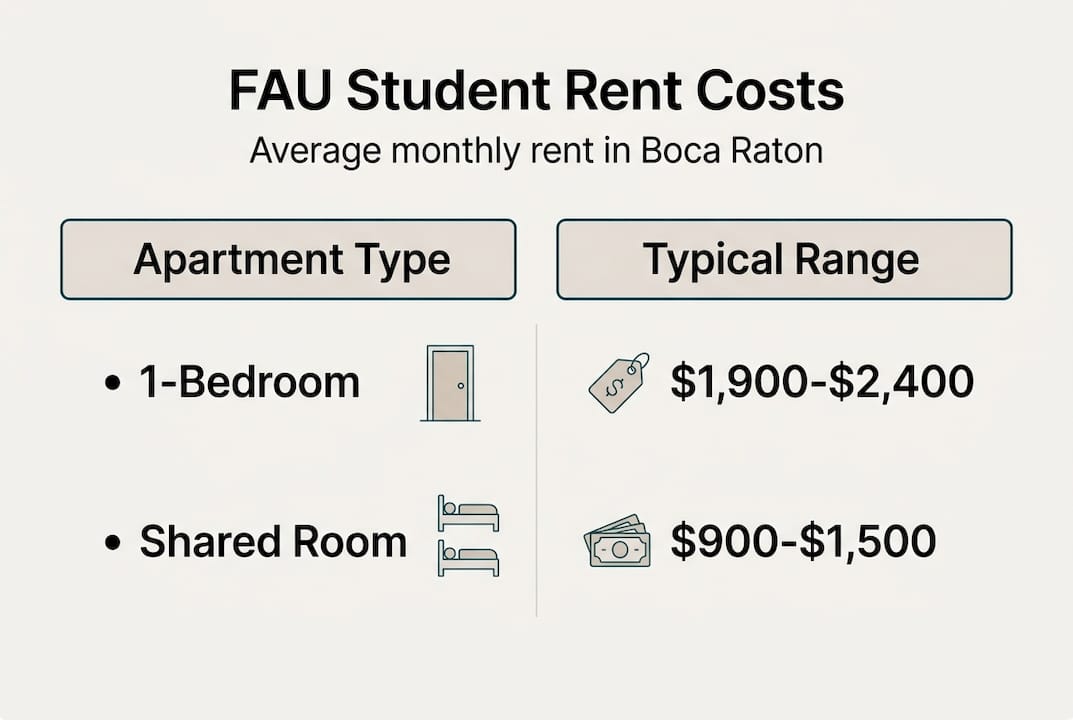
If you’re looking at more budget-conscious options, affordable housing near campus ranges from $1,810 to $2,139 per month for a solo renter. Sharing a unit with one roommate can drop your share to $950 to $1,500 per person, including utilities. That difference is significant when you’re working with a student budget.
Here’s a quick breakdown of what typical monthly housing costs look like:
| Cost item | Solo renter | With one roommate |
|---|---|---|
| Base rent | $1,897 to $2,373 | $950 to $1,187 |
| Utilities (avg.) | $120 to $180 | $60 to $90 |
| Parking | $50 to $100 | $25 to $50 |
| Internet | $50 to $80 | $25 to $40 |
| Total estimated | $2,117 to $2,733 | $1,060 to $1,367 |
A few things students commonly overlook when reviewing listings:
- Base rent rarely includes water, trash, or pest control
- Pet fees can add $50 to $150 per month on top of a one-time deposit
- Short-term leases (under 12 months) often carry a monthly premium of $100 to $200
- Renters insurance is sometimes required and costs $15 to $30 per month
Exploring your student housing options early gives you time to compare what’s actually included before you commit. Many students find that apartments for students with transparent, all-inclusive pricing save them money even when the base rent looks slightly higher.
Calculate your own rent budget step-by-step
Having a sense of typical costs, the next step is figuring out exactly how much you personally can afford to pay for rent. This isn’t guesswork. It’s a straightforward calculation you can do in about 20 minutes.
The standard rule for student rent budgeting is to spend no more than 25 to 30 percent of your gross monthly income on rent. The broader 50/30/20 rule suggests 50 percent of income for needs (rent, food, transport), 30 percent for wants, and 20 percent for savings or debt repayment. For most FAU students, rent alone can consume the entire “needs” bucket, which is why tracking every dollar matters.
FAU’s own off-campus cost benchmark estimates room and board at $10,000 to $12,000 per year, which works out to roughly $833 to $1,000 per month. That’s a useful ceiling to keep in mind.
Here’s how to calculate your personal budget ceiling:
- Add up all monthly income. Include part-time job earnings, financial aid disbursements divided by months in the semester, family contributions, and any scholarships applied to living expenses.
- List your fixed monthly expenses. Tuition payments, car insurance, phone bill, subscriptions, and loan minimums all count.
- Subtract fixed expenses from total income. What’s left is your discretionary pool.
- Apply the 25 to 30 percent rule. Multiply your total monthly income by 0.28 to get a reasonable rent ceiling.
- Add estimated utility costs. This gives you a realistic total housing budget, not just a rent number.
Here’s a comparison of three common student income scenarios:
| Scenario | Monthly income | Max rent (28%) | Realistic total housing |
|---|---|---|---|
| Part-time job only | $1,200 | $336 | Not viable solo |
| Aid + part-time job | $2,000 | $560 | Shared unit needed |
| Aid + job + family support | $3,000 | $840 | Shared or studio feasible |
Pro Tip: Before signing any lease, run a one-month trial budget. Live as if you’re already paying that rent amount. If you can cover all expenses without stress, you’re ready. If you can’t, adjust before you’re locked in.
Looking at affordable Boca apartments with pricing that fits within these ranges is much easier once you know your actual ceiling. Some communities also offer student housing discounts that can bring costs down further.
Smart strategies for lowering rent and total housing expenses
Once you’ve set your budget ceiling, let’s look at techniques to keep your actual housing expenses as low as possible. Some of these are obvious. Others are things most students don’t think about until it’s too late.
The most important insight from working with student renters is this: solo one-bedroom apartments are rarely affordable for students on a standard budget. Sharing a unit or opting for a studio is often the only realistic path to staying within a healthy spending range. Utilities and extras can add $150 to $300 per month to your costs, so choosing a utilities-included lease is one of the smartest moves you can make.
Here are the most effective ways to lower your total housing costs:
- Find a roommate through FAU’s housing board or Facebook groups. Splitting a one-bedroom can cut your share to under $1,200 per month including utilities.
- Prioritize utilities-included listings. You trade a slightly higher base rent for complete cost predictability, which protects your budget.
- Negotiate lease length. A 12-month lease almost always costs less per month than a 9-month or month-to-month arrangement.
- Ask about move-in specials. Many communities offer one free month or reduced deposits for students who sign early.
- Avoid amenity-heavy buildings you won’t use. A rooftop pool sounds great but adds to your rent. Be honest about what you’ll actually use.
“The real monthly cost of an apartment is almost never the number on the listing. Add utilities, parking, pet fees, and any short-term lease premiums, and you could be paying $300 to $500 more than you expected. Always calculate the full number before you decide.”
Two mistakes students make repeatedly: skipping utility estimates when comparing apartments, and ignoring lease flexibility. If your lease doesn’t allow subletting and you need to leave for an internship, you could owe months of rent you’re not even living there.
Pro Tip: When touring apartments, ask specifically, “What is the average utility bill for this unit in summer?” Summer in South Florida means heavy AC use, and a $200 electric bill can wreck a tight budget.
Exploring student housing in Boca Raton with transparent pricing removes a lot of this guesswork. Communities that list all fees upfront help you find affordable apartments without unpleasant surprises.
Verify your housing plan before you sign a lease
Before moving forward with any lease, it’s critical to ensure your choice matches your budget and doesn’t hide unexpected costs. Signing without verifying is one of the most expensive mistakes a student can make.
The smartest approach is to test your housing budget for one full month before committing. Set aside the exact rent amount plus estimated utilities from your bank account and see if you can cover everything else without going negative. If you can, you’re ready. If you can’t, the apartment is too expensive regardless of how nice it looks.
Here’s a verification checklist before signing:
- Request an itemized list of all monthly fees. Rent, utilities, parking, pet fees, trash, and any community fees should be in writing.
- Read the full lease, not just the summary. Look for automatic renewal clauses, early termination penalties, and subletting restrictions.
- Confirm the notice period. Most leases require 30 to 60 days notice before moving out. Missing this can cost you an extra month’s rent.
- Verify the security deposit terms. Know exactly what conditions allow the landlord to keep your deposit.
- Check what happens if a roommate leaves. Are you individually responsible for the full rent, or is it split by the lease?
Here’s how different income types map to realistic payment plans:
| Income type | Monthly housing budget | Best fit |
|---|---|---|
| Financial aid only | $700 to $900 | Shared room or studio |
| Aid + part-time job | $900 to $1,200 | Shared one-bedroom |
| Aid + job + family | $1,200 to $1,600 | Solo studio or 1BR |
Red flags to watch for: sudden fees added after you apply, vague lease language around maintenance responsibilities, and landlords who pressure you to sign the same day. Legitimate affordable apartments for students give you time to review everything without pressure.
What most students get wrong about budgeting for rent
Here’s the uncomfortable truth most budgeting guides skip: students don’t fail at budgeting because they don’t know the rules. They fail because they make decisions based on base rent instead of total living cost.
You see a listing for $1,850 and think it fits your budget. Then you add $160 in utilities, $75 for parking, $30 for renters insurance, and a $100 short-term lease premium. Suddenly you’re at $2,215. That’s a $365 gap that breaks budgets silently, one month at a time.
The other trap is overvaluing amenities. A gym, a pool, and a coworking lounge sound essential during a tour. Three months in, you’re using the gym once a week and wondering why your account is always low. Prioritize what you actually need: location, included utilities, flexible lease terms, and a landlord who communicates clearly.
Being transparent with roommates about finances is also underrated. Awkward conversations upfront prevent much worse situations later. And if you want real flexibility, look for a housing guide for Boca Raton that covers lease structures and what to negotiate before you sign.
Find your affordable one-bedroom or shared apartment in Boca Raton
Ready to apply smart budgeting to your apartment search? Here are resources to help you find the place that’s right for you.
At Cynthia Gardens, we built our leasing process specifically for students and young professionals who need clarity, not confusion. No hidden fees, no pressure tactics, and no surprises on move-in day.
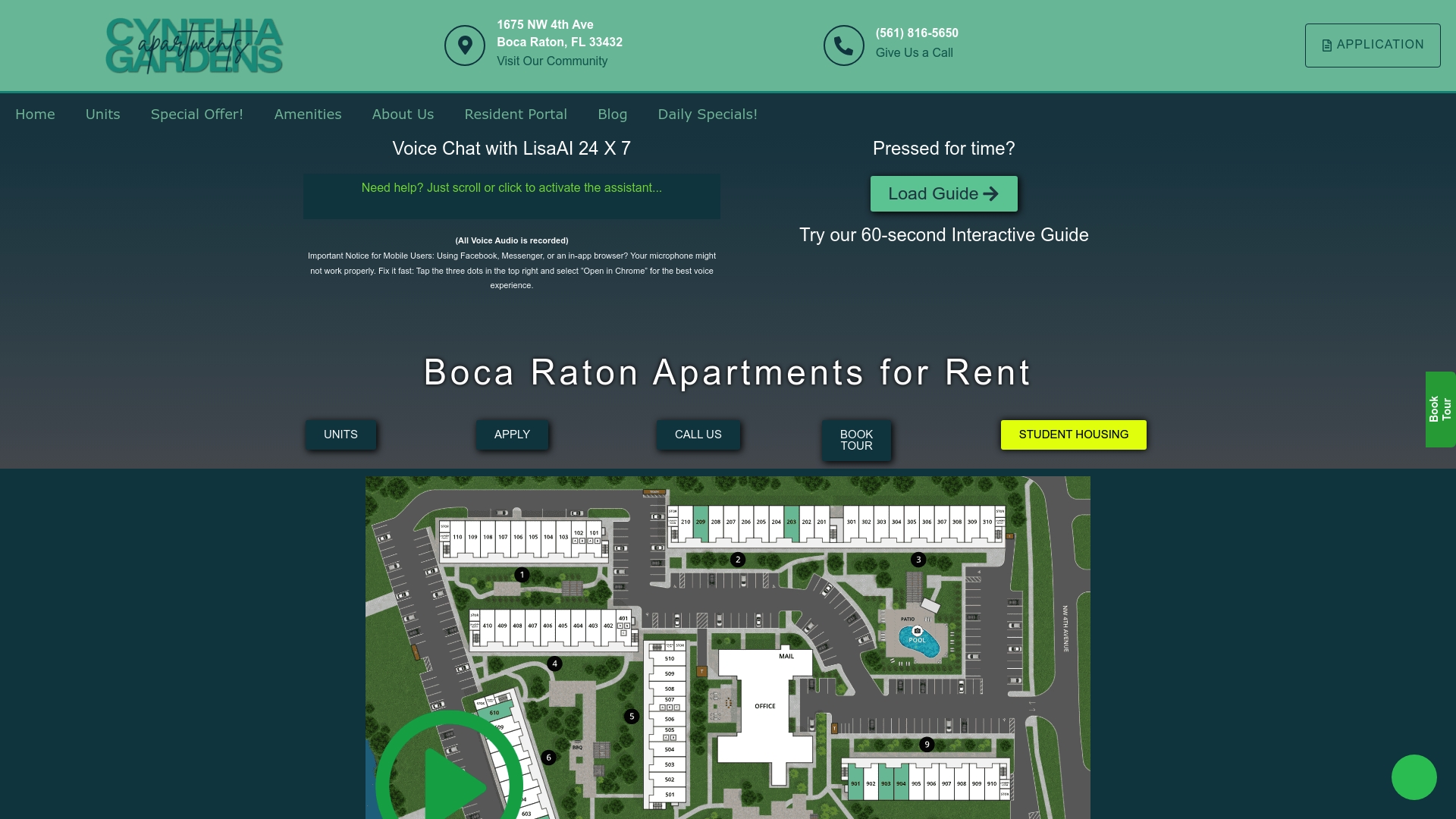
Browse our cheap one-bedroom apartments to see current availability and pricing. Use our affordable one-bedroom comparisons tool to stack options side by side. If you’re weighing the benefits of living alone, our guide to solo living apartment options walks you through exactly what to look for. Virtual tours, AI chat support, and an interactive property map are all available so you can explore on your schedule.
Frequently asked questions
What is the average rent for a one-bedroom apartment in Boca Raton in 2026?
The average one-bedroom rent in Boca Raton ranges from $1,897 to $2,373 per month, depending on location, building age, and included amenities.
What percentage of my income should go toward rent as an FAU student?
Aim to spend no more than 25 to 30 percent of your gross monthly income on rent, keeping total housing costs within your broader needs budget.
How can I reduce my total housing costs in Boca Raton?
Sharing an apartment can bring your share to $950 to $1,500 per month including utilities. Choosing utilities-included leases and avoiding unnecessary pet or parking fees also helps significantly.
Is it possible to find a solo one-bedroom apartment under $1,800 near FAU?
Solo one-bedroom units under $1,800 are rare near FAU. Studios or shared arrangements are more realistic options for keeping costs below that threshold.
What are common hidden costs when budgeting for rent?
Beyond base rent, budget for utilities, pet fees, parking, and renters insurance. Pet fees and utilities alone can add $150 to $300 per month, and short-term leases often carry an additional monthly premium.
Recommended
- Student Living Near FAU: A Practical Guide to Convenient Apartments in Boca Raton – Luxury Apartments for Rent in Boca Raton | Premium Boca Raton Apartments | Aapartments Boca Raton
- Benefits of living off-campus: affordable Boca Raton 2026
- 7 Essential Student Apartment Tips for FAU Renters
- Student-Friendly Apartments Near FAU Boca Campus – Luxury Apartments for Rent in Boca Raton | Premium Boca Raton Apartments | Aapartments Boca Raton