
Digital tenant support is the combination of software tools and automated workflows that let renters handle routine tasks themselves (paying rent, submitting maintenance requests, reserving amenities) while giving property teams a single dashboard to manage the exceptions that actually need a human. It matters because tenants now expect it as the default, not the upgrade. Industry research shows most renters want to complete rental processes digitally, and a majority already pay rent online, according to property management automation data. Communities like Cynthia Gardens in Boca Raton have leaned into this shift with AI chat, voice assistance, and virtual tours built into the leasing process itself.
Pro Tip: Before you shop for a platform, list every phone call your leasing office fielded last week. If more than half were about rent status, lease renewals, or “is my package here yet,” you already have your business case for digital tenant support.
Key Takeaways
Digital tenant support works because it shifts routine, repetitive tasks to self-service tools while freeing staff to handle exceptions that actually require human judgment.
| Point | Details |
|---|---|
| Definition first | Digital tenant support combines self-service tools and automated workflows so tenants handle routine tasks without staff involvement. |
| Prioritize integration | A connected platform beats scattered single-purpose apps because data flows between payments, maintenance, and access control. |
| Fastest ROI features | Rent automation and maintenance intake typically deliver payback before other features like amenity booking or analytics. |
| Start small | Pilot with one building, train staff first, then onboard tenants with incentives rather than just an announcement email. |
| Cynthia Gardens example | Cynthia Gardens applies AI chat, voice assistance, virtual tours, and an interactive map to its leasing process for faster, more transparent decisions. |
Table of Contents
- What Falls Under Digital Tenant Support (and What Doesn’t)
- Key Features Worth Prioritizing in a Tenant Support Platform
- What Property Managers and Landlords Gain From Going Digital
- How to Evaluate, Select, and Roll Out the Right Platform
- Common Pitfalls and How to Avoid Them
- How a Tech-Forward Community Applies Digital Tenant Support in Practice
- Trends Reshaping Digital Tenant Support
- Why Cynthia Gardens Invested in Tech-Forward Leasing
- See Cynthia Gardens’ Tech-Forward Leasing Experience
- Frequently Asked Questions
- Sources
What Falls Under Digital Tenant Support (and What Doesn’t)
Not every app that touches a tenant qualifies as digital tenant support. A single-purpose tool, like a standalone rent payment portal or a maintenance ticket form bolted onto a website, solves one problem in isolation. Digital tenant support describes something broader: an interconnected system where tenant-facing self-service tools and back-office operations share the same data.
The distinction matters because disconnected tools create duplicate work. If your payment app doesn’t talk to your maintenance system, and neither talks to your leasing CRM, your staff spends hours reconciling information that should sync automatically. A production-grade platform typically runs on interconnected modules, treating each lease as a living record that can trigger renewal offers, inspection reminders, and rent adjustments without manual intervention, according to property management software architecture research.
Here’s what typically falls under the umbrella:
- Tenant portals for account access, document storage, and self-service requests
- Communication tools including in-app messaging, SMS, and AI chat routing
- Payment processing for rent, fees, and deposits
- Maintenance and work order systems with status tracking
- Access control and visitor management for building entry
- Package management for delivery notifications and pickup tracking
- Amenity reservation systems for shared spaces like pools or coworking rooms
A single-purpose app handles one of these. A consolidated platform, sometimes called tenant experience technology or TenEx in enterprise circles, handles all of them from one source of truth. That distinction is exactly why the VTS Rise evaluation guide warns that scattered point solutions tend to underperform without centralized data and consistent tenant engagement across every touchpoint.
Key Features Worth Prioritizing in a Tenant Support Platform
Not every feature on a vendor’s slide deck moves the needle equally. Some generate ROI within the first billing cycle. Others matter more for long-term retention. Here’s what actually shows up in the day-to-day operations of a property team:
- Tenant portal: Central hub for payments, documents, requests, and account history, replacing scattered emails and phone calls.
- Automated rent workflows: Recurring payment reminders, autopay enrollment, and late fee automation that reduce the manual chasing that eats up front-desk hours.
- Maintenance ticketing with status tracking: Tenants submit a request, see real-time status, and staff route it by urgency and vendor availability instead of a paper trail.
- Digital lease signing: E-signature workflows that shrink move-in timelines from days to minutes.
- Access control and visitor management: Smart locks, mobile credentials, and visitor logging tied to unit-level permissions. ButterflyMX is a commonly cited example of hardware-integrated access control in multifamily buildings.
- Package management: Automated notifications when deliveries arrive, often paired with smart lockers.
- Amenity reservations: Self-service booking for pools, gyms, or coworking spaces, reducing double-bookings and front-desk coordination.
- Segmented communication: Targeted messaging by unit, building, or lease stage rather than blanket emails everyone ignores.
- Analytics and reporting: Dashboards that surface renewal risk, maintenance bottlenecks, and payment trends before they become problems.
- APIs and integrations: The connective tissue that lets your accounting software, access hardware, and tenant portal share data instead of operating as silos.
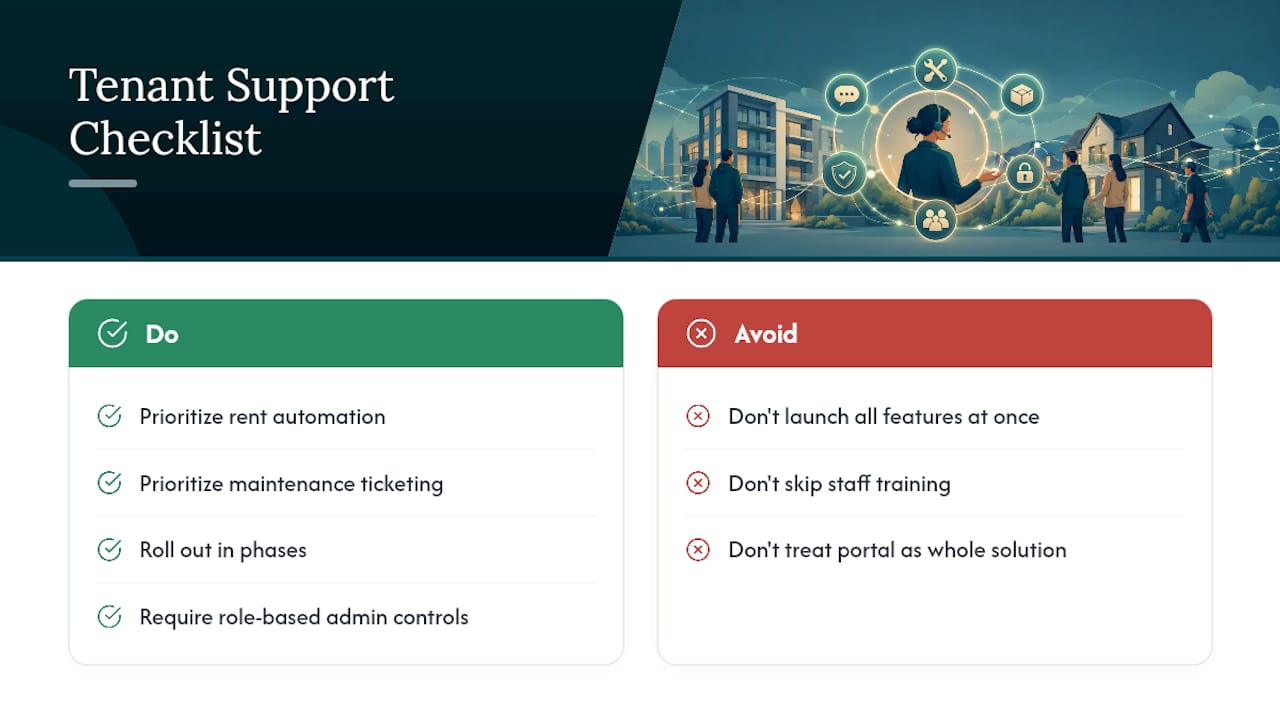
Platforms like Visitt and VTS Rise are frequently referenced as examples of consolidated tenant experience software that bundle several of these capabilities into one system rather than requiring separate point tools for each. Think of them as capability benchmarks rather than a specific recommendation. Of everything on this list, rent automation and maintenance intake tend to deliver the fastest payback. Automating rent reminders and maintenance requests is often the single highest-ROI move a small team can make, since it frees staff to manage more units without adding headcount.
What Property Managers and Landlords Gain From Going Digital
The benefits break down into two categories: things tenants notice, and things your bottom line notices. Both matter, but they show up on different timelines.
Tenants feel the difference immediately when they can pay rent at midnight instead of waiting for office hours, or check a maintenance ticket status instead of calling twice to ask if anyone’s coming. Property teams feel it a few weeks later, once call volume drops and staff time shifts from repetitive tasks to actual problem-solving.
- Reduced routine phone volume: One provider case reported roughly an 85% reduction in inbound tenant calls after rolling out an automated portal with AI-based call routing.
- Faster maintenance resolution: Status tracking and automated routing cut the back-and-forth that used to require three phone calls just to confirm a technician was scheduled.
- Higher renewal rates: About half of renters now prefer handling lease renewals online, according to self-service adoption research, and platforms that make renewal easy tend to convert more of that preference into signed leases.
- Staff efficiency: Fewer manual tasks mean existing staff can manage more units without proportional headcount growth.
- Improved lead capture: Self-service tools like virtual tours and AI chat keep prospects engaged after office hours instead of losing them to a competitor who answered faster.
- Owner transparency: Real-time dashboards give property owners visibility into occupancy, maintenance costs, and collections without waiting for a monthly report.
Even mail handling plays into retention more than most managers expect. One vendor analysis linked improved package and mail management programs to a 68% higher lease renewal rate in multifamily settings, a reminder that small convenience wins add up to bigger retention numbers.
How to Evaluate, Select, and Roll Out the Right Platform
Choosing a platform is less about finding the flashiest feature list and more about matching capability to your team’s actual workflow gaps. Here’s a practical path from evaluation to full adoption.
- Map your current pain points first. Before any demo, document where staff time actually goes: rent chasing, maintenance triage, lease paperwork, or visitor logging. This becomes your evaluation checklist.
- Ask about integrations before features. During vendor demos, ask directly: does this connect to our accounting software? Does it have an open API? Can it sync with existing access control hardware? A platform with impressive tenant-facing features but no integration path creates a new silo instead of solving the old one.
- Pilot with one building or one floor. Roll out to a contained group first, rather than your entire portfolio, so you can catch configuration issues before they scale.
- Layer in integrations during weeks two through four. Connect payment processing, then maintenance routing, then access control, one system at a time rather than all at once.
- Train staff before tenants. Give your team two full weeks of hands-on use before you announce anything to residents. Staff who are still learning the interface can’t confidently walk a confused tenant through it.
- Onboard tenants with incentives, not just instructions. A small credit or amenity perk for completing portal setup in the first month drives adoption faster than an email announcement alone.
- Measure adoption weekly for the first quarter. Track portal login rates, percentage of rent collected digitally, and maintenance tickets submitted through the app versus by phone.
- Scale to the full portfolio once adoption crosses a meaningful threshold, typically once most active leases are using the portal for at least one recurring task.
Pro Tip: Configure your maintenance routing rules before you launch to tenants, not after. Most platforms let you set automatic assignment by category (plumbing, electrical, appliance), and getting this right on day one prevents the “black hole ticket” complaints that kill tenant trust in the system fastest.
Watch for red flags during procurement: vendors who can’t clearly explain their API documentation, platforms with no adoption analytics dashboard, or systems that require a separate login for maintenance versus payments. Those are signs you’re buying disconnected point tools wearing a unified interface.
Common Pitfalls and How to Avoid Them
Even a well-chosen platform can underperform if the rollout ignores a few predictable failure points. Fragmented systems are the most common one: teams buy a portal, then a separate maintenance app, then a separate access control system, and end up with three logins and zero shared data. The fix is an integration layer or a platform built with open APIs from the start, so new tools plug into existing data rather than duplicating it.
Low tenant adoption is the second biggest killer. A platform nobody uses delivers zero ROI regardless of its feature list. Phased rollout with tenant education, not a one-time email blast, solves this. Give residents a walkthrough during move-in, not a PDF buried in a welcome packet.
Poor vendor support shows up months after signing, when integration issues surface and support tickets sit unanswered. Clear service-level agreements in the contract, with defined response times, protect against this before it becomes a crisis.
Hidden costs sneak in through per-unit pricing tiers, add-on fees for access control hardware, or charges for API access that wasn’t disclosed upfront. Get a full cost breakdown in writing before signing, including any charges tied to scaling up unit count.
Security gaps deserve their own checklist, since tenant portals handle sensitive data: payment information, lease documents, and access credentials.
- Confirm role-based admin controls so staff only see data relevant to their job function.
- Verify data encryption both in transit and at rest for payment and personal information.
- Ask for vendor security attestations (SOC 2 or equivalent) before signing.
- Review access control audit logs to confirm visitor and entry activity is tracked and retrievable.
For deeper guidance on physical security integration, property manager security best practices cover access control hardware considerations that pair well with any digital tenant portal.
How a Tech-Forward Community Applies Digital Tenant Support in Practice
Cynthia Gardens, a one-bedroom apartment community in Boca Raton, built its leasing process around several of the same tools discussed above, but applied to the leasing funnel rather than post-move-in operations. Prospects use an interactive property map to explore available units, complete a virtual tour instead of scheduling an in-person visit, and get real-time answers from AI chat and voice assistance without waiting for office hours.

This mirrors a broader pattern industry-wide: enterprise deployments of conversational AI have reportedly resolved as many as nine out of ten routine inquiries at first contact, freeing staff for the exceptions that actually need a human touch.
For similarly sized owners wondering where to start, the leasing funnel is often the easiest place to pilot digital tenant support tools, before tackling post-move-in operations like maintenance and payments.
- Start with a virtual tour option for prospects who can’t visit in person.
- Add AI chat for after-hours leasing questions before building out full portal functionality.
- Use an interactive map or floor plan tool to reduce back-and-forth emails about unit availability.
- Layer in tenant portal and maintenance features once the leasing side proves adoption.
Trends Reshaping Digital Tenant Support
A handful of shifts are already changing what “good” looks like in this space, and they’ll matter more over the next few years than they do today.
AI-powered routing and chat are moving from a nice-to-have to an expectation, particularly for after-hours inquiries. Broader operational research shows AI adoption accelerating across adjacent industries, a signal that property operations will keep following the same trajectory toward automated triage and routing.
Deeper access-control hardware integration means smart locks and visitor systems will increasingly sync directly with tenant portals rather than operating as separate logins. Analytics-driven renewal offers will let platforms flag flight-risk tenants weeks before their lease expires, based on payment patterns and maintenance ticket sentiment, rather than waiting for a 60-day notice deadline to trigger outreach.
Mobile-first self-service keeps raising the adoption bar. If a platform’s mobile experience feels clunky, tenants revert to phone calls regardless of how good the desktop version is. And platform consolidation continues as vendors buy up point solutions to offer end-to-end suites, which means the “many small apps” approach is becoming harder to justify against a single connected platform.
Why Cynthia Gardens Invested in Tech-Forward Leasing
Speed and transparency drove most of the decisions behind Cynthia Gardens’ leasing technology. Renters searching for a one-bedroom apartment in Boca Raton don’t want to wait until Monday morning to get an answer about availability or pricing, and they don’t want to discover hidden fees after they’ve already committed emotionally to a unit.
The AI chat and voice assistance tools exist so prospects get immediate, consistent answers whether they’re browsing at 2 PM or 2 AM. The virtual tours and interactive property map exist so someone relocating from out of state can confidently narrow down a unit before ever setting foot in Florida. None of these tools replace human judgment. They handle the repetitive first layer of questions so the leasing team can spend its time on the conversations that actually require a person, like negotiating move-in dates or answering questions specific to a pet policy.
That combination of speed and transparency shows up directly in leasing outcomes: fewer abandoned inquiries, faster time-to-lease, and prospects who arrive at a tour (virtual or otherwise) already confident in their decision.
See Cynthia Gardens’ Tech-Forward Leasing Experience
If the platforms and workflows covered above sound like a lot to evaluate, you can see one version of it already running. Cynthia Gardens built its leasing process around the same self-service principles this guide covers: AI chat that answers questions instantly, virtual tours that let you explore a unit from anywhere, and an interactive property map that shows real-time availability without a single phone call.
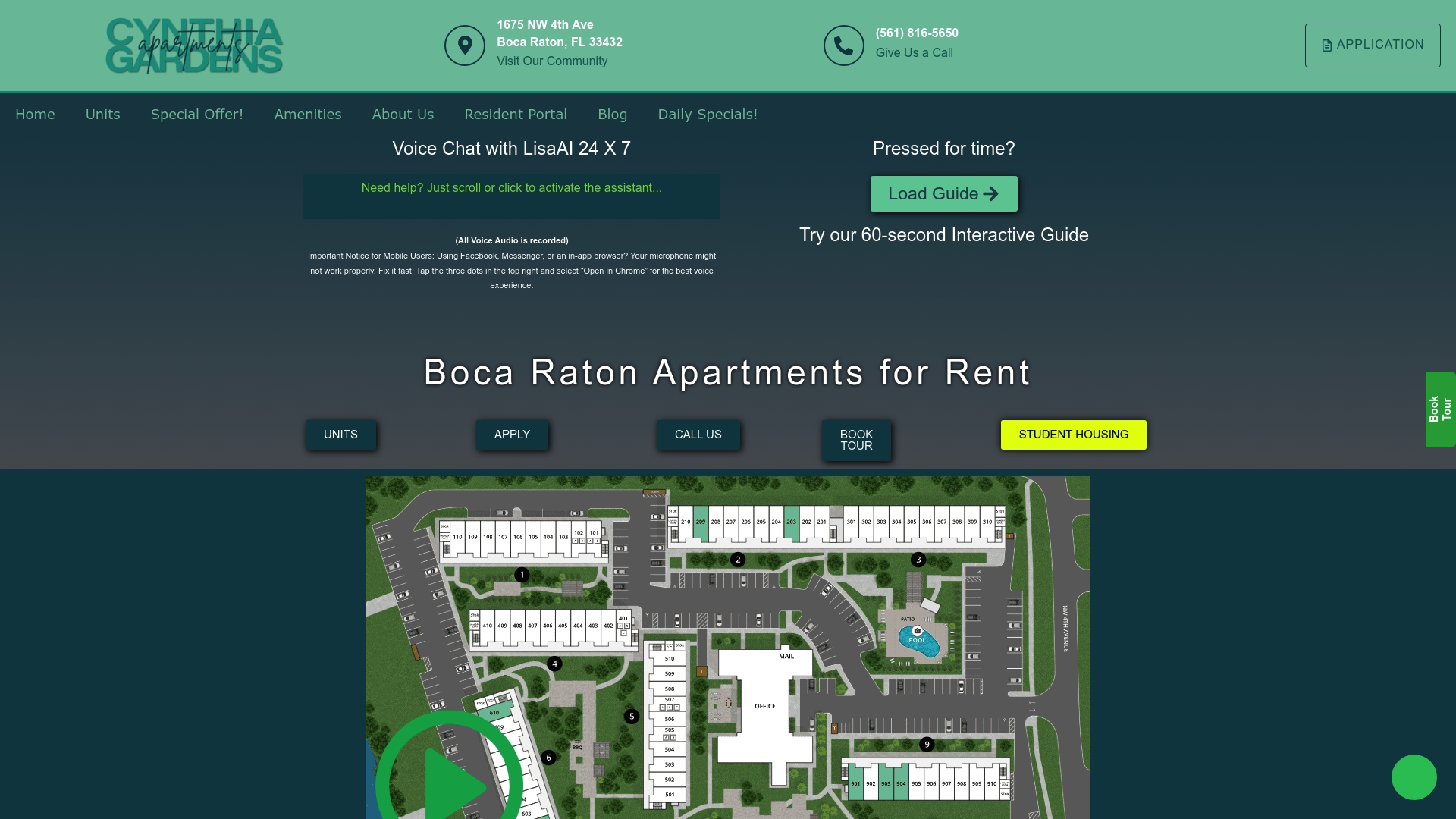
For a one-bedroom apartment in Boca Raton with transparent pricing and no hidden fees, that tech-forward approach means you get answers fast and see exactly what you’re getting before you commit. Explore available units at Cynthia Gardens and take the virtual tour to see the leasing experience for yourself.
Frequently Asked Questions
What is digital tenant support, in simple terms?
Digital tenant support is the set of online tools and automated workflows that let tenants handle routine tasks themselves (paying rent, submitting maintenance requests, booking amenities) while giving property staff a centralized system to manage exceptions and analyze operations.
How is digital tenant support different from a tenant portal?
A tenant portal is one component of digital tenant support, typically the login hub for payments and requests. Digital tenant support is the broader category that includes the portal plus maintenance systems, access control, communication tools, and analytics, ideally all connected through shared data.
What features should I prioritize first when adopting tenant support technology?
Rent automation and maintenance ticketing tend to deliver the fastest return, since they eliminate the most repetitive phone calls and manual tracking. Add access control, package management, and amenity booking once the core workflows are running smoothly.
Is digital tenant support secure?
Security depends on the vendor’s practices, not the category itself. Look for role-based admin controls, encryption for payment and personal data, and third-party security attestations like SOC 2 before signing with any provider.
How long does implementation typically take?
A phased rollout, pilot, integrations, staff training, then tenant onboarding, usually spans a full quarter for a mid-size portfolio. Trying to launch every feature at once to every building tends to overwhelm both staff and tenants and slows adoption rather than speeding it up.
This article provides general information about digital tenant support technology and is not a substitute for professional advice on vendor contracts, data security compliance, or fair housing regulations specific to your property.
Sources
The figures cited throughout this guide come from industry research on tenant technology adoption and property management platform design. A few of the most relevant data points worth revisiting:
- Property Management Tenant Communication Automation
- Cut Tenant Phone Calls 85% With Automated Portals Guide
- How Property Management Software Works: Tenant Portals, Lease Tracking 2026
For more on how digital tools apply specifically to leasing, see the role of digital communication in leasing and digital leasing tools for property managers.