
What you need to know about pet fees in 2026
The three charges you will encounter in any pet-friendly lease are a pet deposit, a pet fee, and pet rent. They are not interchangeable, and confusing them is the fastest way to end up in a dispute. Pet deposits typically vary within a broad range depending on the property and jurisdiction, are refundable if the animal causes no damage beyond normal wear, and must be returned with an itemized statement. Pet fees generally fall within a moderate range reflecting landlords’ administrative costs and are non-refundable from the moment you pay them. Pet rent typically ranges at a modest monthly amount to account for ongoing wear and tear on top of base rent and compensates for ongoing wear and tear over the life of the lease.

Two major federal policy shifts have reshaped the compliance picture heading into 2025 and 2026. HUD’s Office of Fair Housing and Equal Opportunity withdrew its 2020 emotional support animal guidance effective September 17, 2025, and then issued new enforcement guidance on May 22, 2026, narrowing fee waivers to animals individually trained to perform disability-related tasks. That change affects how landlords structure pet policies and how tenants document accommodation requests. Property managers who have not updated their lease language since 2020 are working from an outdated playbook.
Key distinctions at a glance:
- Pet deposit: Refundable, held in trust, subject to security deposit caps in most states
- Pet fee: Non-refundable, earned by the landlord at payment, not subject to deposit caps
- Pet rent: Monthly, recurring, not capped by deposit statutes, but subject to rent control where applicable
- Service animals: No fees or deposits permitted under the Americans with Disabilities Act
- Emotional support animals (ESAs): Fee waivers now evaluated case by case under the 2026 HUD enforcement guidance, not automatically granted
How pet fee laws vary by state and jurisdiction
No single federal statute sets a dollar cap on pet fees or pet rent. The patchwork of state and local rules is where the real compliance work happens, and the differences are significant enough that a policy legal in Texas could expose a California landlord to liability.

California applies the strictest framework. Total security deposits, including any pet deposit, cannot exceed two months’ rent for unfurnished units or three months’ rent for furnished ones. Los Angeles and San Francisco layer rent stabilization programs on top of that, meaning pet rent increases must comply with local rent control ordinances before they can take effect.
Colorado caps pet deposits at $300 and limits pet rent to $35 per month or 1.5% of the tenant’s monthly rent, whichever is greater. That cap came from a 2023 Denver bill and represents one of the few explicit pet-rent limits in the country.
Florida takes the opposite approach. The state places no cap on pet deposits and no ceiling on pet fees, giving landlords wide latitude. That flexibility is why pet deposit rules in Boca Raton can look very different from what a renter coming from Colorado or California expects.
| State | Pet Deposit Cap | Pet Fee Rules | Pet Rent Cap |
|---|---|---|---|
| California | Part of 2-month (unfurnished) or 3-month (furnished) total deposit cap | Allowed; must not push total deposits over cap | Subject to local rent control |
| Colorado | $300 | Allowed | $35/month or 1.5% of rent |
| Florida | No statewide cap | Allowed | No statewide cap |
| Georgia | — | Allowed; non-refundable pet fee ~$300 typical | $10–$60/month typical |
| Texas | No statewide cap | Allowed; legislative proposals pending | No statewide cap |
| Illinois | No statewide cap | Allowed | No statewide cap |
Seattle is worth a specific callout: landlords there can charge up to 25% of one month’s rent as a pet deposit on top of the standard security deposit. For a $2,000 apartment, that translates to a $500 pet deposit ceiling.
A few states prohibit non-refundable fees of any kind. In those jurisdictions, landlords cannot collect a one-time pet fee regardless of how it is labeled. Checking the landlord-tenant statute for your specific state before signing or drafting a lease is the only reliable way to know which charges are permitted.
Compliance requirements to verify by jurisdiction:
- Whether pet deposits count toward the overall security deposit cap
- Whether non-refundable fees are permitted at all
- Whether pet rent falls inside rent control ceilings
- Whether breed or species restrictions are enforceable locally
- Whether itemized deposit return deadlines differ from the standard 14–60 day window
How to tell pet deposits, pet rent, and pet fees apart for legal compliance
The word your lease uses controls whether you get your money back. That is not a technicality. A charge labeled “deposit” carries a legal presumption of refundability, and courts in many jurisdictions will treat a “non-refundable deposit” as a refundable one regardless of what the landlord intended, because the word “deposit” triggers security deposit protections. The phrase “non-refundable deposit” is a legal contradiction that routinely gets ruled in the tenant’s favor.
Pet rent bypasses deposit caps entirely because it is structured as rent, not security. That is one of the main reasons it has become so common: when deposit ceilings are tight, landlords shift pet-related cost recovery into a monthly charge that statutes do not cap. A landlord who charges all three types is not necessarily double-dipping in a legal sense, since each covers a different risk category. Pet rent covers slow cumulative wear. The deposit covers identifiable damage. The fee covers the administrative cost of allowing the animal.
Refundability and usage distinctions:
- Pet deposit: Must be returned within the state-mandated deadline (typically 14–60 days after move-out) minus itemized deductions for actual pet damage
- Pet fee: Belongs to the landlord outright at payment; cannot be applied to specific damages later
- Pet rent: Treated as income when received; deductible repair costs offset it at tax time
- Per-pet vs. per-lease: Pet fees typically apply per animal; pet deposits generally cover all animals under one lease
Pro Tip: Never let a lease say “non-refundable pet deposit.” If the charge is meant to be non-refundable, call it a “pet fee” and structure it accordingly. If it is meant to be refundable security, call it a “pet deposit” and follow your state’s deposit return rules. Mixing the terms in one phrase invites a court to decide which one controls, and landlords rarely win that argument.
How to calculate pet fees fairly:
- Base the pet deposit on pet size, breed, and property history with animals
- Set pet rent at $10–$60 per month depending on pet size, property history, and local market norms
- Charge pet fees per animal when the policy applies per animal, and disclose that clearly in the lease
- Avoid stacking all three charges at maximum amounts; excessive layering can deter quality tenants and increase vacancy costs even when it is technically legal
What the 2026 HUD guidance means for service animals and ESAs
The rules around assistance animals shifted materially in 2025 and 2026, and landlords who have not updated their policies are exposed. HUD’s Office of Fair Housing and Equal Opportunity withdrew its 2020 ESA guidance effective September 17, 2025, under Executive Orders 14192 and 14219. That 2020 guidance had declared that untrained emotional support animals could not be charged pet fees. It no longer applies.
On May 22, 2026, HUD issued replacement enforcement guidance stating that FHEO will recommend charges only for cases involving animals trained to provide disability-related assistance. That aligns assistance animal policy more closely with ADA standards for trained service animals. ESA fee waivers are no longer automatic. Each request is now evaluated on whether the accommodation is both necessary and reasonable given the specific facts.
A federal district court in Henderson v. Five Properties LLC (E.D. La., July 2025) had already moved in this direction before the guidance issued. The court held that waiving an animal fee for an ESA was neither reasonable nor necessary under the Fair Housing Act, noting that the fee represented less than 3% of total housing costs and that the tenant had sufficient income to pay it. That decision is now an appendix to the 2026 HUD enforcement memo.
Key compliance questions landlords should ask for every assistance animal request:
- Is the animal individually trained to perform a specific disability-related task?
- Does the tenant’s documentation establish a disability nexus, not just a general wellness benefit?
- Is the requested fee waiver necessary for the tenant to equally enjoy the housing?
- Is the fee amount proportional to overall housing costs?
- Has the request been evaluated on its specific facts rather than as a blanket policy?
Tenants with ESAs should understand that an online form letter from a telehealth provider is unlikely to satisfy the documentation standard under the current guidance. HUD dismissed two complaints in April 2026 involving ESAs supported only by form letters. A letter from a licensed healthcare provider that establishes both a disability and a clear nexus between the disability and the specific animal carries far more weight.
The Fair Housing Act still prohibits charging fees for trained service animals. That protection has not changed. What changed is the automatic fee-waiver treatment for untrained ESAs.
Rights and responsibilities of landlords and tenants on pet charges
Both sides of a lease carry real obligations when pets are involved, and the paper trail you create at move-in determines who wins a dispute at move-out. Photographic evidence of property condition at move-in is the single most effective protection a tenant has against unjust deposit deductions. Shoot every room, focus on flooring, baseboards, walls, and door frames, and note any pre-existing stains or scratches in writing.
Landlord obligations:
- Return the pet deposit within the state-mandated deadline after move-out
- Provide an itemized deduction statement listing specific damages, not a lump sum
- Include receipts or repair estimates for any amount withheld
- Process reasonable accommodation requests individually and in good faith
- Disclose all pet-related charges in the lease before the tenant signs
Tenant obligations:
- Pay all disclosed pet charges on time as specified in the lease
- Report pet damage promptly rather than concealing it
- Conduct a joint move-out inspection when possible to dispute claims on the spot
- Provide a forwarding address so the landlord can return the deposit or send the itemized statement
- Submit complete documentation for any assistance animal accommodation request
For move-in inspection documentation, the before-and-after photo comparison is what makes or breaks a deposit dispute. Matching photos of the same wall or floor section taken at move-in and move-out make it very difficult for a landlord to charge for damage that was already there. If your landlord provides a move-in checklist, fill it out in detail and keep a signed copy.
Landlords who miss the deposit return deadline face penalties in most states, including double or triple damages plus attorney’s fees in some jurisdictions. A demand letter citing the specific state statute and its penalty provision often resolves disputes without litigation.
Essential pet policy checklist for 2025 residential leases
A lease that covers pet fees incompletely creates disputes. Every pet-friendly lease should address the following before a tenant signs.
Required clauses:
- Explicit identification of each charge type (deposit, fee, or rent) with the exact dollar amount
- Clear statement of refundability for each charge
- Per-animal or per-lease structure for fees, stated unambiguously
- Permitted species, breeds, and weight limits
- Behavioral expectations and noise or nuisance standards
- Tenant liability for all pet-caused damage beyond normal wear and tear
- Requirement for renter’s insurance with pet liability coverage, if applicable
- Process for adding or removing a pet during the lease term
- Consequences for undisclosed pets, including cure-or-quit notice timelines
- Assistance animal accommodation request process and documentation requirements
Documentation and disclosure best practices:
- Attach a signed pet addendum to every lease where a pet is permitted
- Photograph the unit before the pet moves in and store images with the lease file
- Disclose all pet charges in the property listing before the tenant applies
- Label every charge correctly: “pet deposit” for refundable amounts, “pet fee” for non-refundable ones
- State the deposit return deadline and itemization requirements in the lease itself
- Include a clause specifying that pet rent is subject to the same notice requirements as base rent increases
- Note any breed or species restrictions and confirm they comply with local fair housing ordinances
- Reference the applicable state deposit cap and confirm total deposits do not exceed it
Pro Tip: Add a line to the pet addendum that reads: “Tenant acknowledges receipt of the pet policy and agrees that [pet deposit amount] is refundable subject to itemized deductions for pet-caused damage, and that [pet fee amount] is non-refundable.” That single sentence eliminates the most common source of post-move-out disputes.
For a deeper look at pet screening in rentals and how to structure the intake process, the screening step is where you catch undisclosed breeds, verify vaccination records, and set behavioral expectations before a lease is signed.
How automation improves pet fee compliance and tracking
Manual tracking of pet deposits, fees, and rent across a portfolio of units creates gaps. A charge labeled incorrectly in a spreadsheet, a missed deposit return deadline, or an undocumented deduction can each trigger a penalty. Property management platforms built for compliance close those gaps by automating the paper trail.
Technology-forward pet policies with clear fee differentiation reduce legal risks and turnover for property managers. The key is that automation does not just save time; it creates a defensible record for every charge, every communication, and every deadline.
Features to look for in pet fee management software:
- Automated charge categorization that distinguishes deposits from fees from rent in the ledger
- Deadline tracking for deposit returns with state-specific timelines built in
- Digital pet addendum generation and e-signature capture
- Tenant communication logs tied to specific lease events
- Compliance alerts when a proposed charge would exceed a state deposit cap
- Assistance animal request workflows with documentation checklists
LeaseRunner and Cloud Rental Manager are two platforms property managers use specifically for lease compliance and fee tracking. LeaseRunner supports digital lease creation with customizable pet addendum fields, making it straightforward to label charges correctly and capture tenant acknowledgment at signing. Cloud Rental Manager includes compliance reminder workflows that flag upcoming deposit return deadlines and track itemized deduction documentation.
Pro Tip: Integrate your pet fee tracking with your accounting software so that pet deposits sit in a separate trust account from operating funds. Commingling deposit funds with operating income is a violation in most states, and it is one of the first things a tenant’s attorney checks when a dispute goes to court.
For leasing tools that support compliance, the combination of digital lease generation, automated reminders, and tenant-facing communication logs is what separates a defensible process from a reactive one.
How Cynthiagardens approaches pet policy transparency in Boca Raton
Cynthiagardens operates as a pet-friendly apartment community in Boca Raton, Florida, and the approach to pet fees there reflects exactly the kind of transparency this checklist describes. All pet-related charges are disclosed upfront in the listing, labeled correctly in the lease, and explained through the community’s AI chat support before a prospective resident ever schedules a tour.
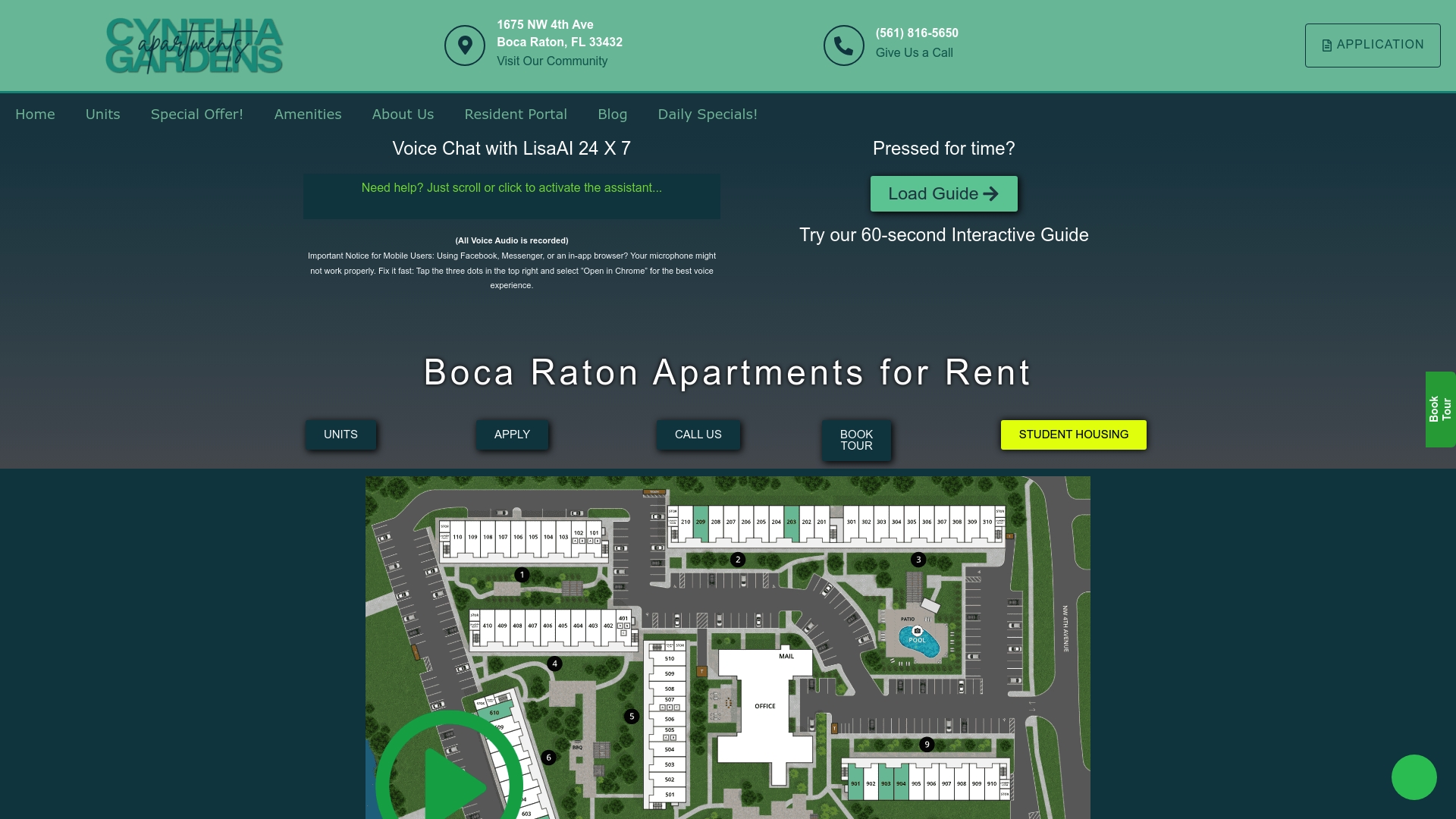
Florida gives landlords wide latitude on pet fees, but Cynthiagardens uses that flexibility to build trust rather than to maximize charges. The community’s leasing process includes virtual tours and an interactive property map so pet owners can assess unit layouts, outdoor spaces, and proximity to green areas before committing. That front-loaded transparency reduces the friction that leads to disputes later.
For residents navigating the pet deposit process in Boca Raton, Cynthiagardens provides guides and checklists that walk pet owners through their rights, the documentation they need at move-in, and what to expect at move-out. The AI chat support answers questions about pet policy in real time, so residents are not left guessing about whether a charge is refundable or what the deposit return timeline looks like.
The community’s modern apartment features include amenities that work for pet owners specifically: outdoor access, well-maintained common areas, and a leasing experience designed to answer questions before they become problems. If you are a pet owner looking for a Boca Raton apartment where the fee structure is clear from the first conversation, Cynthiagardens is worth a look.
Key Takeaways
A compliant 2025 pet fee policy requires correctly labeling each charge, verifying state-specific caps, and updating lease language to reflect HUD’s 2026 enforcement shift on emotional support animals.
| Point | Details |
|---|---|
| Three distinct charge types | Pet deposits ($100–$600, refundable), pet fees ($250–$500, non-refundable), and pet rent ($10–$60/month) each serve a different legal purpose. |
| Label accuracy is legally binding | Courts treat “non-refundable deposit” as a refundable charge; use “pet fee” for any non-refundable amount. |
| HUD’s 2026 ESA shift | Fee waivers for emotional support animals are no longer automatic; each request is evaluated on necessity and reasonableness under ADA-aligned standards. |
| State caps vary widely | California caps total deposits at two months’ rent; Colorado limits pet rent to $35/month; Florida sets no statewide cap. |
| Documentation protects both parties | Move-in photos, signed pet addenda, and itemized deduction statements are the primary evidence in any deposit dispute. |