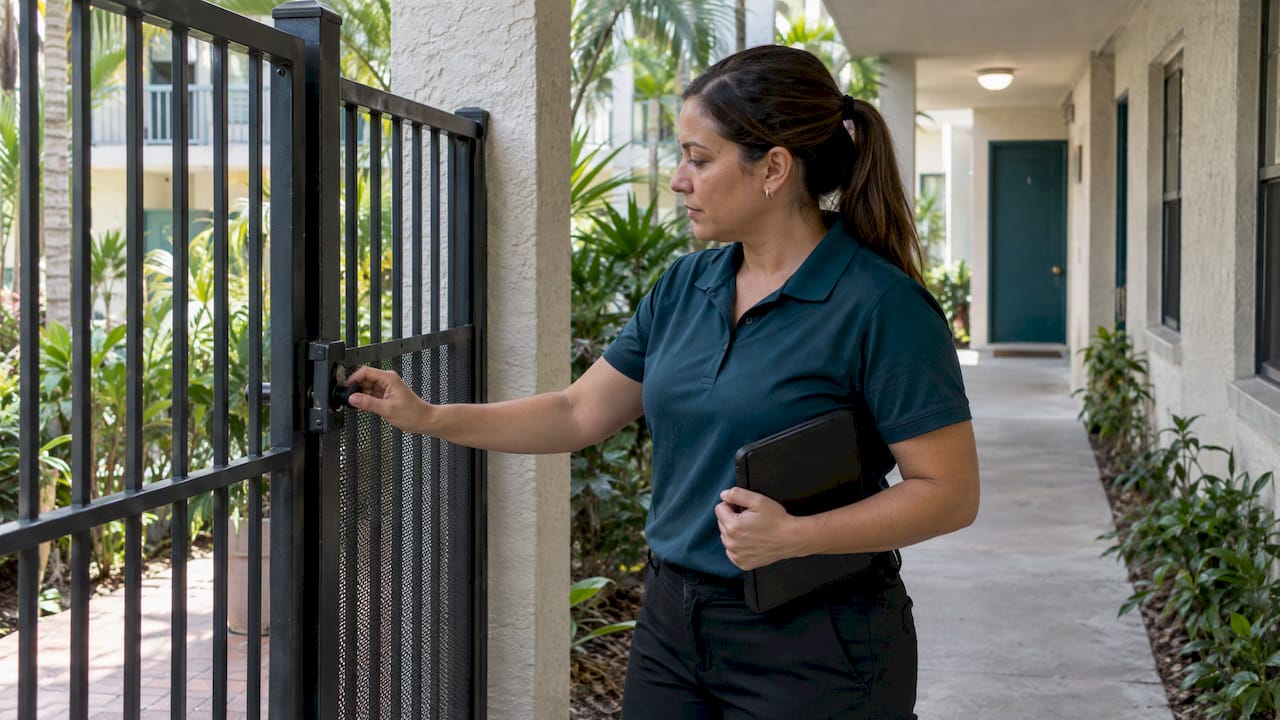
On-site management means a team works at your apartment community every day, so repairs, questions and lease issues go to people who can walk to the problem. For renters, the payoff is faster maintenance, one clear contact, better upkeep and a community that feels looked after. At Cynthia Gardens in Boca Raton, we run our one-bedroom apartments with that in mind, from $1,990 to $2,220 per month, with transparent pricing and no hidden fees.
TL;DR
- On-site managers inspect grounds, take repair requests, resolve complaints and enforce lease terms, so you deal with one local point of contact.
- A 2024 IREM Foundation study of U.S. renters found satisfaction with property management had the greatest impact on overall housing satisfaction.
- Quick responses to service requests are tied to renewals, which is why repair speed is the first thing to check.
- Before you sign, ask about office hours, how repairs are requested, how fast they are answered and what every fee is.
Table of Contents
- What on-site management actually means
- What on-site managers do day to day
- Benefit 1: Repairs get handled faster
- Benefit 2: Clear communication and a real relationship
- Benefit 3: Better upkeep and a safer feeling
- Benefit 4: Fewer surprises with rent, fees and rules
- What to confirm before you sign
- Why it matters in Boca Raton
- Our perspective
- See a one-bedroom at Cynthia Gardens
- FAQ
- Sources
What on-site management actually means
On-site management is a manager or property-level team that handles the day-to-day operations of one community, at that community. The Institute of Real Estate Management (IREM) describes a site manager as responsible for a single property’s daily operations and as the essential link between residents and the property manager. In multifamily housing the role may be called an on-site manager. A “resident manager” is one who lives at the property.
The alternative is a remote or off-site arrangement, where requests go to a call center or a regional office and someone is dispatched later. Both can work, but they feel different when your sink backs up on a Tuesday evening.
What on-site managers do day to day
The U.S. Bureau of Labor Statistics says onsite managers routinely inspect grounds, facilities and equipment, meet with residents to handle repair requests and complaints, show vacant units, enforce lease terms such as rent payment, parking and pet restrictions, and keep income and expense records. IREM adds maintaining the physical plant, handling mechanical and electrical systems, leasing and supervising on-site maintenance staff and contractors.
For a renter, that list translates into five practical things:
- One place to go. NAHMA’s On-Site Insights reports that residents go to the manager for everything, and to maintenance staff only for maintenance problems. You do not need to work out who handles what.
- Someone looking at the property. Regular inspections catch a burned-out walkway light or a sticking gate before it becomes your problem.
- Consistent rule enforcement. Quiet hours, parking and pet rules apply to your neighbors as well as you.
- Records. Rent, requests and lease paperwork stay in one place.
- Leasing help. The same team that shows apartments answers your questions about terms.
Benefit 1: Repairs get handled faster
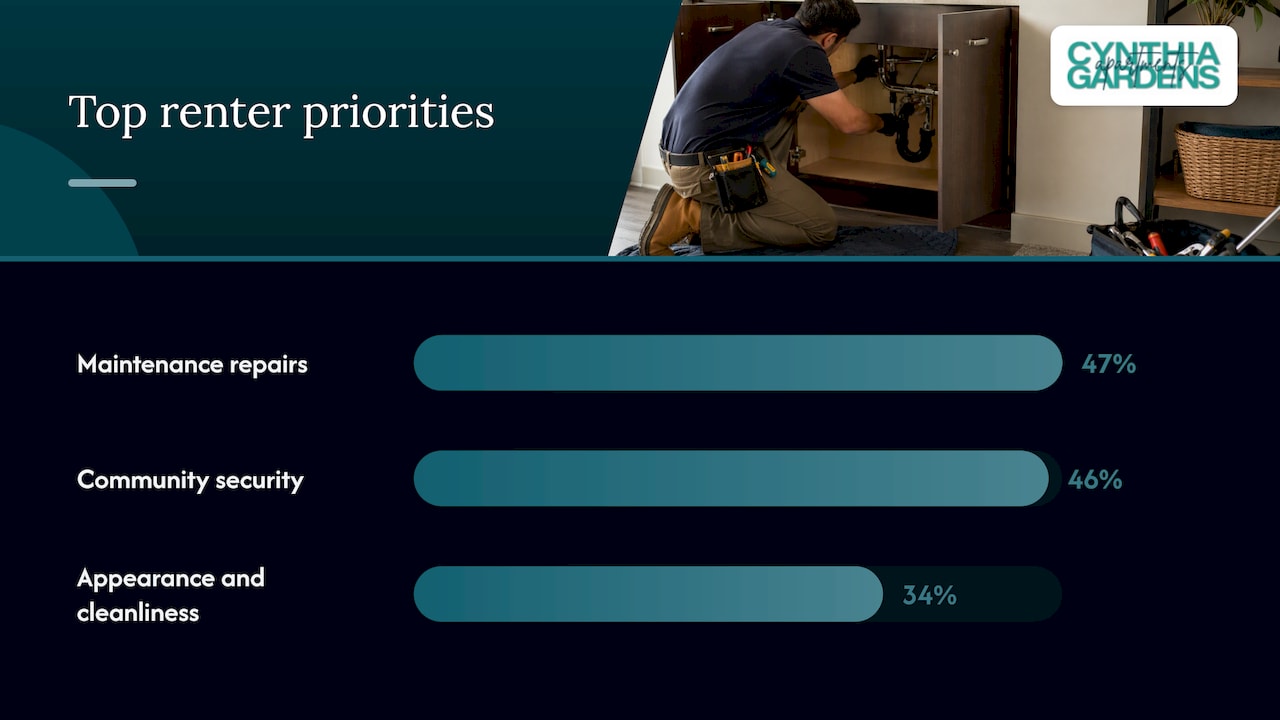
Renters rank maintenance first. Zego’s 2024 Resident Experience Management Report found 47% of renters put maintenance repairs in their top two priorities for their living experience, ahead of community security (46%) and appearance and cleanliness (34%).
Speed shows up in renewal behavior too. A Multi Housing News resident-retention whitepaper, citing Grace Hill data, reports that the share of residents who got service-request responses within 24 hours is 41 percent higher among residents likely to renew. The same paper says maintenance and cleanliness are cited as key problems by more than one-fifth of residents.
For a young professional who works long days, or a graduate student with a thesis deadline, the practical gain is a short, predictable wait. Our positioning is attentive, same-day maintenance, and it is the reason we treat repair response as the core of how we run the community.
What good follow-up looks like
The same whitepaper quotes SatisFacts’ James Watters advising managers to follow up on maintenance requests, for example by telling a resident a part needs to be ordered rather than letting them discover nothing was fixed. As a renter, that is your standard: a request should get an acknowledgment, a time frame and an update if the plan changes.
Benefit 2: Clear communication and a real relationship
Technology gives you 24/7 access to rent payments and maintenance requests, but people still value a face. Inman notes that residents often appreciate calling the manager about a renewal or stopping by the office with an issue, and that managers who go beyond professional services help build a sense of belonging.
The IREM Foundation’s 2024 study of more than 2,000 U.S. rental-housing adults tested how people view different management setups. Renters showed positive, statistically significant preferences for onsite management when judging a manager’s ability to build relationships with residents and address their concerns. They also preferred locally owned and operated management in all five models tested.
That matters for each reader in different ways:
- FAU students and graduate students: lease questions, roommate-free single living and move-in logistics are easier when you can ask a person.
- Young professionals: you want quick answers by chat or phone, and a team that knows your unit.
- Cat owners: a manager who knows your cat’s name and your pet paperwork makes the community feel like home. NAA suggests exactly this kind of personal touch, such as remembering pets’ names, to make residents feel valued.
- Single renters on a budget: fewer miscommunications mean fewer surprise charges.
The daily workload is real. Zego’s report found on-site teams spent an average of 11 hours per month communicating with residents, the most time-consuming task they reported. A community that builds this into its routine, with chat support and clear request channels, spares you from chasing answers.
Contact between staff and residents also shapes how connected people feel. A guide on managing repairs in shared communities makes the same point about direct communication and organized upkeep.
Benefit 3: Better upkeep and a safer feeling
The IREM Foundation found positive, statistically significant relationships between six of the eight management aspects it tested and renters’ quality of life. Promoting safety, building community and engaging residents appeared most important. Satisfaction with property management had the greatest impact on overall housing satisfaction.
Safety does not require a guard booth. Watters, quoted in the Multi Housing News whitepaper, points to low-cost fixes: keyless entry, repaired locks, closed gates and good lighting add up to a safer environment, while 24-hour onsite security is a heavier lift. Those are exactly the things a team that walks the property every day notices.
Florida law sets a floor for upkeep as well. Section 83.51 of the Florida Statutes requires landlords to comply with building, housing and health codes, and for apartments, unless otherwise agreed in writing, to make reasonable provisions for extermination of pests like rats, mice, roaches, ants and bedbugs. On-site staff are the people who turn that obligation into a scheduled visit instead of an argument.
If you want the renter’s side of the process, our guide to apartment maintenance steps for renters and managers walks through reporting an issue and what to expect next.
Benefit 4: Fewer surprises with rent, fees and rules
People will pay for good service. The IREM Foundation study found more than half of respondents would pay some additional monthly rent to ensure satisfactory customer service from the property manager, with an average stated willingness of $27 per month. That is a useful way to think about value: a community with responsive on-site staff can be worth more than a slightly cheaper one where requests disappear.
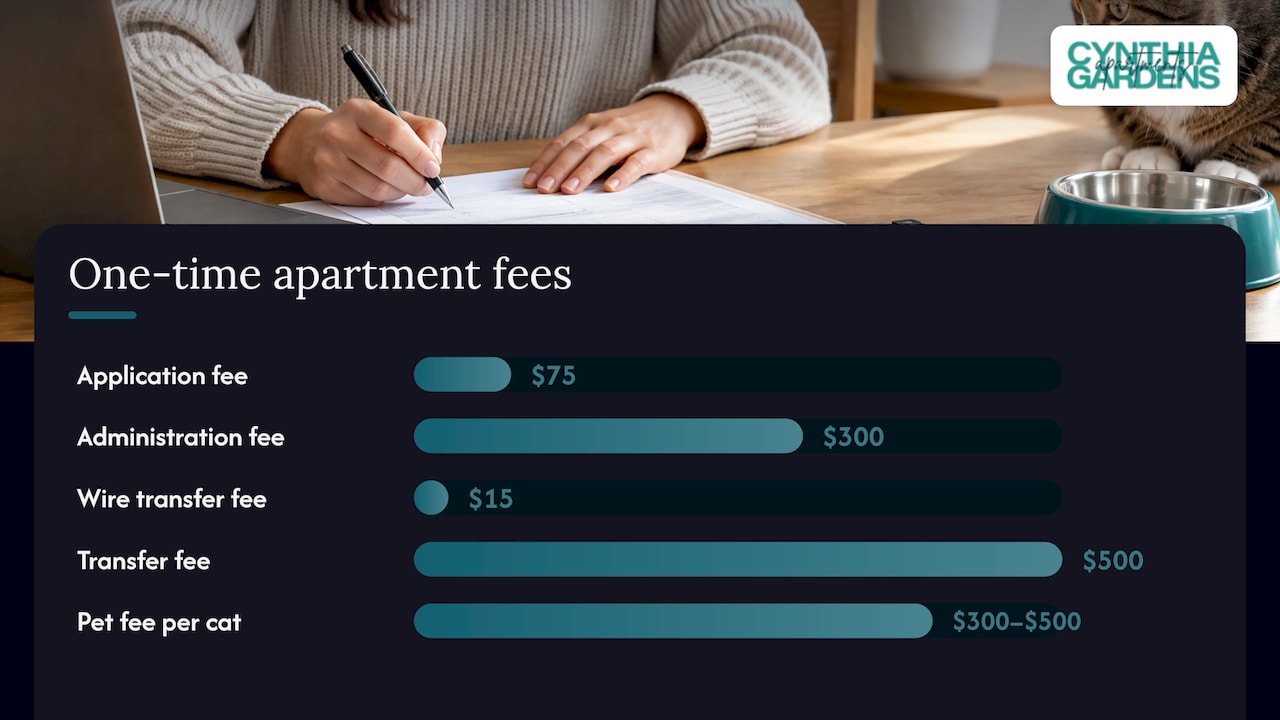
The good news is you should not have to pay extra for it. Here is how to read the cost side of an apartment at Cynthia Gardens, with prices as published on our fees page:
| Item | Amount |
|---|---|
| One-bedroom apartment | $1,990 to $2,220 per month |
| Application fee (non-refundable, per applicant) | $75 one-time |
| Administration fee | $300 one-time |
| Wire transfer fee | $15 one-time |
| Transfer fee | $500 one-time |
| Pet fee (non-refundable, per cat) | $300 to $500 one-time |
There is no ongoing pet rent for cats, only the one-time fee. Having every charge on one page is part of what management does for you: it is the difference between a quoted rent and a real total.
What to confirm before you sign
On-site management is only a benefit if it is available when you need it. Some managers work full time and respond to emergencies off duty, and a live-in resident manager is, as one career guide notes, someone reachable when the office is closed. Before signing anywhere, ask:
- Office hours and after-hours process. Who answers a late-night leak, and how do you reach them?
- How to submit a request. Portal, chat, phone or walk-in? Do you get a confirmation?
- Typical response time. Ask for the standard for urgent and routine repairs.
- Pest and common-area routines. How often are grounds and facilities inspected?
- Every fee, in writing. Application, administration, pet and transfer fees, and whether there is any monthly pet rent.
- Renewal communication. When will you hear about renewal terms?
If you are touring from a distance, a virtual tour lets you see the unit and meet the process before you travel. Our virtual apartment tour benefits page explains what you can see, and online leasing benefits covers signing without a trip to the office.
Why it matters in Boca Raton
Boca Raton renters are often juggling a commute, a class schedule or a pet. A community where people are on site means a package question, a lease change or a noisy-neighbor issue has a person attached to it. Our residents include young professionals, FAU students and cat owners, and we describe our community as quiet, respectful and long established. For more on what shared living looks like day to day, see the benefits of renting in Boca Raton apartment complexes.
Our perspective
We think a lease is a promise about the next twelve months, and management is how that promise gets kept. A renter rarely remembers the day the lease was signed. They remember the day something broke and how long it took to hear back.
That is why we put so much weight on attentive, same-day maintenance, on prices published in full with no hidden fees, and on tools that let you ask a question at 10 p.m. through AI chat or voice assistance, then tour virtually and lease online when you are ready.
For cat owners, we keep it simple: a one-time pet fee and no ongoing pet rent. For students and young professionals, we keep the community quiet and respectful, because home is where you recover from the rest of your day.
Ayman
See a one-bedroom at Cynthia Gardens
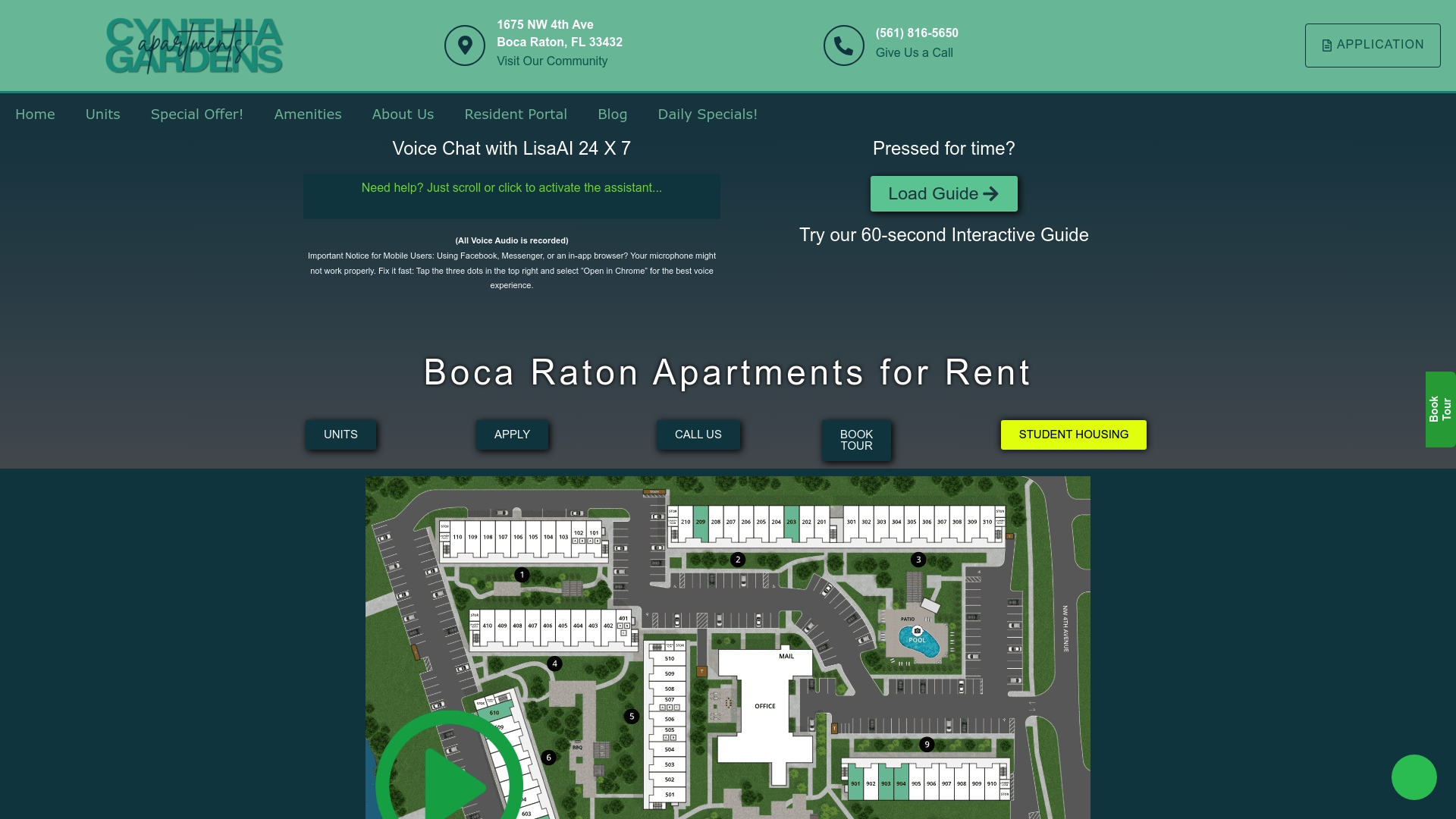
If the points above match what you want from a home, our one-bedroom apartments in Boca Raton run from $1,990 to $2,220 per month. They are pet-friendly, with short- or long-term furnished options available, plus virtual tours, an interactive property map and online leasing. Browse the one-bedroom apartments and pick your unit.
If you would like to compare options first, our pet-friendly one-bedroom apartments page covers the cat-owner details.
FAQ
What are the main benefits of on-site management for renters?
You get one local point of contact for repairs, complaints and lease questions. Staff inspect grounds and facilities, enforce community rules and keep your records in one place. The 2024 IREM Foundation study found satisfaction with property management had the greatest impact on overall housing satisfaction.
Does on-site management mean someone lives at the property?
Not necessarily. IREM uses “on-site manager” for the person or team that runs a single property day to day, and “resident manager” for one who lives there. Ask any community which arrangement it has and what the after-hours process is.
How fast should a maintenance request be handled?
Response within 24 hours is linked to renewal in Grace Hill data cited by Multi Housing News. Urgent problems such as leaks or no cooling deserve faster action. We aim for attentive same-day maintenance at Cynthia Gardens.
What does a cat owner pay at Cynthia Gardens?
The pet fee is a non-refundable one-time charge of $300 to $500 per cat. There is no ongoing pet rent. Full fee details are on our fees page.
Sources
- Site Manager, IREM
- Property, Real Estate, and Community Association Managers, U.S. Bureau of Labor Statistics
- On-Site Insights, Summer 2025, NAHMA
- Resident Retention: Strategies for Success, Multi Housing News, Fall 2026
- Resident Experience Management Report, 2024
- Renters’ Perceptions of Residential Property Management, IREM Foundation, 2024
- Why Onsite Management Will Remain Essential to Multifamily, Inman, 2024
- Florida Statutes, section 83.51
- What Is a Resident Manager? Live-In Apartment Manager
- Consejos para administrar reparaciones en comunidades