Table of Contents
- Can You Really Live in Boca Raton Without a Car?
- Boca Raton Public Transportation Options
- Walk Score Boca Raton: Walkability by Neighborhood
- Bike Score Boca Raton: Cycling Infrastructure and Trails
- Cost of Living in Boca Raton Without a Car
- Practical Tips for Living Car-Free in Boca Raton
- Environmental and Health Benefits of Car-Free Living
- Future Developments in Boca Raton’s Transportation
Living Without a Car in Boca Raton: A Practical Guide
Last Updated: July 17, 2026
Can You Really Live in Boca Raton Without a Car?
Yes, car-free living is feasible in Boca Raton, but it requires strategic neighborhood selection, familiarity with public transportation, and willingness to bike and walk. While the city developed as car-dependent, recent investments in Brightline commuter rail and expanded shuttle services have created genuine alternatives. Feasibility depends heavily on your neighborhood, commute destination, and lifestyle needs.
The Car-Centric Reality
Boca Raton developed primarily as a car-dependent community with wide geographic zones and limited pedestrian infrastructure. A grocery store might be 2-3 miles away; your workplace could be 10+ miles distant. However, this is changing incrementally as the city invests in transit-oriented development. Car-free living works today through three converging factors: specific high-density neighborhoods with walkable cores, expanded public transportation networks, and growing rideshare availability.
Where Car-Free Living is Feasible
Car-free living works best in three areas: Downtown Boca Raton and Mizner Park, neighborhoods surrounding FAU’s campus, and areas within walking distance of Brightline and Tri-Rail stations.
Downtown Boca Raton features restaurants, shops, entertainment, and offices concentrated within a walkable 0.5-1 mile radius. Mizner Park, the adjacent mixed-use development, includes residential units, retail, and dining all accessible on foot.
The FAU area attracts students and young professionals who navigate car-free living successfully. The university shuttle system combined with bus routes and walkable neighborhoods creates a functional transit ecosystem.
Areas near Brightline and Tri-Rail stations enable car-free commuting to Miami, Fort Lauderdale, or West Palm Beach, provided your workplace is also near a station at your destination.
Boca Raton Public Transportation Options
Public transportation in Boca Raton has expanded significantly, creating a functional transit ecosystem for car-free residents.
Brightline and Tri-Rail Commuter Rail
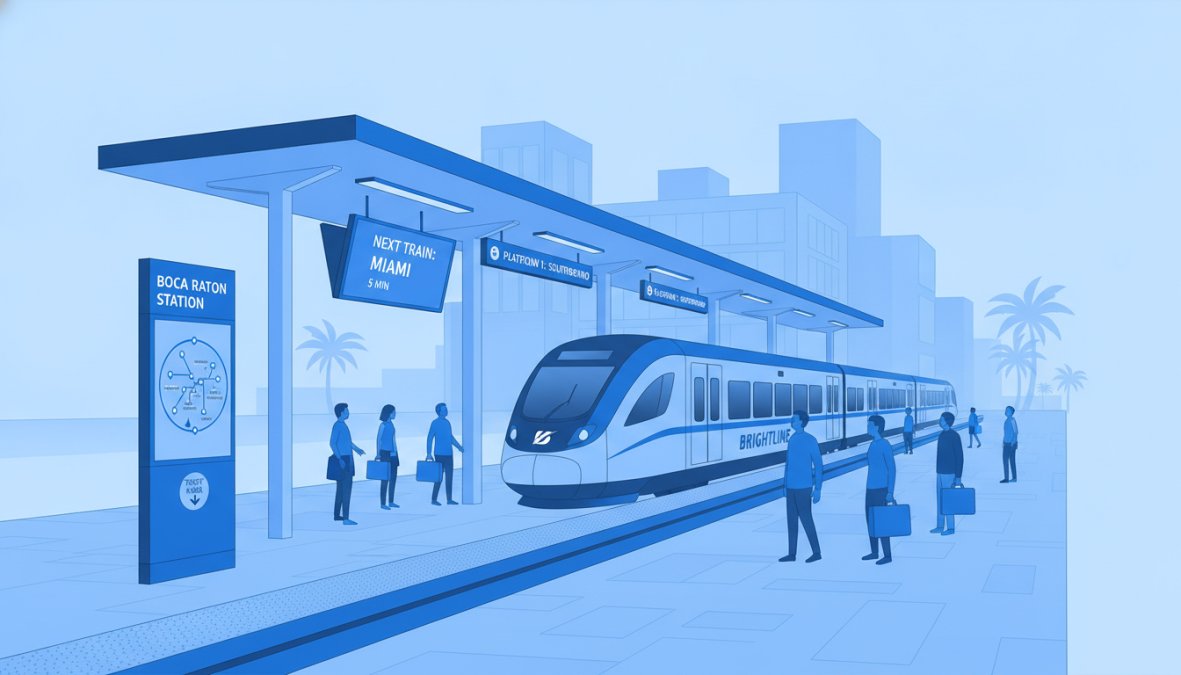
Brightline operates modern, air-conditioned trains connecting downtown Boca Raton to Miami and Fort Lauderdale. Tri-Rail connects via the Yamato Road and Glades Road stations to West Palm Beach, Fort Lauderdale, and Miami. A Brightline monthly pass costs significantly less than vehicle ownership, parking, insurance, and fuel combined. Service runs during peak commute hours (typically 6 AM to 10 PM), though frequency drops during off-peak hours and weekends.
The critical limitation is the first-mile-last-mile problem: getting to the station and from your destination station to your workplace. Biking, walking, rideshare, or employer shuttles solve this challenge.
BocaConnect and Circuit Shuttle Services
BocaConnect is Boca Raton’s free municipal shuttle service connecting residential areas to downtown, shopping centers, parks, and community facilities. Circuit is an on-demand app-based shuttle providing flexible point-to-point service. Together, they handle most local transportation needs without a personal vehicle.
Palm Tran and Broward County Transit
Palm Tran operates bus service throughout Palm Beach County with routes connecting Boca Raton to surrounding communities. Broward County Transit serves Broward County with some routes extending into northern Boca Raton. Buses run every 30-60 minutes, making planned errands feasible though spontaneous trips less convenient.
Living car-free requires combining multiple transit modes: Brightline for commutes, BocaConnect for shopping, bikes for short trips, and occasional rideshare for evening activities.
Walk Score Boca Raton: Walkability by Neighborhood
Downtown Boca Raton and Mizner Park
Downtown Boca Raton scores 78-82 on Walk Score, placing it in the "very walkable" category. Wide sidewalks, mixed-use development, and concentrated retail and dining options allow residents to walk to restaurants, shops, offices, and entertainment. Mizner Park achieves similar walkability scores with residential units above retail and office space.
These areas represent the gold standard for walkability in Boca Raton. The trade-off is higher housing costs, but convenience justifies the expense for many residents.
Other Walkable Communities
Several neighborhoods achieve Walk Scores of 60-75, indicating "somewhat walkable" areas where some errands can be accomplished on foot. Areas near FAU’s campus offer decent walkability combined with university shuttle access and bike-friendly infrastructure. Most residential neighborhoods score below 50, indicating car dependency.
Bike Score Boca Raton: Cycling Infrastructure and Trails
Popular Bike Trails and Routes
The El Rio Trail runs approximately 2.5 miles along a scenic canal corridor, connecting residential areas to downtown and the beach. Spanish River Park includes a dedicated bike path system with connections to nearby neighborhoods. A1A and Ocean Boulevard include dedicated or shared-use bike lanes in many sections, particularly near the beach.
Biking for Daily Commutes
Biking works well for residents living within 3-5 miles of their destination, particularly along established trails or streets with dedicated bike lanes. The flat terrain and year-round warm weather make Boca Raton ideal for cycling. However, summer afternoon thunderstorms and heat can make biking challenging during certain times of year. Many car-free cyclists maintain a backup transit plan for days when weather makes biking unsafe.
Cost of Living in Boca Raton Without a Car
Transportation Costs and Savings
Vehicle ownership in South Florida costs approximately $8,000-12,000 annually. Living car-free costs roughly $2,000-3,000 annually for comprehensive public transit usage, plus $50-100 monthly for occasional rideshare. This means car-free residents save $5,000-10,000 annually on transportation alone.
Housing costs in walkable neighborhoods run higher than suburban areas, but transportation savings often offset higher housing costs, particularly for professionals earning solid incomes.
Housing and Neighborhood Choices
Strategic housing selection is essential for car-free living. Apartment living in walkable neighborhoods works better than single-family homes in suburban areas. Mixed-use developments like Mizner Park offer the best combination of walkability and amenities. Cynthia Gardens provides modern, maintenance-free living in convenient locations with access to transit and walkable areas, making it ideal for residents seeking car-free or car-light lifestyles.
Renting rather than buying offers flexibility for car-free residents, allowing easier relocation if circumstances change.
Practical Tips for Living Car-Free in Boca Raton
First-Mile-Last-Mile Solutions
Biking to transit stations works well for residents living within 2-3 miles. Most stations include bike racks. Electric bikes ($1,200-2,500) make longer distances comfortable in Boca Raton’s heat.
Rideshare services provide reliable first-mile-last-mile solutions at $5-8 per trip. Employer shuttles solve the last-mile problem for many residents working in Miami and Fort Lauderdale.
Rideshare, Taxi, and On-Demand Services
Uber and Lyft operate throughout Boca Raton, though prices vary by location and time. Budget $50-100 monthly for rideshare if living car-free. On-demand shuttle services like Circuit provide middle-ground options between fixed-route buses and rideshare.
Planning Your Weekly Errands and Shopping
Batch errands into planned outings rather than spontaneous trips. Choose grocery stores and shopping centers accessible by transit or bike. Use delivery services for heavy items. Establish routines around transit schedules rather than fighting them.
Environmental and Health Benefits of Car-Free Living
Personal vehicles produce approximately 4.6 metric tons of CO2 annually. Car-free residents eliminate this environmental impact entirely. Reduced vehicle emissions improve air quality, particularly relevant in South Florida where summer ozone pollution affects respiratory health.
Health benefits accumulate through increased physical activity. Biking and walking for transportation provide daily exercise. Transit commuting is significantly less stressful than driving in traffic, improving mental health. Walking and biking through neighborhoods builds community connection and strengthens social bonds.
Future Developments in Boca Raton’s Transportation
Transit-oriented development projects are transforming areas around Brightline and Tri-Rail stations with new mixed-use developments prioritizing walkability. Brightline expansion into West Palm Beach will improve rail connectivity. BocaConnect expansion includes additional routes and increased frequency. Bike infrastructure improvements continue expanding, making cycling safer for transportation. These developments suggest car-free living in Boca Raton will become increasingly practical by 2030.
Living without a car in Boca Raton is genuinely feasible with strategic neighborhood selection and multi-modal transportation. Downtown Boca Raton, Mizner Park, and areas near transit stations offer the best opportunities. Cynthia Gardens provides spacious one-bedroom apartments with high-end finishes, located near FAU, the beach, and accessible transit options, making it ideal for professionals pursuing car-free or car-light living. Schedule a tour today to experience how our garden-style community supports the effortless Florida lifestyle you’re seeking.
Frequently Asked Questions
What public transportation options are available in Boca Raton?
Boca Raton offers several public transit options including Brightline commuter rail connecting to Miami and Fort Lauderdale, Tri-Rail service via Yamato Road station, BocaConnect on-demand shuttle service, Palm Tran bus system, and Broward County Transit (BCT). Brightline and Tri-Rail provide regional connectivity, while BocaConnect and Palm Tran serve local routes. The Circuit App offers additional on-demand mobility. These services vary in coverage and frequency depending on your neighborhood and destination.
How walkable is Boca Raton for daily living without a car?
Walkability in Boca Raton varies significantly by neighborhood. Downtown Boca Raton and Mizner Park have strong Walk Scores and are highly pedestrian-friendly with shops, restaurants, and services within walking distance. Many gated communities and residential areas are less walkable and car-dependent. Areas near FAU and along Ocean Boulevard offer better walkability. Most of Boca Raton is car-centric overall, but specific neighborhoods provide viable car-free living if you choose your location strategically.
Are there bike-friendly areas and trails in Boca Raton?
Yes, Boca Raton has a growing network of bike trails and routes. Popular options include El Rio Trail, Patch Reef Trail, and paths through Green Cay Nature Center, Spanish River Park, and Gumbo Limbo Nature Center. These trails offer scenic biking and connect to some neighborhoods and destinations. However, Bike Score varies by area, downtown and some residential zones are more bike-friendly than others. Biking is viable for recreation and some commutes, but infrastructure isn't comprehensive across the entire city.
What are the realistic costs of living in Boca Raton without owning a car?
Living car-free in Boca Raton can offer savings on vehicle ownership, insurance, gas, and maintenance, but public transit and alternative services have their own costs. Palm Tran and BCT offer affordable monthly passes, while Brightline and Tri-Rail have commuter fares. BocaConnect and rideshare services add occasional expenses. Housing costs in walkable neighborhoods like Downtown Boca Raton or near transit hubs may be higher. Overall savings depend on your location, lifestyle, and frequency of alternative transportation use. Budget for transit passes, occasional rideshare, and potentially higher rent in accessible areas.
Can you live car-free in a gated community in Boca Raton?
Most gated communities in Boca Raton are car-centric and designed for vehicle access, making car-free living challenging. These communities often lack walkable amenities and may have limited public transit access. However, some gated communities closer to Downtown Boca Raton or transit corridors may be more feasible. It's essential to evaluate proximity to BocaConnect, Palm Tran routes, and services before committing. If car-free living is a priority, non-gated neighborhoods with higher Walk Scores and transit access are typically better choices than traditional gated communities.