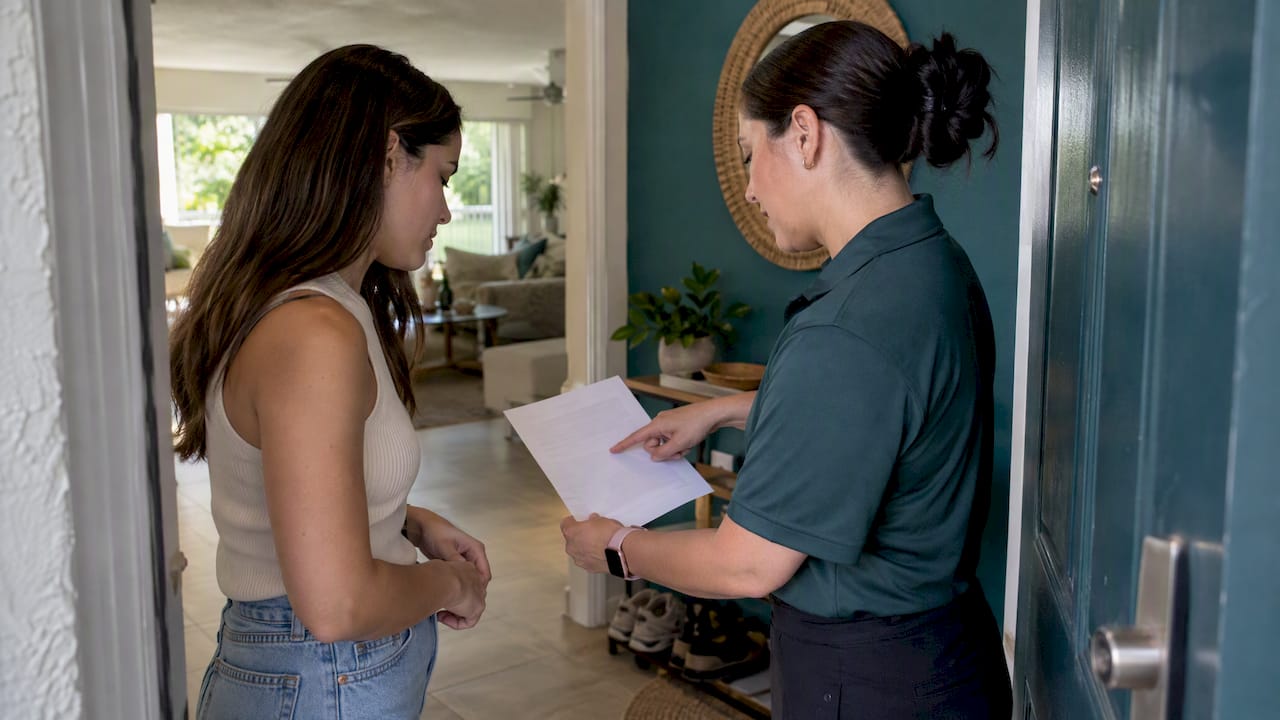
Under Florida law, a landlord generally must give reasonable notice before entering a rental unit. For repairs, that means at least 24 hours’ notice and entry only between 7:30 a.m. and 8:00 p.m. Exceptions exist for emergencies, protecting the property, tenant consent, and extended tenant absence. Written delivery and good records matter, and the core rule comes from Florida Statutes §83.53.
TL;DR:
- Landlords must provide at least 24 hours’ written notice for repairs and other non-emergency entries, with entry limited to between 7:30 a.m. and 8:00 p.m.
- Emergencies and property preservation situations allow entry without notice, such as in case of flooding, fire, gas leaks, or to prevent serious damage.
- Proper documentation of notices and entry times, including timestamps and delivery method, significantly strengthens a landlord’s legal position in disputes.
- Repeated refusal to allow entry can constitute material noncompliance, resulting in potential notice to cure or eviction proceedings under Florida law.
- Starting October 2026, unauthorized entry through deception will be a criminal offense with additional legal consequences for landlords.
Table of Contents
- What Florida Statute §83.53 actually says
- When no notice is required: emergencies and preservation
- How much notice counts as reasonable
- Delivering and documenting an entry notice
- What happens if a tenant refuses access
- A ready-to-use entry notice template
- A property manager’s take on avoiding entry disputes
- FAQ
- Sources
What Florida Statute §83.53 actually says
Section 83.53 lets a landlord enter a rental unit to inspect the premises, make repairs or improvements, supply agreed services, or show the unit to prospective tenants, buyers, workers, or contractors. The statute does not require notice for every single entry, but it sets a clear floor for the most common reason landlords show up unannounced: repairs.
For repair-related entry, the law defines “reasonable notice” as at least 24 hours and “reasonable time” as between 7:30 a.m. and 8:00 p.m. Those two phrases get used loosely in lease templates and online guides, but the statute ties them specifically to repair access. Outside of repairs, the law still expects notice that is reasonable given the purpose and circumstances, even though it does not pin an exact hour count to showings or inspections.
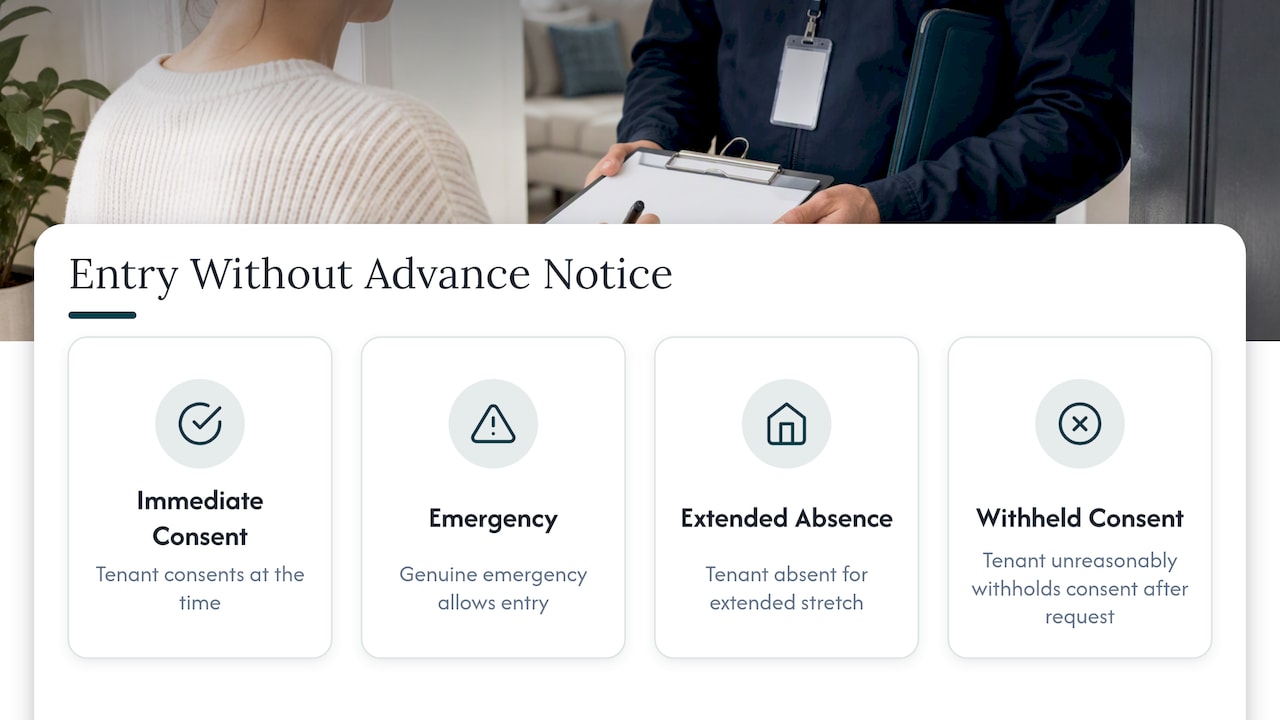
Beyond the 24-hour repair rule, §83.53 allows entry without advance notice when the tenant consents at the time, during a genuine emergency, when the tenant has been absent for an extended stretch, or when the tenant unreasonably withholds consent after a proper request. Each of those grounds carries its own limits, which is where most disputes actually start.
When no notice is required: emergencies and preservation
A true emergency, a burst pipe flooding the unit below, a gas leak, a fire, lets a landlord enter without any advance notice at all. The same goes for entry needed to prevent serious damage to the property, sometimes called the “protection or preservation” ground. These exceptions exist because waiting 24 hours in those situations would make the notice requirement pointless, and in some cases dangerous.
- A true emergency: active flooding, fire, gas odor, or a structural failure threatening the unit.
- Preservation entry: stopping damage already in progress, such as shutting off water after a pipe bursts.
- Not an emergency: a routine appliance repair, a scheduled inspection, or a maintenance request that can wait a day.
- The absence exception: if a tenant is away for an extended period and rent is current, entry is generally limited to situations involving consent or preservation of the unit, not a free pass to enter for any reason.
Pro Tip: Log the date, time, and specific trigger for every no-notice entry; “emergency” claims hold up far better with a timestamped record than a memory.
How much notice counts as reasonable
The 24-hour figure in §83.53 is a statutory minimum for repair access, not a blanket rule that covers every reason a landlord might want in. Showings, routine inspections, and pest control visits still need notice that is reasonable for the circumstances, and many landlords use 24 hours as a practical floor across the board because it is easy to apply consistently and hard to challenge.
“Reasonable time” is defined for repairs as 7:30 a.m. to 8:00 p.m., and most property managers extend that same window to other entry types as a matter of courtesy and consistency. A lease can also set out mutually agreed terms, such as a standing Tuesday maintenance window, as long as those terms do not undercut the statutory floor.
- Repair visit: 24-hour written notice, entry scheduled between 7:30 a.m. and 8:00 p.m.
- Prospective tenant showing: reasonable notice, typically 24 hours, during normal daytime hours.
- Annual inspection: advance notice with a specific date and arrival window, not just a vague “sometime this week.”
Delivering and documenting an entry notice
FDACS guidance confirms that entry notices should be in writing and can be delivered by hand, mail, or email, with email only valid when the lease includes the signed addendum required under §83.505 and a current email address on file. Each delivery method carries tradeoffs: hand delivery is fast but needs a witness or signed acknowledgment, mail is well documented but slow, and email is convenient but legally dependent on that signed addendum being in place.
- State the purpose of entry (repair, inspection, showing) in plain language.
- Include the date and an approximate arrival window, not just “today” or “this week.”
- Name who will be present, whether that is a maintenance tech, a leasing agent, or a contractor.
- Deliver through a method the lease recognizes, and keep proof: a certified mail receipt, a signed hand-delivery log, or an email confirmation with a timestamp.
- File the notice and the proof of delivery together in the tenant’s record, whether on paper or in property management software.
Pro Tip: Treat every entry notice as evidence you might need later. A one-line email with a timestamp is worth more than a verbal heads-up at the door.
What happens if a tenant refuses access
A landlord cannot force entry or physically remove a tenant’s belongings to gain access; eviction and possession disputes go through the courts, not through self-help. If a tenant repeatedly denies reasonable, properly noticed entry, that can count as material noncompliance under §83.56, which governs termination and cure notices.
- A 7-day notice to cure typically applies to a correctable lease violation, such as repeatedly refusing lawful entry.
- Rent-related notices follow their own timelines under the same statute and require delivery by mail, hand, or email per §83.505.
- Starting October 1, 2026, CS/HB 1293 creates a fraudulent-entry offense and a related termination ground, reinforcing that landlords cannot sidestep proper eviction procedure by treating entry disputes as a shortcut to possession.
- Both sides benefit from documenting the dispute in writing immediately, including dates, notices sent, and any tenant responses, before escalating toward a cure notice or eviction filing.
Landlords working through a lease violation or early termination should also understand the broader notice and cure periods involved in ending a lease, since entry disputes often surface alongside other compliance issues.
A ready-to-use entry notice template
A short, neutral notice tends to generate fewer disputes than a vague one. Keep the language factual and include a line offering to reschedule if the timing does not work.
NOTICE OF INTENT TO ENTER
Date of notice: [date]
Property address and unit: [address]
Purpose of entry: [repair / inspection / showing]
Scheduled date: [date]
Arrival window: [between 7:30 a.m. and 8:00 p.m., per Florida law]
Who will attend: [maintenance staff, contractor, agent]
Delivery method: [hand delivery / mail / email per signed addendum]
Contact for rescheduling: [phone or email]
- Adjust the purpose line for repairs versus showings versus routine inspections, since each may call for a different tone.
- Keep a signed or timestamped copy of every notice sent, regardless of delivery method.
- Log the tenant’s response, if any, in the same file.
FDACS highlights sample letters and record retention because, as the agency’s consumer guidance notes, entry notice disputes are mostly proof disputes: whoever has the clearer paper trail tends to win the argument.
A property manager’s take on avoiding entry disputes
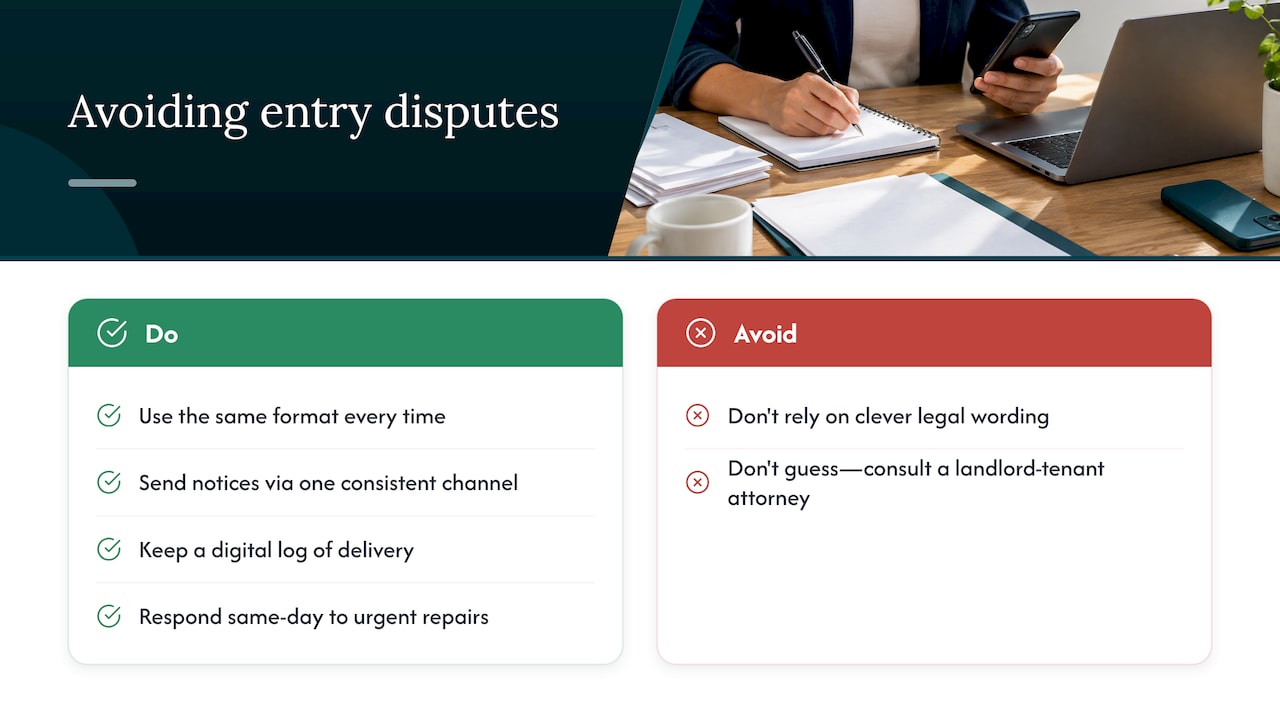
In daily operations, the notices that cause the fewest problems are the boring ones: same format every time, sent through a consistent channel, with a clear purpose and arrival window spelled out. At Cynthia Gardens, we send repair and inspection notices through the same written channel every time and keep a digital log of delivery, because consistency removes most of the ambiguity that turns a routine visit into a dispute. Same-day response to urgent maintenance requests also cuts down on the gray-area cases where a landlord might be tempted to treat a non-emergency as one.
Clear communication beats clever legal language every time a notice gets challenged. When a situation is genuinely ambiguous, such as a tenant disputing an absence-based entry or a repeated refusal that might justify a cure notice, it is worth getting advice from a landlord-tenant attorney rather than guessing.
— Ayman
This article is general information, not a substitute for advice from a qualified lawyer. Consult a qualified legal professional about your own circumstances before acting on anything here.
FAQ
What is a reasonable notice for landlords to enter in Florida?
For repairs, Florida law sets reasonable notice at a minimum of 24 hours, with entry limited to between 7:30 a.m. and 8:00 p.m., under §83.53. Many landlords apply that same 24-hour standard to showings and inspections as a consistent practice, even though the statute’s exact wording targets repair access.
Can my landlord show up unannounced in Florida?
Generally no, except in a genuine emergency, to prevent serious damage to the property, with the tenant’s consent at the time, or in limited absence situations. Outside those exceptions, a landlord is expected to provide reasonable written notice before entering.
Can a landlord evict without notice in Florida?
No. Eviction is a court process, and a landlord must follow statutory termination and cure procedures under §83.56, which typically require a written notice period before filing. Self-help removal, such as changing locks or forcibly entering, is not a lawful substitute for the eviction process.
What are the new rental laws in Florida in 2026?
Starting October 1, 2026, CS/HB 1293 creates a fraudulent-entry offense and an associated termination ground, adding consequences for landlords or others who gain entry to a dwelling through deception. The law reinforces that possession disputes must go through proper statutory and court procedures rather than informal entry tactics.
Does email count as valid delivery for an entry notice?
Yes, but only when the lease includes the signed email addendum required under §83.505 and the landlord has a valid, current email address for the tenant. Without that addendum in place, hand delivery or mail remains the safer, more defensible option.
Sources
The clearest starting point is the statutory text itself: §83.53 covers permitted entry purposes, the 24-hour repair rule, and the exceptions for emergency, consent, and absence, while §83.56 lays out termination and cure notice procedures for noncompliance and rent default.
FDACS landlord-tenant guidance walks through notice delivery rules in plain language and offers sample letters that landlords can adapt. For the 2026 legislative change affecting fraudulent entry, the CS/HB 1293 bill summary explains the new offense and termination ground in detail. Landlords carrying risk on a rental property may also want to review landlord insurance options that address liability tied to property access and emergency entry situations.
- Chapter 83 Section 53 – 2026 Florida Statutes – The Florida Senate
- Landlord/Tenant Law in Florida – Florida Department of Agriculture & Consumer Services
- CS/HB 1293 — Fraudulent Entry of Residential Dwellings (2026) – Florida House