
A service animal under federal law is a dog, or in rare cases a miniature horse, trained to perform a specific task tied to someone’s disability, and it carries public-access rights under the ADA. An emotional support animal offers comfort through its presence alone, not trained tasks, and it doesn’t get those same public-access protections. Housing and air travel follow separate rules, and both got a significant update heading into 2026.
TL;DR:
- HUD’s 2026 guidance emphasizes proof of training and specific tasks over letters alone when considering emotional support animal accommodation requests.
- Only trained dogs and miniature horses (in rare cases) qualify as service animals under the ADA, while ESAs include a broader range of animals that provide comfort.
- Public places and airlines can only ask limited questions about an animal’s necessity or trained tasks, and cannot demand documentation or demonstrations.
- Landlords must evaluate requests based on actual conduct and training evidence, and cannot charge pet fees for legally recognized service animals or ESAs.
- Genuine disability-related needs and trained tasks are now the key factors, making superficial ESA letters less effective in securing accommodations.
Table of Contents
- ESA vs Service Animal: The Core Legal Difference
- Where the Law Actually Applies: Public Places, Housing, and Flights
- Trained Task or Comfort? Real Examples That Settle It
- How to Request an Accommodation as a Tenant
- What Landlords and Businesses Can Actually Ask
- How Cynthiagardens Handles Pet and ESA Requests
- Where to Read the Primary Sources
- Why the ESA Conversation Keeps Getting Misread
- Sources
ESA vs Service Animal: The Core Legal Difference
The distinction comes down to one question: does the animal do a job, or does it just make someone feel better? That sounds almost too simple, but it’s the exact test federal agencies use, and it’s why the difference between an ESA and a service animal trips up so many renters, employers, and business owners.
A service animal is legally defined as a dog individually trained to do work or perform a task directly related to a person’s disability. Guiding someone who is blind, alerting a diabetic to a blood sugar crash, interrupting a panic attack, these are tasks. Miniature horses get a narrow carve-out under the ADA in specific situations, but no other species qualifies for ADA service-animal status, period.
An emotional support animal, by contrast, provides comfort through companionship. No task, no training requirement, no species restriction. A cat, a rabbit, a bearded dragon, all can serve as ESAs in the right context, most commonly housing.
Here’s where each classification actually matters:
- Public accommodations (restaurants, stores, hotels, transit): service animals get access; ESAs generally do not.
- Housing (apartments, condos, co-ops): ESAs can qualify for reasonable accommodation under the Fair Housing Act, alongside service animals.
- Air travel: only trained service animals get the protections defined by the Department of Transportation; ESAs are treated as pets under current airline policy.
- Employment: service animals are typically part of a workplace accommodation conversation; ESAs may or may not be, depending on the employer’s own policy.
That’s the whole picture in miniature. Everything else in this guide is detail layered onto that one framework.
Where the Law Actually Applies: Public Places, Housing, and Flights
Three separate federal frameworks govern service animal laws and emotional support animal regulations, and they don’t overlap as much as people assume. Mixing them up is the single most common mistake renters and business owners make.
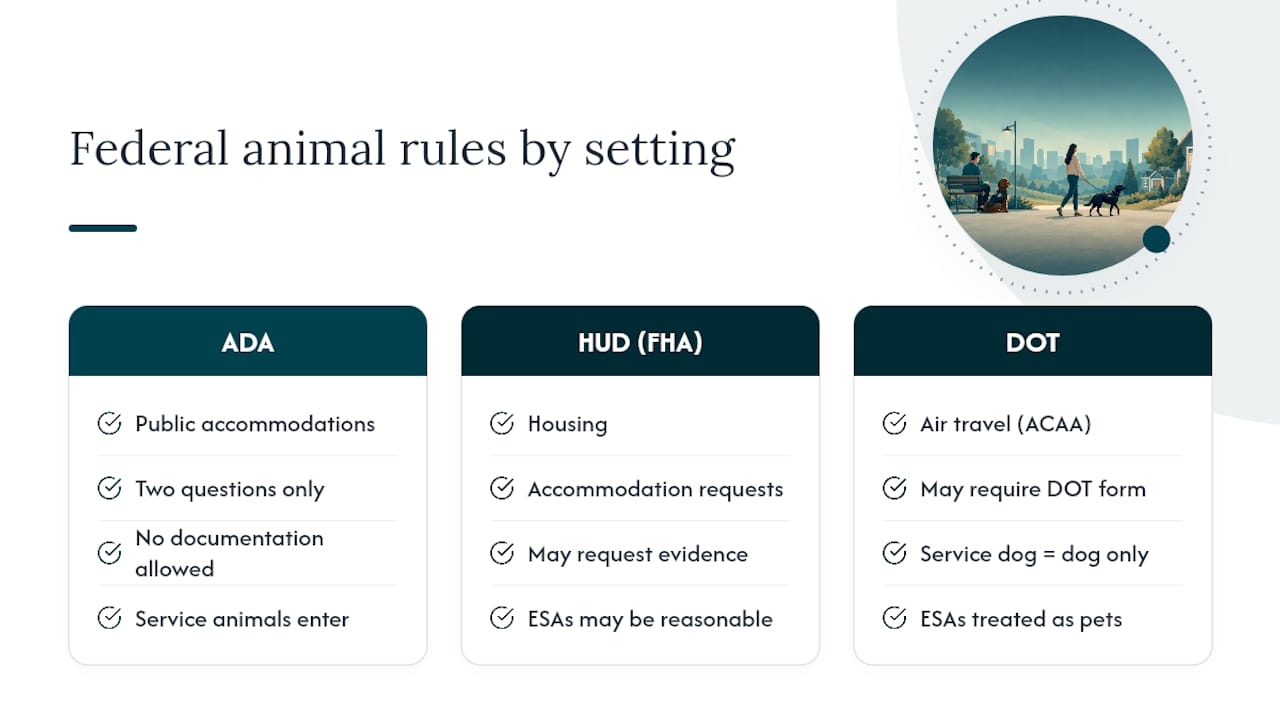
Public accommodations fall under the ADA. A business can ask only two questions when it isn’t obvious an animal is task-trained: is the animal required because of a disability, and what task has it been trained to perform. Staff cannot demand documentation, ask about the person’s diagnosis, or require the animal to demonstrate its task on the spot, according to ADA guidance. ESAs have no equivalent right to enter a restaurant, retail store, or hotel lobby under federal law, even with a letter from a therapist.
Housing falls under the Fair Housing Act, enforced by HUD. This is where ESAs actually have federal standing, but the ground shifted substantially in 2026. HUD’s Office of Fair Housing and Equal Opportunity issued enforcement guidance in May 2026 directing staff to prioritize complaints involving animals trained to provide disability-related assistance. Practically, that means an untrained ESA request is no longer presumptively reasonable the way it was under HUD’s 2020 notice. Landlords now have more room to weigh training and task evidence before approving a request.
The 2026 shift in one sentence: HUD’s own assistance-animal guidance still recognizes ESAs as potentially reasonable accommodations, but enforcement priority has moved toward animals with demonstrable training, a real recalibration from the assumption that any ESA letter guarantees approval.
Air travel falls under the Air Carrier Access Act, regulated by the DOT. Current DOT guidance defines a service animal for flying purposes as a dog, regardless of breed, individually trained to perform work or a task for a person with a disability. Airlines are permitted to require a DOT form attesting to the animal’s training and behavior, and ESAs are booked and treated as pets, often with a pet fee and cargo-hold or carrier restrictions depending on the airline.
Legal commentary on the 2026 HUD memo frames it as an effort to curb an industry built around quick-issue ESA letters sold online with little to no clinical relationship behind them.
Trained Task or Comfort? Real Examples That Settle It
The legal test isn’t about breed, size, or even how well-behaved the animal is. It’s about whether the animal performs a specific, learned action connected to a disability. Here’s what actually counts as a qualifying task versus what signals an ESA.
- Guide work – leading a person who is blind or has low vision around obstacles.
- Medical alerting – signaling a drop in blood sugar or an oncoming seizure before it happens.
- Seizure response – positioning the body to prevent injury or activating a pre-programmed alert device.
- Mobility assistance – retrieving dropped items, opening doors, or providing balance support for someone with a physical disability.
- Psychiatric interruption – physically nudging or pawing to break up a dissociative episode, panic attack, or repetitive self-harming behavior.
Compare that to comfort-only behavior: sitting on a lap during anxiety, sleeping next to someone with depression, being present during a stressful commute. These are genuinely valuable, but they aren’t trained tasks, and legally they place the animal in ESA territory, not service-animal territory.
Edge cases get messier. A psychiatric service dog trained to interrupt a panic attack qualifies as a service animal, even though the underlying disability is invisible, because the animal performs a task. A dog still in training generally does not qualify for full ADA protection, though some states extend partial protections to trainers working with service animals in public. Multiple animals for one person are legally possible but rare, and a business can reasonably ask which animal is doing which task if more than one is present.

Pro Tip: If you’re not sure whether your animal’s behavior counts as a task, ask yourself if you could describe it in one sentence starting with an action verb: “alerts,” “retrieves,” “guides,” “interrupts.” If the honest answer is “comforts” or “calms,” you’re describing an ESA, not a service animal.
How to Request an Accommodation as a Tenant
Getting an ESA or service animal approved in a rental comes down to timing and clarity. Skip the vague online letter and follow a process that actually holds up.
- Put the request in writing and date it. State that you have a disability (you don’t need to name the diagnosis), describe the animal’s role, and if it’s a trained service animal, list the specific tasks it performs.
- Attach reasonable documentation, not your full medical file. A short note from a licensed clinician describing the disability-related need is typically sufficient. For trained animals, documentation of the training or the trainer’s credentials strengthens the request considerably under the 2026 enforcement standard. Skip the $50 instant-certificate websites; they carry little weight anymore.
- Expect a response within a reasonable window, typically a couple of weeks, though this varies by property. If the provider asks follow-up questions, they’re allowed to under the interactive process; answer them without volunteering more medical detail than necessary.
- If denied, ask for the reasoning in writing. You can escalate through the property’s internal appeal process first, and if that fails, file an intake complaint with HUD, which starts the formal fair housing complaint process.
The properties that handle this well tend to be transparent about their pet policy upfront, so tenants know what documentation to prepare before they ever submit a request.
What Landlords and Businesses Can Actually Ask
Handling an accommodation request correctly protects both the resident’s rights and the business from a fair housing complaint. The rules differ depending on whether you’re running a store or managing an apartment building, so keep the two frameworks separate.
In a public accommodation setting, staff get exactly two questions when a service animal’s role isn’t obvious: is the animal required because of a disability, and what task is it trained to perform. That’s the ceiling. No demanding a certificate, no asking the person to explain their disability, no requiring a demonstration.
In housing, the calculation is broader but still bounded:
- Landlords must consider reasonable accommodation requests for both service animals and ESAs under the FHA.
- Training and task evidence now carries more weight in the request review, following the 2026 HUD guidance.
- A request can be denied if the specific animal poses a direct threat, is out of control despite the resident’s efforts to control it, or isn’t housebroken, but the denial has to be based on the animal’s actual conduct, not assumptions about the breed or species.
- Every decision, approval or denial, should be documented with the reasoning, since that record matters if a complaint gets filed later.
Pro Tip: Never charge a pet deposit or pet rent for a legitimate service animal or ESA. Both are accommodations, not pets, under fair housing law, even though the animal living in the unit might look identical to a regular pet on the lease. A clear breakdown of what’s allowed on the fee side lives in our pet fee checklist.
How Cynthiagardens Handles Pet and ESA Requests
Cynthiagardens built its pet policy around the same principle that runs through federal guidance: clarity upfront prevents disputes later. Every applicant sees pet fees, breed considerations, and accommodation procedures before signing, with no surprise charges layered in after move-in.
For accommodation requests specifically, the leasing team asks for the same lean documentation HUD guidance now favors: a brief note establishing the disability-related need, plus training evidence when the animal is a service animal rather than an ESA. Turnaround times can vary, but the process is more standardized than handled on a case-by-case basis, which can sometimes speed decisions.
The community’s AI chat support and voice assistance let applicants ask policy questions any time, without waiting on office hours, while the virtual tours and interactive property map help pet owners scope out unit layouts and nearby outdoor space before applying. For renters managing a service animal’s mobility needs or an ESA’s routine, seeing the floor plan and grounds in advance genuinely changes the decision. If you’re weighing your options in Boca Raton, Cynthiagardens’ one-bedroom apartments are built around exactly this kind of transparent, pet-inclusive leasing.
Where to Read the Primary Sources
Skip the secondhand summaries when you need something that holds up in a dispute. Start with the ADA’s service animal requirements and the DOJ’s service animal FAQ for public-access rules. For housing, read HUD’s 2026 enforcement memorandum alongside its assistance-animal notice. For flying, check the DOT’s aviation guidance before you book. These are the documents that matter if you ever file a formal complaint.
Why the ESA Conversation Keeps Getting Misread
Most advice on this topic treats “get an ESA letter” as a shortcut, and that’s exactly the assumption the 2026 HUD guidance was built to correct. The letter was never the protection. The disability-related need and, increasingly, the animal’s actual training are what carry weight now. Renters who lean entirely on a same-day online certificate are going to run into more friction this year than they would have three years ago.
What gets underestimated is how much documentation quality matters compared to documentation quantity. A one-page clinician’s note describing a genuine need beats a ten-page packet padded with irrelevant medical history, and it protects the tenant’s privacy better too. Landlords, for their part, tend to overcorrect toward blanket denials out of fear of a Fair Housing complaint, when the actual legal standard just asks for a documented, individualized review.
If you take one thing from this: stop asking “will this letter work?” and start asking “does this animal’s role actually meet the standard for where I’m using it?” That question, asked honestly, resolves most disputes before they start.
— Ayman
This article is general information, not a substitute for advice from a qualified lawyer. Consult a qualified legal professional about your own circumstances before acting on anything here.
Sources
- Ada
- Enforcement guidance — Assessing requests for the use of an animal as a reasonable accommodation under the Fair Housing Act (FHEO, May 22, 2026) — HUD
- Service animals — U.S. Department of Transportation (Aviation consumer protection)