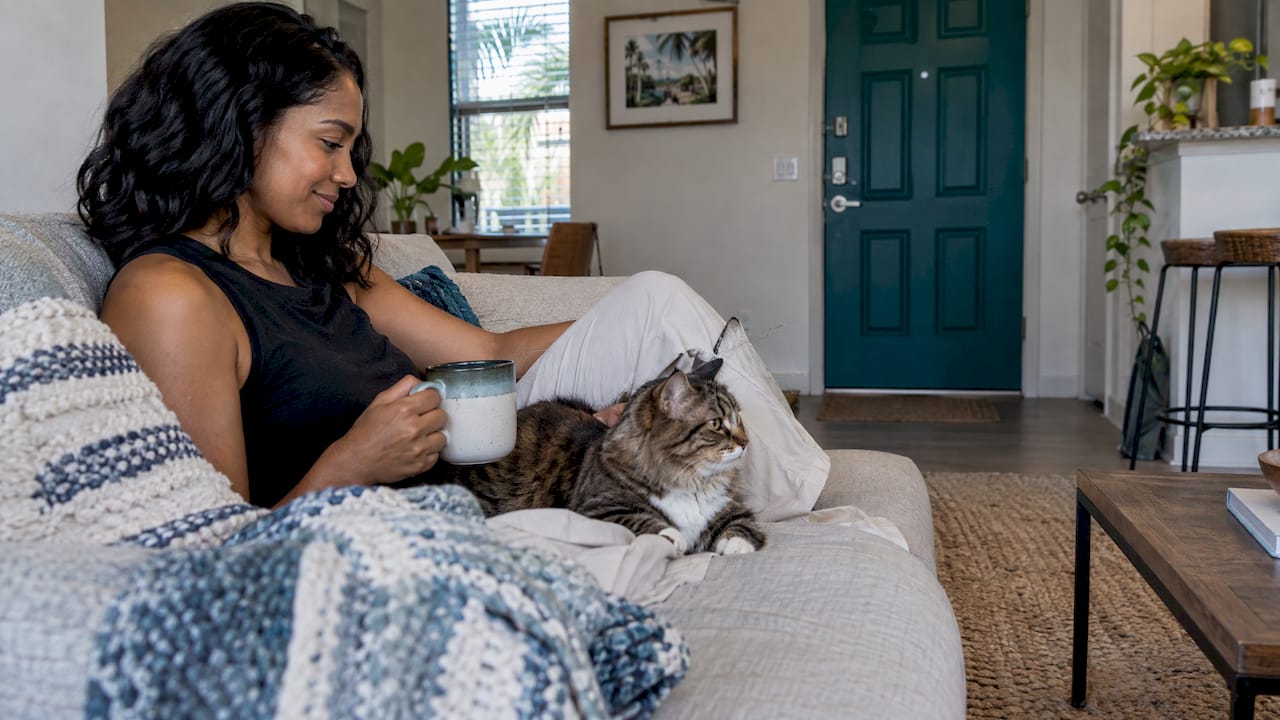
You can rent an apartment and live with a cat when you have a cat allergy, but the apartment matters as much as the cat. Cat allergen is a sticky protein that spreads through the air and settles into carpet and upholstery, so a small one-bedroom with easy-to-clean surfaces, a clear layout and a cat-friendly lease is the best starting point. At Cynthia Gardens in Boca Raton, one-bedroom apartments run $1,990 to $2,220 per month, cats are welcome, and there is no ongoing pet rent, only a one-time fee. You can see the one-bedroom apartments and tour them online before you decide.
TL;DR
- Cat allergen is a protein from saliva, skin and dander. It stays airborne, travels on clothing and lingers in carpet and furniture for months, which is why a small apartment can feel worse than a house.
- Combine measures: a HEPA air cleaner, a bedroom the cat does not enter, weekly washing of bedding, hard surfaces you can wipe, and regular vacuuming with a HEPA vacuum. No single step does the job alone.
- Surfaces decide most of the work. Sofas and carpet hold the most allergen, so look at floors and layout before you sign.
- Persistent symptoms belong with an allergist, who can discuss medication and allergy shots (immunotherapy).
- Our cat policy is a one-time pet fee of $300 to $500 per cat, with no monthly pet rent.
Table of Contents
- Why cat allergy feels stronger in an apartment
- Choose the apartment before you choose the routine
- The routine that lowers allergen levels
- Air filters: what to look for
- What to expect from cleaning
- When allergy symptoms need an allergist
- Our view
- The cost of a cat-friendly one-bedroom
- See a cat-friendly one-bedroom in Boca Raton
- FAQ
- Sources
Why cat allergy feels stronger in an apartment
The National Institute of Environmental Health Sciences explains that cat allergens are proteins found in saliva, skin glands, dander and male-cat urine. They are light enough to stay airborne, circulate through a room, and stay on carpets and furniture for months. They also ride on clothing into places where no pet has ever been.
The main one is called Fel d 1. In a small space, there is simply less air and less surface area to dilute it. A study of British homes found that two days after a cat was removed, 73% of the airborne Fel d 1 was on small particles that stay suspended and reach deep into the airways. The allergen is also nearly everywhere: a review reports it in 99.9% of 831 U.S. homes, though only 49.1% of them had a dog or cat.
What that means for you: the goal is not a spotless apartment, it is lowering the total load of allergen in the rooms where you spend the most time, especially the bedroom, where you spend about a third of your life.
Choose the apartment before you choose the routine
Most advice online starts with cleaning. For a renter, the smarter first move is picking a unit that makes cleaning easier, because you usually cannot rip out carpet or replace a sofa that your landlord owns.
Floors and soft surfaces
The AAFA’s Ask the Allergist service advises replacing old carpets with hard flooring where possible. A 2025 review found that sofas had the highest Fel d 1 levels in homes, because cloth upholstery is hard to clean and cats keep reintroducing allergen. The same review reports that removing all carpets and furniture lowered Fel d 1 faster than routine vacuuming and steam cleaning, and that tightly woven or nonwoven synthetic covers can block it while still allowing airflow.
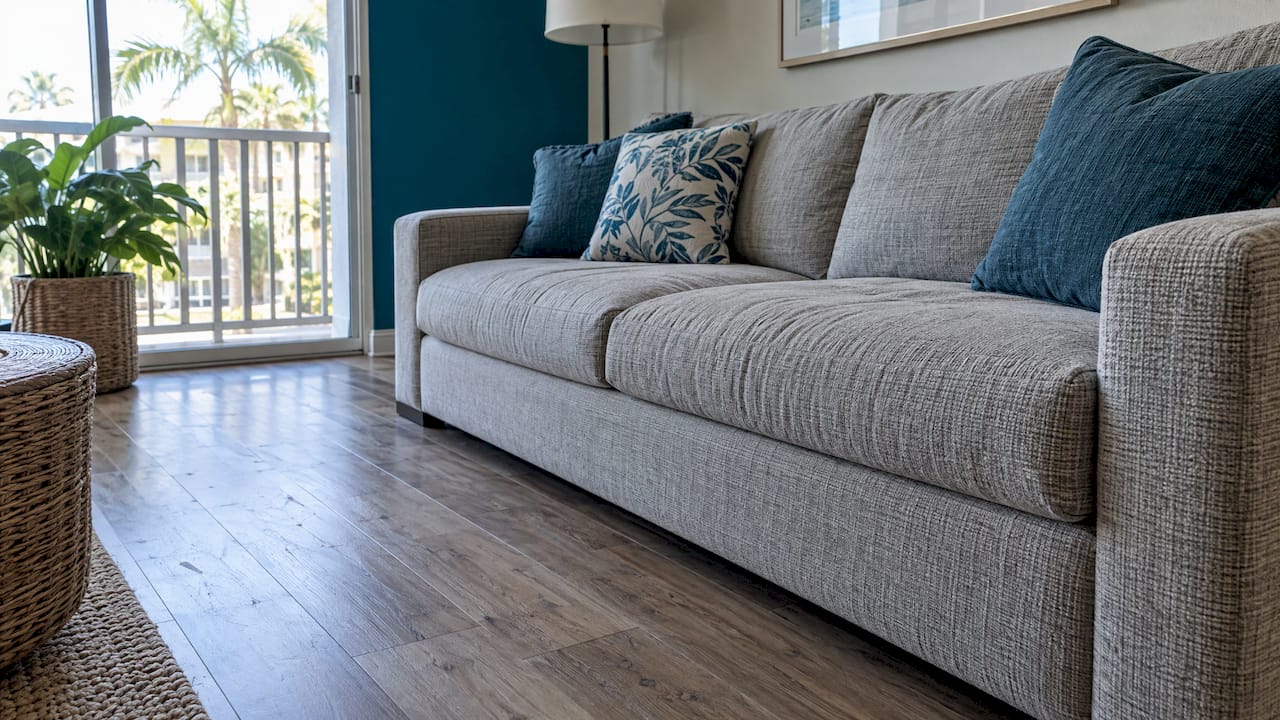
So when you shop, ask what the floor is made of, and plan on a sofa with a removable, washable or tightly woven cover. Our guide to flooring differences for pet apartments explains how each surface behaves with a cat in the home.
Layout
A one-bedroom gives you a natural split: a bedroom with a door you can close and a living area where the cat spends its day. A clear floor plan helps you decide where the litter box, the cat tree and your bed will go before you move in. Our overview of apartment floor plans for cats walks through the options.
Tour first, from your couch
We offer fully digital property tours and an interactive property map, so you can look at the floor, the layout and the bedroom door from home, and compare units without driving across Boca Raton between allergy flare-ups. Read how virtual tours help you choose before you commit.
The routine that lowers allergen levels
The American College of Allergy, Asthma and Immunology (ACAAI) and NIEHS agree on a core set of habits. A 2024 review found that the main measures lower cat allergen levels but take sustained effort. Here is the version that fits a one-bedroom.
- Keep the bedroom as the quiet zone. Close the door and keep the cat out. ACAAI notes that confining a cat to one room does not contain allergen, so think of the bedroom as the room you protect, not the only room the cat avoids. The 2025 review adds that excluding the cat from the bedroom works best together with other measures such as HEPA filtration.
- Run a HEPA air cleaner. ACAAI recommends running one continuously in the bedroom or living room. Avoid ionic air cleaners that generate ozone, which NIEHS warns against.
- Cover the bed. Allergen-proof covers on the mattress and pillows keep allergen that has already settled from reaching your face.
- Wash bedding weekly in hot water. Banner Health also suggests washing blankets and pet bedding weekly.
- Vacuum with the right machine. Use a vacuum with a HEPA filter or a double-layered microfilter bag, and ideally have someone else do it, or leave the room for a while afterward. NIEHS says to vacuum when the allergic person is not present.
- Wipe, do not dry-dust. Damp cloths lift allergen instead of moving it around. The AAAAI practice parameter also notes that a sticky dust cloth removes Fel d 1 from surfaces.
- Keep the cat off the furniture and wash your hands. After petting, wash your hands and change clothes if you can. ACAAI also advises against hugging or kissing the cat.
- Brush the cat away from where you sit. CVS’s health guidance suggests brushing pets in a closed-off area, away from allergic people.
For day-to-day cat-proofing that also protects your deposit, our renter-safe cat-proofing steps cover the rest of the home.
Bathing the cat
ACAAI recommends bathing the cat at least once a week to reduce airborne allergen. A 1997 study found that washing cats by immersion for three minutes weekly lowered airborne allergen by a mean of 79% over a month. Many cats dislike baths, so start early, keep it short and use a gentle routine. If a full bath is not possible, banner and ACAAI-style advice on wiping with a damp cloth is a lighter option, and your vet can show you the safest way for your cat.
A realistic weekly schedule
| Task | How often | Why it matters |
|---|---|---|
| Wash bedding and blankets in hot water | Weekly | Removes allergen where you sleep |
| Wash pet bedding | Weekly | Keeps the cat’s resting spots from refilling the air |
| Vacuum floors and furniture with a HEPA vacuum | At least weekly | Banner Health suggests two to three times a week for carpet |
| Damp-wipe hard surfaces | Several times a week | Lifts dander instead of stirring it |
| Bathe or wipe the cat | Weekly, as your cat tolerates | Lowers airborne allergen |
| Check air cleaner and HVAC filters | As the maker recommends | A clogged filter stops working |
Air filters: what to look for
Air filtration is the single step with the strongest case. A 2024 review reports that ASHRAE recommends MERV 10 or higher for pet dander. Modeling found that filters rated MERV 12 or higher remove over 70% of Fel d 1 and cut indoor concentrations by more than 50%, and MERV 16 was only marginally better than MERV 12 or 13. Banner Health suggests upgrading to MERV 11 or higher if the system can handle it.
For your portable unit, choose a HEPA air cleaner sized for the room, run it all the time and replace the filter as the manufacturer says. A 2025 review describes an expert panel concluding that air filters can help people with allergic airway disease, but that benefits usually show only after about a year of use. Give it time before you judge it.
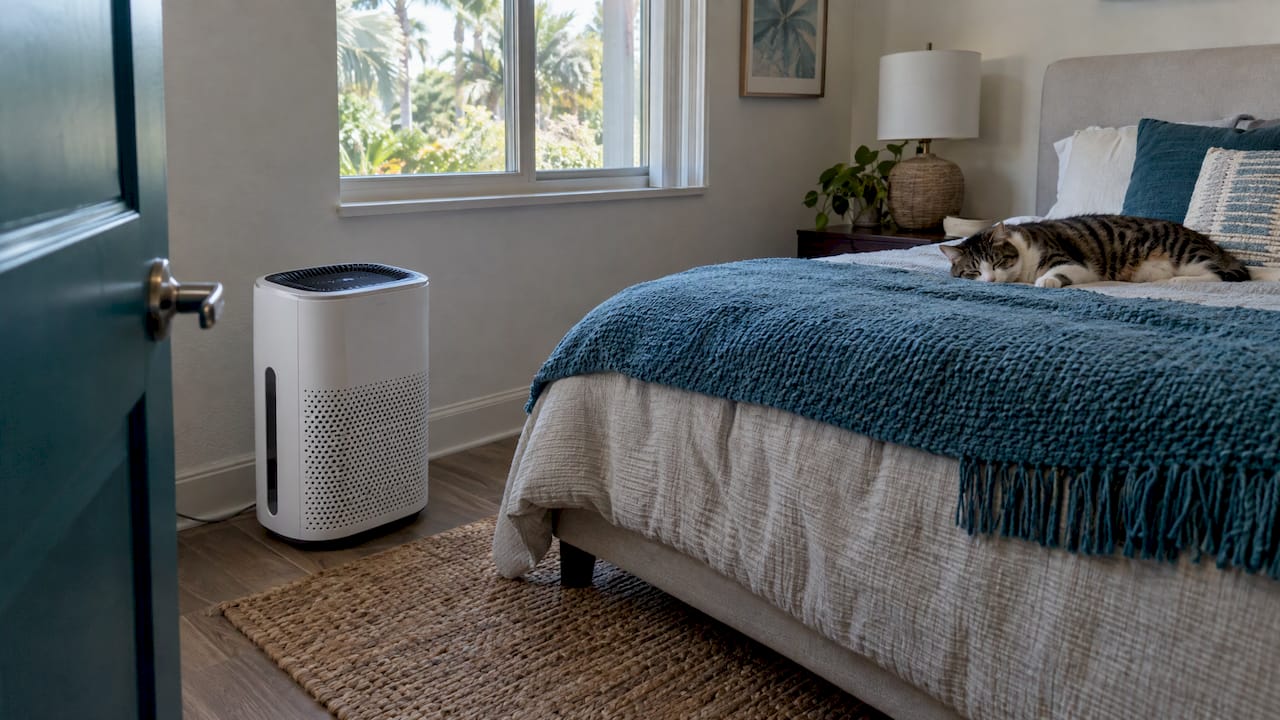
In an apartment, the central system’s filter is changed by maintenance, so tell us you have a cat allergy when you move in. We aim for same-day maintenance on requests, and our guide to maintenance in cat-friendly apartments shows what to ask for.

What to expect from cleaning
Cleaning lowers allergen, but it does not erase it. In a study of Minneapolis households, an intensive cleaning program reduced cat allergen by 43% in cat homes, and levels afterward were still far higher than in homes without a cat. That is why the routine has to be a habit built from several steps, rather than one deep clean on move-in day.
The habit also pays off if you ever move. AAFA says it can take up to six months for all cat allergen to clear after a cat leaves a home, which is why a thorough cleaning matters the day you move in with a cat or move out.
When allergy symptoms need an allergist
If you sneeze, itch, wheeze or cough in spite of these steps, see an allergist. ACAAI says an allergist can find the right treatment: steroid nasal sprays or oral antihistamines for nasal symptoms, antihistamine eye drops for itchy eyes, and inhaled medicines for asthma. See a doctor promptly if you have wheezing or shortness of breath.
Allergy shots are the long-term option. A 2026 review reports that cat immunotherapy has been used for over 40 years, and that in a real-life study of 46 cat-allergic patients, shots improved symptoms, quality of life and asthma control at 6 and 12 months even when patients kept their cat at home. In a double-blind trial, sublingual (under-the-tongue) treatment reduced symptoms by 62% over a year. Guidelines recommend considering immunotherapy for moderate to severe symptoms despite avoidance and medication, so ask your allergist whether you are a candidate. The 2025 review also notes that exposure outside the home counts too, so a plan for work or school matters as well as one for your apartment.
Our view
We built our community around renters who want a cat and a comfortable home, and we know that allergies are often the deciding question. Our one-bedroom apartments suit young professionals, FAU students and anyone living on their own, and a one-bedroom gives you a bedroom you can close and a living area for your cat.
The costs are meant to be easy to see. Cats are welcome, with a one-time, non-refundable pet fee of $300 to $500 per cat and no ongoing pet rent. Our virtual tours and interactive property map let you look at the layout and floors before you visit, and you can ask our AI chat or voice assistant questions at any hour.
We keep the community quiet and well maintained, and our maintenance team aims to respond the same day. If you are weighing a cat against your allergies, start with the space, then build the routine.
Ayman
The cost of a cat-friendly one-bedroom
Here is what the published numbers look like at Cynthia Gardens, so you can budget before you tour. Our rent for one-bedroom apartments is $1,990 to $2,220 per month. One-time fees are a $75 non-refundable application fee per applicant, a $300 administration fee, and the non-refundable pet fee of $300 to $500 per cat. A $15 wire transfer fee and a $500 transfer fee are also listed on our fees page. Because there is no monthly pet rent, a cat does not add to your rent every month.

Our approach is no hidden fees, and the pet fee is the cat’s only cost on the lease. You can also read our overview of cat-friendly amenities and how to choose an apartment for your cat’s comfort.
See a cat-friendly one-bedroom in Boca Raton
If you want a home where you and your cat can both settle in, start with our pet-friendly one-bedroom apartments in Boca Raton. Take the digital tour, check the floors and the bedroom door, and apply online when you are ready.

You can compare units on the one-bedroom apartments page, and our AI chat and voice assistant can answer questions about the cat policy and fees at any time.
FAQ
Can I live with a cat if I am allergic?
Many people do, with a combination of steps: a bedroom the cat stays out of, a HEPA air cleaner, regular washing and vacuuming, and medical treatment where needed. Reviews report that reducing allergen at home may not be enough if you are also exposed at work or school. An allergist can build the plan around your symptoms.
Why are my allergies so bad with cats?
The allergen is a protein that is carried on tiny particles, stays in the air and sticks to fabric. In a small apartment, there is little space for it to disperse, so the concentration stays higher. NIEHS notes that it can remain on carpets and furniture for months.
What is the best flooring for cat allergies?
Hard flooring is easier to wipe and vacuum than carpet, and AAFA recommends replacing old carpet with hard flooring where possible. Check the floors on a digital tour, and read our guide to flooring for pet apartments.
Does Cynthia Gardens charge monthly pet rent for a cat?
No. We charge a one-time, non-refundable pet fee of $300 to $500 per cat and no ongoing pet rent. Our fees page lists every one-time fee.
Sources
- Pet Allergens, National Institute of Environmental Health Sciences
- Distribution, aerodynamic characteristics, and removal of the major cat allergen, PubMed
- Pets, Dog and Cat Allergies, ACAAI
- Minimizing indoor allergen exposure: What works?, PMC
- Should the Cat Stay Home? A Guide to Managing Cat Allergies, MDPI
- Should the Cat Stay Home? A Guide to Managing Cat Allergies, full text
- How Do We Remove Cat Dander from a Home?, AAFA
- Allergen levels in inner city homes, CDC
- Evaluation of different techniques for washing cats
- Environmental assessment and exposure control, AAAAI practice parameter
- How to Treat Pet Allergies Without Giving Them Up, Banner Health
- How to deal with pet dander at home, CVS
- Allergy to Cats: Current Perspectives and Therapeutic Options, PMC