Boca Raton runs well below the national crime average, with property crime as the dominant category and violent crime relatively rare. average, with a violent-crime victimization chance near 1 in 466. The sections below break down the actual per-100k figures, neighborhood variation, and how the city’s shift to NIBRS reporting changes how you should read those numbers.
TL;DR:
- Boca Raton’s violent crime rate is roughly 172 incidents per 100,000 residents in 2024, about 44% below the national average, with a victimization chance of 1 in 466.
- The transition to NIBRS reporting may inflate recent crime statistics because it records multiple offenses within a single incident, making year-to-year comparisons more complex.
- Property crimes, particularly larceny and vehicle theft, outnumber violent crimes significantly, with risk levels varying by neighborhood depending on location and security measures.
- Crime tends to cluster around beach parking lots, retail areas, and rental-heavy neighborhoods, with residential areas generally experiencing lower violence but variable property crime.
- Seasonal tourism and rental turnover influence property theft rates, which often spike during peak holiday months, while violent crime remains relatively steady over time.
Table of Contents
- Boca Raton Crime Rate by the Numbers: A Data Snapshot
- How Crime Gets Counted: NIBRS, UCR, and Why the Numbers Shifted
- Neighborhood Variation: Where Boca Raton’s Crime Actually Clusters
- Recent Trends: What’s Shifted Over the Last Few Years
- Turning Statistics Into a Safety Checklist
- What Actually Gets Stolen or Reported Most Often
- Who Boca Raton’s Crime Patterns Actually Affect
- Crime Data’s Ripple Effect on Real Estate and Local Safety Efforts
- Reading the Data Like a Local
- Move With Confidence: Safety-Minded Renting at Cynthia Gardens
- Sources
Boca Raton Crime Rate by the Numbers: A Data Snapshot
Boca Raton’s violent crime rate sat at about 172.0 incidents per 100,000 residents in 2024, according to SpotCrime’s five-year tracking data. That figure earns the city a grade of B, or 5 out of 10, on SpotCrime’s scale, a middling score for Florida but still favorable next to many larger metro areas in the state.
Separately, DoorProfit’s aggregated estimate puts Boca Raton’s overall crime rate around 44% below the national average, translating to roughly a 1 in 466 chance of becoming a violent-crime victim in a given year. Property crime tells a different story. Aggregators consistently note that property offenses outnumber violent ones by a wide margin, with larceny and vehicle theft making up the bulk of resident-reported incidents.
Here’s how the core metrics line up:
| Metric | Figure | Source |
|---|---|---|
| Violent crime rate (2024) | ~172.0 per 100,000 | SpotCrime |
| Overall crime vs. national average | ~44% lower | DoorProfit |
| Estimated violent-crime victim chance | ~1 in 466 | DoorProfit |
| SpotCrime safety grade | B (5/10) | SpotCrime |
A few notes on what these numbers actually measure:
- Per-100k rate: normalizes incident counts against population, so cities of different sizes can be compared fairly.
- Victim chance: an estimated probability, not a guarantee, based on population and reported incident volume.
- Safety grade: a composite score aggregators build from recent incident data, useful for a quick read but not an official government metric.
- Year-over-year change: worth tracking over multiple years rather than a single snapshot, since incident counts can swing with reporting changes alone.
None of these figures replace a look at your specific block or building, which later sections cover in more detail.
How Crime Gets Counted: NIBRS, UCR, and Why the Numbers Shifted
The Boca Raton Police Department moved to the FBI’s National Incident-Based Reporting System, retiring the older Uniform Crime Reporting summary method. That switch matters more than it sounds.
NIBRS is the national standard for incident-based reporting, and it counts every offense within an incident rather than just the single most serious one. A break-in that also involves an assault gets logged as two offenses under NIBRS, where UCR would have recorded only the assault. That difference alone can make post-transition numbers look higher, even when actual crime hasn’t changed.
A few practical points for anyone comparing years:
- Treat any comparison spanning the NIBRS transition with caution, since methodology, not crime, may explain a jump.
- Pull current data from Boca Raton’s official crime alerts page or the FBI’s NIBRS portal rather than relying on secondhand summaries.
- Remember that unreported crime, especially minor thefts, never enters these figures at all, so official rates understate the full picture somewhat.
Neighborhood Variation: Where Boca Raton’s Crime Actually Clusters
City-wide averages flatten out real differences between blocks. Property crime in Boca Raton tends to cluster around beach parking areas, retail corridors, and certain rental-heavy pockets, while violent crime stays comparatively rare across most residential neighborhoods. Travel-safety indices back this pattern, rating Boca Raton around 88 out of 100 for general visitor safety while still flagging smash-and-grab incidents at beach lots as a recurring nuisance.
If you’re sizing up a specific area, a few checks go further than a single citywide statistic:
- Check the city’s crime alert page for recent incidents tied to the exact zip code or neighborhood you’re considering.
- Look at parking setups. Open, unmonitored lots near retail or beach access see more break-ins than gated or attended garages.
- Ask about building-specific security. Keyed entry, on-site staff, and lit walkways all shift the practical risk more than the city average does.
- Cross-reference rental turnover. Complexes with heavy short-term or seasonal turnover sometimes see more opportunistic theft than stable, long-term communities.
Our guide to evaluating Boca Raton neighborhoods walks through this block-by-block approach in more depth, which matters more than most renters assume once you’re actually signing a lease.
Recent Trends: What’s Shifted Over the Last Few Years
Violent crime in Boca Raton has stayed in a relatively narrow band over the past several years, without the sharp spikes seen in some comparable Florida cities. SpotCrime’s five-year trend data shows incremental movement rather than dramatic swings, which tracks with a stable, affluent suburb rather than a high-crime urban core.
Property crime categories, particularly vehicle theft and larceny, show more year-to-year variability. Some of that likely ties to seasonal tourism patterns. Local safety guides note that property-crime opportunities rise during peak tourist months and holiday shopping periods, when parking lots fill and valuables sit visible in cars longer than usual.
It’s worth being careful about attributing any single-year change to one cause. Reporting-method shifts under NIBRS, seasonal tourism cycles, and genuine enforcement changes can all move the same number in the same direction, and separating them requires more than one year of data.
Turning Statistics Into a Safety Checklist
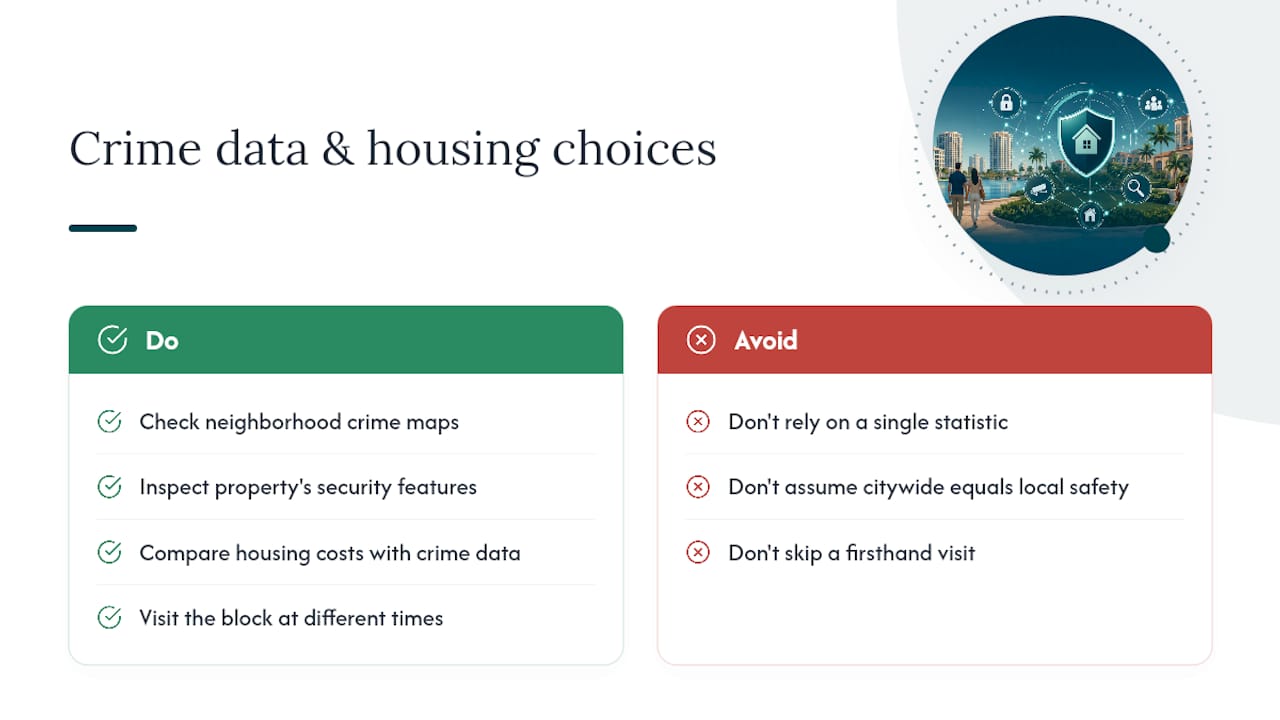
Numbers only help if you act on them. Here’s a practical sequence for weighing crime data against a specific apartment or block:
- Pull the per-100k rate and victim chance for the general area, then compare against the citywide averages above.
- Check the city’s crime alerts for the exact neighborhood over the past 90 days.
- Walk or drive the block at night to judge lighting, foot traffic, and parking security firsthand.
- Ask the property about door and window hardware, gate access, and whether packages or mail are secured.
- Keep valuables out of sight in your car and lock doors even in “safe” neighborhoods, since opportunistic theft doesn’t discriminate by zip code.
Pro Tip: Follow the Boca Raton Police Department’s official channels and sign up for city crime alerts before you move, not after. Most residents only discover these exist once something happens nearby.
What Actually Gets Stolen or Reported Most Often
Larceny and theft make up the largest single category of reported crime in Boca Raton, consistent with the broader pattern that property crime outnumbers violent crime by a wide margin here. Vehicle-related theft, including items stolen from unlocked cars, ranks close behind, driven partly by beach and shopping-center parking lots where cars sit unattended for hours.
Burglary, meaning unlawful entry into a home or building, occurs less frequently than larceny but tends to draw more attention because of its direct impact on residents. Assault cases are comparatively uncommon, and Boca Raton’s violent crime rate of 172.0 per 100,000 reflects that overall rarity relative to property offenses.
Robbery, which involves force or the threat of force to take property, sits at the low end of frequency in Boca Raton compared with larger South Florida metros. Fraud and scam-related incidents, including cases targeting tourists or seasonal residents, show up in local guides as a recurring but usually nonviolent concern.
The pattern that emerges: if you’re worried about becoming a crime victim in Boca Raton, the realistic risk skews toward losing property, not facing physical harm. That shapes which precautions matter most. Locking your car and securing your unit does more heavy lifting than any personal-safety measure aimed at violent encounters, simply because the odds favor property crime by a wide margin.
Who Boca Raton’s Crime Patterns Actually Affect
Crime in Boca Raton doesn’t distribute evenly across the population or the map, and socioeconomic context explains part of that. Higher-income residential neighborhoods, common throughout much of the city, generally see lower property crime than areas with heavier rental turnover or proximity to major retail and tourist corridors.
Seasonal population swings play a real role too. Boca Raton’s population grows noticeably during winter months as seasonal residents and tourists arrive, and that influx tracks with the property-crime uptick that local safety guides associate with peak tourism periods. More cars in beach lots and more shoppers carrying bags simply means more opportunity for theft, regardless of any underlying change in the resident population’s behavior.
Rental density matters as well. Areas with a higher concentration of short-term or transient renters tend to show slightly different crime profiles than stable, owner-occupied blocks, mostly because transient populations create less of the informal social oversight that naturally discourages opportunistic crime. This isn’t a judgment on renters. It’s a documented pattern that shows up across most Florida coastal cities, and it’s exactly why building-level security and community engagement matter as much as the zip code itself.
Age and lifestyle factors shape reporting patterns too. College-age renters and young professionals often keep different schedules and park in different locations than older, established residents, which shifts personal exposure to certain crime types like vehicle break-ins.
Crime Data’s Ripple Effect on Real Estate and Local Safety Efforts
Crime statistics feed directly into how buyers, renters, and appraisers view specific Boca Raton neighborhoods, and that influence runs both ways. Areas with consistently low reported crime tend to command steadier property values and faster lease turnover, while pockets with visible property-crime issues, like frequent car break-ins near retail centers, can see more price sensitivity even when violent crime stays low citywide.
The city and its police department haven’t stayed passive on this front. The move to NIBRS reporting itself reflects a broader push toward more transparent, incident-level data that residents and prospective movers can actually use, rather than the vaguer summary counts of the old UCR system. Community-facing tools like the city’s crime alert page extend that transparency directly to residents deciding where to live.
For anyone factoring safety into a housing decision, the practical takeaway is that crime data and property value move together closely enough to matter, but not so tightly that a single statistic should override a firsthand look at a building or block. A property with strong security features, gated parking, and active management can outperform its neighborhood’s average, and vice versa. Readers weighing a move might also want to review housing costs and neighborhood context alongside crime figures, since affordability and safety often trade off against each other in specific Boca Raton pockets.
Reading the Data Like a Local
Numbers tell you the odds, not your comfort level, and those are two different things. Boca Raton’s statistics point to a city where violent crime stays genuinely rare and property crime is the real, manageable risk, and that distinction should guide where your attention goes when you’re apartment hunting.
Cynthia Gardens works from that same data-first mindset. The community offers transparent pricing, virtual tours, and local weather and neighborhood context so prospective residents can evaluate a move with real information instead of guesswork. Safety decisions ultimately blend hard numbers with how a block feels when you walk it, and that combination matters more than either factor alone.
— Ayman
Move With Confidence: Safety-Minded Renting at Cynthia Gardens
Safety-conscious renters benefit from full pricing transparency alongside real security features you can verify before you ever sign a lease. One-bedroom units include secure building access, well-lit parking, and managed common areas, and every detail is laid out upfront with no hidden fees buried in the fine print.
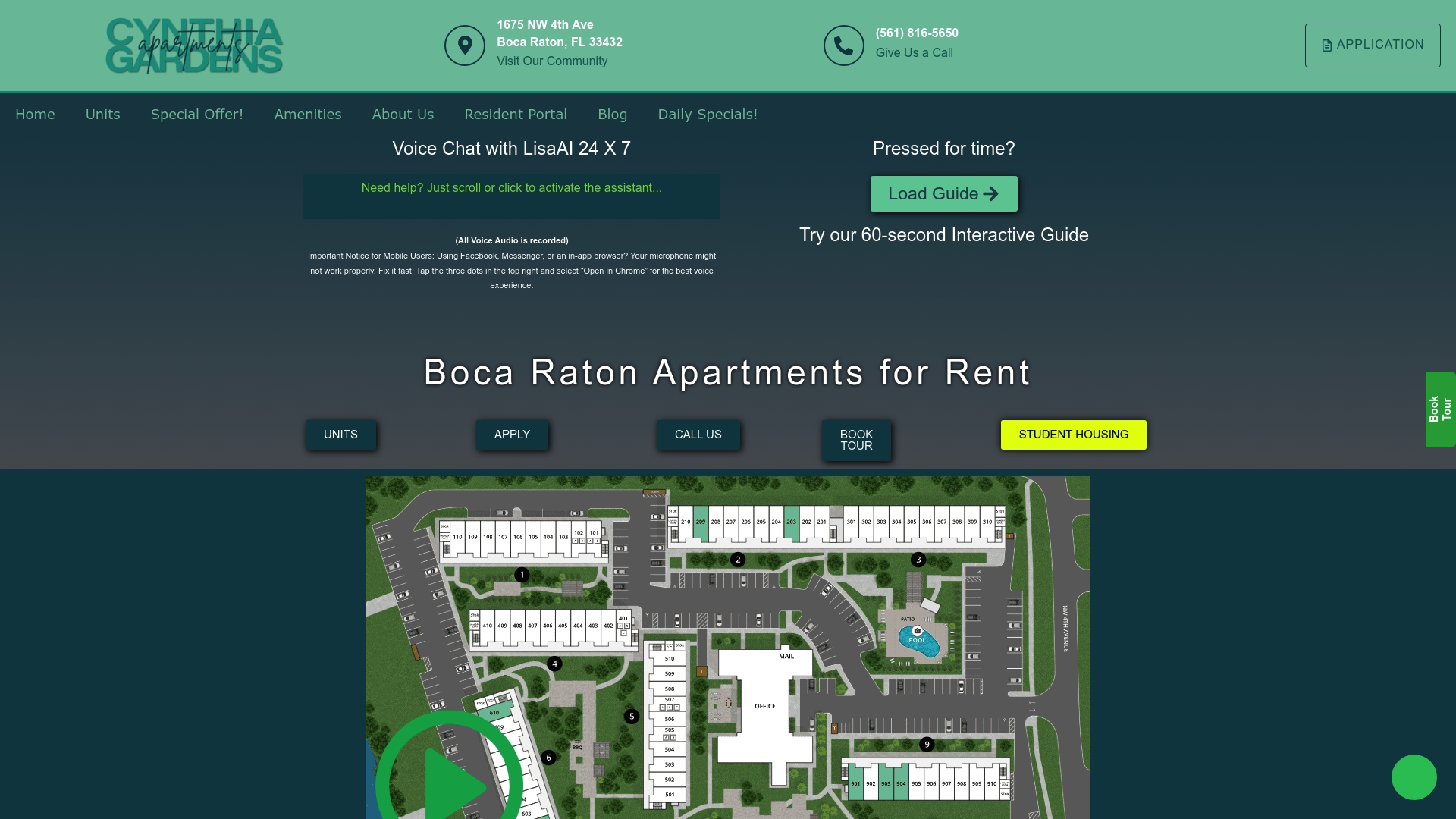
You can check unit availability and neighborhood specifics through an interactive property map before ever scheduling an in-person visit, and a virtual tour option lets you inspect a unit and its surroundings remotely, which matters if you’re relocating from out of state and want to assess a block before committing. If legal questions come up during your move, resources like Oldham Law’s guide to real estate fees cover what to expect on the closing or leasing side.
Ready to see a specific unit? Explore available apartments and book a tour today.
Sources
- Boca Raton, FL Crime Rate & More | DoorProfit
- Spotcrime
- Crime Alerts | Boca Raton, FL
- National Incident-Based Reporting System (NIBRS) — FBI