
Virtual tours increase engagement, improve remote decision-making, and lift conversion efficiency when they match the right audience and market context. Three groups gain the most:
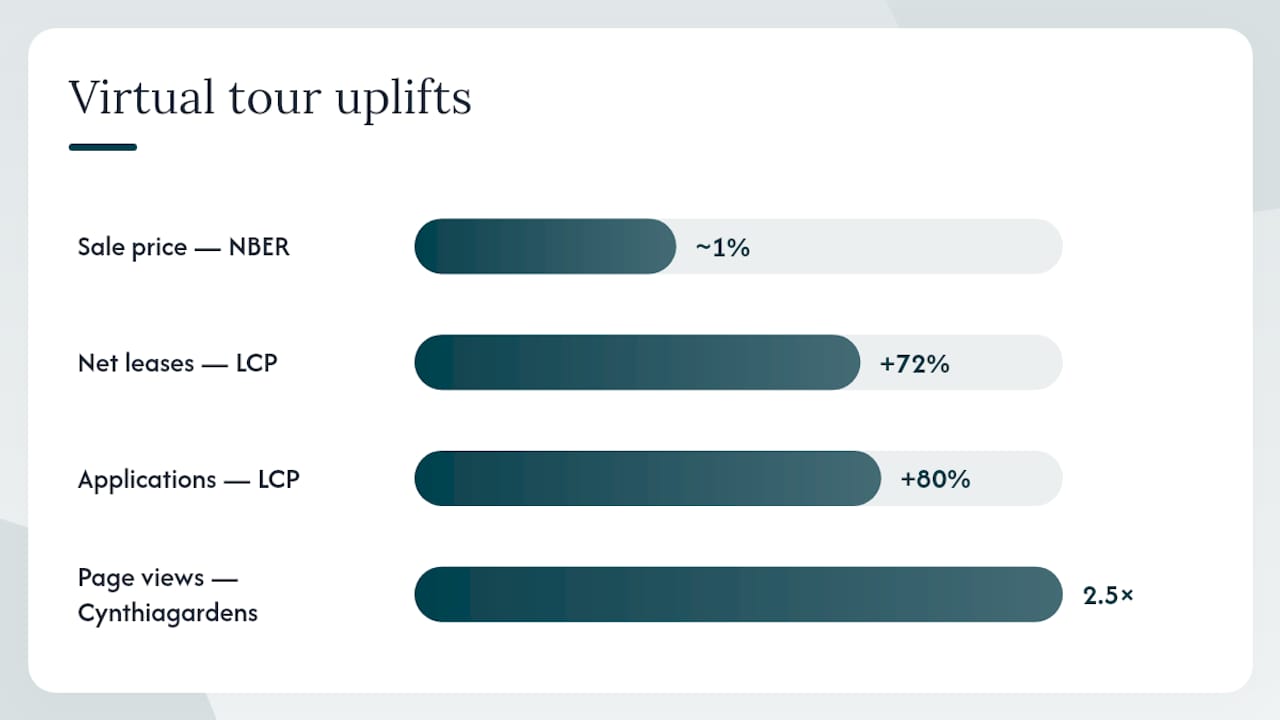
- Property managers and leasing teams: higher-quality leads, fewer no-shows, and out-of-market lease signings that would otherwise be impossible. Cynthiagardens’ own listings with virtual tours received 2.5× more views than listings without them.
- Tourism and attraction marketers: broader geographic reach and measurable pre-visit interest from prospects who would never have found the property through static photos alone.
- Educators and cultural organizations: asynchronous access, deeper learning engagement, and accessibility features that serve students and visitors regardless of physical location.
The catch is that “virtual tour” covers a wide range of quality levels, and a poorly executed one can hurt as much as help. The evidence, the trade-offs, and the implementation details are what actually determine whether you see a return.
Key Takeaways
Virtual tours deliver the strongest ROI when they are unit-level, mobile-optimized, integrated with lead capture, and measured against a clear leasing funnel.
| Point | Details |
|---|---|
| Engagement lift is real | Tour-enabled listings at Cynthiagardens received 2.5× more views than listings without tours. |
| Academic price effects are modest | NBER research puts the average sale price increase at a small amount, with strong variation by market. |
| Campaign-level gains can be large | One LCP Media case study showed 72% more net leases over 12 months with unit-level, integrated tours. |
| Integration determines ROI | Tour embed plus lead capture plus CRM sync is the combination that converts views into signed leases. |
| Pilot before scaling | Run a 60-day A/B test on a representative sample of listings before committing to a full rollout. |
Table of Contents
- What exactly is a virtual tour, and which type do you need?
- What are the core benefits of virtual tours across industries?
- How virtual tours work in real estate, tourism, education, and marketing
- When virtual tours fail or make things worse
- What does the evidence actually show about virtual tour impact?
- How to produce, publish, and measure a virtual tour that actually performs
- Sources
What exactly is a virtual tour, and which type do you need?
A virtual tour is an interactive, navigable digital representation of a physical space that lets viewers explore it on their own terms, at their own pace, from any device.
360° panoramic walkthroughs
These are photo-based: a camera captures overlapping spherical images that stitch together into a navigable scene. The viewer clicks or drags to look around each “node” and moves between rooms by clicking hotspots. Production is relatively fast and affordable, which makes 360° tours the practical choice for most apartment communities, small hotels, and retail spaces. CloudPano and similar platforms let operators publish and embed these tours within hours of a shoot.
3D digital twins
Matterport pioneered this format: a structured-light or LiDAR camera captures spatial data that software converts into a measurable 3D mesh. The result is a “dollhouse” model you can walk through, measure, and annotate. It costs more to produce and process, but the spatial accuracy justifies the investment for high-end listings, large commercial spaces, and facilities management scenarios where dimensions matter. A leasing team showing a penthouse or a university giving a campus tour of a research lab gets more from a Matterport digital twin than from a stitched photo walkthrough.

Distribution matters as much as format
Both types can be embedded on property pages, shared via social media, and submitted to Google Maps through Google Street View’s business integration. That last channel matters more than most operators realize: a tour indexed in Google Maps appears in local search results and on Google Business Profiles, putting the space in front of prospects who are actively comparing options in the area.
Pro Tip: For most one-bedroom apartment communities, a well-lit 360° walkthrough distributed across your website, Google Maps, and your primary listing platform will outperform an expensive 3D digital twin that only lives on one page.
What are the core benefits of virtual tours across industries?
The advantages of virtual tours cluster into six practical themes. Each one shows up differently depending on the industry, but the underlying mechanism is the same.
-
Immersive engagement and longer attention: Prospects spend more time with a space they can navigate than with a photo gallery they scroll past. In leasing, that time translates directly into intent signals. A renter who completes a full unit walkthrough is a warmer lead than one who glanced at six photos.
-
24/7 remote access on any device: A tour is available at 2 AM on a phone, a tablet, or a laptop. For apartment communities near universities or corporate relocators, this means prospects in other states or countries can make confident decisions without a flight. KNTXT Group reports that over 70% of virtual tour consumption happens on mobile devices, which makes mobile optimization non-negotiable.
-
Conversion lift and lead quality: Unit-level virtual tours in one apartment community produced roughly 40% more leads, 80% more applications, and 72% more net leases over 12 months, according to case data reported by LCP Media. These are single-community figures, not averages, but they illustrate the ceiling when tours are properly integrated with lead capture.
-
Time and cost savings through pre-qualification: A prospect who has already walked through a unit virtually arrives at an in-person showing ready to decide, not to browse. That pre-qualification cuts no-show rates and reduces the number of tours leasing staff need to run per signed lease. RentVision frames this as operational ROI: fewer vacancy days, better staff efficiency, and marketing spend that works harder because the audience is already warmed up.
-
Accessibility and inclusivity: A well-built tour with keyboard navigation, captions on embedded video, and screen-reader-compatible hotspot labels serves visitors who cannot physically access a space. Museums and universities have used this to extend reach to students with mobility limitations or remote learners who would otherwise miss the experience entirely.
-
SEO and distribution integration: Embedding a tour on a property page increases time-on-site, which is a positive signal for search rankings. Publishing to Google Maps via Street View puts the space in local search results. Listing platforms like Zillow surface tour-enabled listings with a distinct badge, which improves click-through rates from search results pages.
How virtual tours work in real estate, tourism, education, and marketing
Real estate and apartment leasing
This is where the ROI case is most documented. Unit-level tours, as opposed to community-only walkthroughs, are what drive application rates. A prospect who can see the actual unit they would sign a lease on makes a faster, more confident decision. Cynthiagardens’ virtual leasing process combines embedded tours with AI chat support and an interactive property map, so a remote prospect in another state can tour, ask questions, and apply without a single in-person visit. That workflow is what out-of-market leasing actually requires.
Tourism and attractions
Virtual previews drive physical visitation rather than replacing it. A hotel that publishes a room tour on its booking page reduces the uncertainty that causes last-minute cancellations. A national park or museum that offers a virtual preview gives a prospective visitor enough of a taste to commit to the trip. IdeaUsher’s analysis of VR in tourism notes that immersive previews can also serve segments who cannot travel, creating a separate audience for digital-only experiences.
Education and cultural institutions
Universities use 360° campus tours to recruit students who cannot visit in person, a segment that grew substantially after 2020 and has not fully reverted. Libraries and museums use digital twins to create asynchronous learning modules: a student can “walk” a historical archive or a science exhibit at their own pace, pause on artifacts, and read embedded annotations. The accessibility argument is strong here because the alternative for a student with a mobility limitation is often no access at all.
Marketing and events
Product launches, venue walkthroughs, and trade show booths translated into virtual spaces all benefit from the same mechanism: longer on-page time and a more vivid impression than a static image delivers. For paid media campaigns, a landing page with an embedded tour typically holds attention longer, which improves quality scores and lowers cost-per-click over time.
When virtual tours fail or make things worse
Not every tour is worth producing. The limitations are real, and ignoring them leads to wasted spend or, worse, a tour that actively misrepresents a space.
- Production cost vs. expected ROI: A Matterport scan for a 200-unit apartment community typically runs between several thousand and around fifteen thousand dollars according to KNTXT Group’s practitioner estimates. For a single commodity unit in a slow market, that math rarely works.
- Outdated or misleading imagery: A tour shot before a renovation, or one that shows a model unit rather than the actual available unit, sets expectations the real space cannot meet. That gap increases move-out rates and damages trust.
- Poor mobile optimization: A tour that lags, crashes, or requires a plugin on mobile loses the majority of its audience before they finish the first room.
- No analytics instrumentation: A tour with no event tracking is a black box. You cannot tell whether prospects are dropping off at the kitchen or completing the full walkthrough, which means you cannot improve it.
- Missing accessibility features: No captions, no keyboard navigation, and no alt text on hotspots excludes a meaningful share of users and, in some institutional contexts, creates compliance exposure.
- Privacy and security risks: A 3D digital twin of a private residence captures spatial data that could reveal security vulnerabilities, valuables, or layout details the owner did not intend to disclose. Publishing a tour of an occupied unit without explicit consent is a liability.
When to skip a virtual tour entirely: If the listing is highly unique, the market is extremely tight, and in-person demand already exceeds supply, a tour adds cost without adding conversion lift. The same applies to short-term furnished rentals where the turnover is so fast that keeping tour imagery current is operationally impractical.
What does the evidence actually show about virtual tour impact?
The academic picture is more nuanced than vendor marketing suggests.
A Harvard Business School study of 75,178 Los Angeles-area sales found that 3D virtual tours deliver modest average benefits on sale outcomes, with effects that vary substantially by market, listing attributes, and seller characteristics. The Baker Library summary of that research advises practitioners to match tour investment to listing and market context rather than assume broad price gains. An NBER working paper puts the average price increase at roughly 1%, with strong heterogeneity across markets, and notes that the effect has declined as tours became standard post-COVID.
Academic research also finds that tours are more effective for smaller or less-experienced sellers who need to disclose more information, and in competitive, standardized markets where buyers are comparing many similar properties simultaneously.
Industry case data tells a different story at the campaign level, but the context matters. That is not a passive “add a tour and wait” result.
| Source | Metric | Reported Effect | Context |
|---|---|---|---|
| NBER working paper | Sale price | ~1% average increase | large sample; strong market heterogeneity |
| HBS study | Time on market | Modest short-term reduction | LA-area; effect varies by listing and seller |
| LCP Media case study | Net leases (12 months) | +72% | Single community; unit-level tours + lead capture |
| LCP Media case study | Applications | +80% | Same community; mobile-optimized, integrated |
| Cynthiagardens internal | Page views | 2.5× more vs. no tour | Boca Raton one-bedroom listings |
Cynthiagardens measures the leasing funnel impact of its tours by tracking views, tour completion rates, and lead-to-application conversion. The 2.5× view lift on tour-enabled pages is the top-of-funnel signal; the downstream metric that matters is whether those additional views convert to signed leases at a higher rate than photo-only listings.
The recommended KPIs for any operator: views per listing, average time-on-tour, lead-to-application rate, no-show rate, days-to-lease, and saves-to-contact ratio on listing platforms.
How to produce, publish, and measure a virtual tour that actually performs
Production checklist
- Stage and light the space before the shoot. Remove personal items, maximize natural light, and add supplemental lighting in dark corners. A tour shot in poor light looks worse than professional photos and cannot be fixed in post-production.
- Choose the right format. 360° walkthrough for standard units and most commercial spaces; Matterport digital twin for high-end listings, large facilities, or spaces where dimensions matter.
- Shoot unit-level, not just common areas. Community amenity tours are useful, but the conversion lift comes from showing the actual unit the prospect would lease.
- Add captions and alt text to all hotspots. This serves screen readers, improves accessibility compliance, and adds indexable text for search engines.
- Optimize for mobile first. Test on at least two mobile browsers before publishing. A tour that works on desktop but fails on mobile loses the majority of its audience.
- Add metadata. Title, description, and geo-tags on the tour file improve discoverability in Google Maps and on listing platforms.
Distribution
- Embed on the property or unit page with a visible call-to-action above the fold.
- Submit to Google Maps via the Street View business integration.
- Integrate with your listing platform (Zillow, Apartments.com, or equivalent) to trigger the tour badge in search results.
- Connect tour completion events to your CRM so warm leads are flagged automatically.
- Use short social clips from the tour for paid media retargeting.
Analytics
Instrument at minimum: tour start, room transitions, hotspot clicks, and tour completion. Set a conversion funnel from tour start to lead form submission. Run an A/B test against photo-only listings for at least 60 days before drawing conclusions. For a practical walkthrough of how this integrates with a full remote touring workflow, Cynthiagardens’ leasing guide covers the end-to-end process.
Pro Tip: The single highest-ROI integration is tour embed plus lead capture plus CRM sync. A prospect who completes a tour and submits a contact form in the same session is your most qualified lead. Without the CRM hook, you cannot identify or prioritize them.
An editorial perspective on where virtual tours actually move the needle
The evidence points to one clear pattern: virtual tours work best as a pre-qualification and reach tool, not as a price-maximization tool. The academic finding of a small average price lift is real but modest. The operational gains, fewer no-shows, faster lease-up, and out-of-market conversions, are where the actual return lives for most property managers.
If I were advising a leasing team today, I would start with a pilot on a representative sample of units, instrument the full funnel, and measure days-to-lease and no-show rate before committing to a full-community rollout. A 360° walkthrough is almost always the right starting point. A Matterport digital twin is worth the premium only when the listing is complex, the prospect pool is geographically dispersed, or the space genuinely needs spatial accuracy to sell itself.
For Cynthiagardens, the combination of virtual tours, an interactive apartment map, and AI-assisted leasing is not a marketing gimmick. It is the operational infrastructure that makes remote leasing possible for students relocating from out of state and young professionals who cannot take a day off to tour apartments in person. That is the use case where the investment pays back fastest.
Sources
- Beyond the Hype: Unveiling the Marginal Benefits of 3D Virtual Tours in Real Estate
- Working Paper 33204
- Are Virtual Tours Still Worth It in Real Estate? Evidence from 75,000 Home Sales
- Virtual Tours for Apartment Leasing: The ROI Case for 360° VR | KNTXT Group
- Why virtual tours convert: New case study data from LCP Media
- The ROI of Virtual Apartment Tours | RentVision
- What are the Advantages and Disadvantages of Virtual Tours?