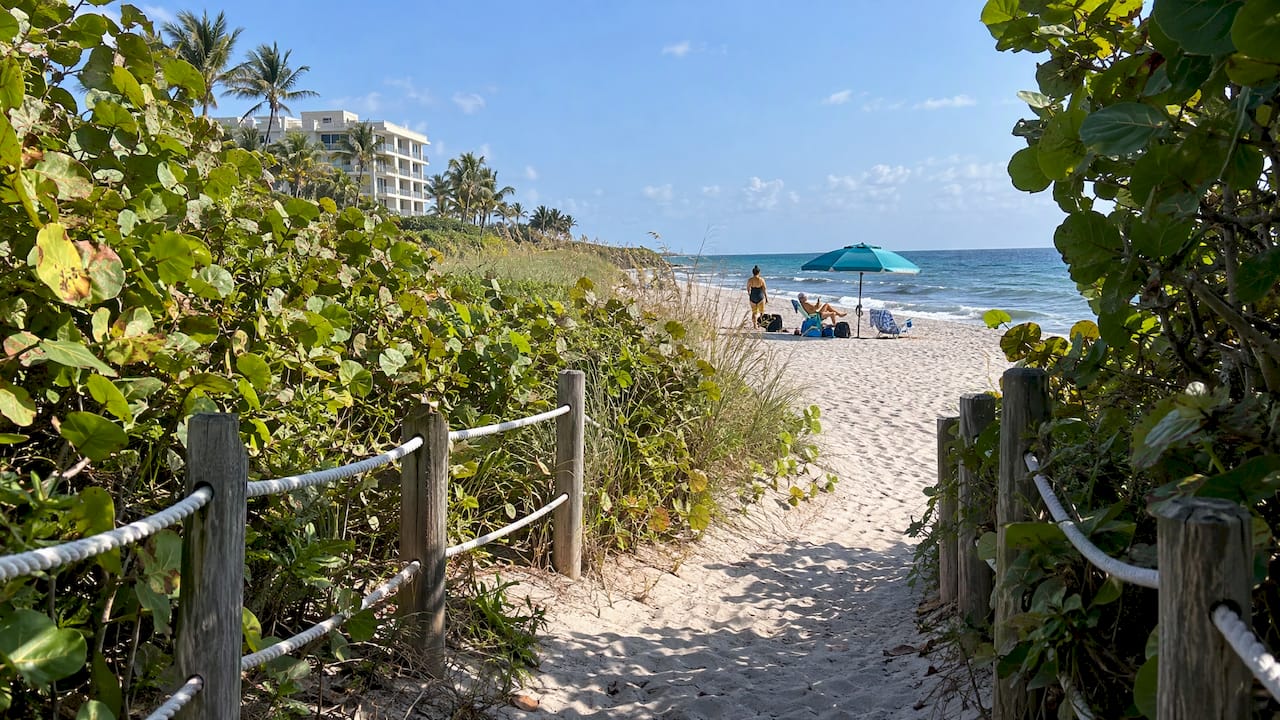
For a renter in a one-bedroom, the beach-or-inland question comes down to three things: how often you will really use the sand, how you get to work or class, and what the address costs you each month. Boca Raton is compact enough that you can live inland and still be at the ocean in 15 to 35 minutes, so you rarely need to pay a coastal premium to enjoy the coast. At Cynthia Gardens, our one-bedroom apartments rent for $1,990 to $2,220 per month, with the fees published on our site, and that is the kind of math this guide helps you run.
TL;DR
- “East Boca” means roughly the Intracoastal and I-95 to the ocean: beach, downtown, Mizner Park and the Brightline station. “West Boca” means west of the Turnpike, mostly gated, car-based and quieter.
- Even living near the beach, you will plan around parking. The city sets a beach vehicle permit ($90 a year for city and Beach and Park District residents) or a daily fee of $40 on weekdays and $55 on weekends and holidays, as of October 1, 2026.
- Flood zones and evacuation zones differ by address, not by “side of town.” Check both before you sign.
- Brightline gives East Boca renters a car-light commute up and down the coast. Inland renters rely on a car, with shuttles and Palm Tran filling some gaps.
- Cat owners: a one-time pet fee beats ongoing monthly pet rent, wherever you live.
Table of Contents
- What “east” and “west” Boca actually mean
- A day near the beach
- Beach parking: the cost nobody puts in the rent
- A day inland
- Rent: what the coast costs you
- Flood, hurricane and evacuation: check the address
- Getting around: Brightline, Tri-Rail and your car
- Which side fits which renter
- Perspective
- See the apartments for yourself
- FAQ
- Sources
What “east” and “west” Boca actually mean
Locals draw the map with two highways. Per a local comparison of east and west Boca, the stretch from the Intracoastal to I-95 is East Boca, with the beach, downtown, Mizner Park, the Brightline station and the marina district. Between I-95 and Florida’s Turnpike is central Boca, and west of the Turnpike is West Boca: master-planned, gated communities toward the Everglades.
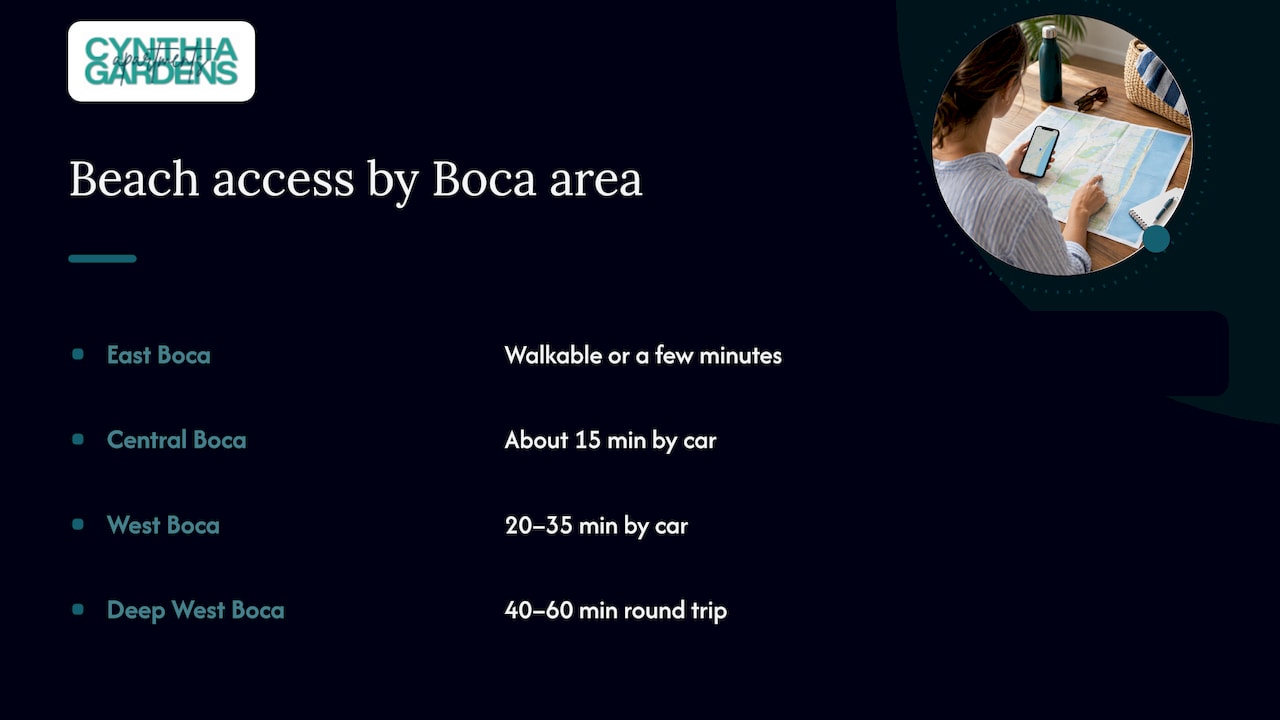
The same guide puts beach access at walkable or a few minutes in East Boca, about 15 minutes by car from central Boca, and 20 to 35 minutes from West Boca. A round trip to Mizner Park or the beach from deep West Boca can take 40 minutes to an hour.
One catch matters for renters. A Boca Raton mailing address does not always mean the property is inside the city. A local guide notes that some areas called West Boca sit in unincorporated Palm Beach County. That affects beach permits, as explained below.
Florida Atlantic University anchors the middle of the city, so students are not forced to pick a side. Central Boca is the compromise zone. For a wider tour of neighborhoods, see our guide to the best residential areas in Boca Raton.
A day near the beach
Coastal days in Boca follow the heat. Mornings and late afternoons are for walking, jogging or paddleboarding. Midday is for errands and air conditioning. Evenings often mean outdoor dining, with a relaxed feel rather than big-city nightlife, according to one coastal living guide.
East Boca is also the most walkable part of town. If you want to run errands without a car, our page on walkable neighborhoods in Boca Raton covers what a car-light routine looks like. Recovery and wellness services cluster here too, such as East Boca wellness options for people who train outdoors.
The trade-off is that the beach is not a spontaneous after-work dip for most people. Boca Raton has about five miles of Atlantic coastline organized around three city beach parks: Spanish River, Red Reef and South Beach, per a local daily-life guide. Parking is the gate.
Beach parking: the cost nobody puts in the rent
The city’s beach permit and daily rate page lists the fees as of October 1, 2026:
| Who | Cost |
|---|---|
| City of Boca Raton and Greater Boca Raton Beach and Park District residents | $90 annual permit, all three beach parks |
| Other Palm Beach County residents | $108 annual permit, South Beach only |
| Anyone, daily entry | $40 weekdays, $55 weekends and holidays |
Annual permits run October 1 through September 30 and are not prorated. They are also not valid at metered spaces around the city.
Here is a worked example. If you go to the beach twice a week and pay daily fees on weekdays, you would spend about $80 a week, far above the $90 permit. So the permit is the sensible choice for regular beachgoers, and the question is whether your address qualifies for the resident rate. Because a Boca mailing address is not proof of city residency, confirm your property against the city’s limits map before you count on the $90 permit. Schedules and fees are reviewed by the city each year, so check the page above for the current ones.
This changes the “beach vs. inland” math. A renter in West Boca who qualifies for the permit and drives 25 minutes pays the same $90 as someone a block from the sand. What the coastal renter buys with a higher rent is time and convenience, not access.
A day inland
A few minutes west of the coast, streets get leafier and quieter and life becomes more car-based. Quick drives get you to parks, schools and community centers. One local guide frames the difference as compactness: East Boca keeps destinations clustered near downtown, while West Boca days are built around major roads and planned stops.
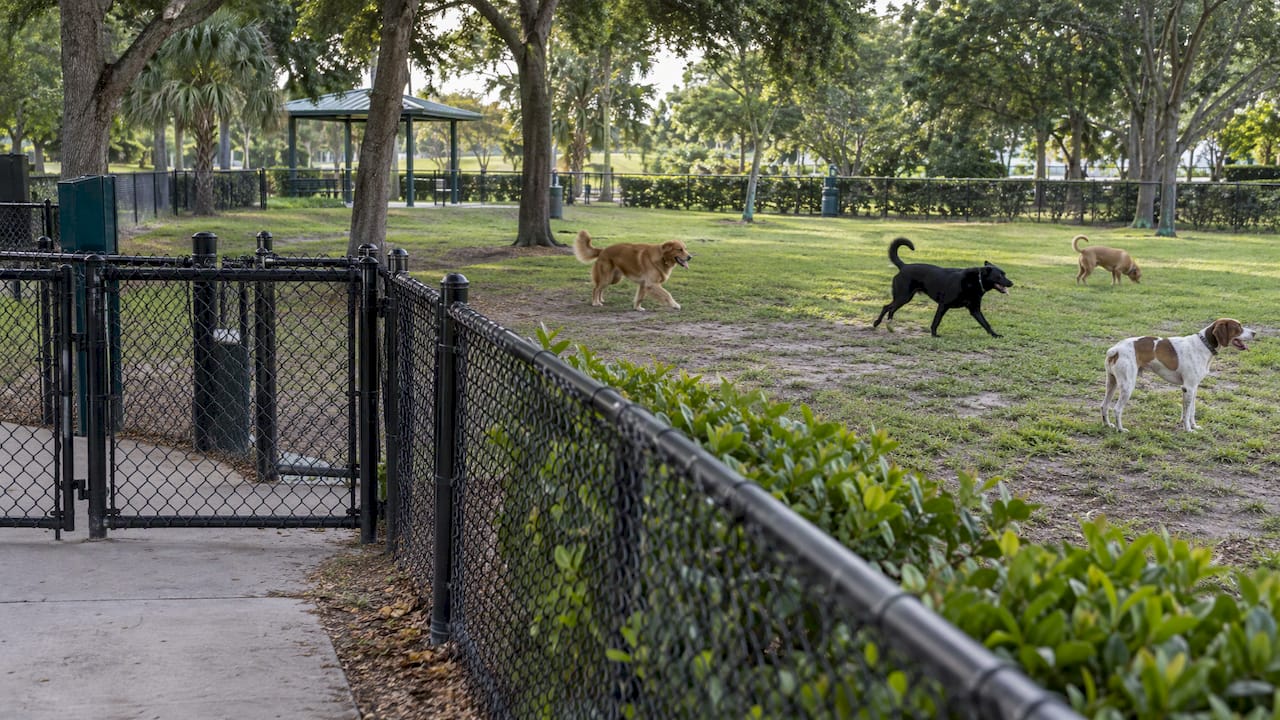
Recreation inland is bigger-scale. The same guide points to Burt Aaronson South County Regional Park, an 880-acre park west of Boca with a dog park, tennis center, walking and bike paths and an amphitheater. Most gated and golf communities are on the inland side too, per a Boca Raton local guide.
If your day is built around a desk, a campus or a gym rather than the sand, inland living often fits better. You trade walkability for quiet and, usually, a lower price per square foot. If you are weighing the west side specifically, our overview of why West Boca works as a home base goes deeper.
Rent: what the coast costs you
One published 2026 renter guide put the average Boca Raton one-bedroom rent at $2,370 per month, with studios near $1,959 and two-bedrooms near $3,057. Averages like that move with the market, so treat them as a snapshot. Our one-bedroom apartments are listed at $1,990 to $2,220 per month on our units page.
The bigger cost gaps sit in home ownership, and they shape what landlords charge. Per one 2026 cost comparison, east-side waterfront homes often run $2 million to $5 million or more, while inland medians are in the mid-six figures. That same guide estimates coastal condo association fees of $700 to $1,500 or more per month versus $100 to $300 for inland single-family homes. Owners carry those costs, and rents on the water reflect them.
For your budget, look at the total monthly picture:
- Base rent.
- Fees at move-in. Ours are listed on our fees page: a $75 non-refundable application fee per applicant, a $300 administration fee and a $15 wire transfer fee.
- Parking: beach permit, plus any paid parking near downtown.
- Commute: gas and tolls, or Brightline fares.
- Renters insurance and electricity. Florida has no state income tax, but air conditioning runs most of the year.
A one-bedroom with a straightforward fee schedule is easier to compare than one whose “low” rent hides add-ons. If affordability is your main filter, our tips on cheap one-bedroom apartments in Boca Raton are a useful next stop.
Flood, hurricane and evacuation: check the address
Hurricane season runs June through November. For a renter, the questions are narrower than for a buyer, but they still depend on the address.
- Flood zone. Palm Beach County reports that FEMA’s updated flood maps took effect December 20, 2024, adding thousands more eastern-county residents to high-risk zones, and that every county resident lives in a flood zone. Coastal buildings face higher storm-surge exposure. Inland neighborhoods carry lower surge risk, though flood zones exist along canals.
- Evacuation zone. The Florida homeowners handbook from Florida Sea Grant says to follow evacuation orders especially if you live on the coast, in a floodplain, on a barrier island, or in a high-rise or mobile home. Know your zone before a storm forms.
- Your belongings. A landlord’s policy covers the building, not your things. Get renters insurance, and read what it says about flood.
Our page on Boca Raton flood zones explains the local rules in more detail.
Getting around: Brightline, Tri-Rail and your car
Brightline is the biggest commuting perk of living in East Boca. The Boca Raton station is at 101 NW 4th St, next to Mizner Park, and per Brightline’s station page it is open from 5:30 AM daily until the last train. A published 2026 guide puts the trip at about 25 minutes to West Palm Beach and around 60 minutes to Miami, according to a local neighborhood guide. Check Brightline’s own schedule and fares for the current timetable.
For a young professional with a hybrid schedule in Miami or West Palm, living within walking distance of the station can replace a car for many trips. Further west, a Boca Raton routine guide says free city shuttles from the Yamato Road Tri-Rail station serve the Park at Broken Sound, Town Center, FAU and Lynn University, and Palm Tran runs crosstown routes on Glades and Palmetto Park Road.
If you do drive, inland living means longer trips to downtown and the beach but easier access to the Turnpike and the middle of the city.
Which side fits which renter
Young professionals working in Boca. If you commute to a downtown office or take Brightline, East Boca saves time every day. If your office is in the Glades Road corridor or you work remotely, central or inland can be calmer and cheaper.
FAU students and graduate students. FAU sits in the middle of the city, so central Boca cuts the commute to a short drive or shuttle ride. You can reach the beach in around 15 minutes by car and avoid the high rents of the immediate coast.
Cat owners. Cats do not need beach access, so you can prioritize quiet, a building that allows pets and fees that stay predictable. Our pet fee is one-time at $300 to $500 per cat, with no ongoing pet rent. Our pet-friendly one-bedroom apartments page covers how that works. Salt air and sun do not bother an indoor cat, but a quiet street helps with windows open and a calm routine.
Single renters watching the budget. Run the total monthly picture above before you decide. A modest rent difference can vanish once you add parking, tolls and a long commute.
Perspective
We think most one-bedroom renters in Boca Raton ask the wrong question. They ask whether the beach is worth the coastal premium, when the more useful question is how often they will go and what each trip costs in time and parking.
The city’s beach permit is the same price whether you live a block from the sand or a short drive away, provided your address qualifies. That means a well-priced apartment with clear terms can give you most of the coastal lifestyle without paying coastal rent.
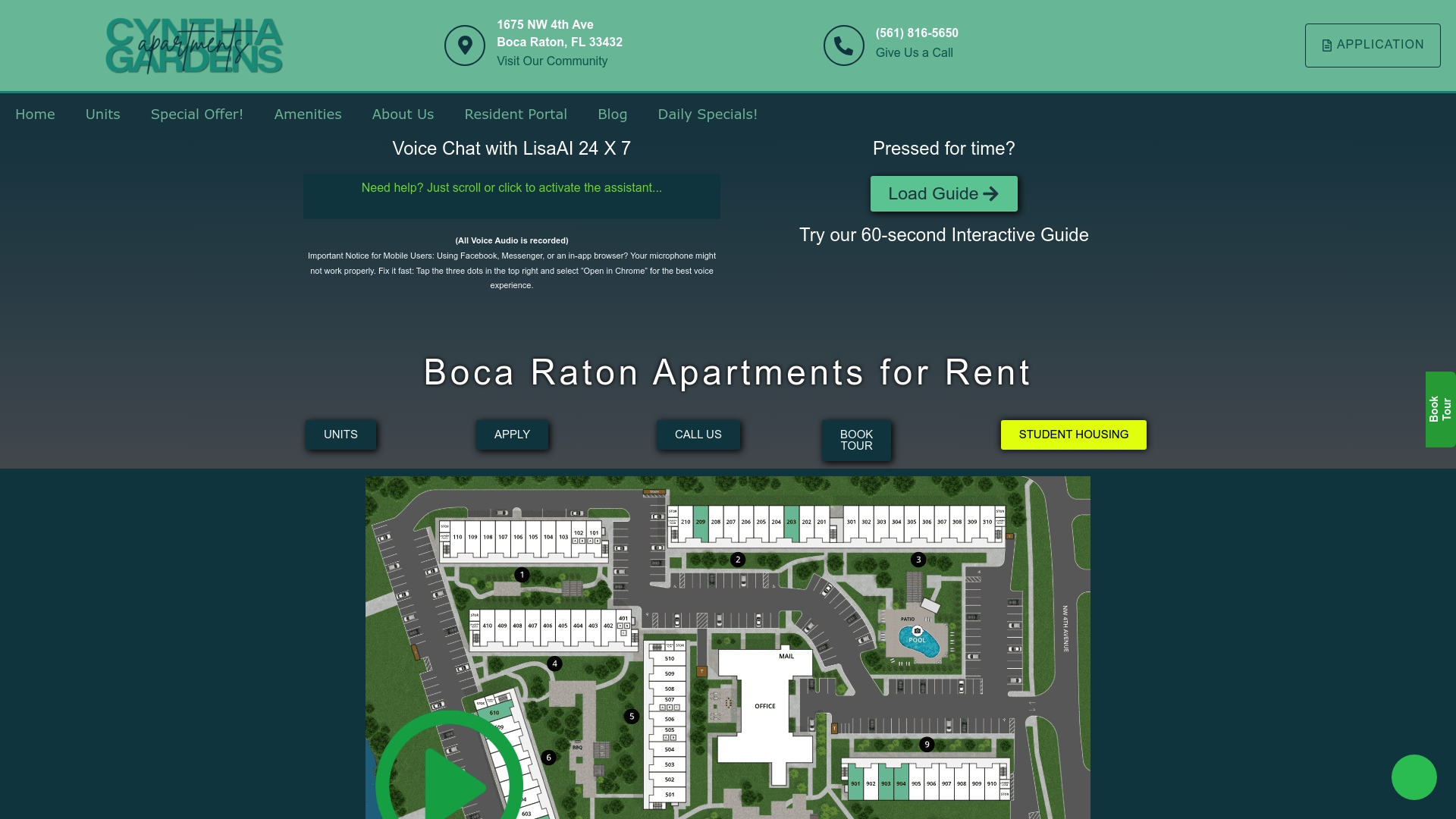
That is how we approach our community: one-bedroom apartments from $1,990 to $2,220 per month, a fee schedule published openly, a cat-friendly policy with a one-time pet fee and no ongoing pet rent, and same-day maintenance. Our leasing process is online, with virtual tours, AI chat support and an interactive property map, so you can compare addresses without burning weekends on the road.
Ayman
See the apartments for yourself
We offer one-bedroom apartments in Boca Raton for young professionals, students and pet owners, with transparent pricing and no hidden fees. You can browse the one-bedroom apartments, take a virtual tour and apply online.
If you want furnished short- or long-term options, see our furnished apartments. To compare the neighborhood setting first, our Boca Raton rental guide covers pricing and areas.
FAQ
Is it better to live in East Boca or West Boca?
East Boca suits you if you want walkability, the beach, Mizner Park and the Brightline station. West Boca suits you if you want quiet streets, larger parks and a car-based routine. Central Boca, near FAU, sits in between and is a common choice for students.
Do I need a car if I live near the beach in Boca Raton?
In East Boca you can walk to many daily needs and use Brightline for regional trips. Most people still keep a car, because beach parks charge for vehicle entry and weekend lots fill up. Inland, a car is essential for most routines.
How much does beach parking cost in Boca Raton?
As of October 1, 2026, city and Beach and Park District residents pay $90 for an annual permit covering all three beach parks. Other Palm Beach County residents pay $108 for South Beach only. Daily entry is $40 on weekdays and $55 on weekends and holidays, per the city’s fee page.
Does a Boca Raton mailing address make me a city resident?
Not always. Some neighborhoods with Boca Raton addresses, especially in the west, are in unincorporated Palm Beach County. Check the city’s limits map against your property address before you buy a permit.
Are cats allowed in your apartments, and what does it cost?
Yes. Our pet fee is a one-time, non-refundable $300 to $500 per cat, and there is no ongoing monthly pet rent.
Sources
- Beach Permits & Daily Rates, City of Boca Raton
- Boca Raton Train Station, Brightline
- Homeowner’s Handbook To Prepare For Natural Disasters, Florida Sea Grant
- Waterfront or Inland Living in Boca Raton?
- East Boca vs. West Boca: Which Side of the City Fits Your Life
- East vs West Boca Raton: Find the Right Fit
- Your Boca Raton Guide to Coastal Life & Neighborhood Vibes
- Living Near Boca Raton Beaches: What Daily Life Feels Like
- East vs West Boca Living: Which Side Fits You?
- Boca Raton, FL Local Guide: Areas, Traffic & Daily Life
- Moving to Boca Raton, FL: Cost of Living and Neighborhoods
- Beach vs Inland South Florida: The Real Cost (2026)
- Boca Raton East vs West: Choose the Side That Fits You
- Boca Raton Coastal vs West: Find Your Best Fit
- OsteoStrong East Boca