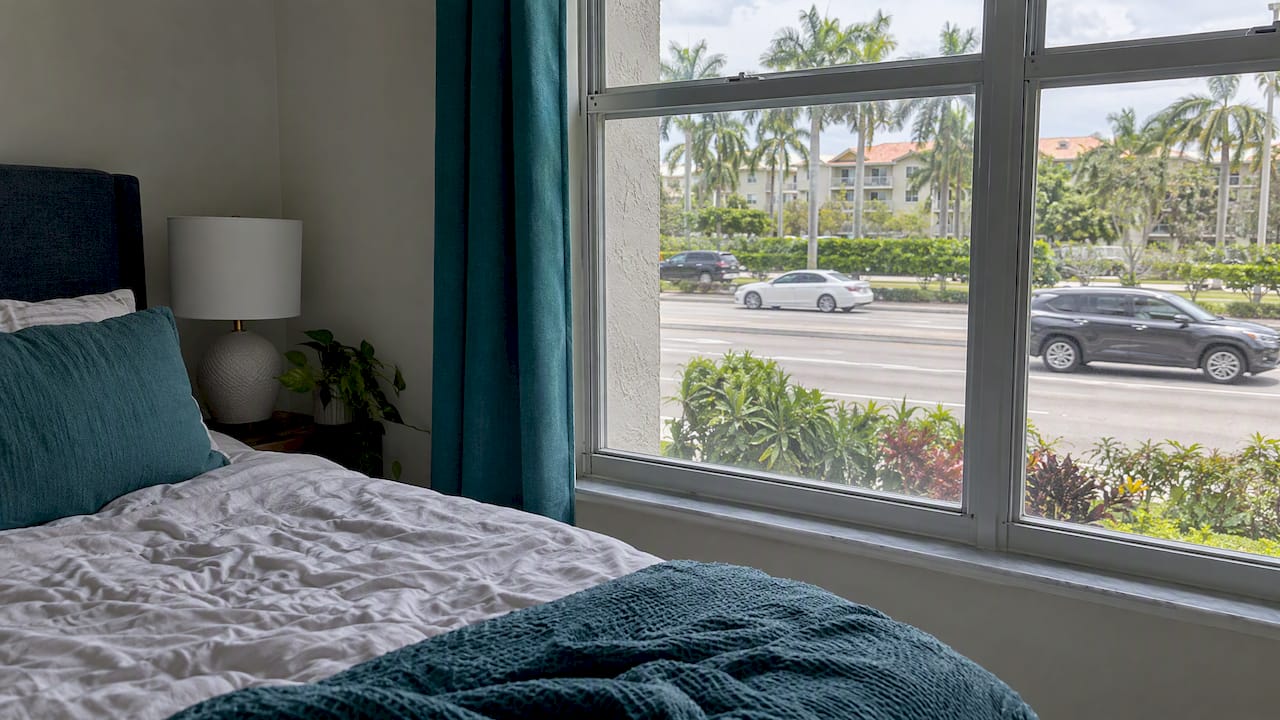
Seal air gaps, add heavy textiles, and prioritize bedroom placement away from the road: these three moves produce the biggest, fastest reductions in road noise inside an apartment. Weatherstripping and curtains help within a day, but if your bedroom shares a wall with the street, swapping it for a quieter room often matters more than any product you can buy.
TL;DR:
- Touch the wall: a felt hum signals vibration traveling through the building, which needs structural isolation; airborne traffic noise usually responds to sealing.
- A quiet side bedroom cut predicted moderate annoyance from 45% to 10% in one study; another found sleep benefits near 20 decibels.
- Secondary glazing inserts add an air gap without replacing windows, but airtight sealing can reduce ventilation, so maintain mechanical airflow or schedule airing.
- Road barriers cut noise about 5 to 10 decibels near ground level within roughly 200 feet, but gaps or views over them weaken protection.
- Document noise through maintenance requests and log times; report road noise to management or local authorities, and consider a quieter unit if it persists.
Table of Contents
- How road and traffic noise reaches your apartment
- Low-cost renter-friendly fixes you can do today
- Window and door upgrades that cut noise further
- Building and neighborhood noise measures, and when to escalate
- Bedroom placement and the quiet side effect
- Sleep tactics while you work on the rest
- Our take on quiet living from the ground up
- Another option: moving to a quieter unit entirely
- FAQ
- Sources
How road and traffic noise reaches your apartment
Before fixing anything, figure out whether you’re dealing with airborne sound or structural vibration, because the fixes differ. Airborne noise travels through the air and sneaks in through gaps: it sounds like tire hiss, horns, or conversations carried on wind. Structure-borne vibration travels through the building itself: it shows up as a low rumble or a felt shudder, often from heavy trucks, buses, or trains, and no amount of curtain or caulk will stop it because it moves through concrete and framing rather than open air.
A quick way to tell them apart: stand near a wall and see if you feel a hum through your palm. If you do, you’re dealing with vibration, which usually requires structural isolation rather than sealing. If the sound rises and falls with traffic but you feel nothing, it’s airborne, and sealing will help.
Road noise typically enters through a predictable set of weak points:
- Windows, especially single-pane glass and loose frames
- Door gaps and worn weatherstripping
- Balcony door thresholds and sliding tracks
- Vents, exhaust fans, and through-wall air conditioning units
- Thin walls shared with hallways or exterior facades
Floor level and sightline to the road also matter. Lower floors tend to catch more direct noise because they sit closer to the source and often lack any barrier between the unit and traffic. As you go up, exposure can actually increase again once you clear nearby buildings or trees that were blocking the sound, so the relationship between floor height and noise isn’t always a straight line down.
Low-cost renter-friendly fixes you can do today
These fixes require no permission from a landlord, leave no permanent marks, and can meaningfully reduce what you hear within hours.
- Weatherstrip your windows and doors. Press-in foam or V-strip weatherstripping seals the gaps where sound sneaks through frames; apply it along the full perimeter, not just the obvious gaps.
- Install a door sweep. A sweep under your entry or balcony door closes the gap at the floor, which is often the single leakiest spot in an apartment.
- Add removable acoustic caulk around trim. Temporary, peelable sealants close hairline gaps between the window frame and wall without damaging paint.
- Hang heavy curtains over every noise-facing window. Dense, lined curtains absorb and dampen sound; the heavier and more floor-to-ceiling they are, the better they work.
- Use window plugs or removable acoustic panels. Foam-core inserts cut to fit the window frame work well overnight and can be pulled out for daytime light and airflow.
- Layer rugs and soft furniture. Hard floors and bare walls bounce sound around the room, so a thick rug and upholstered furniture reduce reflected noise.
- Seal balcony door thresholds and track gaps. Foam tape along the sliding track closes a common, overlooked leak point.
- Screen or seal through-wall vents when not in use. A removable acoustic vent cover or foam insert blocks a direct path to the outside without affecting airflow when you take it out.
- Add white noise at the source of disruption. A fan or dedicated white noise machine placed near the window can mask residual traffic sound that sealing alone won’t catch.
Pro Tip: Layer your fixes: seal first, add soft textiles second, then mask whatever’s left with white noise. Each layer catches what the one before it missed.
What can you realistically expect? Sealing and heavy textiles won’t eliminate road noise, but combined, they noticeably reduce how loud and intrusive it feels, especially for mid and high-frequency sounds like tire hiss and voices. Rumbling, low-frequency engine noise is harder to touch with soft fixes alone. For a full renter-safe walkthrough, our apartment soundproofing tips guide breaks down which fixes to try first depending on your budget.
Window and door upgrades that cut noise further
When sealing and textiles aren’t enough, the next tier of fixes targets the windows and doors themselves, and the gains here are bigger but require more investment or landlord cooperation.
- Secondary glazing or acoustic window inserts add a second pane of glass or acrylic a few inches behind your existing window, creating an air gap that interrupts sound transmission. These are removable, don’t require replacing the original window, and can be requested as a reasonable accommodation in some leases.
- Storm windows offer a similar air-gap principle at a lower cost than full replacement, though performance depends heavily on how airtight the installation is.
- Full window replacement with laminated or dual-pane acoustic glass delivers the largest gains, but it’s a landlord decision in most rental situations, not a renter DIY project.
- Solid-core interior and entry doors block more sound than hollow-core doors, and pairing one with a quality perimeter seal and an adjustable threshold closes the remaining gaps. One day door replacement specialist walks through which door and seal combinations perform best for noise, which is useful if you’re asking your property manager to consider an upgrade.
Pro Tip: Airtight installation matters more than glass thickness. A thin pane sealed perfectly often outperforms thick glass in a leaky frame.
One tradeoff worth planning for: sealing windows tightly reduces natural airflow. HUD guidance warns that sealing windows for noise without adequate mechanical ventilation can hurt indoor air quality, so pair any serious sealing project with a bathroom fan, trickle vent, or periodic scheduled airing rather than keeping everything shut around the clock.
Building and neighborhood noise measures, and when to escalate
Some noise problems are bigger than any single unit can fix, and it helps to know where the ceiling is before you spend more money or energy chasing a result that isn’t achievable from inside your apartment.
- Noise barriers built along highways and major roads typically reduce sound levels by about 5 to 10 decibels for nearby ground-level units, and they work best within roughly 200 feet of the roadway.
- Line-of-sight and gaps in a barrier matter enormously: once a wall or berm breaks your direct sightline to the road, each additional meter of distance adds further reduction, but any opening in the barrier undercuts its effectiveness.
- Vegetation alone rarely moves the needle much; FHWA guidance notes that a planted buffer would need to be roughly 200 feet wide to achieve a meaningful 10 dB reduction, which is impractical for most properties.
- Unit elevation changes exposure in ways a barrier can’t fix: upper floors that clear a barrier’s height often hear more direct road noise than ground-floor units shielded behind it.
For noise coming from inside the building, a maintenance ticket documenting the issue is the right first step, and keeping a simple log of dates and times strengthens your case if the problem continues. When the noise source is the road itself, that’s a conversation for building management or local authorities rather than maintenance, since it usually involves infrastructure outside the property line. Our guide on apartment noise laws covers how to document complaints properly, and our piece on the Boca Raton noise ordinance walks through how local noise complaint processes typically work. If none of this moves the needle and the unit’s exposure is simply too high, asking about a transfer to a quieter unit in the same building, or looking elsewhere entirely, is often the most pragmatic path.
Bedroom placement and the quiet side effect
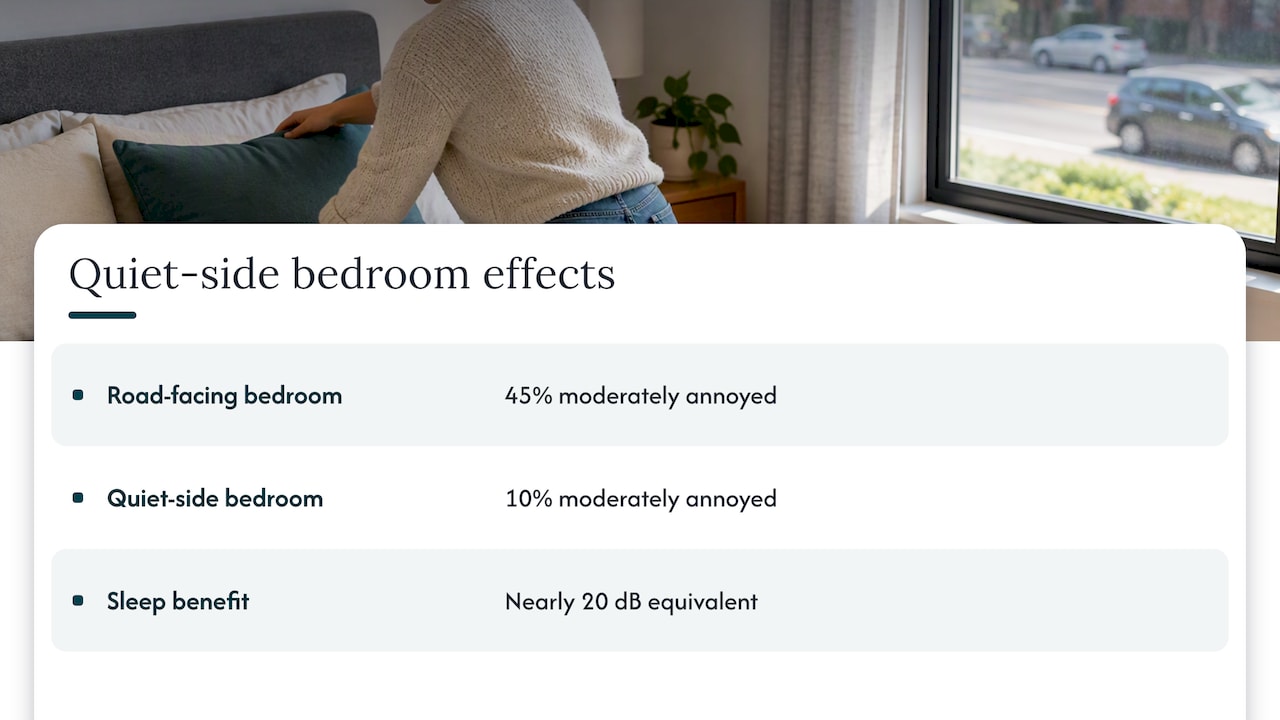
The single most effective non-construction move you can make is putting your bedroom on the side of the building that faces away from the road. A focused study on the quiet-side effect found that having a bedroom on the quiet side reduced the predicted chance of being moderately annoyed by road noise from 45% down to 10% in the sampled dwellings, a difference far larger than most retrofit products deliver on their own.
The SiRENE study backs this up at a larger scale, finding that bedroom orientation toward a quiet facade can provide a sleep disturbance benefit equivalent to nearly 20 decibels in some cases, making it one of the most powerful levers available to anyone who can act on it.
Having a bedroom on the quiet side reduced the predicted chance of being moderately annoyed from 45% to 10% in the sampled dwellings.
If your apartment has any room facing away from the street, even a smaller one, consider swapping its function with your current bedroom. A living room with no obvious reason to face the street can become your sleeping space, while the noisier room becomes the living area where background sound matters less. When no quiet-facing room exists, concentrate your soft furnishings, heavy curtains, and white noise setup in whichever space you sleep in to approximate the effect as closely as possible.
Sleep tactics while you work on the rest
While you’re sealing gaps or waiting on a window upgrade, a few sleep adjustments reduce disturbance immediately.
- Use broadband white noise (a steady hiss across frequencies) rather than tuned nature sounds, since it masks irregular traffic noise more consistently.
- Choose foam or silicone earplugs rated for sleep comfort, not just noise reduction, since a poor fit causes more tossing and turning than the noise itself.
- Position your bed against an interior wall rather than the wall facing the road whenever your layout allows it.
- Use blackout curtains that are also heavy and lined, since the same density that blocks light also dampens sound.
Pro Tip: If you find yourself needing louder white noise every few weeks to get the same effect, that’s a sign of habituation, not improvement. Getting used to noise isn’t the same as sleeping well through it, and ongoing sleep disruption is worth mentioning to a doctor.
Our take on quiet living from the ground up
We think a lot of noise advice stops at products and skips the room-by-room thinking that actually solves the problem. A bedroom swap costs nothing and often does more than a $200 window insert, yet it’s the step most renters skip because it feels disruptive. We encourage residents to document noise issues through maintenance requests as soon as they notice a pattern, since a dated record makes any later conversation about a unit transfer or building fix far easier to have. Quiet living is rarely about one fix: it’s about stacking the right ones in the right order for your specific layout.
— Ayman
Another option: moving to a quieter unit entirely
Sometimes the fastest fix isn’t a product at all: it’s a different unit with a quieter facade and better-sealed windows from the start. Our community is designed to put living spaces toward the street and bedrooms toward quieter courtyards where possible, with transparent pricing and a digital leasing process so you can tour and compare units.
If chronic road noise has you considering a move rather than another round of retrofits, you can browse our one-bedroom apartments and take a virtual tour before deciding, or read our guide on how to find quiet rental units for what to check before you sign a new lease.
FAQ
How to deal with road noise in an apartment?
Start by sealing window and door gaps with weatherstripping and a door sweep, then add heavy curtains and rugs to absorb sound. If the noise persists after those fixes, consider a secondary glazing insert or ask about transferring to a unit with a quieter bedroom facade, since research shows that orientation alone can cut the chance of being annoyed by more than half.
What can cause loud road noise?
Road noise comes from a mix of tire friction, engine sound, and braking, and it reaches your apartment through gaps around windows and doors, thin walls, and vents. Heavier vehicle traffic and higher speeds both raise noise levels, and proximity to the road without a barrier makes any of these sources more noticeable indoors.
How many floors up to avoid street noise?
There’s no fixed floor that guarantees quiet, since exposure depends on nearby barriers, building height, and sightline to the road rather than floor number alone. Ground floors often get the most direct noise, but upper floors that clear a nearby barrier’s height can end up more exposed than a lower unit shielded behind it, according to FHWA guidance on barrier effectiveness.
How to sleep next to a noisy road?
Use broadband white noise to mask irregular traffic sound, choose comfortable sleep-rated earplugs, and position your bed against an interior wall rather than one facing the street. A 2022 meta-analysis found that a 10-decibel increase in nighttime road noise roughly doubles the odds of reporting high sleep disturbance, which is why nighttime-focused fixes like these matter more than daytime ones.
Sources
- Updated meta-analysis on environmental noise and sleep disturbance (2022)
- FHWA policy and guidance on noise barriers and abatement
- Focused study on the quiet side effect in dwellings exposed to road traffic noise
- HUD guidance on noise acceptability and interior/exterior noise thresholds