Table of Contents
- Apartment Lease vs Month to Month Rental: Key Differences
- Comparison Table: Lease vs Month-to-Month
- Pros and Cons of Month to Month Lease
- Pros and Cons of Fixed-Term Apartment Leases
- Lease Termination Notice Requirements
- Breaking a Fixed Term Lease: Options and Consequences
- Flexibility vs Stability: Which Rental Agreement Fits Your Lifestyle?
- Rent Increase Potential and Financial Implications
Last Updated: July 1, 2026
Apartment Lease vs Month to Month Rental: Key Differences
Understanding the distinction between an apartment lease and a month-to-month rental is essential for anyone navigating the housing market. These two rental structures offer fundamentally different levels of commitment, flexibility, and financial implications that significantly impact your lifestyle and budget. Whether you’re relocating for work, seeking temporary housing, or establishing roots, knowing which rental agreement suits your needs is critical.
What is a Fixed-Term Apartment Lease?
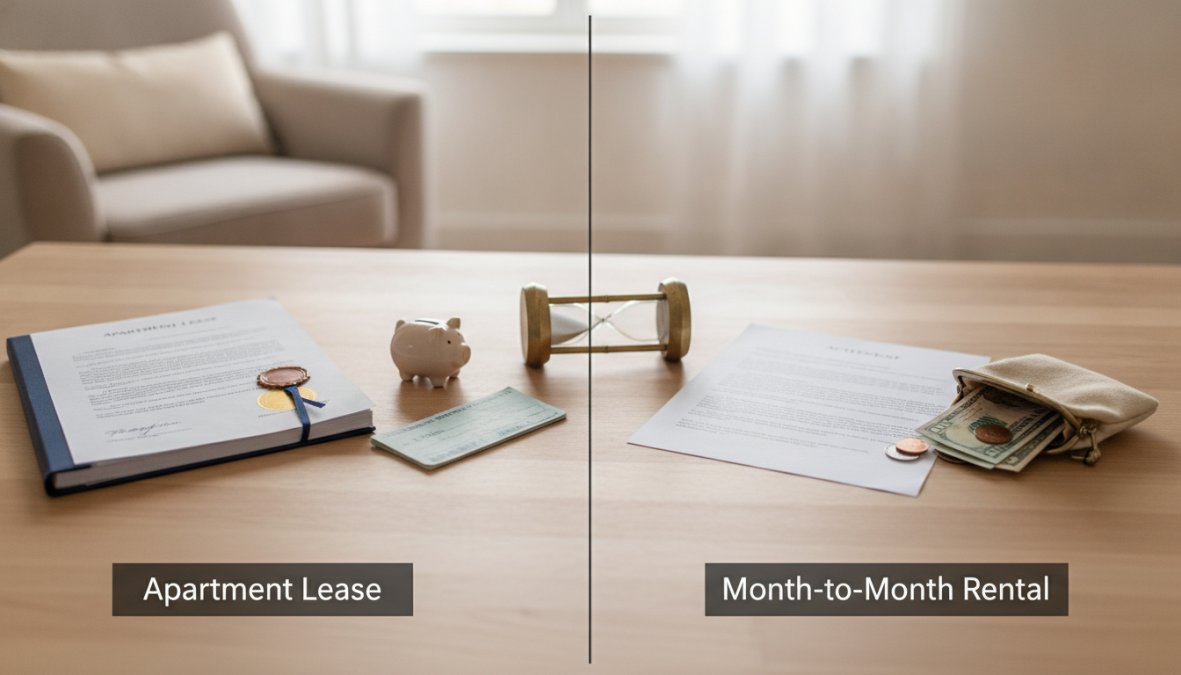
A fixed-term apartment lease is a legally binding rental agreement that commits both landlord and tenant to a specific term, typically 12 months. Once signed, you’re obligated to pay rent for the entire duration, and the landlord cannot raise your rent or ask you to leave without cause before expiration.
Fixed-term leases provide predictability: your rent is locked in for the entire agreement period, protecting you from unexpected increases. This structure benefits landlords with stable income and tenants with housing stability and budgeting certainty.
What is a Month-to-Month Rental?
A month-to-month rental is a flexible tenancy that renews automatically each month unless either party provides notice to terminate, typically 30 days. This arrangement offers maximum flexibility for both parties but comes with trade-offs: landlords can raise rent with proper notice, and tenants have less stability.
Month-to-month arrangements are ideal for people needing short-term housing or uncertain about long-term plans. Many begin after a fixed-term lease expires or serve tenants seeking temporary solutions.
Comparison Table: Lease vs Month-to-Month

| Feature | Fixed-Term Lease | Month-to-Month Rental |
|---|---|---|
| Commitment Length | 6-12 months (typically 12) | Renews monthly, either party can terminate |
| Rent Increases | Locked in for lease term | Can increase with 30-60 day notice |
| Notice to Vacate | Typically 30-60 days before expiration | 30-60 days depending on state |
| Stability | High, predictable housing situation | Low, can end or change terms monthly |
| Flexibility | Low, breaking lease has penalties | High, exit with proper notice |
| Best For | Long-term residents, families, stability seekers | Short-term needs, uncertain timelines |
| Landlord Perspective | Predictable income, reduced vacancy risk | Higher turnover, rent flexibility |
| Tenant Perspective | Budget certainty, housing security | Freedom to leave, adaptability |
Pros and Cons of Month to Month Lease
Advantages for Tenants
Month-to-month rentals offer substantial flexibility. You can leave with 30 days’ notice without penalty, making these arrangements ideal for temporary jobs, home purchases, or testing neighborhoods. The lack of long-term commitment means job loss or family emergencies won’t trap you in an unaffordable lease.
You can also negotiate more frequently. If your landlord wants to retain you, they may offer concessions on rent increases or maintenance to keep you as a tenant.
Request written confirmation of the monthly rent amount and lease terms. This protects you from unexpected disputes about verbal agreements.
Disadvantages for Tenants
Rent instability is the primary concern: landlords can increase rent with 30 days’ notice in most states, with no cap on increases. If your neighborhood becomes desirable, you could face substantial increases that force relocation.
Housing insecurity is another major disadvantage. Your landlord can choose not to renew your tenancy for any legal reason, giving you just 30 days to find new housing. Families with children, elderly residents, and people with pets often find this stressful.
Month-to-month tenants also face challenges with credit and housing applications. Many landlords view month-to-month tenancy as instability, affecting your ability to qualify for future leases or mortgages.
Frequent month-to-month moves can damage your rental history. Multiple short-term tenancies appear as red flags to landlords, making it harder to qualify for premium apartments or favorable mortgage rates.
Pros and Cons of Fixed-Term Apartment Leases
Advantages for Tenants
Fixed-term leases provide housing stability essential for building your life. Your rent is locked in for the entire term, allowing you to budget with certainty and plan long-term expenses without worrying about unexpected increases.
A fixed-term lease also strengthens your rental history and creditworthiness. Landlords and lenders view long-term commitments as evidence of stability and reliability, improving your chances of approval for future housing or financing.
Fixed-term leases provide legal protection against arbitrary eviction. Your landlord cannot ask you to leave without cause during the lease term, and they cannot raise your rent. This security allows you to invest in your living space and plan your life without constant threat of displacement.
Disadvantages for Tenants
The primary disadvantage is inflexibility. If circumstances change, job loss, family relocation, or simply wanting to move, you’re contractually obligated to continue paying rent. Breaking a lease early typically results in financial penalties and potential legal consequences.
The costs can be substantial. Most leases include early termination fees, and you may be responsible for rent until the landlord finds a new tenant. In some cases, landlords pursue legal action, damaging your credit and rental history.
Fixed-term leases also lock you into a specific property and neighborhood. If the location doesn’t work or your needs change, you’re stuck for the remainder of the lease.
Before signing a fixed-term lease, thoroughly inspect the property and ensure the location suits your lifestyle. The longer commitment makes this decision critical.
Lease Termination Notice Requirements
30-Day vs 60-Day Notice Periods
Notice requirements vary by state and lease agreement. Most month-to-month rentals in Florida require 30 days’ notice to terminate, though some landlords may require 60 days. Fixed-term leases typically specify notice requirements in the lease document, often 30-60 days before expiration if you don’t plan to renew.
The difference is substantial when planning a move. A 30-day notice gives you one month to find housing and arrange logistics. A 60-day notice provides more time for thorough planning. Always clarify this requirement before signing, as misunderstanding notice periods is a common source of disputes.
State-Specific Legal Variations
Rental laws vary dramatically by state. In Florida, the default notice period for month-to-month tenancies is 15 days unless the lease specifies otherwise, though many landlords include 30-day or 60-day clauses. Your specific lease terms control the notice requirement.
Florida also requires landlords to provide at least 30 days’ notice of any rent increase before a fixed-term lease expires, giving you time to negotiate or decide whether to renew.
If you’re relocating to Boca Raton from another state, research Florida’s specific landlord-tenant laws. Florida Statutes Chapter 83 governs residential tenancies and is worth reviewing before signing any rental agreement.
Florida Statutes Chapter 83 on residential tenancies
Breaking a Fixed Term Lease: Options and Consequences
Early Termination Fees and Penalties
Breaking a fixed-term lease before expiration typically triggers financial penalties. Most leases include an early termination fee, typically ranging from one month’s rent to three months’ rent, depending on lease terms and remaining time.
Beyond the termination fee, you may be responsible for rent until the landlord re-rents the unit. If your lease has 6 months remaining and you leave after 2 months, you could be liable for the remaining 4 months. However, many states require landlords to make reasonable efforts to find a new tenant, reducing your liability once they’ve re-leased the unit.
Some leases include buyout clauses specifying the exact early termination cost. Without one, you’re negotiating with the landlord, creating uncertainty.
Impact on Credit and Housing Applications
Breaking a lease and owing unpaid rent severely damages your credit score. If the landlord reports the unpaid balance to credit bureaus, it appears as a collection account, lowering your score and making it harder to qualify for future credit, mortgages, or rental applications.
Future landlords conduct background checks revealing evictions and broken leases. This can result in lease denials, higher security deposits, or co-signer requirements. In competitive rental markets, a damaged rental history can eliminate you from consideration for premium properties.
Mortgage lenders also scrutinize rental history. A history of broken leases damages your ability to qualify for favorable interest rates or loan amounts.
The credit impact of breaking a lease persists for 7 years. Even after resolving the debt, the negative mark remains on your credit report, affecting future housing, auto loans, and credit cards.
Flexibility vs Stability: Which Rental Agreement Fits Your Lifestyle?
Choosing between apartment lease and month-to-month rental depends on your personal circumstances, financial situation, and lifestyle preferences. The decision is about which aligns with your current needs and future plans.
When to Choose Month-to-Month
Month-to-month rentals make sense if you’re in a transitional period or value flexibility above all else. Choose this option if you’re relocating for a temporary job, waiting to purchase a home, or unsure whether you’ll stay long-term.
This option also works well if you’re testing out a neighborhood before committing long-term or have unpredictable circumstances requiring flexibility.
When to Choose a Fixed-Term Lease
Fixed-term leases are ideal if you’re seeking stability and want to establish roots. Choose this option if you plan to stay at least a year, have a stable job, and want security knowing your rent won’t increase.
Families with children particularly benefit from the stability and predictability. Fixed-term leases also make financial sense if you’re building credit and rental history, demonstrating stability to future lenders and landlords.
Choose a fixed-term lease if you value budget certainty and want to avoid stress from potential rent increases or eviction notices.
Rent Increase Potential and Financial Implications
Rent increases represent one of the most significant financial differences between apartment lease and month-to-month rental arrangements.
With a fixed-term lease, your rent is locked in for the entire period. If you sign a 12-month lease at $1,500 per month, your rent remains $1,500 for all 12 months. However, when your lease renews, the landlord can propose a new amount.
Month-to-month rentals offer no rent protection. Landlords can increase rent with 30 days’ notice, with typically no cap on increases. A $1,500 monthly rent could become $1,650 or more within months.
The cumulative financial impact over time is substantial. In a month-to-month rental at $1,500 per month with 5% annual increases, your rent climbs to $1,575 after one year, $1,654 after two years, and $1,737 after three years. Over three years, you’ve paid an additional $1,266 compared to a fixed-term lease locked at $1,500.
According to research from the National Multifamily Housing Council, rent increases in competitive markets have averaged 3-5% annually in recent years. Understanding this trend helps you evaluate whether a fixed-term lease or month-to-month arrangement better suits your financial situation.
National Multifamily Housing Council rent trends data
For residents of Boca Raton considering long-term housing, the financial implications of rent increases make fixed-term leases particularly attractive. Communities like Cynthia Gardens offer stable, predictable housing costs when you commit to a lease term, allowing you to budget confidently without worrying about sudden rent spikes.
Choosing between an apartment lease and month-to-month rental requires careful consideration of your lifestyle, financial goals, and future plans. If you’re seeking a stable, maintenance-free living experience in Boca Raton with beautiful amenities and a serene community atmosphere, Cynthia Gardens offers fixed-term lease options that provide the security and quality of life you deserve. Our modern one-bedroom apartments feature stainless steel appliances, quartz countertops, and access to a resort-style pool and lush landscaped grounds. Schedule a tour today and discover how Cynthia Gardens can provide the stable, refined living experience that transforms your daily life into an effortless Florida lifestyle.
Frequently Asked Questions
Is a month-to-month rental more expensive than an apartment lease?
Month-to-month rentals typically cost 5-10% more per month than fixed-term leases, as landlords charge a premium for flexibility. However, you avoid long-term financial commitment and potential early termination fees. When comparing total costs, factor in the security deposit requirements and whether the landlord offers lease renewal incentives for longer fixed-term agreements.
What notice is required to end a month-to-month rental agreement?
Most month-to-month rentals require 30 days' written notice to vacate, though some states mandate 60 days or more. The specific notice period depends on your state's landlord-tenant law and the language in your rental agreement. Always review your lease carefully and check your state's requirements, as failing to provide proper notice can result in holdover tenant status and potential eviction proceedings.
Can I break a fixed-term lease early without penalties?
Breaking a fixed-term lease typically incurs early termination fees and may damage your rental history. Some landlords allow lease buyouts or will release you if they find a replacement tenant quickly. Early termination can negatively impact your credit score and future housing applications, making it harder to qualify for apartments. Always explore negotiation options before breaking your lease agreement.
What are the main advantages of a fixed-term apartment lease?
Fixed-term leases provide housing stability with predictable rent payments, protection against sudden rent increases, and a clear lease expiration date. They're ideal for professionals seeking long-term housing and those who value knowing exactly when their tenancy ends. Fixed-term agreements also typically offer better rates than month-to-month options and demonstrate housing stability to employers and lenders.
How does month-to-month flexibility benefit renters?
Month-to-month rentals offer short-term flexibility without long-term commitment, making them ideal for those with uncertain plans or frequent relocations. You can leave with 30 days' notice and avoid early termination penalties. This arrangement suits professionals, students, and individuals exploring new cities, though it comes with higher monthly rent and the risk of rent increases or non-renewal at lease expiration.