
TL;DR:
- Transparent leasing builds trust, shortens leases, and reduces disputes, leading to higher occupancy and renewal rates. It significantly increases page views, form submissions, and improves online reputation while lowering negative reviews related to hidden fees. Implementing clear, all-in fee disclosures and a phased rollout can provide measurable operational and financial benefits.
Transparent leasing increases trust, shortens the marketing-to-lease timeline, and cuts disputes before they start. For landlords, that translates directly into faster occupancy, stronger renewal rates, and fewer negative reviews eating into your reputation. The advantages of transparent leasing are not theoretical: 73% higher page views have been reported for listings that display total monthly pricing versus those that hide fees in the fine print.
Here is what landlords gain immediately:
- Faster lease-up: Qualified prospects self-select when they see all-in pricing upfront, compressing the funnel.
- Higher renewal rates: Residents who are never surprised by hidden charges are materially more likely to renew.
- Fewer disputes: Clear written terms eliminate the “I didn’t know about that fee” conversation at move-out.
- Lower marketing spend: Better lead quality means fewer wasted tours and follow-up calls.
- Stronger online reputation: Transparent operators see measurable reputation-score improvements after publishing clear fee disclosures.
- Better NOI: Operator pilots show that consolidating mandatory fees into one monthly price can raise NOI and reduce delinquency.
Table of Contents
- 1. Why transparent leasing gives you a measurable business edge
- 2. What every transparent lease must include
- 3. How to roll out transparent leasing across your properties
- 4. US legal and regulatory considerations you need to check
- 5. Industry data that shows what transparent leasing actually does
- 6. Red flags in leases and listings that erode trust fast
- 7. Tenant-facing disclosure checklist for listings and move-in packets
- Key Takeaways
- A landlord’s perspective on what transparency actually changes
- Cynthiagardens: transparent leasing built into the experience
- Useful sources and further reading
1. Why transparent leasing gives you a measurable business edge
The business case for open leasing terms goes well beyond goodwill. Each advantage connects to a metric landlords already track.
Shorter leasing funnel. When your listing shows a true monthly total, prospects arrive pre-qualified. They have already done the math. That means fewer tire-kickers, shorter tours, and a higher lead-to-lease conversion rate. Operators that display a total monthly price and clear fee disclosures have seen measurable engagement and reputation gains across their portfolios, including higher page views and improved form submissions.
Fewer negative reviews. 56.4% of renters say unclear or unexpected fees would prompt a negative review. That single figure should reframe how you think about your fee schedule: it is a reputation asset, not just an accounting line. Landlords who disclose fees clearly before signing remove the single biggest trigger for one-star reviews.
Higher renewal rates. Residents who feel informed and respected renew. Transparency acts as a trust moment: the resident who was never surprised at month one is the resident who signs again at month twelve. That dynamic shows up in NOI because every renewal avoids a vacancy, a turnover clean, and a new marketing cycle.
Improved lead quality. Showing full costs filters out unqualified prospects earlier. The conversations that remain after a prospect has seen your all-in price are commercially motivated ones. They convert faster and require less leasing-staff time per signed lease.
| Metric | Typical effect after adopting transparent pricing |
|---|---|
| Listing page views | Up to 73% higher (Engrain/MultiHousing News data) |
| Form submissions | Measurable increase reported by NAA panel operators |
| Lead-to-lease conversion | Higher; fewer unqualified tours |
| Renewal rate | Improves when residents report no fee surprises |
| NOI | Pilot operators report gains after fee consolidation |
| Negative reviews (fee-related) | Reduced; fee clarity removes the top trigger |
Cynthiagardens applies this logic directly at its Boca Raton community. By publishing transparent pricing with no hidden fees, the community attracts prospects who already understand what they will pay, which shortens the leasing conversation and supports stronger resident satisfaction scores.
2. What every transparent lease must include
A lease is only as transparent as its least-disclosed clause. These are the elements landlords must cover to meet the standard renters now expect.
Fee schedule (itemized). List every recurring and one-time charge: base rent, pet rent, parking, trash, utility pass-through, and any amenity fees. Label each line clearly. “Admin fee” with no explanation is not transparent; “one-time lease administration fee, nonrefundable” is.

Security deposit rules. State the deposit amount, the conditions under which deductions are made, the timeline for returning the balance, and whether any portion is nonrefundable. Most states set a statutory deadline; publish it in the lease so residents know it before they sign.
Utility billing method. Specify whether utilities are billed as a flat allocation, a ratio utility billing system (RUBS), or direct metering. Residents who discover a RUBS charge after move-in are among the most likely to leave negative reviews.
Pet policy and fees. Distinguish between a pet deposit (potentially refundable) and a pet fee (nonrefundable). State the monthly pet rent separately. Vague “pet charges may apply” language is a red flag.
Entry and notice requirements. Your state’s statute sets the minimum notice period for non-emergency entry (commonly 24 hours). Restate it in plain English in the lease, and add your own policy for scheduled inspections.
Renewal terms and rent increase notice. Specify how far in advance you will notify residents of a renewal offer and any rent adjustment. Sixty days is a common best practice; some states require it by law.
Maintenance timelines. Define your response SLA: emergency repairs within 24 hours, non-emergency within a stated number of business days. This sets expectations and gives you a defensible standard if a dispute arises.
For a deeper look at how clear lease language improves resident satisfaction, the role of transparent lease agreements is worth reviewing before you draft or revise your template.
Sample clause (plain-language model):
Pro Tip: Publish a one-page lease summary — a plain-English snapshot of the five most important financial terms — and hand it to prospects before they read the full document. Residents who understand the summary before signing dispute far fewer charges at move-out.
3. How to roll out transparent leasing across your properties
Implementation does not require a full system overhaul. A phased approach lets you pilot at one property, measure the results, and scale what works.
Step 1: Audit your current fee structure. Pull every charge residents pay, including any buried in addenda. List them in a spreadsheet with the label used in the lease, the label used in marketing, and whether the two match. Mismatches are your first remediation targets.
Step 2: Consolidate mandatory fees into one monthly total. Add base rent, mandatory pet rent, parking, and any required utility fees into a single “total monthly cost” figure. Display that number prominently on every listing. Optional fees (storage, premium parking) stay separate but labeled.
Step 3: Update listings and your property website simultaneously. An ILS listing that shows the total monthly cost while your website still shows base rent only creates distrust the moment a prospect compares the two. Keep every channel synchronized.
Step 4: Train leasing staff on the disclosure script. Every team member should be able to walk a prospect through the full monthly cost in under two minutes, explain each line, and answer the three most common fee questions without hesitation. Script it, practice it, record it.
Step 5: Publish a sample Month 1 ledger. A one-page statement showing exactly what a new resident will see on their first invoice removes ambiguity entirely. Post it on your website and include it in your digital leasing packet.
Step 6: Implement a tenant portal for ongoing transparency. Online payment platforms, maintenance-request tracking, and digital lease storage give residents a running record of every transaction. Automated maintenance logs show when a request was submitted, assigned, and resolved, which protects you legally and builds resident confidence. Digital leasing tools make this step easier to operationalize at scale.
Step 7: Add a pricing calculator or virtual tour to your listing. Renters using price-calculator tools report higher confidence, which correlates to faster lease-up and increased retention. Virtual tours paired with full fee disclosure let out-of-area prospects commit with confidence.
Pro Tip: Pilot the full transparency rollout at one property for 60 days before scaling. Track lead-to-lease conversion, tour-to-application rate, and fee-related questions in lead notes. Those three inputs will tell you exactly what is working before you invest in a portfolio-wide update.
4. US legal and regulatory considerations you need to check
Transparency is good practice. In a growing number of states and cities, it is also the law.
Key disclosure areas landlords must verify for their jurisdiction:
- Application fees: Several states cap or regulate application fees and require written disclosure of what the fee covers and whether it is refundable.
- Security deposit limits: State statutes commonly cap deposits at one to two months’ rent and set strict timelines for return (often 14–30 days after move-out).
- Late-fee limits: Many states cap late fees as a flat dollar amount or percentage of monthly rent. Publishing a late fee that exceeds the statutory cap creates legal exposure.
- Required fee language: Some jurisdictions require specific statutory language in the lease for certain disclosures. A clause that is transparent but uses the wrong phrasing may still be non-compliant.
- Rent increase notice periods: State law sets minimum notice periods for rent increases, typically 30–60 days. Some localities require longer notice for larger increases.
Where to publish fee disclosures:
- ILS listings (Zillow, Apartments.com, and similar platforms)
- Your property website’s pricing or floor-plan page
- The lease itself and a plain-language lease summary
- Move-in packet and welcome letter
Keep all four channels synchronized. A fee that appears on your website but not in the lease, or vice versa, is a compliance and trust problem.
Pro Tip: State statutes change. Review your lease template against your state’s landlord-tenant act annually, and consult a licensed real estate attorney for any jurisdiction-specific edge cases. This article is general information, not legal advice — confirm current rules with your state’s housing authority or a qualified attorney for your specific situation.
5. Industry data that shows what transparent leasing actually does
The evidence for transparent leasing is no longer anecdotal. A growing body of operator data and renter research quantify the impact.
“Fee transparency ranks as renters’ top information need — and 56.4% of renters say unclear or unexpected fees would prompt a negative review.”
— SatisFacts 2025 Renter Study
| Metric | Reported effect | Source |
|---|---|---|
| Listing page views | ~73% higher when total monthly price is shown | MultiHousing News / Engrain |
| Form submissions | Measurable increase across operator panels | NAA/Apartmentalize |
| Renter confidence | Higher when pricing calculators are available | Resi / Multifamily Executive |
| Negative reviews (fee-related) | 56.4% of renters cite hidden fees as trigger | SatisFacts 2025 |
| NOI | Pilot operators report improvement after fee consolidation | MultiHousing News AIM report |
| Delinquency | Reduced in some pilots after simplifying fee presentation | MultiHousing News AIM report |
First-mover operators that adopted total monthly pricing saw NOI improvements and large percentage gains in page views and form activity. Fee transparency is also becoming an expected baseline rather than a differentiator, which means operators who delay are ceding ground, not just missing an opportunity.
For a community like Cynthiagardens, tracking the right signals matters as much as publishing clear fees. Useful metrics to monitor include: site visits to the pricing page, form submissions per listing view, fee-related questions in lead notes, and renewal-offer acceptance rates. Qualitative inputs, such as open-ended survey responses and review content, often surface fee-related sentiment before it shows up in aggregate scores.
6. Red flags in leases and listings that erode trust fast
Most transparency failures are not intentional. They are the result of outdated templates, inconsistent copy across channels, or fee labels that made sense internally but confuse residents. Here is what to look for and how to fix each one.
- Ambiguously labeled fees (“admin fee,” “processing charge,” “convenience fee” with no explanation). Fix: add a one-line description of what each fee covers directly next to the label.
- Inconsistent numbers across channels (ILS shows $1,450/mo, website shows $1,395/mo base). Fix: publish total monthly cost everywhere and audit all channels after any pricing change.
- Vague maintenance timelines (“we will address your request as soon as possible”). Fix: set a written SLA — emergency within 24 hours, non-emergency within [X] business days — and put it in the lease.
- Buried pet fees in addenda that residents do not read until move-in. Fix: summarize all pet-related charges in the main lease body and in listing copy.
- Nonrefundable charges labeled as “deposits” (legally and ethically problematic in most states). Fix: use “fee” for nonrefundable charges and “deposit” only for refundable ones, consistently.
- Renewal terms that appear only in fine print. Fix: include a plain-language renewal section and send a proactive renewal offer 60 days before lease end.
- Overcomplicated acronyms (RUBS, CAM, NNN) with no plain-English explanation. Fix: define every acronym the first time it appears in the lease.
Monitor where red-flag complaints surface: Google reviews, ILS ratings, lead notes from prospects who did not convert, and move-out surveys. Fee-related language in those channels is your early-warning system. Landlords looking to spot hidden rental fees from a renter’s perspective will find that exercise useful for auditing their own disclosures.
7. Tenant-facing disclosure checklist for listings and move-in packets
On your listing page, show:
- Total monthly cost (base rent + all mandatory recurring fees)
- Security deposit amount and refund conditions (one line)
- Pet policy: monthly pet rent, pet fee (nonrefundable), pet deposit (refundable), breed/weight limits
- Parking: included or fee, amount
- Utility billing method (included, RUBS, or direct meter)
- Lease term options (6-month, 12-month, month-to-month)
- Application fee amount and whether it is refundable
In the lease summary (one-page document):
- Month 1 total cost itemized (rent + all fees + estimated utilities if applicable)
- Security deposit amount, deduction conditions, return timeline
- Maintenance request process and response SLA
- Entry/notice policy
- Renewal notice timeline and process
During tours or virtual visits, cover verbally:
- Walk through the Month 1 ledger line by line
- Confirm pet policy details if applicable
- Explain the maintenance request process and expected response times
- State the renewal timeline so residents know when to expect an offer
Sample listing copy snippet:
Operators that display total monthly price and clear fee details in their listings report improved search visibility and lead conversions. For a practical look at how to structure this for a Boca Raton audience, the transparent pricing guide offers a useful model. Understanding how condo maintenance fees are disclosed in other property types can also sharpen how you frame recurring charges for prospective residents.
Key Takeaways
Transparent leasing is the single most direct lever landlords have for improving lead quality, renewal rates, and online reputation simultaneously.
| Point | Details |
|---|---|
| Publish total monthly cost | Show all-in pricing on every listing channel; operators report up to 73% higher page views. |
| Disclose fees before signing | 56.4% of renters cite unexpected fees as the top trigger for a negative review. |
| Synchronize all channels | ILS, website, and lease must show identical figures; mismatches destroy trust instantly. |
| Pilot tools before scaling | Test tenant portals, pricing calculators, and virtual tours at one property for 60 days first. |
| Cynthiagardens as a model | Cynthiagardens publishes no-hidden-fee pricing and uses digital leasing tools to give Boca Raton residents full cost clarity before they sign. |
A landlord’s perspective on what transparency actually changes
The conventional wisdom treats fee transparency as a compliance checkbox. That framing undersells it and, in practice, leads landlords to do the minimum: add a fee schedule to the lease and call it done.
What actually changes when you commit to full transparency is the quality of the relationship from day one. A prospect who arrives at a tour already knowing the total monthly cost is not there to negotiate; they are there to confirm. That shift in dynamic is worth more than any individual fee disclosure. It shortens the leasing conversation, reduces the adversarial energy that drives disputes, and sets a tone that carries through the entire tenancy.
The operators who see the strongest results treat transparent pricing as a value-framing tool, not a commodity-comparison sheet. They use it to justify service levels and attract residents who are buying into a community, not just hunting for the lowest base rent. That distinction shows up in renewal rates and in the quality of online reviews, which are increasingly the first thing a prospective resident reads before they ever contact a leasing office.
For smaller landlords managing a handful of units, the same logic applies at a smaller scale. Publish your total monthly cost. Hand every prospect a one-page lease summary before they read the full document. Set a written maintenance SLA. Those three steps alone will separate you from the majority of independent landlords in your market.
Cynthiagardens: transparent leasing built into the experience
No-hidden-fee pricing is not a feature Cynthiagardens added after the fact. It is the foundation of how the community presents itself to prospective residents in Boca Raton.
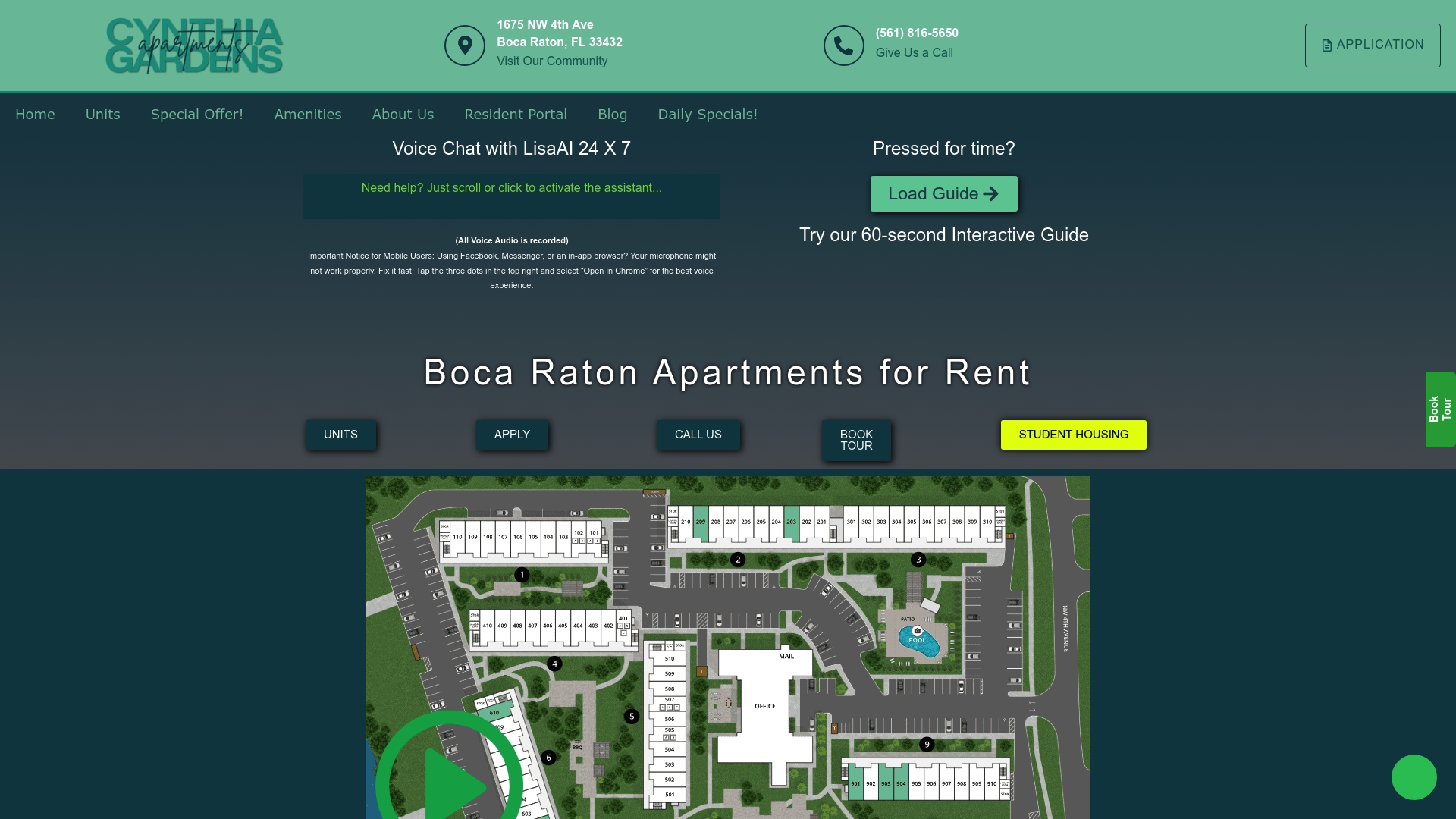
Every listing shows the true monthly cost. The leasing process runs through AI chat support, voice assistance, and virtual tours so prospects can confirm every detail before they ever step on-site. The interactive property map lets renters explore unit options and pricing in real time. For young professionals, students, and pet owners who have been burned by surprise fees elsewhere, that level of clarity is the deciding factor.
If you are a landlord looking to see what a fully transparent leasing experience looks like in practice, browse the apartment styles and features at Cynthiagardens or walk through the one-bedroom leasing workflow to see how fee clarity is built into every step of the process.
Useful sources and further reading
- Fee Transparency that Works — National Apartment Association: NAA/Apartmentalize panel data on engagement and reputation gains from total monthly pricing; use for conversion and reputation claims.
- Why Fee Transparency Is a Must in 2026 — SatisFacts: 2025 renter study with the 56.4% negative-review trigger statistic; essential for reputational risk arguments.
- AIM Special Report: Measurable Benefits of Fee Transparency — MultiHousing News: Engrain data on 73% page-view lifts and NOI pilot results; strongest quantitative source in this piece.
- Fee Transparency as a Leasing Strategy — Resi: Covers pricing calculators and the confidence-to-conversion link; useful for best-practices sections.
- Why Fee Transparency May Be the Focal Amenity for Renters — Multifamily Executive: Industry framing of transparency as an expected baseline; supports the competitive-urgency argument.
- Creating Transparent Lease Agreements — LandKreek: Practical guidance on lease drafting and plain-language clause construction; useful for lease-template work.
- Why Transparency Is Important in Property Management — Platuni: Covers digital tools, maintenance logs, and the landlord-protection case for transparency; good for operational implementation.
- Why Property Management Fee Transparency Wins Landlords — TYPZA: Detailed argument for fee transparency as a lead-qualification and conversion tool; strong support for the lead-quality advantage.