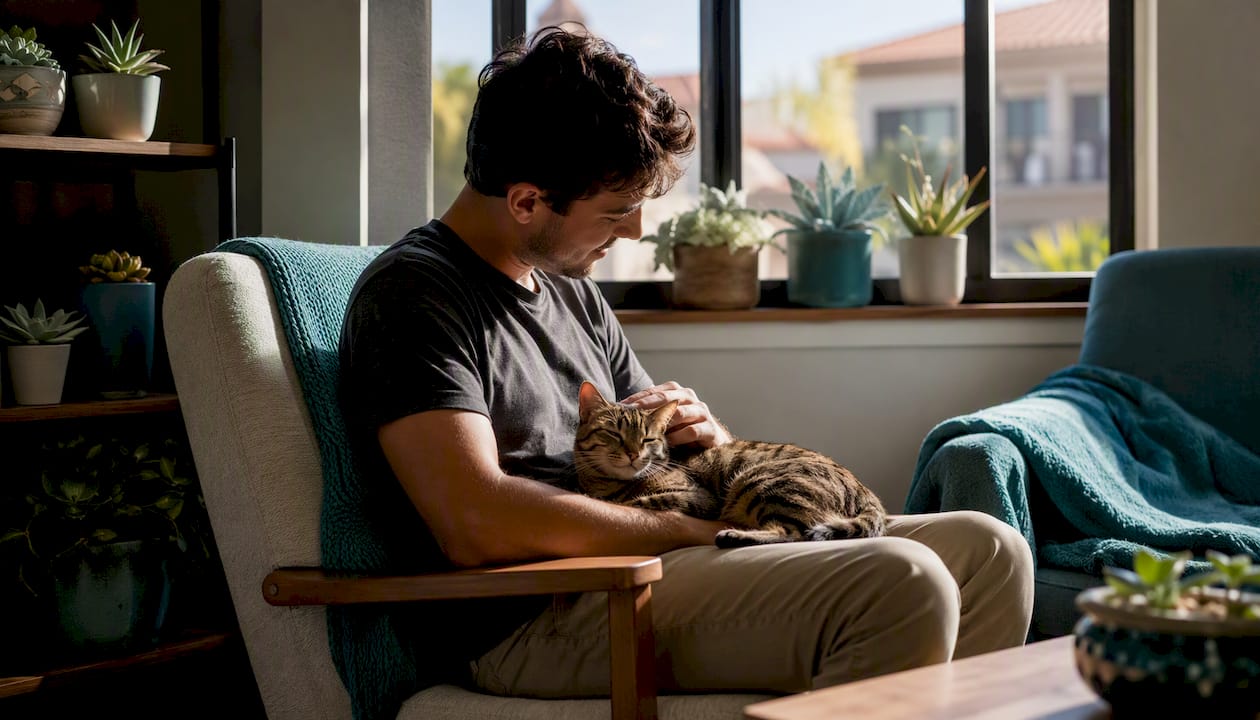
Living with cats reliably delivers companionship, measurable mood improvements, reduced loneliness, and potential cardiovascular benefits for many owners — though the research carries important caveats about causality and selection bias that are worth understanding before you adopt.
Here is what the evidence actually supports:
- Companionship and reduced loneliness: cats provide consistent, low-demand social presence that owners consistently report as meaningful
- Higher positive affect daily: ecological momentary assessment research links cat interaction to higher positive mood and lower negative mood in everyday life
- Potential cardiovascular protection: one epidemiological study found cat ownership associated with an odds ratio of 0.56 for cardiovascular disease compared to non-owners
- Stress relief through touch: petting a cat activates tactile pathways associated with oxytocin release and parasympathetic relaxation
- Mood improvement: cat interaction is linked to reduced anxiety and depressive symptoms in multiple survey studies
- Apartment-friendly lifestyle fit: cats use litter boxes, do not need daily walks, and adapt well to smaller spaces
- Predictable routine benefits: feeding and play schedules create structure that supports owner mental health
- Emotional support through presence: cats respond to owner mood and provide comfort through proximity and subtle behavioral cues
One honest caveat: most studies are cross-sectional or observational, which means healthier or happier people may be more likely to own cats in the first place — causality has not been established.
Key Takeaways
Living with cats provides real, research-supported emotional and physical benefits for most owners — but bond quality, honest risk assessment, and apartment-friendly habits determine how much of that benefit you actually experience.
| Point | Details |
|---|---|
| Mood benefits are well-supported | EMA research links cat interaction to higher positive affect and lower negative affect in daily life. |
| Cardiovascular association is promising | Cat ownership showed an OR of 0.56 for CVD risk in one epidemiological study; causality is unproven. |
| Bond quality drives stress benefits | Emotional closeness — not just physical interaction — is the primary mediator for cat owners’ stress reduction. |
| Risks require honest self-assessment | Allergies, financial costs, lease pet policies, and zoonotic risks are real and should be evaluated before adopting. |
| Cynthiagardens supports cat owners | Pet-inclusive one-bedroom apartments in Boca Raton with transparent policies and layouts suited for cat ownership. |
This article is general information, not a substitute for advice from a qualified doctor. Consult a qualified healthcare professional about your own circumstances before acting on anything here.
Table of Contents
- What Are the Advantages of Living With Cats Emotionally?
- Do Cats Actually Improve Your Physical Health?
- How Do Cats Actually Produce These Benefits?
- When Cat Ownership Might Not Help You
- Practical Steps to Maximize Benefits in an Apartment
- How Strong Is the Research, Really?
- Pet-Friendly Apartments That Make Cat Ownership Easier
- Sources
What Are the Advantages of Living With Cats Emotionally?
Everyday interactions with cats are consistently associated with higher positive affect and lower negative affect in daily life. That finding comes from ecological momentary assessment (EMA) research, which captures real-time mood rather than relying on memory, making it one of the stronger methodological designs in this field.
A study published in Frontiers in Psychology tracked 188 pet owners and found that cat and dog interactions both predicted higher positive affect and lower negative affect in the moment. The same study found no general stress-buffering effect, and — notably — interacting with cats actually amplified negative affect under event-related stress for the cat subsample. That nuance matters: cats lift your mood on ordinary days but may not absorb stress during genuinely difficult ones.
The stress picture gets more specific when you look at how cat ownership reduces perceived stress. A large comparative mediation study involving over 1,800 cat owners found that emotional closeness was the primary mediator between cat ownership and lower perceived stress — not the physical act of interaction itself. Dog owners benefited more from the interaction behavior; cat owners benefited more from the bond. That distinction shapes everything about how you get the most from living with a cat.
Owners commonly report these psychological benefits:
- Reduced isolation: a cat’s presence makes a quiet apartment feel occupied and alive
- Mood anchoring: the routine of feeding, grooming, and play gives the day structure
- Comfort during low periods: proximity and purring provide sensory reassurance without requiring conversation
- Sense of purpose: caring for another living thing counters the passivity that often accompanies anxiety or depression
Do Cats Actually Improve Your Physical Health?
Some epidemiological and physiological studies do link cat ownership to lower cardiovascular risk and short-term reductions in physiological stress markers. The effect sizes are meaningful enough to take seriously, even if causality remains unproven.
The most cited epidemiological finding: cat ownership was associated with a significantly lower cardiovascular disease risk, with an overall odds ratio of 0.56 compared to non-cat owners. Age modified the effect: for adults aged 40–64, owning only a cat was associated with an OR of 0.40 for CVD in the sample. That is a substantial association, though the study design cannot rule out that healthier people simply choose to own cats.
At the physiological level, petting a cat tends to lower heart rate and blood pressure in controlled settings. The tactile contact appears to activate the parasympathetic nervous system, slowing the stress response. These short-term effects are well-replicated in lab settings, even if their long-term clinical significance is still debated.
What the evidence supports with reasonable confidence:
- Short-term reductions in heart rate and blood pressure during cat petting
- Epidemiological association between cat ownership and lower CVD risk, particularly for midlife adults
- Reduced cortisol-linked stress responses in some owner populations
Where the evidence is weaker:
- Long-term causal claims about cardiovascular outcomes
- Generalizability across age groups, health statuses, and relationship qualities
- Whether the cat itself causes the benefit or whether cat owners share other protective lifestyle factors
The honest read: the cardiovascular signal is promising and consistent enough to be worth noting, but it should not be treated as a medical recommendation.
How Do Cats Actually Produce These Benefits?
The benefits of cat companionship flow through four overlapping pathways: tactile contact, predictable caregiving routines, social referencing, and species-specific interaction patterns like purring and proximity-seeking.
Tactile contact and oxytocin. Physical petting is the most studied mechanism. Research on oxytocin and human-animal interaction shows that affectionate behaviors — petting, holding, gentle contact — produce more consistent hormonal responses than passive presence alone. Oxytocin responses also vary by familiarity: a cat you know well produces a stronger physiological response than an unfamiliar animal. This is why shelter visits feel pleasant but do not replicate what living with your own cat provides.
Purring and proximity. A cat’s purr falls in the 25–150 Hz frequency range, which overlaps with frequencies used in vibroacoustic therapy for tissue repair and relaxation. Cats also sleep on or near owners because proximity to breathing and heartbeat mimics the comfort of kittenhood, which reinforces bonding and promotes owner relaxation simultaneously.
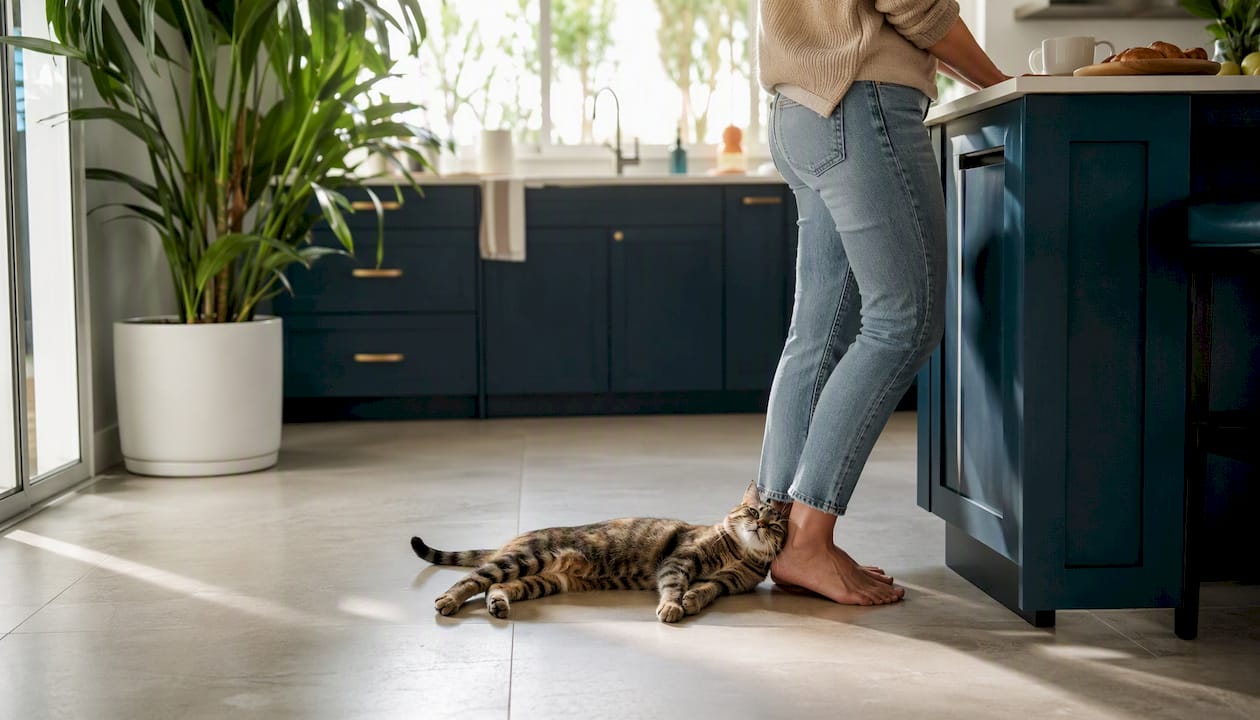
Predictable routines. Feeding, play, and grooming schedules create daily structure. For people managing anxiety or depression, that structure functions as a behavioral anchor — a reason to get up, move, and engage at consistent times.

Social referencing. Cats monitor owner emotional states and adjust their behavior accordingly. Veterinarians note that cats’ sensitivity to owner mood allows them to provide emotional support through presence and subtle behavioral shifts, even if they are not guard animals in any deterrent sense.
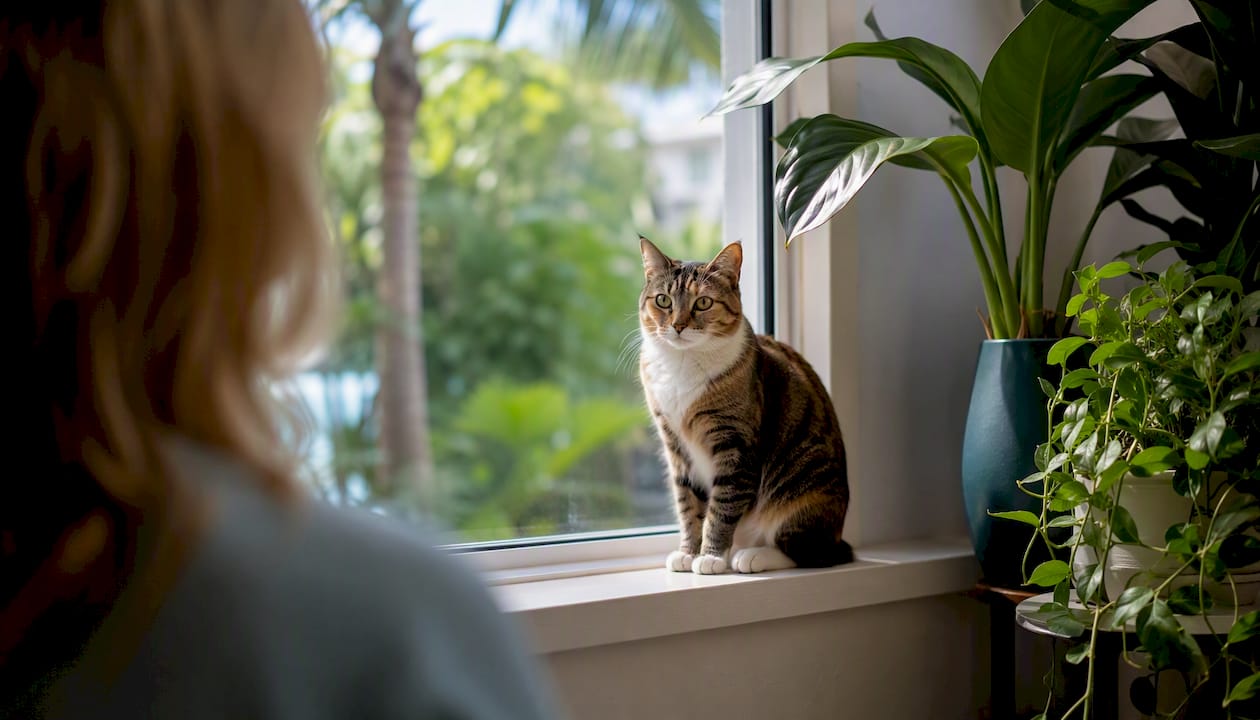
The PLOS One mediation study reinforces this: for cat owners, emotional closeness — not just physical interaction — is what drives stress reduction. Building that closeness through consistent, gentle engagement is the mechanism worth investing in.
Pro Tip: Encourage cat-initiated contact rather than forcing interaction. Cats that approach on their own terms show stronger bonding behaviors, and owner-reported wellbeing is higher when the cat seeks proximity voluntarily.
When Cat Ownership Might Not Help You
Benefits are common but not universal. Relationship quality matters enormously, and selection bias in the research means the average finding may not apply to every situation.
Research on perceived pet insensitivity shows that when owners feel their cat is unresponsive or indifferent, anxiety and loneliness can actually increase rather than decrease. The bond is the mechanism — without it, the expected benefits do not reliably materialize.
Risks and responsibilities to assess honestly:
- Allergies: cat dander is one of the most common indoor allergens; symptoms range from mild to severe and can worsen with prolonged exposure
- Zoonotic disease risk: immunocompromised individuals face elevated risk from toxoplasmosis and certain bacterial infections; consult a physician before adopting
- Bites and scratches: even well-socialized cats scratch; cat bites carry infection risk and should be treated promptly
- Behavioral problems: untreated anxiety, aggression, or litter-box avoidance can create significant stress for owners
- Financial costs: annual veterinary care, food, litter, and emergency expenses add up; budget realistically before committing
- Time demands: cats need daily play, feeding, and social interaction — they are lower-maintenance than dogs but not maintenance-free
- Lease and pet-policy restrictions: many apartments charge pet deposits or monthly fees, and some prohibit cats entirely
Quick self-assessment before adopting:
- Have you been allergy-tested or spent extended time with cats without symptoms?
- Can you budget for annual vet visits and a potential emergency fund?
- Does your lease permit cats, and have you reviewed the community pet policies in detail?
- Are you prepared for 15+ years of daily care?
Practical Steps to Maximize Benefits in an Apartment
Small, repeatable habits increase the likelihood of a healthy, beneficial human-cat bond. Apartment living actually suits cats well — they are naturally suited to smaller spaces — but a few specific investments make a real difference.
Apartment-friendly setup checklist:
- Install a cat tree or wall shelves to provide vertical space; cats use height for security and territory
- Place the litter box in a low-traffic area, cleaned daily — odor management is the single biggest quality-of-life factor in a small unit
- Use a consistent feeding schedule; predictability reduces cat anxiety and strengthens the routine-based bonding mechanism
- Keep a dedicated play session of 10–15 minutes daily using wand toys or puzzle feeders to meet hunting instincts
- Use a HEPA air purifier and regular vacuuming to manage dander, especially in a one-bedroom layout where the cat shares your sleeping space
- Schedule annual vet checkups and stay current on vaccinations and flea prevention; routine preventive care reduces behavioral problems tied to undetected pain or illness
Bonding habits tied to the mechanism evidence:
- Pet gently around the cheeks and chin (where cats have scent glands) rather than the belly, which many cats find overstimulating
- Use a soft, higher-pitched voice when talking to your cat; research on pet-directed speech suggests it increases cat attention and responsiveness
- Let your cat choose when to approach; forced interaction reduces trust and weakens the emotional closeness that drives stress benefits
Pro Tip: Vertical enrichment — cat trees, shelves, window perches — reliably increases cat-initiated contact with owners. More cat-initiated contact means more of the tactile interaction that research links to better oxytocin responses and improved mood.
For apartment-specific guidance on setting up a cat-friendly space, the cat-friendly apartment amenities guide for Boca Raton covers unit features and litter-box planning in detail.
How Strong Is the Research, Really?
The honest summary: momentary-affect findings are among the strongest in this literature; long-term causal claims are weaker; epidemiological associations are promising but confounded.
Living with cats is associated with better psychological outcomes on average, and the Greater Good Science Center’s synthesis of multiple studies confirms that the pattern is consistent across different methodologies. But “associated with” is doing real work in that sentence.
What the research landscape actually looks like:
- Momentary-affect evidence (EMA studies): strongest design; captures real-time mood; findings replicate across samples
- Epidemiological cardiovascular data: large samples, meaningful effect sizes, but cross-sectional and unable to establish causality
- Oxytocin and physiological studies: lab-based, short-term, behavior-specific; results vary by familiarity and interaction type
- Survey and self-report studies: consistent direction but subject to recall bias and social desirability effects
Common confounds across the literature:
- Selection bias: people who are already healthier, more socially connected, or more financially stable are more likely to own pets
- Bond quality as a moderator: studies that do not measure relationship quality miss the primary mechanism for cat-owner benefits
- Species differences: dog and cat ownership produce benefits through different pathways; averaging them obscures cat-specific findings
The oxytocin research is a useful example of mechanism-level complexity: affectionate, active contact with a familiar cat produces more consistent hormonal responses than simply being in the same room. Passive ownership is not the same as engaged ownership, and the research increasingly reflects that distinction.
For readers who want to go deeper, the sources listed below represent the strongest available evidence as of the time of writing.
What living with a cat has taught me about the research
The gap between what studies measure and what owners actually experience is real, and I think it gets underreported. Most of the research captures averages — but the person who bonds deeply with a specific cat, builds a consistent daily routine around that animal, and allows the relationship to develop over years is getting something qualitatively different from what a cross-sectional survey can detect.
The EMA finding that cat interaction amplifies negative affect under event-related stress initially sounds like a strike against cat ownership. Spend time with it and it reads differently: cats do not absorb your stress the way a dog might through active play or walks. They sit with you in it. Whether that is a comfort or an irritant depends entirely on what you need in that moment and how well you know your cat. That is not a flaw in the research — it is the research accurately describing a real feature of the human-cat relationship that owners already know intuitively.
The cardiovascular association (OR: 0.56) is the kind of number that gets turned into headlines, and it probably should not be. What it tells you is that cat owners in that sample had meaningfully lower CVD rates — not that getting a cat will protect your heart. The distinction matters, but so does the signal. Midlife adults in particular show the strongest association, and that age group is also the one most likely to benefit from the routine, companionship, and daily tactile engagement that cat ownership provides.
The practical implication: treat the research as directional, not prescriptive. The benefits are real for most people who build a genuine bond. The risks are also real and worth taking seriously before you commit.
Pet-Friendly Apartments That Make Cat Ownership Easier
Cat ownership is more rewarding when your apartment is actually built for it. Cynthiagardens in Boca Raton offers pet-inclusive one-bedroom apartments with transparent pet policies, no hidden fees, and unit layouts that work for both you and your cat — enough space for vertical enrichment, easy litter-box placement, and the kind of quiet, low-traffic environment cats prefer.

The leasing process is fully online with AI chat support and virtual tours, so you can check pet policies, review floor plans, and confirm availability without playing phone tag. For cat owners who want to see exactly what the space looks like before committing, the apartment styles and features page shows unit layouts in detail. If you are still comparing options, the affordable one-bedroom apartments comparison gives you a clear side-by-side on pricing and features.
Note: the health and wellbeing findings discussed in this article are general research summaries, not medical advice. Consult a physician or veterinarian for guidance specific to your situation.
Sources
- Frontiers | Age modifies the association between pet ownership and cardiovascular disease
- Comparative mediation analysis of dog and cat ownership and perceived stress | PLOS One
- The Science-Backed Benefits of Being a Cat Lover