
Florida law does not set a late fee for you, and it does not cap one. The fee exists only if your signed lease says so, and a court can still refuse to enforce an amount it considers excessive. For a renter in Boca Raton, that means the most important late-fee protection is the lease itself: read the fee clause before you sign, and choose a community that puts its charges in writing, up front. At Cynthia Gardens, our one-bedroom apartments are priced at $1,990 to $2,220 per month and our one-time fees are published on our fees page.
This guide is for renters: students at FAU, young professionals, cat owners and anyone on a one-bedroom budget who wants to know what a late fee can be, when it can start and what happens if rent slips.
TL;DR
- Florida has no statewide cap on late fees. A late fee must come from the lease, and a court can refuse to enforce one that is unconscionable (grossly unfair) or works as a penalty.
- Many legal guides treat a fee of about 4% to 5% of rent, with an upper limit, as generally reasonable. That is a rule of thumb from how courts react, not a statute.
- Florida has no required grace period. A grace period in your lease is a contract favor, and it does not delay the landlord’s 3-day notice for unpaid rent.
- Daily fees that keep growing, fees on top of fees and fees the lease never mentioned are the ones most open to challenge.
- Before signing, find the fee amount, the day it starts, whether it repeats and whether the lease allows a late fee to be charged on a late fee.
Table of Contents
- What Florida law actually says about late fees
- The lease decides whether there is a fee at all
- How much is a reasonable late fee?
- Grace periods and the 3-day notice are different things
- Daily fees, stacked fees and fees on fees
- What changed recently, and what did not
- How to protect yourself before you sign
- Our perspective
- Renting a one-bedroom in Boca Raton with clear costs
- FAQ
- Sources
What Florida law actually says about late fees
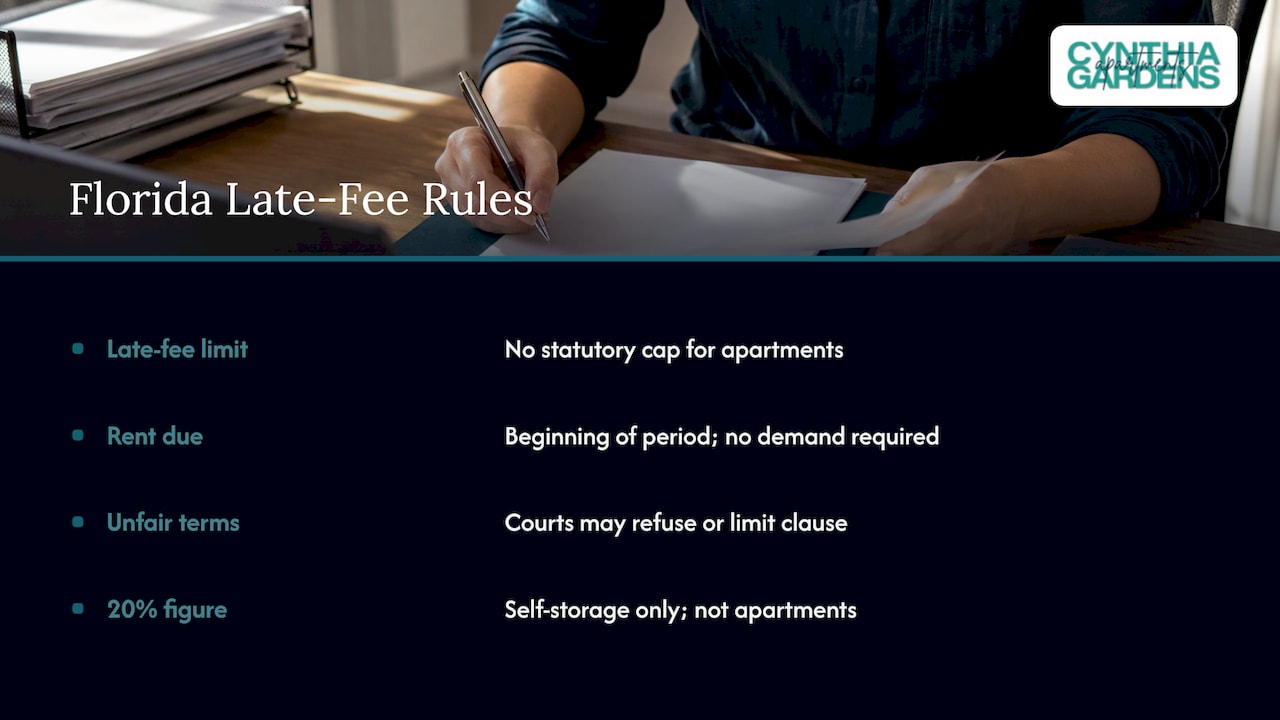
The Florida Residential Landlord and Tenant Act (Chapter 83, Part II of the Florida Statutes) governs ordinary apartment rentals. It does not contain a rule that limits late fees or says how much a landlord may charge. A late fee is therefore treated as a contract term: the landlord and tenant agree to it in the lease, and it is enforced like any other term.
What the statute does say about rent is short. Under Fla. Stat. § 83.46, rent is payable without demand or notice, and periodic rent is due at the beginning of each rent payment period unless the lease says otherwise. In other words, if your lease says rent is due on the 1st, the landlord does not need to remind you. The rent is late on the 2nd unless the lease gives you extra days.
The statute also contains a backstop for unfair terms. Section 83.45 lets a court refuse to enforce a lease provision it finds unconscionable, enforce the rest of the lease without it, or limit the provision so the result is not unfair. A late-fee clause is one of the places this comes up.
You may see a “$20 or 20%” figure quoted online as Florida’s late-fee safe harbor. Be careful with it: it is a self-storage rule and does not apply to apartments.
The lease decides whether there is a fee at all
Because the fee is contractual, three consequences follow:
- A fee the lease does not mention cannot be charged. If the lease is silent on late fees, there is no late fee to collect.
- The landlord cannot charge more than the lease says. If the clause states a flat amount, that is the amount.
- A fee cannot simply be added mid-lease. A new charge needs a proper new agreement, not a notice taped to your door.
Standard Florida leases make this easy to find. The Florida Bar’s sample residential lease for apartments includes a late-charge line: a stated dollar amount for each payment made more than a stated number of days after the due date. That sample also caps the returned-check fee at $20 or 5% of the payment, whichever is greater, which shows how itemized a good lease can be.
When you review a lease, look for these four details in the late-fee paragraph:
- The amount, as a dollar figure or a percentage of rent.
- The start day, such as the 3rd or the 6th of the month.
- Whether it is one-time or daily. A flat fee is easier to understand than one that keeps adding.
- What else the lease charges for payment problems, such as returned payments, so you can see the total cost of a slip.
The same logic applies to every charge in the lease. Our guide to nonrefundable apartment fees explains what to ask about each one.
How much is a reasonable late fee?
There is no number in the statute, so the question becomes what a Florida court would enforce. Nolo’s overview of Florida landlord-tenant law says that Florida does not limit the amount of a late fee, but most judges will not enforce an unreasonable one. It describes a fee as generally reasonable when it does not exceed 4% to 5% of the rent and has an upper limit.
The reasoning behind that comes from Florida’s liquidated-damages rule. A fixed charge for late payment is enforced only if the harm from late payment was hard to estimate when the lease was signed and the fixed amount is not grossly out of proportion to the loss a landlord could reasonably expect. That loss is usually interest on the money and the administrative effort of chasing it. A fee that looks like a punishment for being late, rather than an estimate of that loss, is where tenants have the best argument.
Here is a worked example using a rent inside our published range of $1,990 to $2,220:
| Monthly rent | 5% of rent | 10% of rent |
|---|---|---|
| $1,990 | $99.50 | $199.00 |
| $2,000 | $100.00 | $200.00 |
| $2,220 | $111.00 | $222.00 |
A one-time fee near the 5% line is the kind of charge that sits comfortably within the rule of thumb. Fees that climb toward 10% and beyond draw more scrutiny, and a flat fee plus a daily add-on that has no ceiling is harder still to justify as an estimate of actual cost. Treat the table as a way to judge a clause, not as a legal limit: a court looks at the specific lease, not a percentage.
Grace periods and the 3-day notice are different things
This is the point that confuses most renters. Florida law does not give you a grace period. If your lease gives you until the 5th before a late fee applies, that is a courtesy written into the contract. It changes when the fee starts. It does not change when the landlord may begin the eviction process.
Under Fla. Stat. § 83.56(3), a landlord can end a rental for nonpayment only if rent is unpaid when due and the default continues for 3 days after the tenant receives a written demand for payment or possession. Those 3 days do not count Saturdays, Sundays or court-observed legal holidays.
The same section says what the notice must contain: the amount owed, the address of the rental including the county, a demand to pay or move out within 3 days, and the landlord’s name, address and phone number. The notice may be delivered by mail, by handing over a true copy, by email where the signed addendum under § 83.505 allows it, or by leaving it at the home if the tenant is absent. These notice requirements cannot be waived in the lease.
If you are ever in this situation, a few practical points follow:
- Pay the full amount in the notice within the 3 days (not counting weekends and court holidays). The notice states the figure the landlord is demanding.
- Ask what the number includes. If the notice lumps in a late fee, check it against your lease.
- Keep a receipt. If a landlord accepts partial rent after posting a notice, § 83.56(5)(a) requires one of three things: a receipt showing the date, the amount and the agreed balance; placing the partial payment in the court registry when filing for possession; or posting a new 3-day notice for the new amount.
If a landlord has threatened eviction or filed a case against you, speak with a Florida attorney or your local legal aid office. This article explains the rules; it does not replace advice on your own case.
Daily fees, stacked fees and fees on fees
The most common question tenants raise is whether a landlord can charge a late fee on an unpaid late fee. The answer depends on the lease wording. A lease can define what counts as “rent” and what counts as “additional rent,” and a clause that treats an unpaid fee as late rent can produce a second fee the following month. That is why you should read how the lease defines those terms.
Courts look hard at fees that grow quickly, have no upper limit or bear no relationship to the landlord’s likely loss. A clause that lets the landlord choose between a fixed sum and actual damages is also vulnerable, because the choice itself reads like a penalty. A daily fee is not automatically unlawful, but it needs a clear start date, a clear calculation and a limit that makes it look like an estimate of cost rather than pressure.
Some Florida legal commentary describes a common structure as a flat fee of $50 to $75 plus $5 to $10 per day, capped at about 10% of rent. Take that as a description of what leases commonly look like, not as something Florida law requires or guarantees will be enforced.
Here is a quick way to think through a late payment:
- Find the late-fee clause in your lease and read the amount, the start day and whether it repeats.
- Add up what you owe: rent plus only the fee the lease allows.
- Pay the rent portion first if you cannot cover everything, and get a written receipt.
- If the fee looks larger than the lease says, ask for the clause in writing and a breakdown of the charge.
What changed recently, and what did not
One recent change affects how notices reach you. A 2025 law created § 83.505, which lets landlord and tenant agree by signed addendum to deliver notices by email. If you sign that addendum, a 3-day notice can arrive in your inbox, so check it as carefully as your mail.
Proposals to lengthen the nonpayment notice to 5 days have been discussed in the legislature, but the 3-day rule in the current statute is what applies. For any dispute, check the current text of Chapter 83 on the Florida Legislature’s site, since statutes can change from one session to the next.
How to protect yourself before you sign
The best time to deal with a late fee is before there is one. For a student on a monthly budget or a young professional whose pay date does not line up with the 1st, a few habits help:
- Ask for the full fee schedule in writing. Application, administration, pet, transfer and wire fees should all be itemized. Our published fee list shows the one-time charges we use, from the $75 application fee per applicant to the $15 wire transfer fee.
- Match the due date to payday. If rent is due on the 1st and you are paid on the 31st, set up payment the week before.
- Use scheduled payments. An automatic payment removes the risk of forgetting.
- Check the other charges too. Late fees are only one line. Rent increase rules, amenity fees and move-out charges deserve the same read-through, and we cover them in our guides on Florida rent increases, amenity fees and move-out charges.
- Keep every payment record. A bank confirmation or receipt settles most disputes about when rent arrived.
Our perspective
A late fee should never be a surprise. The law leaves the amount to the lease, which means the renter’s protection is a clear lease and a landlord who explains it. That is how we approach it at Cynthia Gardens: our community is built around transparent pricing and no hidden fees, and the one-time charges we publish are listed on our site for anyone to read before applying.
Our residents are often students and young professionals renting their first or second one-bedroom, and many are cat owners. For them, the numbers that matter are simple: the monthly rent, the application and administration fees, and for cats a one-time pet fee of $300 to $500 per cat with no ongoing pet rent. When every charge is stated plainly, there is less room for a misunderstanding about what is owed and when.
Our advice to any renter in Boca Raton is the same: read the payment clause, ask questions while you are still choosing, and sign only when you can say in one sentence what happens if rent is late. Our leasing tools, including AI chat support, voice assistance and virtual tours, are there so you can get those answers on your schedule.
Ayman
Renting a one-bedroom in Boca Raton with clear costs
If you are comparing apartments, our one-bedroom apartments in Boca Raton are listed at $1,990 to $2,220 per month. They suit FAU students, young professionals working nearby and cat owners, and we offer both short- and long-term furnished options. You can tour online, explore the interactive property map and ask our AI chat or voice assistant about the lease before you apply.
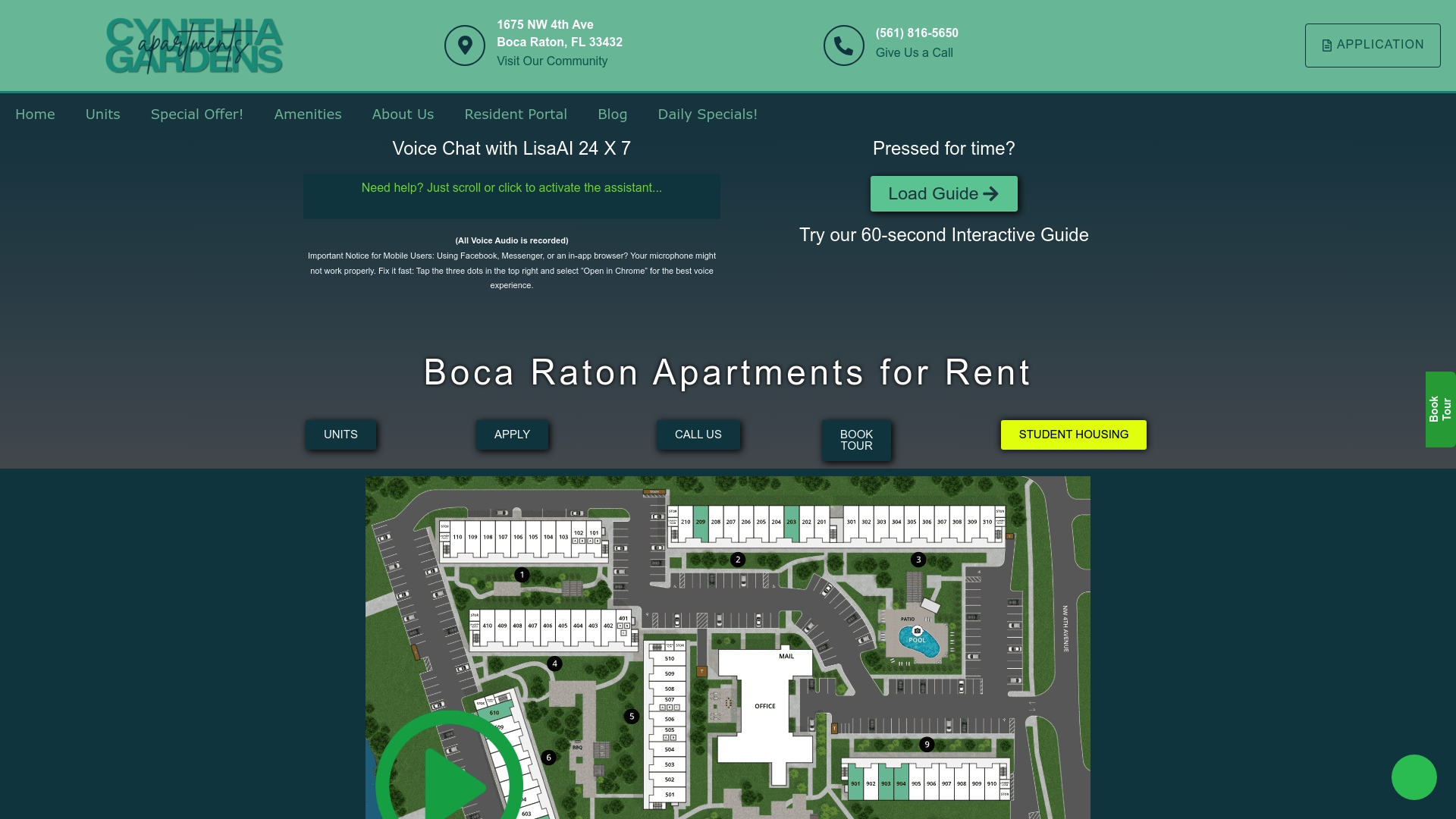
See the available one-bedroom apartments and the full list of one-time fees side by side, so you know the full cost before you apply.
FAQ
Is there a legal limit on late fees for rent in Florida?
No. Chapter 83, Part II does not cap late fees for ordinary apartment rentals. The fee must be in your lease, and a court can refuse to enforce an unconscionable or penalty-like amount. Many guides treat a fee of about 4% to 5% of rent, with an upper limit, as generally reasonable.
How many days late can rent be in Florida?
State law sets no grace period. Rent is due at the start of each rental period unless your lease says otherwise. Many leases offer a few days before the fee starts, but that is a contract term. The landlord can serve a 3-day notice for unpaid rent without waiting for that grace period to end.
Can my landlord charge a late fee that is not in my lease?
No. A late fee comes from the written agreement. If the lease does not mention one, there is no late fee to collect, and a landlord cannot simply add one mid-lease without a proper new agreement.
Can a landlord charge a late fee on a late fee?
Only if the lease clearly allows it, and even then it is open to challenge. Fees that grow without a limit or bear little relationship to the landlord’s actual cost can be struck down as penalties. Read how your lease defines rent and additional charges before signing.
Does the 3-day notice count weekends?
No. Under § 83.56(3), the 3 days exclude Saturdays, Sundays and court-observed legal holidays. The notice must state the amount owed and demand payment or possession.
Sources
- Fla. Stat. § 83.46, Rent; duration of tenancies
- Fla. Stat. § 83.56, Termination of rental agreement
- Overview of Landlord-Tenant Laws in Florida
- Residential Lease for Apartment, The Florida Bar